Tesla Tow Capacity at a Glance: What Each Model Can Pull
Electric trucks and SUVs have redefined what's possible for zero-emission towing, but not all Teslas are built equally when it comes to hauling trailers, boats, or campers. Tesla's tow capacity varies dramatically across its lineup — from the compact Model Y's modest 3,500-pound rating to the Cybertruck's class-leading 11,000-pound maximum. This guide breaks down exactly what each current Tesla model can tow, how towing impacts real-world range, and what you need to know before hitching up.
| Model | Max Tow Capacity | Hitch Type | Drivetrain | Battery (kWh) | EPA Range (unloaded) |
|---|---|---|---|---|---|
| Model Y Long Range AWD | 3,500 lbs | 1.25" receiver | Dual Motor AWD | ~75 kWh (NMC) | 310 miles |
| Model Y Performance | 3,500 lbs | 1.25" receiver | Dual Motor AWD | ~75 kWh (NMC) | 285 miles |
| Model X Long Range | 5,000 lbs | 2" receiver | Dual Motor AWD | ~100 kWh (NMC) | 335 miles |
| Model X Plaid | 5,000 lbs | 2" receiver | Tri-Motor AWD | ~100 kWh (NMC) | 311 miles |
| Cybertruck AWD | 7,500 lbs | 2" receiver | Dual Motor AWD | ~123 kWh (NMC) | 340 miles |
| Cybertruck Cyberbeast | 11,000 lbs | 2" receiver | Tri-Motor AWD | ~123 kWh (NMC) | 320 miles |
Model Y Towing: Light-Duty Utility for Small Trailers
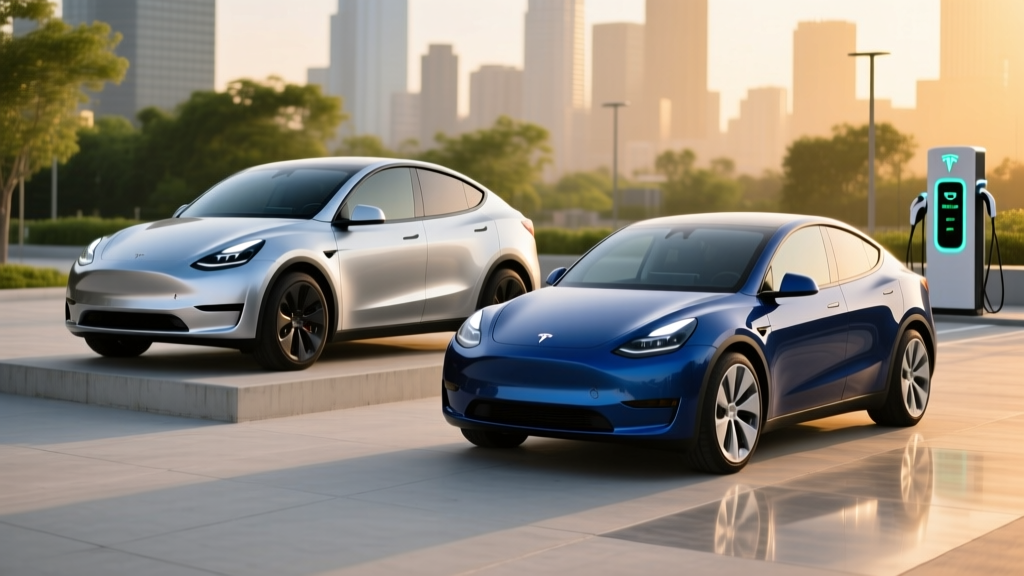
The Tesla Model Y is the brand's bestseller for good reason — it offers crossover practicality with sedan-like efficiency. But its 3,500-pound tow rating places it firmly in light-duty territory. Think small utility trailers, jet skis, motorcycle carriers, or lightweight teardrop campers under 3,000 pounds loaded.
Tesla offers a factory-installed tow package that includes a 1.25-inch hitch receiver and a wiring harness for trailer lights. The tow package adds roughly $1,000 to the vehicle's MSRP when ordered at purchase. Retrofitting a hitch after delivery is possible through third-party suppliers like Curt or Draw-Tite, but you'll need to source a compatible 7-pin or 4-pin wiring adapter separately.
EPA estimate: 310 miles (unloaded). When towing a 2,500-pound camper trailer at highway speeds (65-70 mph), expect range to drop to approximately 170-195 miles depending on trailer aerodynamics, terrain, and temperature. Cold weather (below 40°F) compounds this loss by an additional 15-20%, potentially reducing towing range to 140-160 miles. Plan charging stops accordingly.
Model Y Towing Efficiency and Charging
Unloaded, the Model Y Long Range achieves an EPA-rated 122 MPGe combined (27 kWh/100mi). When towing, energy consumption typically increases to 55-70 kWh/100mi — effectively doubling your electricity use per mile. This isn't unique to Tesla; any vehicle towing near its capacity will see efficiency plummet. The difference is that EV range loss is immediately visible and requires more frequent charging stops on long hauls.
On a DC fast charger, the Model Y Long Range peaks at approximately 250 kW at a V3 Supercharger, achieving a 10-80% charge in roughly 25-27 minutes under ideal conditions. At home on a Level 2 Wall Connector (48 amps/11.5 kW), you'll add about 44 miles of range per hour — fully replenishing the battery overnight in 7-8 hours.
Model X Towing: The Family Hauler That Can Actually Pull
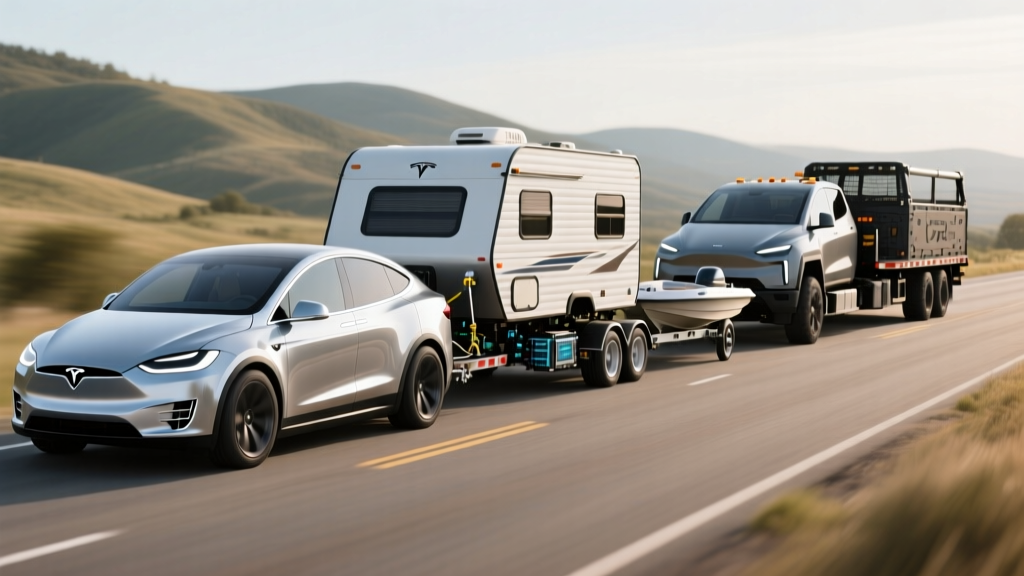
The Model X remains Tesla's most capable SUV for towing, with a 5,000-pound rating that covers most mid-size boat trailers, enclosed car haulers, and travel campers in the 4,000-4,800-pound range. The standard 2-inch hitch receiver accommodates a wider range of trailer couplers and weight-distribution hitches compared to the Model Y's smaller setup.
Both the Long Range and Plaid variants share the same 5,000-pound rating, though the Plaid's tri-motor powertrain (1,020 hp) provides noticeably more confident acceleration when merging onto highways with a heavy load. The Long Range's dual-motor setup (670 hp) is more than adequate for most towing scenarios and delivers better range — a meaningful advantage when every mile counts.
EPA estimate: 335 miles (unloaded). Towing a 4,500-pound travel trailer at 65 mph typically yields 180-210 miles of practical range. The Model X's larger 100 kWh battery provides a buffer the Model Y lacks, but the SUV's higher curb weight (5,100+ lbs) and less aerodynamic profile when hitched partially offset this advantage. In mountainous terrain or sustained headwinds, expect the lower end of that range.
Model X Charging and Tech for Towing
The Model X supports up to 250 kW DC fast charging, with 10-80% taking approximately 30-32 minutes. Tesla's built-in navigation includes trailer mode, which adjusts route planning to account for reduced range and directs you through Supercharger stations with pull-through layouts — essential when you can't easily disconnect a trailer.
Standard features like Adaptive Air Suspension help level the vehicle when tongue weight compresses the rear, and the 360-degree camera system (via the center display) aids in hitching and low-speed maneuvering with a trailer attached. Autopilot remains functional while towing, though Tesla's driver-assist system is SAE Level 2 and requires continuous driver supervision — it does not handle trailer sway correction automatically.
Cybertruck Towing: Built for Heavy Hauling
The Cybertruck is Tesla's answer to the full-size truck market, and its towing credentials are genuinely competitive with internal-combustion rivals. The dual-motor AWD variant tows up to 7,500 pounds, while the tri-motor Cyberbeast pushes that to 11,000 pounds — matching or exceeding many half-ton gas trucks like the Ford F-150 and Ram 1500 in maximum rating.
The Cybertruck's stainless steel exoskeleton and integrated bed features (including a powered tonneau cover and built-in ramp system) make it practical for both trailer towing and direct cargo hauling. The 2-inch hitch receiver is frame-mounted, and Tesla provides an integrated trailer brake controller — a critical feature for trailers exceeding 3,000 pounds that have their own electric brakes.
EPA estimate: 340 miles (unloaded). Towing a 6,500-pound enclosed trailer at highway speeds typically yields 160-190 miles of range. The Cybertruck's angular design creates significant aerodynamic drag, and adding a tall trailer amplifies this effect. Tesla's range-extender battery pack (a dealer-installed option adding ~50 kWh in the bed) can extend unloaded range to 470+ miles and partially offset towing losses, bringing practical towing range closer to 220-250 miles with the extender engaged.
Cybertruck Charging Speed and Towing-Specific Features
The Cybertruck's 800-volt architecture enables peak DC fast charging at approximately 350 kW at V4 Superchargers, achieving a 10-80% charge in roughly 15-18 minutes under optimal conditions. This is a meaningful advantage for towing — shorter charging stops mean less time disconnected and reconnected. Level 2 home charging via the Wall Connector delivers up to 11.5 kW (44 miles/hour), fully replenishing the 123 kWh battery in about 10-11 hours.
Tesla's trailer-specific software includes a trailer light check function, hitch assist camera overlay, and trailer sway mitigation that applies selective braking to individual wheels if oscillation is detected. The air suspension automatically adjusts ride height based on detected tongue weight, and the steer-by-wire system (no physical steering column connection) provides variable ratio adjustments that make low-speed trailer maneuvering less effort-intensive.
Real-World Range Loss: What Towing Actually Does to Your Battery
Every EV owner considering towing needs to understand the physics at play: towing dramatically increases energy consumption due to added mass, rolling resistance, and — most significantly — aerodynamic drag. A boxy travel trailer can double or triple the combined frontal area of your vehicle, forcing the powertrain to work exponentially harder at highway speeds where air resistance dominates.
Based on real-world owner reports and independent testing, here's what to expect when towing near each Tesla's maximum capacity:
- Model Y (3,500 lbs max): 45-55% range reduction at highway speeds
- Model X (5,000 lbs max): 40-50% range reduction at highway speeds
- Cybertruck AWD (7,500 lbs max): 45-55% range reduction at highway speeds
- Cybertruck Cyberbeast (11,000 lbs max): 50-60% range reduction at highway speeds
These figures assume flat terrain, moderate temperatures (60-75°F), and speeds of 65-70 mph. Mountain passes, extreme heat or cold, and speeds above 70 mph will push range loss toward the higher end of these ranges or beyond. The key takeaway: plan your route around charging infrastructure, not the other way around. Tesla's in-dash navigation with trailer mode helps, but always verify Supercharger availability and pull-through accessibility for your specific trailer length.
Tesla Towing vs. Key Competitors
Tesla Advantages for Towing
- Instant torque delivery provides confident acceleration from stops with heavy loads
- Supercharger network offers the most reliable and widespread DC fast charging for long-distance towing
- Integrated trailer software (sway mitigation, hitch assist, route planning) is more cohesive than most competitors
- Lower per-mile energy cost vs. gas trucks — electricity at $0.15/kWh towing costs roughly $0.10-0.15/mile vs. $0.35-0.50/mile for a gas truck getting 10-12 mpg while towing
- No engine strain or overheating concerns on long grades — electric motors don't overheat like internal combustion engines under sustained load
Tesla Towing Limitations
- Range reduction while towing is more operationally impactful than gas trucks' fuel economy drop — charging takes longer than refueling
- Model Y's 3,500-lb rating is lower than competitors like the Ford Mustang Mach-E (3,500 lbs, but with more cargo space) or Hyundai Ioniq 5 (not rated for towing in US)
- Cybertruck's polarizing design and limited service center availability in rural areas where towing is most common
- No Tesla model offers a gooseneck or fifth-wheel hitch option — conventional bumper-pull only
- Trailer mode and advanced towing features require software updates that may not be available on older vehicles
Compared to the Ford F-150 Lightning (10,000 lbs max tow, 230-320 mile range), the Cybertruck Cyberbeast offers slightly higher capacity but similar real-world range loss. The Rivian R1T (11,000 lbs max tow, 270-410 mile range depending on battery pack) is the Cybertruck's closest competitor, offering comparable capability with a more conventional truck design and broader accessory ecosystem. For lighter towing, the Model X's 5,000-pound rating and 335-mile range make it more practical than the Kia EV9 (5,000 lbs, 270-300 mile range) for longer trips due to Tesla's charging network advantage.
Pricing, Tax Credits, and Total Cost of Towing
| Model | Base MSRP | Tow Package | As-Tested (with tow) | §30D Credit Eligible? | Effective Price After Credit |
|---|---|---|---|---|---|
| Model Y Long Range AWD | $48,990 | $1,000 | $49,990 | Yes — up to $7,500 | ~$42,490 |
| Model X Long Range | $79,990 | Included | $79,990 | No — exceeds MSRP cap | $79,990 |
| Cybertruck AWD | $79,990 | Included | $79,990 | No — exceeds MSRP cap | $79,990 |
| Cybertruck Cyberbeast | $99,990 | Included | $99,990 | No — exceeds MSRP cap | $99,990 |
Under current IRS §30D rules, only the Model Y qualifies for the full $7,500 federal tax credit because it is the only Tesla SUV priced below the $80,000 MSRP cap for trucks, vans, and SUVs. The Model X and all Cybertruck variants exceed this threshold and are ineligible regardless of buyer income or battery sourcing. Additionally, the credit requires meeting critical mineral and battery component sourcing requirements that Tesla has largely satisfied for US-built vehicles, and buyer income must not exceed $150,000 (single) or $300,000 (joint filing). The credit can be transferred to the dealer at point of sale, effectively reducing your purchase price upfront.
For buyers focused on towing, the Model Y offers the best value proposition if your trailer weighs under 3,500 pounds. The effective post-credit price of roughly $42,490 is compelling for a dual-motor AWD crossover with integrated towing software. If you need more capacity, the Cybertruck AWD at $79,990 provides 7,500 pounds of tow rating and competitive range, but you'll pay full MSRP without federal incentive help.
Who Should Buy a Tesla for Towing?
Choose the Model Y if: You need to tow a small utility trailer, jet ski, or lightweight camper under 3,000 pounds for weekend trips, you prioritize efficiency and lower operating costs, and you want access to the federal tax credit.
Choose the Model X if: You need 5,000 pounds of capacity for a mid-size boat or travel trailer, you value the falcon-wing doors for easy cargo access, and you regularly take family road trips where the third-row seating and 335-mile range are beneficial.
Choose the Cybertruck if: You need heavy-duty towing capacity (7,500-11,000 lbs) for car haulers, large boats, or equipment trailers, you want truck-bed utility alongside towing capability, and you're willing to accept the polarizing design and higher price without tax credit assistance.
Frequently Asked Questions About Tesla Towing
Does Tesla's warranty cover towing-related issues?
Tesla's New Vehicle Limited Warranty (4 years/50,000 miles) and Battery and Drive Unit Warranty (8 years/120,000-150,000 miles depending on model) cover defects in materials and workmanship. However, damage caused by exceeding the rated tow capacity, improper hitch installation, or trailer-related accidents is not covered. Using the factory tow package and staying within rated limits ensures warranty protection remains intact.
Can I install an aftermarket hitch on a Tesla without the factory tow package?
Yes, third-party hitches from manufacturers like Curt, Draw-Tite, and EcoHitch are available for Model Y and Model X. However, you'll need to source compatible wiring for trailer lights separately, and Tesla's software trailer mode may not activate without the factory tow package. Aftermarket hitches also may not integrate with the vehicle's rear crash structure as cleanly as the factory option, potentially affecting insurance claims in rear-end collisions.
How does regenerative braking work while towing?
Tesla's regenerative braking remains active while towing and can recover meaningful energy on downhill grades or during deceleration. However, regen alone is insufficient for controlling a heavy trailer — you must use the integrated trailer brake controller (standard on Cybertruck, optional on Model X) to activate the trailer's electric brakes. Relying solely on regen and the Tesla's friction brakes with a heavy trailer risks brake fade on long descents.
What's the best way to plan a long-distance tow trip in a Tesla?
Enable trailer mode in your Tesla's settings before departure, which adjusts the navigation system's range calculations and routes you through Superchargers with pull-through accessibility. Plan to charge more frequently than you would unloaded — every 120-160 miles depending on your trailer weight and conditions. Use apps like A Better Routeplanner (ABRP) with your specific trailer weight and drag coefficient for more accurate range predictions than the in-dash system provides.
Does towing affect Tesla battery degradation?
Occasional towing within rated limits does not meaningfully accelerate battery degradation. Tesla's battery management system protects against excessive heat and deep discharge regardless of load. However, frequent towing in extreme heat (above 95°F) combined with repeated DC fast charging at maximum power could marginally increase long-term degradation. For owners who tow regularly, maintaining charge between 20-80% for daily use and only charging to 100% immediately before long towing trips helps preserve battery health over the vehicle's lifetime.