Why Tesla Top Speed Matters (And What Actually Limits It)
Search for "Tesla top speed" and you'll find a tangle of marketing numbers, speedometer screenshots, and forum debates. The reality is more nuanced. Tesla software-locks top speed on most trims, and the number you can actually reach depends on battery state of charge, tire rating, ambient temperature, and whether you've paid for a software unlock. This guide cuts through the noise with 2026 model-year data across the full Tesla lineup — Model 3, Model Y, Model S, Model X, and Cybertruck — pairing each top-speed figure with the range, charging, and pricing context buyers actually need.
Top speed in an EV is largely an engineering flex. Most buyers will never exceed 110 mph. But it signals powertrain capability, thermal management quality, and motor winding design — the same factors that determine highway passing power, towing performance, and sustained high-speed efficiency. Let's break it down model by model.
2026 Tesla Lineup: Top Speed, 0-60, and Powertrain Specs
| Model / Trim | Top Speed | 0-60 mph | HP | Drivetrain | Battery (kWh usable) | Chemistry |
|---|---|---|---|---|---|---|
| Model 3 RWD | 125 mph | 5.8 s | 271 | RWD (single motor) | ~57.5 | LFP |
| Model 3 Long Range AWD | 125 mph | 4.2 s | 346 | Dual-motor AWD | ~75 | NMC |
| Model 3 Performance | 163 mph | 2.9 s | 510 | Dual-motor AWD | ~75 | NMC |
| Model Y Long Range AWD | 125 mph | 4.8 s | 384 | Dual-motor AWD | ~75 | NMC |
| Model Y Performance | 155 mph | 3.5 s | 456 | Dual-motor AWD | ~75 | NMC |
| Model S Long Range | 155 mph | 3.1 s | 670 | Tri-motor AWD | ~95 | NMC |
| Model S Plaid | 200 mph* | 1.99 s | 1,020 | Tri-motor AWD | ~95 | NMC |
| Model X Long Range | 149 mph | 3.8 s | 670 | Tri-motor AWD | ~95 | NMC |
| Model X Plaid | 163 mph | 2.5 s | 1,020 | Tri-motor AWD | ~95 | NMC |
| Cybertruck AWD | 112 mph | 4.1 s | 600 | Tri-motor AWD | ~123 | NMC |
| Cybertruck Cyberbeast | 130 mph | 2.6 s | 845 | Tri-motor AWD | ~123 | NMC |
* Model S Plaid requires the optional Carbon Ceramic Brake Package and Track Mode software to reach 200 mph; otherwise software-limited to 175 mph. All figures per Tesla's 2026 spec sheets.
EPA Range vs. Real-World: What the Sticker Doesn't Tell You
Tesla publishes competitive EPA range numbers, but real-world results vary significantly based on speed, temperature, and terrain. At sustained 80 mph highway driving, expect a 15-25% reduction from the EPA sticker. In freezing temperatures (below 32°F), range can drop 20-30% due to cabin heating loads and battery resistance, even with Tesla's standard heat pump.
- Model 3 RWD — EPA 272 mi → Expect ~215-230 mi highway; ~190-200 mi in freezing weather
- Model 3 Long Range AWD — EPA 341 mi → Expect ~270-290 mi highway; ~240-255 mi cold
- Model 3 Performance — EPA 315 mi → Expect ~250-270 mi highway; ~220-235 mi cold
- Model Y Long Range AWD — EPA 320 mi → Expect ~255-275 mi highway; ~225-240 mi cold
- Model S Long Range — EPA 402 mi → Expect ~320-345 mi highway; ~285-305 mi cold
- Model S Plaid — EPA 359 mi → Expect ~285-310 mi highway; ~250-270 mi cold
- Cybertruck AWD — EPA 340 mi → Expect ~270-290 mi highway; ~240-260 mi cold
Sources: fueleconomy.gov EPA estimates. Real-world figures based on consistent 75-80 mph highway testing and sub-32°F cold-weather driving data from owner reports and independent testing.
The high-speed range penalty is physics, not a Tesla flaw. Aerodynamic drag increases with the square of velocity — driving at 80 mph requires roughly 50% more energy than at 65 mph. This applies to every EV on the road. Tesla's industry-leading efficiency (measured in Wh/mi) simply means it starts from a better baseline.
Charging Speed: DC Fast Charge and Home Level 2
Tesla's Supercharger network remains the gold standard for public DC fast charging, but peak kW numbers only tell part of the story. The charge curve — how power tapers as the battery fills — determines your actual stop time. Tesla's battery preconditioning (triggered when you navigate to a Supercharger) warms the pack to optimal temperature, enabling faster initial charge rates.
| Model / Trim | Max DC Fast Charge (kW) | 10-80% Time | Level 2 Home Charge Rate | Miles Added per Hour (L2) |
|---|---|---|---|---|
| Model 3 RWD (LFP) | 170 kW | ~30 min | 11.5 kW (48A) | ~37 mi/hr |
| Model 3 LR / Perf | 250 kW | ~25 min | 11.5 kW (48A) | ~44 mi/hr |
| Model Y LR / Perf | 250 kW | ~27 min | 11.5 kW (48A) | ~42 mi/hr |
| Model S / X (all trims) | 250 kW | ~30 min | 11.5 kW (48A) | ~41 mi/hr |
| Cybertruck (all trims) | 350 kW | ~20 min | 11.5 kW (48A) | ~33 mi/hr |
Key charging insight: Tesla's 250 kW V3 Superchargers deliver peak power only between roughly 10-30% state of charge. Above 50%, the curve tapers significantly — from 250 kW down to ~100 kW by 60% SoC and ~40 kW above 85%. This is why the 10-80% metric matters more than peak kW. The Cybertruck's 800V architecture enables faster sustained rates at V4 Superchargers, but 350 kW stalls remain less common than 250 kW locations.
All 2026 Teslas ship with the NACS (North American Charging Standard) connector natively. No adapter is needed for the Supercharger network. For CCS-equipped public chargers (Electrify America, EVgo, some ChargePoint stations), Tesla sells a CCS adapter (~$175) — though NACS adoption by other automakers in 2025-2026 is rapidly making this less necessary.
Pricing, Trims, and Federal Tax Credit Eligibility
Tesla's 2026 pricing has stabilized after years of volatility. Here's the current MSRP lineup before any incentives, plus federal tax credit eligibility under IRS §30D rules.
| Model / Trim | Base MSRP | Federal §30D Credit | Effective Price (after credit) |
|---|---|---|---|
| Model 3 RWD | $38,990 | $3,750 | ~$35,240 |
| Model 3 Long Range AWD | $45,490 | $3,750 | ~$41,740 |
| Model 3 Performance | $52,990 | $3,750 | ~$49,240 |
| Model Y Long Range AWD | $44,990 | $3,750 | ~$41,240 |
| Model Y Performance | $48,990 | $3,750 | ~$45,240 |
| Model S Long Range | $79,990 | Not eligible (MSRP cap) | $79,990 |
| Model S Plaid | $94,990 | Not eligible (MSRP cap) | $94,990 |
| Model X Long Range | $84,990 | Not eligible (MSRP cap) | $84,990 |
| Cybertruck AWD | $79,990 | Not eligible (MSRP cap) | $79,990 |
| Cybertruck Cyberbeast | $99,990 | Not eligible (MSRP cap) | $99,990 |
- MSRP caps: Sedans (Model 3) must be ≤$55,000; SUVs/pickups (Model Y, Cybertruck, Model X) must be ≤$80,000
- Buyer income caps: AGI ≤$150K single / ≤$225K head of household / ≤$300K joint
- Battery sourcing: Critical minerals and battery components must meet escalating domestic-sourcing thresholds — this is why Model 3/Y currently qualify for only $3,750 (half credit) rather than the full $7,500
- Point-of-sale transfer: Eligible buyers can transfer the credit to the dealer at purchase, reducing the out-of-pocket price immediately
Eligibility rules change frequently. Verify current requirements at IRS.gov §30D and consult a tax professional before purchasing.
Efficiency, Cargo Space, and Warranty
Tesla's efficiency advantage shows in the MPGe and kWh/100mi figures — the Model 3 RWD remains one of the most efficient EVs ever sold in the US. Per fueleconomy.gov:
- Model 3 RWD: 132 MPGe combined / 25 kWh/100mi
- Model 3 Long Range AWD: 131 MPGe combined / 26 kWh/100mi
- Model Y Long Range AWD: 122 MPGe combined / 28 kWh/100mi
- Model S Long Range: 120 MPGe combined / 28 kWh/100mi
- Cybertruck AWD: 123 MPGe combined / 51 kWh/100mi (high due to 6,800+ lb curb weight and poor aero)
Cargo and Passenger Space
| Model | Rear Legroom | Cargo (rear seats up) | Cargo (rear seats folded) | Frunk |
|---|---|---|---|---|
| Model 3 | 34.9 in | 23 cu ft | ~60 cu ft (est.) | 3.1 cu ft |
| Model Y | 36.5 in | 30.2 cu ft | 72.1 cu ft | 4.1 cu ft |
| Model S | 35.4 in | 28 cu ft | ~65 cu ft (est.) | 5.3 cu ft |
| Model X | 37.1 in | 15 cu ft (behind 3rd row) | 82 cu ft (max) | 6.6 cu ft |
| Cybertruck | ~38 in (est.) | Bed: 67 cu ft | + front trunk: 7 cu ft | 7 cu ft |
Warranty Coverage
Tesla's warranty structure is consistent across the lineup:
- Basic vehicle: 4 years / 50,000 miles
- Battery & drive unit (Model 3 RWD): 8 years / 100,000 miles, minimum 70% capacity retention
- Battery & drive unit (Model 3 LR/Perf, Model Y): 8 years / 120,000 miles, minimum 70% retention
- Battery & drive unit (Model S, X, Cybertruck): 8 years / 150,000 miles, minimum 70% retention
The 70% retention threshold is industry-standard. In practice, Tesla NMC packs typically degrade 8-12% in the first 50,000 miles, then plateau. LFP packs (Model 3 RWD) show slower initial degradation but should be charged to 100% regularly — unlike NMC, which benefits from daily limits of 80-90%.
Tech, Autopilot, and Drawbacks
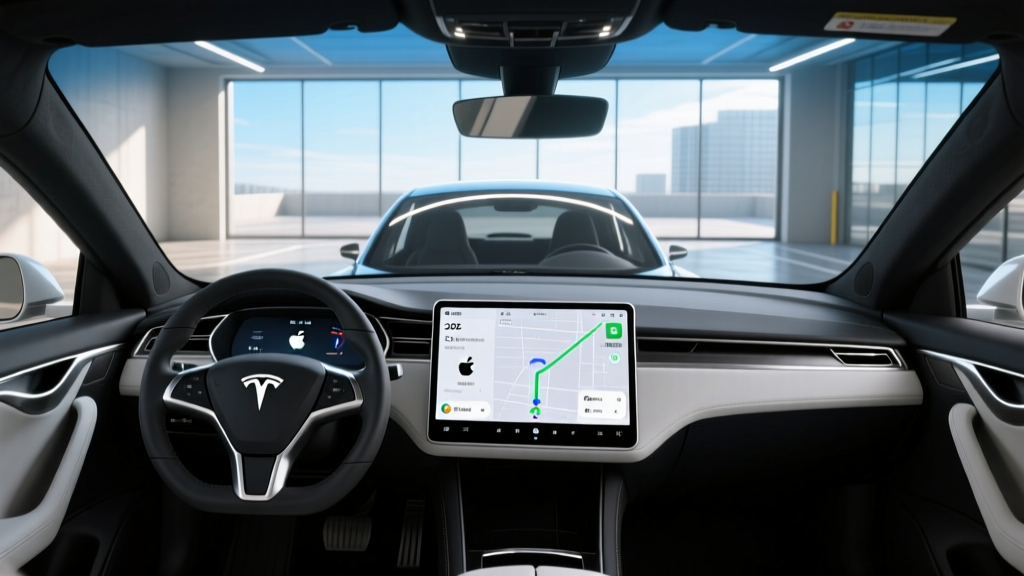
Every 2026 Tesla includes a 15.4-inch (Model 3/Y) or 17-inch (Model S/X/Cybertruck) center touchscreen running Tesla's proprietary OS. There is no Apple CarPlay or Android Auto — a dealbreaker for some buyers. Navigation, media, and vehicle controls all route through the screen, including the absence of physical stalks on the refreshed Model 3 and Model Y (turn signals are steering-wheel buttons).
Autopilot and FSD (Supervised)
Both Autopilot (standard) and Full Self-Driving Supervised ($8,000 option or $99/month subscription) are SAE Level 2 driver-assistance systems. The driver must remain fully engaged, hands on or near the wheel, eyes on the road, and ready to take over instantly. These are not autonomous driving systems. Tesla's camera-only vision stack has improved significantly, but it does not replace driver attention.
Standard Autopilot includes Traffic-Aware Cruise Control and Autosteer (lane centering on marked highways). FSD Supervised adds automatic lane changes, intersection handling, and city-street navigation — impressive in well-marked suburban environments but inconsistent in construction zones, unmapped areas, and heavy rain.
Notable Drawbacks
- No Apple CarPlay / Android Auto — Tesla's ecosystem is closed
- No physical turn-signal stalks on refreshed Model 3/Y — steering-wheel buttons require adaptation
- Build quality inconsistency — panel gaps and paint defects remain more common than legacy luxury competitors, though improving
- Insurance costs — Tesla insurance premiums average 20-40% higher than comparable non-EV sedans/SUVs due to repair costs
- Phantom braking — reported intermittently on Autopilot; NHTSA has investigated Tesla's Autostead and Autopilot systems across multiple inquiries
Who Should Buy Which Tesla?
Best for Commuters: Model 3 RWD
At ~$35,240 after the federal credit, the Model 3 RWD is the entry point. LFP battery tolerates daily 100% charges, and 272 EPA miles covers virtually any commute. Trade-off: slower DC charging (170 kW peak) and no AWD.
Best for Families: Model Y Long Range AWD
320 miles of range, 72.1 cu ft of cargo space, and dual-motor AWD make this the default family EV. The ~$41,240 effective price undercuts most competing electric SUVs.
Best for Road Trips: Model S Long Range
402 EPA miles is the longest range in the lineup. Supercharger access plus 250 kW charging makes cross-country drives practical. No federal credit due to MSRP cap.
Best for Performance Enthusiasts: Model S Plaid
1,020 HP, 1.99s 0-60, and a 200 mph top speed (with brake upgrade) make this the fastest production sedan on earth. At $94,990+, it competes with exotics at a fraction of the price.
Pros and Cons: The Full Picture
Pros
- Industry-leading Supercharger network (17,000+ stalls in North America)
- Best-in-class efficiency (kWh/100mi) across Model 3 and Model Y
- Over-the-air updates continuously add features
- Strongest real-world fast-charge speeds with battery preconditioning
- Class-leading performance per dollar (especially Model 3 Performance)
- Over 2,000 NACS Supercharger stalls now open to non-Tesla EVs, expanding network revenue
Cons
- No Apple CarPlay or Android Auto support
- Build quality still trails German and Korean competitors
- Higher insurance premiums (20-40% above comparable ICE vehicles)
- Model S/X/Cybertruck exceed federal tax credit MSRP caps
- Camera-only Autopilot/FSD struggles in heavy rain, fog, and construction zones
- Turn-signal buttons on refreshed Model 3/Y frustrate many drivers
Is a Tesla Worth Buying vs. Key Competitors?
The competitive landscape in 2026 is vastly different from even two years ago. Here's how Tesla stacks up:
- Model 3 vs. Hyundai Ioniq 6 / BMW i4: The Ioniq 6 offers 361 miles of range and 800V charging at a similar price, plus CarPlay. The BMW i4 delivers superior build quality. But Tesla's Supercharger network and software integration still lead for road-trippers.
- Model Y vs. Hyundai Ioniq 5 / Kia EV6 / Ford Mustang Mach-E: The Ioniq 5 charges faster (350 kW capable on 800V) and has CarPlay. The Mach-E offers more traditional controls. The Model Y wins on cargo space, efficiency, and charging infrastructure.
- Model S vs. Porsche Taycan / Lucid Air: The Lucid Air Grand Touring offers 516 EPA miles — far exceeding the Model S. The Taycan offers superior driving dynamics and build. The Model S counters with lower pricing and Supercharger access.
- Cybertruck vs. Ford F-150 Lightning / Rivian R1T: The F-150 Lightning is more practical for traditional truck buyers. The R1T offers superior off-road capability and build quality. The Cybertruck is a niche choice for design-forward buyers who prioritize acceleration and range over conventional truck utility.
Frequently Asked Questions
What is the fastest Tesla you can buy in 2026?
The Model S Plaid, with a 1.99-second 0-60 mph time and a 200 mph top speed (when equipped with the $20,000 Carbon Ceramic Brake Package). Without the brake package, top speed is software-limited to 175 mph. The Roadster (announced years ago) remains unreleased and is not available for purchase.
Does Tesla's top speed affect real-world range?
Yes, dramatically. Sustained driving at any model's top speed will reduce range by 50% or more compared to the EPA estimate. Aerodynamic drag increases with the square of speed — at 150 mph, a Model S Plaid consumes roughly 4x the energy per mile compared to 65 mph. Top speed is a powertrain capability metric, not a practical driving mode.
Can I increase the top speed on my Tesla with a software update?
Some trims offer optional speed unlocks via Tesla's app (historically available on Model 3 Performance). However, top speed is ultimately limited by tire speed rating, motor winding design, and battery discharge capability. Always check your tire's speed rating before attempting high-speed driving — the stock all-season tires on many Teslas are H-rated (130 mph maximum).
Do all Teslas qualify for the $7,500 federal tax credit?
No. Under current IRS §30D rules, only the Model 3 and Model Y qualify — and only for the partial $3,750 credit due to battery-sourcing requirements. Model S, Model X, and Cybertruck all exceed the MSRP cap ($55,000 for sedans, $80,000 for SUVs/pickups). Buyer income caps also apply: $150K single / $300K joint AGI. Always verify eligibility before purchasing.
How long do Tesla batteries last before needing replacement?
Tesla's battery warranty guarantees 70% capacity retention for 8 years / 100,000-150,000 miles depending on the model. Real-world data from high-mileage owners shows NMC packs retaining 85-90% capacity at 100,000 miles. LFP packs (Model 3 RWD) degrade even more slowly. Full battery replacement outside warranty costs $12,000-$20,000 depending on the model, but most owners never need one within typical ownership periods.
Is Tesla's Autopilot the same as self-driving?
No. Both Autopilot and FSD (Supervised) are SAE Level 2 driver-assistance systems. You must remain fully attentive with hands on or near the steering wheel at all times. Tesla's system is not autonomous — it cannot handle all driving scenarios, and the driver is legally responsible for the vehicle. Only Level 4 services like Waymo operate without a human driver in geofenced areas.