Why Tesla Model Y Tires Matter More Than You Think
The Tesla Model Y remains the best-selling electric vehicle in the United States for good reason: strong range, access to the Supercharger network, and practical crossover utility. But one of the most overlooked ownership decisions — and one that directly affects your real-world range, ride comfort, and operating cost — is your choice of Tesla Model Y tires. The wrong tire can cost you 15–25 miles of EPA-estimated range, increase road noise substantially, and wear out in under 25,000 miles. The right tire preserves efficiency, extends tread life, and keeps the cabin quiet at highway speed.
This guide covers the 2026 Tesla Model Y in full — specs, range, charging, pricing, and federal tax credit eligibility — then dives deep into the tire question: OEM options, aftermarket replacements, rolling-resistance trade-offs, and how tire choice interacts with the Model Y's weight, torque, and regenerative braking system.
2026 Tesla Model Y: Core Specs at a Glance
| Specification | Long Range AWD | Performance | RWD (Standard) |
|---|---|---|---|
| EPA Range | 320 miles | 295 miles | 260 miles |
| Battery (usable) | ~75 kWh, NMC | ~75 kWh, NMC | ~60 kWh, LFP |
| Drivetrain | Dual-Motor AWD | Dual-Motor AWD | Single-Motor RWD |
| Horsepower | 384 hp | 456 hp | 295 hp |
| 0–60 mph | 4.8 sec | 3.5 sec | 6.6 sec |
| Max DC Fast Charge | 250 kW | 250 kW | 170 kW |
| 10–80% DC Time | ~27 min | ~27 min | ~35 min |
| Level 2 Home Rate | 11.5 kW (~37 mi/hr) | 11.5 kW (~37 mi/hr) | 11.5 kW (~37 mi/hr) |
| MPGe (combined) | 111 MPGe | 103 MPGe | 123 MPGe |
| Efficiency | 28 kWh/100 mi | 30 kWh/100 mi | 25 kWh/100 mi |
| Cargo (rear seats up) | 30.2 cu ft | 30.2 cu ft | 30.2 cu ft |
| Cargo (seats folded) | 72.1 cu ft | 72.1 cu ft | 72.1 cu ft |
| Rear Legroom | 36.6 in | 36.6 in | 36.6 in |
| Base MSRP | $44,990 | $48,990 | $39,990 |
| Battery Warranty | 8 yr / 120,000 mi | 8 yr / 120,000 mi | 8 yr / 100,000 mi |
Source: fueleconomy.gov and Tesla spec sheets. Figures reflect 2026 model-year EPA data.
The EPA estimates 320 miles for the Long Range AWD, but expect ~260–280 miles at sustained 75 mph highway speeds in moderate temperatures. In winter conditions (below 32°F), range can drop to 220–250 miles due to battery heating demands and increased air density. City driving with frequent regenerative braking recovers energy and often exceeds the EPA combined figure. Tire choice directly impacts these numbers — more on that below.
Charging Speed and Infrastructure
| Charging Level | Power | Miles Added per Hour | Typical Use Case |
|---|---|---|---|
| Level 1 (120V) | ~1.4 kW | ~4–5 mi/hr | Overnight trickle, emergencies |
| Level 2 (240V, 48A) | 11.5 kW | ~37 mi/hr | Home daily charging |
| DC Fast (V3 Supercharger) | Up to 250 kW | ~1,000 mi/hr peak | Road trips, 10–80% in ~27 min |
| DC Fast (V4 Supercharger) | Up to 250 kW | ~1,000 mi/hr peak | Same as V3 for Model Y architecture |
The Model Y's 250 kW peak DC charge rate is competitive but no longer class-leading — the Hyundai Ioniq 5 and Kia EV6 accept up to 350 kW on 800V architectures. The critical nuance: peak kW is not sustained kW. The Model Y charges near 250 kW only between roughly 10–30% state of charge, then tapers progressively. From 50–80%, expect rates closer to 80–120 kW. This taper is why the 10–80% time is ~27 minutes, not the theoretical ~18 minutes a flat 250 kW curve would suggest.
For home charging, a Level 2 wall connector on a 60-amp circuit delivers the full 11.5 kW (48 amps continuous), adding roughly 37 miles of range per hour. A full overnight charge from 20% to 80% takes about 4 hours. Installation typically costs $800–$2,000 depending on panel proximity and whether a 200-amp panel upgrade is needed.
Tesla Model Y Tire Options: OEM and Aftermarket
The 2026 Tesla Model Y ships with two primary wheel and tire configurations depending on trim:
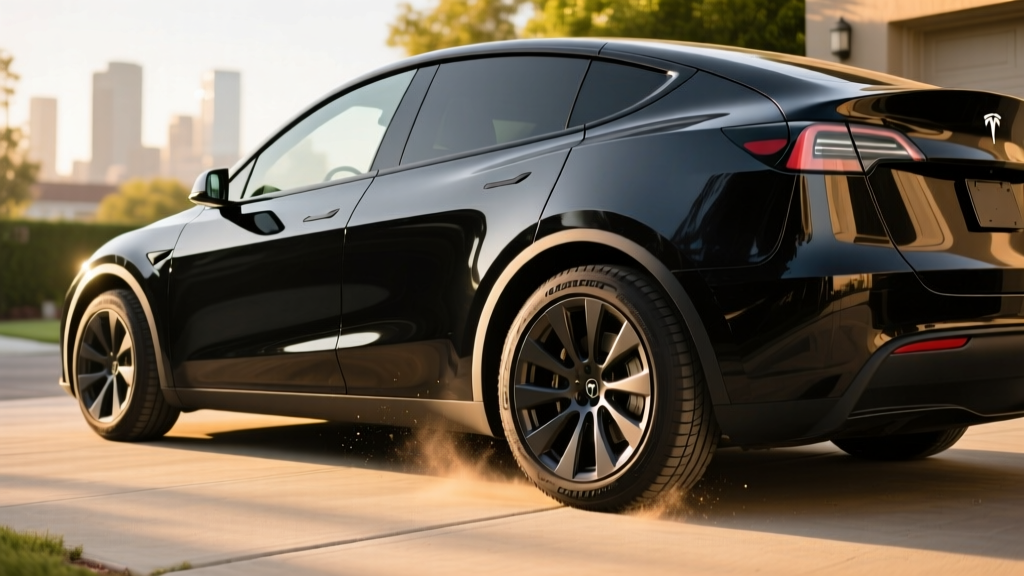
- 19-inch Gemini wheels: 255/45R19 all-season tires (Hankook Ventus S1 noble3 or Michelin Primacy All-Season). These are the efficiency-optimized option and come standard on the Long Range.
- 20-inch Induction or 21-inch Überturbine wheels: 255/40R20 or 265/35R21 performance-oriented summer or all-season tires. These prioritize grip and handling at the cost of 10–20 miles of EPA range and a firmer ride.
How Tire Choice Affects Range and Efficiency
EV tires are not interchangeable with standard passenger car tires. The Model Y weighs approximately 4,400 lbs and delivers instant torque from 0 RPM — two factors that accelerate tread wear and increase rolling resistance. Tesla specifies tires with a low rolling-resistance coefficient (typically under 7.0 kg/t) and a foam noise-dampening liner to reduce cabin noise (the Model Y has no engine sound to mask road noise).
Based on owner-reported data and third-party testing, here is how tire selection impacts range:
- OEM 19" all-season (low rolling resistance): Baseline — full EPA range achievable under ideal conditions.
- OEM 21" performance summer: Expect a 5–8% range reduction (~15–25 miles lost on the Long Range).
- Aftermarket touring all-season (e.g., Michelin CrossClimate2): Typically 3–5% range reduction vs. OEM 19" — a worthwhile trade for all-weather capability.
- Budget all-season replacements: Can reduce range by 8–12% and increase road noise noticeably. Not recommended.
Top Tire Picks for the Model Y (2026)
- Best overall efficiency: Michelin Primacy All-Season (OEM equivalent, ~$230/tire)
- Best all-weather: Michelin CrossClimate2 (3PMSF-rated for snow, ~$260/tire, minor range penalty)
- Best performance: Pirelli P Zero (PZ4) with Tesla acoustic foam liner (~$310/tire)
- Best value: Hankook Ventus S1 noble3 (~$180/tire, solid efficiency, shorter tread life)
Critical note: If you replace OEM tires, ensure the new tires match the OEM load index (105 or higher) and speed rating (W or Y). The Model Y's weight demands XL (extra load) rated tires. Installing standard-load tires risks premature wear and potential safety issues.
Pricing, Tax Credits, and Total Cost
| Trim | Base MSRP | Federal Credit (§30D) | Effective Price |
|---|---|---|---|
| RWD (Standard) | $39,990 | Up to $7,500* | ~$32,490* |
| Long Range AWD | $44,990 | Up to $7,500* | ~$37,490* |
| Performance | $48,990 | Up to $7,500* | ~$41,490* |
* Federal tax credit eligibility under IRS §30D depends on multiple factors. See checklist below. Point-of-sale transfer is available, reducing your purchase price at the dealer.
- Vehicle MSRP cap: SUVs/vans/pickups must be under $80,000 (Model Y qualifies at all trims)
- Buyer income cap: AGI must not exceed $150,000 (single), $225,000 (head of household), or $300,000 (joint)
- Battery sourcing: Required percentages of critical minerals and battery components must be sourced from the US or FTA partners — Tesla's domestic battery production generally satisfies this for 2026, but verify at irs.gov before purchase
- Assembly: Vehicle must undergo final assembly in North America (Model Y is built in Austin, TX and Fremont, CA — qualifies)
- Point-of-sale transfer: You can transfer the credit to the dealer at purchase, reducing your out-of-pocket cost immediately rather than waiting for tax filing
Rules are subject to change. Consult a tax professional and verify current eligibility at irs.gov before purchasing.
Tire Replacement as an Ownership Cost
Budget for tire replacement every 25,000–40,000 miles depending on tire choice and driving style. The Model Y's instant torque and heavy weight wear tires faster than a comparable gas-powered crossover. A set of four OEM-equivalent tires costs roughly $800–$1,100 installed. Over a 5-year/60,000-mile ownership period, expect to purchase two sets of tires — a cost often overlooked in EV total-cost-of-ownership calculators.
Performance, Tech, and Daily Driving
The Model Y Long Range AWD delivers 384 hp and a 4.8-second 0–60 mph time — quick by any measure and more than adequate for highway merging and passing. The Performance trim drops that to 3.5 seconds with 456 hp, making it one of the quickest crossovers on the market regardless of powertrain.
Ride quality has improved meaningfully in the 2025–2026 "Juniper" refresh with revised suspension tuning and additional sound-deadening material. However, the Model Y still rides firmer than a Toyota RAV4 or Hyundai Ioniq 5, especially on 21-inch wheels. If ride comfort is a priority, stick with the 19-inch Gemini wheels and higher-sidewall tires.
Tech and Driver Assistance
The 15.4-inch center touchscreen handles all vehicle functions — no physical instrument cluster or dedicated climate controls. The interface is responsive but demands familiarity; new owners should budget a learning curve.
Standard Autopilot includes adaptive cruise control and lane-centering. This is an SAE Level 2 driver-assist system — you must keep your hands on the wheel and remain fully engaged at all times. The optional Full Self-Driving (Supervised) package ($8,000 or $99/month) adds automated lane changes, traffic-light recognition, and city-street navigation, but it remains a Level 2 system requiring continuous driver supervision. Tesla's naming is aspirational; the technology is not autonomous.
Neither Autopilot nor FSD (Supervised) is self-driving. Both are SAE Level 2 systems. You are legally and operationally responsible for the vehicle at all times. These systems can disengage unexpectedly, fail to detect certain obstacles, and require immediate driver takeover. Do not use them as a substitute for attention.
Cargo and Passenger Practicality
With 30.2 cu ft behind the second row and 72.1 cu ft with seats folded, the Model Y offers best-in-class cargo space for its segment. The front trunk (frunk) adds additional storage for charging cables or a small bag. Rear legroom at 36.6 inches is adequate for adults on shorter trips, though the sloping roofline limits headroom for passengers over 6 feet.
Pros, Cons, and Competitor Comparison
- Access to the Tesla Supercharger network (17,000+ US stalls, highest reliability of any public network)
- Class-leading cargo volume and practical hatchback design
- Strong efficiency (25–30 kWh/100 mi) keeps charging costs low
- Over-the-air updates continuously add features
- Competitive pricing after federal tax credit
- Extensive tire aftermarket with well-documented owner data
- Firm ride quality, especially on 20" and 21" wheels
- No physical controls for climate or volume — all touchscreen
- DC fast-charge speed (250 kW) trails 800V competitors (350 kW)
- Rear visibility is limited; relies heavily on backup camera
- Tire wear is faster than average due to weight and torque
- FSD ($8,000) remains Level 2 despite the name and cost
Model Y vs. Key Competitors
Against the Hyundai Ioniq 5, the Model Y wins on Supercharger access and cargo space but loses on DC charge speed (Ioniq 5 charges 10–80% in ~18 minutes at 350 kW) and ride comfort. The Ford Mustang Mach-E offers a more engaging driving experience and comparable range but has a less reliable public charging experience outside the Tesla network. The Kia EV6 matches the Ioniq 5's charging speed with a sportier design but offers less rear cargo room.
If Supercharger access is your top priority (and for road-trip-heavy owners, it should be), the Model Y remains the default choice. If you primarily charge at home and want a more comfortable ride or faster public charging, the Ioniq 5 or EV6 deserve serious consideration.
Frequently Asked Questions
What is the real-world range of the Tesla Model Y?
The EPA rates the Long Range AWD at 320 miles. In real-world highway driving at 75 mph in moderate temperatures, expect 260–280 miles. In cold weather (below freezing), plan for 220–250 miles. The RWD model's 260-mile EPA rating translates to roughly 210–230 miles highway in fair conditions.
How fast does the Model Y charge at home and on the road?
At home on a Level 2 (240V, 48A) charger, the Model Y adds about 37 miles of range per hour — a full overnight session easily covers daily driving. On a V3 Supercharger (250 kW DC), a 10–80% charge takes approximately 27 minutes, though the rate tapers significantly above 50% state of charge.
Does the Tesla Model Y qualify for the federal EV tax credit?
Yes, all 2026 Model Y trims qualify for up to $7,500 under IRS §30D, provided the buyer meets income limits ($150K single / $300K joint), the vehicle is under the $80,000 SUV MSRP cap (all trims are), and battery sourcing requirements are met. The credit can be transferred at point of sale to reduce your purchase price immediately. Verify current rules at irs.gov.
How often do Tesla Model Y tires need to be replaced?
Expect 25,000–40,000 miles from a set of tires depending on compound, driving style, and whether you rotate regularly (every 6,250 miles is recommended). The Model Y's 4,400-lb weight and instant torque accelerate wear compared to lighter, gas-powered crossovers. Budget roughly $800–$1,100 per set of four, installed.
Can I put non-Tesla-spec tires on my Model Y?
Yes, but you must match the OEM load index (105 XL minimum), speed rating (W or Y), and tire size. Choose tires with low rolling resistance to preserve range, and consider tires with acoustic foam liners to reduce cabin noise. Michelin CrossClimate2, Pirelli P Zero, and Hankook Ventus S1 noble3 are proven aftermarket options.
Is the Model Y worth buying over the Ioniq 5 or Mach-E?
It depends on your priorities. Choose the Model Y if Supercharger network access, cargo space, and efficiency are paramount. Choose the Ioniq 5 or EV6 if you want faster DC charging (350 kW), a more comfortable ride, and physical interior controls. Choose the Mach-E if driving dynamics matter most and you can accept a less mature public charging experience.
Does tire choice really affect my Model Y's range?
Yes. Switching from OEM 19" low-rolling-resistance tires to 21" performance summer tires typically costs 5–8% of range — that's 15–25 miles on a Long Range model. Budget or high-resistance aftermarket tires can reduce range by up to 12%. Always check the tire's rolling-resistance rating and load index before purchasing replacements.
Who Should Buy the 2026 Tesla Model Y?
The Model Y is the right choice if you need a practical family EV with strong range, access to the most reliable public charging network in the US, and best-in-class cargo space. It excels as a daily commuter and road-trip vehicle, particularly for owners who can charge at home and take advantage of the $7,500 federal tax credit.
It is less ideal if you prioritize a plush ride (look at the Ioniq 5), want the fastest possible DC charging (the 800V Hyundai/Kia platforms are faster), or prefer physical controls and a traditional instrument cluster. For those buyers, the competitive set has never been stronger.
Regardless of which trim you choose, invest in the right tires. They are the single most impactful aftermarket decision you'll make — affecting range, noise, comfort, and safety every mile you drive.