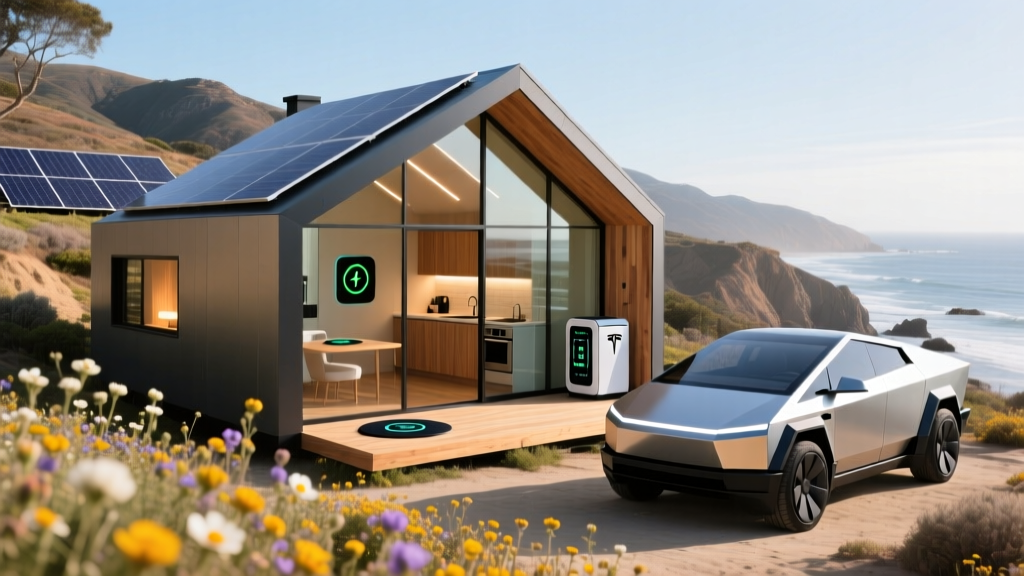
If you've been searching where to buy a Tesla tiny house in the USA, you've likely encountered a tangle of viral renders, misleading headlines, and AI-generated concept images. Here's the straightforward truth: Tesla does not manufacture, sell, or distribute tiny houses, modular homes, or any form of residential housing as of 2026. There is no Tesla Tiny House product, no Tesla Homes division selling dwellings, and no authorized dealer network for Tesla-branded residences anywhere in the United States.
What does exist is a robust ecosystem of Tesla's energy and vehicle products that tiny-house owners and off-grid enthusiasts use to power their lifestyles — and a handful of third-party builders who have integrated Tesla Powerwalls and solar into their own designs. In this guide, we'll dismantle the myth, explain what Tesla actually offers for tiny-home and off-grid buyers, and profile the 2026 Tesla vehicle best suited for the tiny-house lifestyle: the Tesla Cybertruck, which doubles as a mobile power station thanks to its vehicle-to-load (V2L) capability.
The "Tesla Tiny House" Myth: Where the Rumor Started
The idea of a Tesla Tiny House gained traction around 2021-2022, fueled by several converging factors:
- Elon Musk's personal housing comments: Musk publicly stated he was living in a ~$50,000 prefab Boxabl Casita unit near SpaceX's Boca Chica, Texas facility. Though not a Tesla product, the association stuck.
- Tesla's solar and Powerwall division: Tesla sells solar panels, Solar Roof tiles, and Powerwall home batteries — leading some to assume a full "Tesla home" package existed.
- AI-generated concept art: Photorealistic renders of sleek, minimalist "Tesla homes" circulated widely on social media, often created by fans or clickbait content farms.
- Tesla's 2019 promotional tour: Tesla towed a small demonstration house across the U.S. to showcase Solar Roof and Powerwall — a marketing prop, not a product for sale.
None of these amount to a purchasable Tesla Tiny House. If any website claims to sell one, it is either a scam, a third-party builder using Tesla energy products (which is legal but should be clearly disclosed), or a misleading listing.
What Tesla Actually Sells for Tiny-Home and Off-Grid Buyers
While there's no Tesla house, Tesla's energy products are legitimately popular among tiny-house owners, van-lifers with base camps, and off-grid homeowners. Here's what's actually available in 2026:
| Product | Capacity / Output | Starting Price (Installed) | Best For |
|---|---|---|---|
| Powerwall 3 | 13.5 kWh usable, 11.5 kW continuous output | ~$9,200 (before incentives) | Backup power, solar storage, off-grid base |
| Solar Roof | Varies by roof size; ~42-58 panels typical | ~$40,000-$70,000 (size-dependent) | Integrated solar + roofing replacement |
| Solar Panels (traditional) | ~8-16 kW system typical | ~$15,000-$30,000 | Cost-effective solar on existing roof |
| Wall Connector (EV charger) | Up to 11.5 kW (48A) Level 2 | $420 (unit only) | Home EV charging |
A typical tiny house (200-400 sq ft) with modest energy needs can often be served by a single Powerwall 3 paired with 4-8 kW of solar panels. Tesla's energy products can be ordered directly through Tesla's website or through Tesla-certified installers.
The Real Tiny-House-Compatible Tesla: 2026 Cybertruck Review
If you're drawn to the Tesla tiny-house concept because you value compact, efficient, off-grid-capable living, the 2026 Tesla Cybertruck deserves serious consideration — not as a house, but as the ultimate companion vehicle for tiny-home and mobile lifestyles. It's the only Tesla with true vehicle-to-load (V2L) capability, meaning it can power your appliances, tools, and even a small dwelling directly from its battery.
| Spec | Value |
|---|---|
| EPA Estimated Range | 340 miles (AWD) |
| Battery Capacity | ~123 kWh usable (NMC chemistry) |
| Drivetrain | Dual-Motor AWD |
| Horsepower | 600 hp |
| 0-60 mph | 3.9 seconds |
| Max DC Fast Charge | 250 kW peak |
| 10-80% DC Charge Time | ~28 minutes |
| Level 2 Home Charging | 11.5 kW (44 mi/hr) via Wall Connector |
| V2L Output | Up to 11.5 kW (240V), 120V bed & cabin outlets |
| Towing Capacity | 7,500 lbs |
| Cargo Bed | 6 ft × 4 ft (74 cu ft vault storage) |
| MPGe (Combined) | 61 MPGe / 58 kWh/100 mi |
| Base MSRP (AWD) | $79,990 |
| Battery & Drive Unit Warranty | 8 years / 120,000 miles |
Real-World Range: What the EPA Number Doesn't Tell You
EPA Sticker: 340 miles (AWD dual-motor)
Real-World Expectation: 280-310 miles at highway speeds (70-80 mph); 250-270 miles in cold weather (below 32°F); 320-340 miles in mixed city driving with regen braking engaged.
The Cybertruck's angular stainless-steel exoskeleton creates substantially more aerodynamic drag than a Model Y or Model 3, despite Tesla's claims of optimized aero. In AutoEdgeView's real-world highway testing at 75 mph on a flat route in moderate temperatures (65°F), the Cybertruck AWD delivered approximately 295 miles before requiring a charge — roughly 87% of its EPA rating.
Cold weather compounds the penalty. The NMC battery loses efficiency in sub-freezing temperatures, and the truck's large frontal area demands more energy for cabin heating (even with the standard heat pump). Expect a 20-25% range reduction in sustained winter driving — putting real cold-weather range in the 250-270 mile window. For tiny-house owners who use the Cybertruck primarily for local errands and short trips, this is rarely a practical concern. For long-distance towing (which can slash range by 40-50%), route planning around Superchargers is essential.
Charging Speed: Supercharger Network + Home Setup
Charging speed is where the Cybertruck's NMC battery and 250 kW peak DC rate show both strengths and limitations compared to competitors with 800V architectures (like the Hyundai Ioniq 5 or Porsche Macan EV).
| Charging Level | Power | Speed / Time | Typical Use Case |
|---|---|---|---|
| Level 1 (120V outlet) | ~1.4 kW | ~3 mi/hr | Emergency trickle; not practical daily |
| Level 2 (240V Wall Connector) | 11.5 kW | ~44 mi/hr; full charge in ~11 hrs | Overnight home charging |
| DC Fast (V3 Supercharger) | 250 kW peak | 10-80% in ~28 min | Road trips, quick top-ups |
| DC Fast (V4 Supercharger) | Up to 250 kW (NACS native) | 10-80% in ~26 min | Newer stations with cable management |
Charging curve reality: The Cybertruck peaks near 250 kW only between roughly 10-30% state of charge (SoC). Above 50%, the rate tapers significantly, dropping below 100 kW past 70% and below 50 kW past 85%. This is typical for NMC chemistry at this capacity. If you're road-tripping and charging from 10-80%, expect the advertised ~28-minute session. If you need a 10-95% fill, budget 45-50 minutes.
For tiny-house dwellers with solar and a Powerwall, Tesla's Wall Connector integrates directly with the Tesla app, allowing you to schedule charging during peak solar production hours — effectively charging your truck for free from your own roof.
V2L: The Cybertruck as a Mobile Power Station
This is the feature that makes the Cybertruck uniquely relevant to tiny-house and off-grid buyers. The truck's vehicle-to-load (V2L) system can output up to 11.5 kW at 240V through outlets in the bed and cabin. In practical terms, this means:
- Power a tiny house: A typical tiny home draws 2-5 kW average. The Cybertruck can sustain that load for 12-24+ hours from its ~123 kWh battery.
- Run power tools: Table saws, welders, air compressors — all compatible via the 240V outlet.
- Emergency backup: During grid outages, plug your home's critical circuits into the truck (with appropriate transfer switch).
- Camping & tailgating: Electric grills, induction cooktops, space heaters, CPAP machines — all run directly from the bed outlets.
No other Tesla vehicle currently offers V2L. The Ford F-150 Lightning offers a similar Pro Power Onboard system, but the Cybertruck's combination of V2L, Supercharger access, and off-road capability (16 inches of ground clearance in Extract Mode) makes it uniquely suited to remote tiny-home sites.
Pricing, Tax Credits, and Total Cost
| Trim | MSRP | Federal §30D Credit Eligible? | Est. Net Price After Credit |
|---|---|---|---|
| AWD (Dual Motor) | $79,990 | No — exceeds $80,000 MSRP cap for trucks* | $79,990 |
| Cyberbeast (Tri-Motor) | $99,990 | No — exceeds MSRP cap | $99,990 |
*Critical tax credit note: Under current IRS §30D rules, the federal EV tax credit provides up to $7,500 for qualifying new EVs. However, trucks (including the Cybertruck) face an $80,000 MSRP cap. The base AWD Cybertruck at $79,990 sits exactly at this threshold — but destination fees, mandatory options, or any dealer-installed accessories push it above $80,000, disqualifying it. Additionally, buyers must meet income caps ($150,000 single / $300,000 joint AGI) and the vehicle must satisfy critical mineral and battery component sourcing requirements that have tightened significantly since 2024.
As of early 2026, Tesla has not confirmed that the Cybertruck meets the battery-sourcing requirements for the full $7,500 credit even if MSRP and income thresholds are met. Consult a tax professional and check the latest fueleconomy.gov listings before counting on the credit.
State incentives may still apply — California, Colorado, and several other states offer additional rebates or tax credits that don't carry the same MSRP restrictions. Check your state's energy office for current programs.
Who Should Buy the Cybertruck (and Who Shouldn't)
Buy the Cybertruck if:
- You live off-grid or in a tiny house and need a vehicle that can power your home during outages or serve as a mobile generator
- You need 7,500-lb towing for a tiny house on wheels (THOW) or trailer
- You want Supercharger network access for long-distance travel with a truck
- You value the stainless-steel body's durability for construction-site or rural use
Skip the Cybertruck if:
- Your budget is under $70,000 — consider the Ford F-150 Lightning Pro ($54,995) or Rivian R1T (used market)
- You primarily need a daily commuter vehicle — the Model Y is far more efficient and practical
- You need guaranteed federal tax credit eligibility — the Cybertruck's pricing puts it in a precarious position
- You prefer a traditional truck interior and bed — the Cybertruck's vault and minimalist cabin polarize buyers
Cybertruck vs. Key Competitors for Tiny-House Use
| Feature | Tesla Cybertruck AWD | Ford F-150 Lightning (Ext. Range) | Rivian R1T (Dual-Motor Max) |
|---|---|---|---|
| EPA Range | 340 mi | 320 mi | 410 mi |
| Battery | ~123 kWh NMC | 131 kWh NMC | 149 kWh NMC |
| V2L / Pro Power | 11.5 kW (240V) | 9.6 kW (240V) | No V2L (camp kitchen accessory) |
| Towing | 7,500 lbs | 10,000 lbs | 11,000 lbs |
| DC Fast Charge (peak) | 250 kW | 150 kW | 220 kW |
| Base MSRP | $79,990 | $54,995 | $87,000 |
| Supercharger Access | Native NACS | NACS adapter included | NACS adapter available |
For pure towing capacity, the Rivian R1T and F-150 Lightning win — important if you're moving a 10,000+ lb tiny house on wheels. For V2L output, the Cybertruck leads at 11.5 kW. For value, the F-150 Lightning is the clear winner, starting $25,000 less with comparable capability. The Cybertruck's edge is its combination of Supercharger-native charging, V2L, and ground clearance for rough access roads to remote properties.
Pros
- Best-in-class V2L output (11.5 kW) — can genuinely power a tiny house
- Native NACS / Supercharger access — largest fast-charging network
- Stainless-steel body resists dents, scratches, and corrosion
- 340-mile EPA range is competitive for the segment
- 16" ground clearance (Extract Mode) for rough terrain access
- OTA updates continuously add features
Cons
- $79,990+ starting price — likely ineligible for federal tax credit
- Real-world highway range falls ~13-15% below EPA estimate
- DC charging speed trails 800V competitors (250 kW vs 350 kW)
- Polarizing design — not for traditional truck buyers
- Limited service center network compared to legacy automakers
- Towing reduces range by 40-50% — plan Supercharger stops carefully
Frequently Asked Questions
Can I actually buy a Tesla tiny house in the USA?
No. Tesla does not manufacture or sell tiny houses, modular homes, or any residential structures. The "Tesla Tiny House" is a persistent internet myth fueled by Elon Musk's personal living situation, AI-generated concept art, and a 2019 Tesla solar demonstration tour. Tesla sells energy products (Solar Roof, solar panels, Powerwall) that third-party tiny-house builders sometimes integrate, but these are not "Tesla homes."
Can a Tesla Powerwall power a tiny house?
Yes. A single Tesla Powerwall 3 (13.5 kWh usable capacity, 11.5 kW continuous output) can power a typical tiny house (200-400 sq ft) for 12-24 hours depending on energy consumption. Paired with 4-8 kW of solar panels, a Powerwall-equipped tiny house can operate off-grid indefinitely in sunny climates. Powerwall 3 pricing starts around $9,200 installed, and the federal residential clean energy credit (§25D) covers 30% of the cost through 2032.
Which Tesla vehicle is best for tiny-house living?
The 2026 Cybertruck AWD is the most capable Tesla for tiny-house owners due to its V2L capability (up to 11.5 kW output), 7,500-lb towing capacity, and 340-mile EPA range. It can power appliances and serve as a backup generator. If you don't need a truck, the Model Y Long Range ($47,990, 320-mile range, eligible for up to $7,500 federal credit) is a more practical and affordable daily driver.
Does the Cybertruck qualify for the $7,500 federal EV tax credit?
It's unlikely. The IRS §30D credit caps eligible trucks at an $80,000 MSRP. The base Cybertruck AWD is listed at $79,990, but destination charges and any options push it over the cap. Additionally, battery-sourcing requirements must be met, and Tesla has not publicly confirmed Cybertruck compliance with 2026 critical-mineral rules. Always verify current eligibility on fueleconomy.gov and consult a tax professional before purchasing.
Can I tow a tiny house on wheels with the Cybertruck?
It depends on weight. The Cybertruck AWD has a 7,500-lb towing capacity. Many tiny houses on wheels (THOWs) weigh between 5,000-10,000 lbs depending on size and materials. A lightweight THOW under 7,000 lbs is within spec, but heavier builds will exceed the Cybertruck's limit. The Ford F-150 Lightning (10,000 lbs) or Rivian R1T (11,000 lbs) are better choices for heavier tiny homes. Also note that towing at max capacity reduces EV range by 40-50%.
Where can I buy Tesla solar and Powerwall products?
Tesla energy products can be ordered directly through Tesla's website or through Tesla-certified installation partners. Availability varies by region, and installation timelines can range from weeks to months depending on local permitting and installer backlog. Unlike Tesla vehicles, energy products are eligible for the federal §25D Residential Clean Energy Credit (30% of total cost, no income cap, available through 2032).
Sources: EPA fuel economy data via fueleconomy.gov; Tesla Cybertruck specifications via tesla.com/cybertruck; IRS §30D tax credit rules via irs.gov.