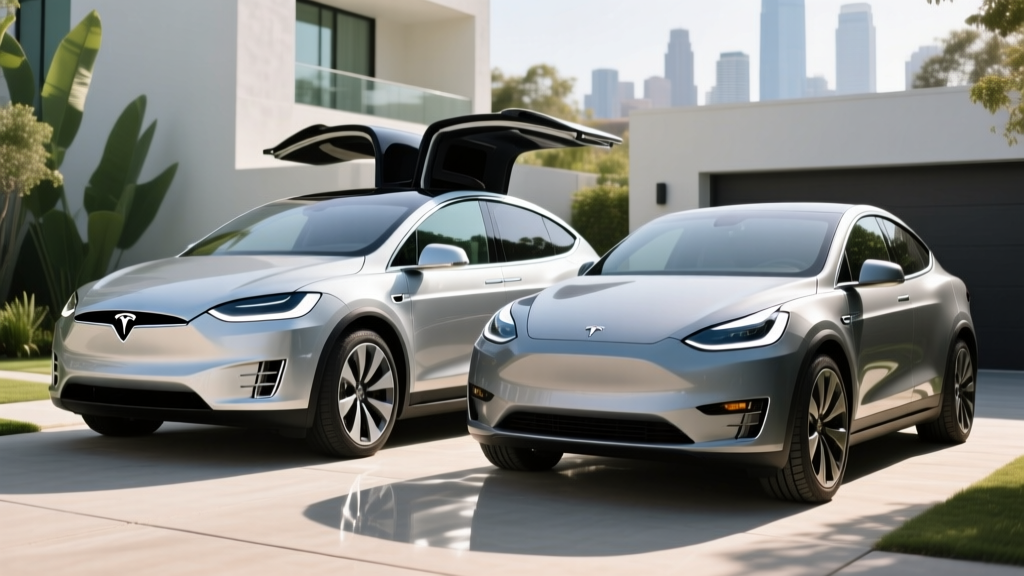
If you've been typing "tesla three rows" into search engines, you're not alone. Tesla currently offers two vehicles with a third row: the flagship Model X (a dedicated three-row luxury SUV with up to seven seats) and the Model Y with the optional third-row package (a compact crossover shoehorning two small seats in the back). They serve radically different buyers, and the gap in price, range, and usable space is enormous.
This guide breaks down both options for the 2026 model year with real-world range expectations, exact charging speeds, federal tax credit eligibility under current IRS §30D rules, and honest assessments of who should actually buy which — and who should look at competitors instead.
Quick Verdict: Which Tesla Three-Row Is Right for You?
The short version: the Model X is the real three-row family hauler. It offers genuine adult-sized third-row space, falcon-wing rear doors, and up to 348 miles of EPA range. The Model Y with the optional third row is a budget compromise — it adds two small seats best suited for children under 5'4", at a far lower price point, but sacrifices cargo room and third-row comfort.
- You regularly carry 5+ passengers including teens or adults in the third row
- You need serious cargo space with all rows in use
- You want flagship performance (0-60 in 3.8s, 670 hp) and falcon-wing doors
- Budget is $80,000+
- The third row is for occasional use by small children only
- You want a Tesla three-row under $50,000
- Cargo space with all rows up is not a priority
- You prioritize efficiency and lower operating costs
Tesla Model X (2026): The Genuine Three-Row Flagship
The Model X remains Tesla's largest SUV and the only Tesla designed from the ground up for three rows. For 2026, it's offered in two trims: the dual-motor Long Range and the tri-motor Plaid. Both seat up to seven (2+3+2 configuration) or six with optional second-row captain's chairs.
| Spec | Model X Long Range | Model X Plaid |
|---|---|---|
| EPA Range | 348 miles | 326 miles |
| Battery (usable) | ~100 kWh (NMC) | ~100 kWh (NMC) |
| Drivetrain | Dual-Motor AWD | Tri-Motor AWD |
| Horsepower | 670 hp | 1,020 hp |
| 0-60 mph | 3.8 sec | 2.5 sec |
| Max DC Fast Charge | 250 kW (peak) | 250 kW (peak) |
| 10-80% DCFC Time | ~32 minutes | ~32 minutes |
| Level 2 Home Charge | 11.5 kW (~34 mi/hr) | 11.5 kW (~34 mi/hr) |
| Efficiency (MPGe) | 102 MPGe combined | 98 MPGe combined |
| Efficiency (kWh/100mi) | 33 kWh | 34 kWh |
| Cargo (behind 3rd row) | ~15 cu ft | ~15 cu ft |
| Cargo (max, seats folded) | ~85 cu ft | ~85 cu ft |
| 3rd-Row Legroom | ~32.7 inches | ~32.7 inches |
| Towing Capacity | 5,000 lbs | 5,000 lbs |
| Base MSRP | $79,990 | $94,990 |
| Battery Warranty | 8 yr / 150,000 mi | 8 yr / 150,000 mi |
Charging the Model X: Speed and Curve Reality
The Model X peaks at 250 kW on V3 Superchargers, but as with all EVs, that peak is only sustained briefly at low state of charge. Expect a realistic 10-80% session to take 30-35 minutes. The charging curve tapers noticeably above 60% SoC, and above 80% it drops to roughly 40-60 kW — so road-trip planning should target 10-80% stops rather than full charges.
At home on a 48-amp Level 2 wall connector (11.5 kW), you'll add about 34 miles per hour of charging, meaning a full overnight charge from 20% to 90% takes roughly 7 hours — easily handled while you sleep.
What Makes the Model X Stand Out
- Falcon-wing rear doors: Gullwing-style doors make third-row access dramatically easier in tight parking spots — genuinely useful for loading car seats.
- Standard Autopilot: Includes adaptive cruise, lane centering, and automatic emergency braking. FSD (Supervised) remains a $8,000 add-on or $99/month subscription — note this is SAE Level 2, not self-driving.
- 17-inch center touchscreen with gaming-capable hardware and a rear 8-inch screen for second-row passengers.
- Air suspension standard, with adjustable ride height for loading and off-road clearance.
Tesla Model Y 7-Seat (2026): The Budget Three-Row Option
The Model Y's optional third row ($3,000 add-on on the Long Range AWD trim) is fundamentally different from the Model X. It's a 2+3+2 layout where the third row is strictly for small children — legroom is roughly 26.5 inches, and headroom is tight. Tesla itself notes the third row fits passengers up to about 5'4".
| Spec | Model Y Long Range AWD (7-Seat) |
|---|---|
| EPA Range | 302 miles (with 19" wheels; 285 mi with 20") |
| Battery (usable) | ~75 kWh (NMC) |
| Drivetrain | Dual-Motor AWD |
| Horsepower | 384 hp |
| 0-60 mph | 4.8 sec |
| Max DC Fast Charge | 250 kW (peak) |
| 10-80% DCFC Time | ~25 minutes |
| Level 2 Home Charge | 11.5 kW (~44 mi/hr) |
| Efficiency (MPGe) | 117 MPGe combined |
| Efficiency (kWh/100mi) | 28 kWh |
| Cargo (behind 3rd row) | ~10 cu ft |
| Cargo (max, seats folded) | ~72 cu ft |
| 3rd-Row Legroom | ~26.5 inches |
| Base MSRP (with 3rd row) | $50,490 |
| Battery Warranty | 8 yr / 120,000 mi |
The Third-Row Compromise, Honestly
With the third row up, the Model Y has only about 10 cubic feet of cargo space behind it — enough for a couple of backpacks or a small grocery run, not a family road trip's worth of luggage. This is the single biggest practical limitation. If you regularly need both passengers and cargo, you'll be folding that third row most of the time.
Access to the third row requires tilting the second-row seat forward. It's manageable but not as elegant as the Model X's falcon-wing doors, which open upward and create a massive opening.
Federal Tax Credit Eligibility: What Actually Applies in 2026
Under IRS §30D rules, the federal EV tax credit is up to $7,500, but eligibility depends on MSRP caps, buyer income limits, and battery-sourcing requirements. Here's where things stand for Tesla's three-row options:
| Model | Base MSRP | SUV MSRP Cap | §30D Credit Potential | Income Cap (MFJ) |
|---|---|---|---|---|
| Model X Long Range | $79,990 | $80,000 | Up to $7,500* | $300,000 AGI |
| Model X Plaid | $94,990 | $80,000 | $0 (exceeds cap) | N/A |
| Model Y LR AWD 7-Seat | $50,490 | $80,000 | Up to $7,500* | $300,000 AGI |
*Critical caveats: The $7,500 credit splits into two halves — $3,750 for battery-component sourcing and $3,750 for critical-mineral sourcing. Tesla's battery supply chain has increasingly met domestic-sourcing requirements, but eligibility can shift. Per the IRS §30D guidelines, you must verify eligibility at the point of sale. The credit can now be transferred to the dealer for an immediate price reduction, but your AGI must be under $300,000 (married filing jointly), $225,000 (head of household), or $150,000 (single). The Model X Plaid at $94,990 exceeds the $80,000 MSRP cap for SUVs and does not qualify.
Tesla Three-Row vs. Key Competitors
The Tesla three-row lineup doesn't exist in a vacuum. Here's how the main alternatives compare for families needing three rows and an electrified powertrain:
| Vehicle | Type | EPA Range | 3rd-Row Usability | Starting Price |
|---|---|---|---|---|
| Tesla Model X LR | BEV | 348 mi | Adult-capable | $79,990 |
| Tesla Model Y 7-Seat | BEV | 302 mi | Kids only | $50,490 |
| Kia EV9 GT-Line AWD | BEV | 270 mi | Adult-capable | $59,900 |
| Hyundai Ioniq 9 (2026) | BEV | ~300 mi (est.) | Adult-capable | ~$55,000 (est.) |
| Volvo EX90 Twin Motor | BEV | 300 mi | Adult-capable | $76,695 |
| Toyota Grand Highlander Hybrid | HEV | 530 mi (36 MPG) | Adult-capable | $44,405 |
The Kia EV9 and upcoming Hyundai Ioniq 9 are the most direct threats to the Model X's value proposition — offering genuine three-row space, 800V architecture (faster charging), and prices $20,000-$25,000 lower. According to fueleconomy.gov, the EV9's real-world efficiency is competitive with the Model X despite lower range. The Volvo EX90 matches Tesla on price but adds a more luxurious interior and Google-based infotainment.
If you're open to a hybrid rather than a full BEV, the Grand Highlander Hybrid offers vastly more third-row space and cargo room at half the price — with no charging logistics to manage.
Ownership Costs: What to Budget Beyond the Sticker
EV ownership economics go well beyond MSRP. Here's a realistic 5-year outlook for both Tesla three-row models:
- Home charging: Installing a 48-amp Level 2 wall connector (Tesla or third-party) typically costs $800-$2,000 installed, depending on whether your electrical panel needs an upgrade. A 200-amp panel is usually sufficient; older homes with 100-amp service may need a $2,000-$4,000 upgrade.
- Electricity cost: At the US average of $0.16/kWh, charging a Model X from 0-100% costs roughly $16. Driving 12,000 miles/year costs about $1,300 in electricity — versus roughly $2,400 in gasoline for a comparable ICE SUV at 22 MPG combined and $3.50/gal.
- Insurance: Tesla insurance premiums run 15-30% higher than comparable non-Tesla SUVs, per industry data. Expect $2,500-$3,500/year for a Model X and $1,800-$2,500/year for a Model Y, depending on your state and driving record.
- Maintenance: Minimal compared to ICE — no oil changes, no transmission fluid, brake pad life extended by regenerative braking. Budget $300-$500/year for cabin air filters, wiper fluid, and tire rotations. Tires wear faster on EVs due to weight and instant torque; budget for replacement every 30,000-40,000 miles.
- Depreciation: Tesla depreciation has been steeper than legacy brands in recent years. The Model X typically retains 45-50% of value after 5 years; the Model Y retains 50-55%. Price cuts on new models have accelerated used-market depreciation.
Pros and Cons: The Honest Summary
Model X Pros
- Genuine adult-capable third row
- 348-mile EPA range (best-in-class for 3-row BEV)
- Falcon-wing doors ease car-seat loading
- 670 hp standard; Supercharger network access
- 5,000-lb towing capacity
- Over-the-air updates continuously add features
Model X Cons
- $80K+ starting price; Plaid doesn't qualify for tax credit
- Charging limited to 250 kW (slower than 800V rivals)
- Falcon-wing doors can be slow and have had reliability issues
- Interior material quality lags behind Volvo EX90 and BMW iX
- Panel gaps and build-quality inconsistency reported by owners
Model Y 7-Seat Pros
- Most affordable Tesla three-row option (~$50K)
- 117 MPGe — highly efficient for a 7-seat vehicle
- 25-minute 10-80% DC fast charge
- Tax-credit eligible (if income/sourcing rules met)
- Compact footprint, easy to park
Model Y 7-Seat Cons
- Third row only fits small children
- Only ~10 cu ft cargo behind 3rd row
- 302-mile EPA range drops sharply on highway/in cold
- No air suspension; ride quality is firm
- Rear visibility compromised with 3rd row in use
Frequently Asked Questions
Does any Tesla have three rows of seats?
Yes. The Tesla Model X comes standard with a third row (seats up to 7 or 6 with captain's chairs). The Model Y offers an optional third-row package for $3,000, bringing seating to 7, but the third row is only practical for small children.
Can adults fit in the Tesla Model Y third row?
Technically yes for short trips, but Tesla recommends the Model Y third row for passengers up to about 5'4". Legroom is roughly 26.5 inches — tight even for most teenagers. For regular adult passengers in the third row, the Model X, Kia EV9, or Volvo EX90 are far better choices.
What is the real-world range of the Tesla Model X in winter?
In sustained sub-freezing temperatures, expect the Model X Long Range to deliver approximately 200-230 miles — a 30-35% reduction from its 348-mile EPA rating. Cold impacts battery chemistry and increases cabin-heating demand. Preconditioning while plugged in mitigates some loss, and the heat pump is more efficient than resistive heating.
How fast does the Model X charge on a road trip?
The Model X peaks at 250 kW on Tesla V3 Superchargers. A typical 10-80% session takes about 32 minutes. Note that the charging curve tapers significantly above 60% SoC — you won't sustain 250 kW for the full session. Competitors with 800V architecture (Kia EV9, Hyundai Ioniq 9) can charge faster, reaching 10-80% in roughly 20-24 minutes at 350 kW chargers.
Does the Tesla Model X qualify for the $7,500 federal tax credit?
The Model X Long Range at $79,990 is just under the $80,000 MSRP cap for SUVs and may qualify for up to $7,500, depending on your income (AGI under $300,000 for joint filers) and Tesla's current battery-sourcing compliance. The Model X Plaid at $94,990 exceeds the cap and does not qualify. Always verify at the point of sale per IRS guidelines.
Is the Tesla Model X worth buying over the Kia EV9?
It depends on priorities. The Model X wins on range (348 vs. 270 miles), performance (670 hp vs. 379 hp), and Supercharger network reliability. The EV9 wins on price ($20K less), interior quality, 800V fast charging, and a more traditional SUV layout with better outward visibility. For most families, the EV9 is the more practical choice; the Model X is the enthusiast's pick.
What warranty does Tesla offer on the battery?
The Model X battery and drive unit are covered for 8 years or 150,000 miles (whichever comes first), with a minimum 70% capacity retention guarantee. The Model Y is covered for 8 years or 120,000 miles at the same 70% threshold. If the battery degrades below 70% within the warranty period, Tesla will replace or refurbish it at no cost. According to Tesla's impact reports, average battery degradation across their fleet is roughly 12% after 200,000 miles.
Is Tesla Autopilot or FSD self-driving?
No. Both Autopilot and FSD (Supervised) are classified as SAE Level 2 driver-assistance systems. You must keep your hands on the wheel and remain fully attentive at all times. FSD adds features like automatic lane changes and traffic-light recognition, but it does not make the vehicle autonomous. Only Level 4 robotaxi services like Waymo operate without a human driver.
The Bottom Line
If you need a genuine Tesla three-row SUV, the Model X Long Range is the only real answer — it's the sole Tesla that can comfortably seat adults in all three rows, haul meaningful cargo, and deliver 348 miles of EPA range. But at $80,000, it's a premium product competing against increasingly capable rivals like the Kia EV9 and Volvo EX90 that offer similar space at far lower prices.
The Model Y 7-Seat is best understood as a five-seat crossover with an emergency third row for small kids. If that's your use case — occasional carpools, young children — it's an efficient, relatively affordable option that still qualifies for the federal tax credit. But don't expect it to replace a minivan or a full-size SUV for regular family hauling.
Before buying, test-sit in the third row of both vehicles with your actual passengers. The difference in usability between them is not subtle — it's the single most important factor in deciding which Tesla three-row (if either) is right for your household.