If you've spent more than five minutes in a parked Tesla, you've likely bumped into Tesla Theater — the in-car entertainment suite that turns the central touchscreen into a streaming and gaming hub. But Theater mode is only as compelling as the vehicle wrapping around it. For 2026, the refreshed Model Y (internally dubbed "Juniper") remains Tesla's volume leader and the platform on which Theater shines brightest, thanks to a larger 15.4-inch display, ventilated seats, and a quieter cabin that makes movie night genuinely enjoyable.
This review covers everything a prospective buyer needs: the real-world range you can actually count on, DC fast-charging speeds that matter on road trips, the nuances of the 2026 federal EV tax credit, and whether Tesla Theater is a gimmick or a genuine ownership perk. We'll also stack the Model Y against the Hyundai Ioniq 5, Ford Mustang Mach-E, and Kia EV6 so you can see where it wins — and where it falls short.
2026 Tesla Model Y: Quick Verdict
The 2026 Model Y Long Range AWD is a remarkably well-rounded electric SUV. It delivers class-leading efficiency, access to the most reliable DC fast-charging network in North America (Tesla's Supercharger network, now partially open to other brands), and an infotainment system — including Tesla Theater — that has no equal for parked-car entertainment. The trade-offs are familiar: a minimalist interior that won't suit everyone, a ride that's firm over broken pavement, and a base price that has crept upward even as competitors have slashed theirs.
| Spec | Value |
|---|---|
| EPA Range | 320 miles |
| Battery (usable) | ~78 kWh, NMC (2170 cells) |
| Drivetrain | Dual-motor AWD |
| Horsepower | 384 hp (combined) |
| 0–60 mph | 4.8 seconds |
| Peak DC Fast Charge | 250 kW (V3 Supercharger) |
| 10–80% DC Charge Time | ~25 minutes |
| Level 2 Home Charge | 11.5 kW (~44 mi/hr) |
| Efficiency | 111 MPGe combined / 28 kWh/100 mi |
| Cargo (rear seats up / folded) | 30.2 / 72.1 cu ft |
| Base MSRP | $48,380 (incl. destination) |
| Battery & Drive Unit Warranty | 8 years / 120,000 miles |
Range, Efficiency, and the Real-World Reality
The EPA rates the 2026 Model Y Long Range AWD at 320 miles. That number is achievable — if you're driving 55–65 mph in mild weather on flat terrain. Tesla's efficiency engineering remains best-in-class: 28 kWh per 100 miles is a benchmark other automakers are still chasing.
- City / moderate-speed suburban: 310–330 miles (regen braking helps)
- Highway at 75 mph: ~265–285 miles (aerodynamic drag dominates)
- Highway at 75 mph in cold weather (below 32°F): ~220–245 miles (cabin heating + battery resistance)
- Mixed driving, temperate climate: ~290 miles is a safe planning number
The Juniper refresh added a standard heat pump, which significantly reduces cold-weather range loss compared to resistive cabin heaters. Owners in northern climates should still plan for 20–30% range reduction in deep winter.
For context, fueleconomy.gov lists the Model Y Long Range at 111 MPGe combined. That translates to roughly 3.6 miles per kWh — a figure that matters when you're calculating charging costs at home or on the road.
Charging Speed: Supercharger Network and Home Setup
Charging is where the Model Y's ecosystem advantage becomes tangible. Tesla's V3 Superchargers deliver up to 250 kW of peak DC fast-charging power. In practice, the 2026 Model Y's NMC battery sustains strong charge rates through the mid-SoC range before tapering above 80% — a normal lithium-ion behavior to protect long-term cell health.
| Charging Level | Power / Rate | Speed | Typical Use Case |
|---|---|---|---|
| Level 1 (120V) | ~1.4 kW | ~5 mi/hr | Emergency / trickle top-up |
| Level 2 (240V, 48A) | 11.5 kW | ~44 mi/hr | Home daily charging (Wall Connector) |
| DC Fast (V3 Supercharger) | Peak 250 kW | 10–80% in ~25 min | Road trips, highway corridors |
| DC Fast (V4 Supercharger) | Peak 250 kW* | 10–80% in ~25 min | Newer stations; similar to V3 for this vehicle |
*V4 Supercharger cabinets can deliver higher power to compatible future vehicles; the 2026 Model Y caps at 250 kW on the vehicle side.
Home charging practicality: Installing a Tesla Wall Connector on a 60-amp circuit (48A continuous) adds roughly 44 miles of range per hour of charging. Most owners who drive 30–50 miles daily need only 1–2 hours of plug-in time overnight. A full 0–100% Level 2 charge takes approximately 8.5 hours.
Charging curve reality check: The 250 kW peak only applies at low state-of-charge (roughly 10–30% SoC). From 50–80%, expect rates closer to 80–120 kW. This is why the 10–80% time of ~25 minutes is a more useful metric than the peak kW number. Always precondition the battery by navigating to a Supercharger in the Tesla app or nav — the car warms the pack to optimize charge acceptance, shaving 5–10 minutes off your stop in cold weather.
Tesla Theater Mode: Entertainment While Parked
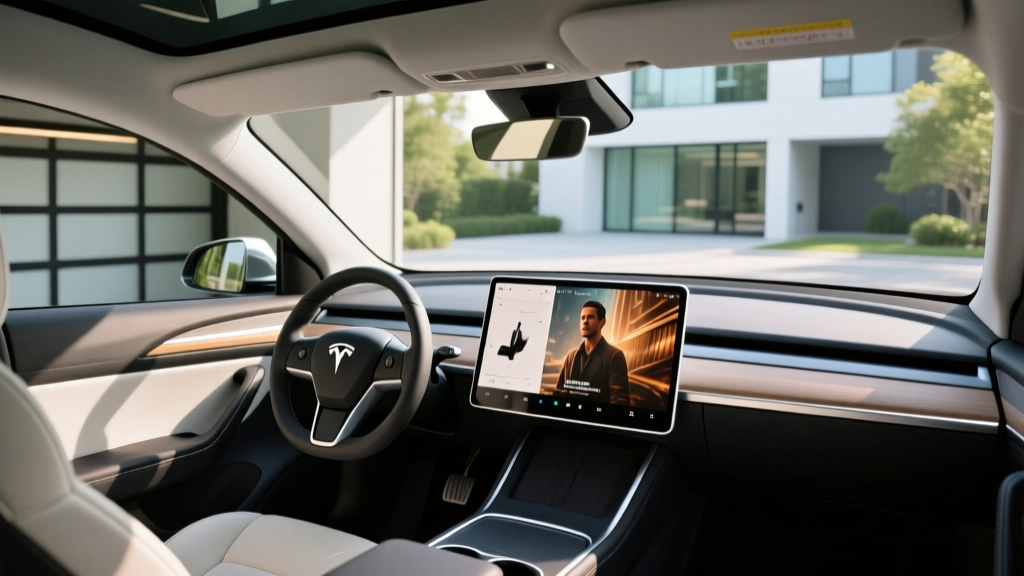
Now to the keyword that brought you here. Tesla Theater is the umbrella term for the parked-car entertainment experience on Tesla's touchscreen. When the vehicle is in Park, the 15.4-inch Juniper display unlocks:
- Streaming video: Netflix, YouTube, Disney+, Hulu, and Twitch (availability varies by region and subscription)
- Gaming: Titles like Stardew Valley, Cyberpunk 2077 (on higher-spec hardware), Cuphead, and Tesla Arcade classics — playable with the steering wheel and pedals or a connected Bluetooth controller
- Theater browser: A Chromium-based web browser for general browsing
- Audio: Spotify, Apple Music, Tidal, and TuneIn radio, with the cabin's upgraded speaker system (14 speakers in the Juniper refresh)
Is Tesla Theater a gimmick? For Supercharger stops on road trips, it's genuinely useful — a 25-minute charge is the perfect length for an episode of a show. For camping in the car (with Camp Mode running climate control), it transforms the cabin into a private cinema. The Juniper's improved cabin insulation makes the audio experience noticeably better than pre-2025 Model Ys.
Limitation: Theater is locked out while the car is in Drive. This is a safety feature and a regulatory requirement — video playback is never available to the driver while the vehicle is in motion. Some owners wish for a rear-seat screen option, which Tesla does not currently offer; the Model Y's entertainment is front-screen only.
Performance, Ride, and Daily Drivability
The dual-motor AWD powertrain produces 384 horsepower and launches the Model Y to 60 mph in 4.8 seconds. That's quick enough to merge onto any highway with authority, though the Performance variant (3.5 seconds, 510 hp) is the one for enthusiasts who want sports-sedan acceleration in a crossover body.
The Juniper refresh brought meaningful ride-quality improvements: revised suspension bushings, retuned dampers, and acoustic glass on all four doors. It's still a firm-riding vehicle — Tesla prioritizes handling precision over plushness — but the gap between the Model Y and comfort-oriented rivals like the Hyundai Ioniq 5 has narrowed.
Driver assistance: Every Model Y ships with Basic Autopilot (adaptive cruise + lane centering). The optional Full Self-Driving (Supervised) package ($8,000 or $99/month) adds city-street navigation, traffic-light recognition, and automatic parking. FSD is a SAE Level 2 system — the driver must remain attentive and keep hands on the wheel at all times. It is not autonomous driving. For hands-free driving on mapped highways, GM's Super Cruise and Ford's BlueCruise remain more polished, though Tesla's coverage area is vastly broader.
Pricing, Trims, and the 2026 Federal Tax Credit
The 2026 Model Y lineup has been simplified compared to prior years. Here's how pricing breaks down:
| Trim | Base MSRP | Est. Price After §30D Credit | Key Notes |
|---|---|---|---|
| Long Range AWD | $48,380 | ~$40,880* | Most popular; 320-mi range |
| Performance AWD | $53,380 | ~$45,880* | 3.5-sec 0-60; 295-mi range |
*Assumes full $7,500 §30D credit eligibility. Actual credit depends on buyer income, battery sourcing, and MSRP caps. Point-of-sale transfer available at participating dealers. Verify current rules at IRS.gov.
- MSRP cap: SUVs/vans/pickups must be ≤ $80,000 — Model Y qualifies easily
- Buyer income cap: AGI ≤ $150,000 (single) / $300,000 (joint) / $225,000 (head of household)
- Battery sourcing: Critical minerals and battery components must meet escalating North American / FTA-partner thresholds (stricter in 2026 than prior years)
- Point-of-sale transfer: Eligible buyers can apply the credit as an immediate price reduction at purchase, rather than waiting for a tax refund
- Assembly: Model Y is assembled at Giga Texas — domestic assembly requirement is met
Tesla's battery supply chain has shifted significantly toward compliant sourcing, but the exact credit amount can vary by production batch. Always confirm eligibility with Tesla at time of purchase and consult a tax professional.
Interior Space, Cargo, and Family Practicality
The Model Y's crossover proportions deliver genuine utility:
- Cargo behind second row: 30.2 cubic feet (competitive with compact SUVs)
- Cargo with second row folded: 72.1 cubic feet (nearly midsize-SUV territory)
- Rear legroom: 41.6 inches — generous for adults on long trips
- Front trunk (frunk): 4.1 cubic feet — useful for charging cables, groceries, or a small bag
The Juniper interior refresh added ventilated front seats, ambient lighting, a rear-seat touchscreen for climate and media controls, and improved materials (vegan leather, soft-touch surfaces). It's a meaningful step up from the 2024 interior, though it still won't match the material richness of a Genesis GV60 or BMW iX at this price point.
Family suitability: Two LATCH points in the rear outboard seats, a wide rear bench that fits three-across car seats (tight but possible), and the cargo volume to handle a double stroller plus groceries. The Model Y is one of the best family EVs under $55,000.
Model Y vs. Key Competitors
| Spec | Tesla Model Y LR AWD | Hyundai Ioniq 5 Limited AWD | Ford Mustang Mach-E Premium AWD | Kia EV6 GT-Line AWD |
|---|---|---|---|---|
| EPA Range | 320 mi | 290 mi | 290 mi | 282 mi |
| Battery | ~78 kWh NMC | 84 kWh NMC | 91 kWh NMC (ext. range) | 77.4 kWh NMC |
| Peak DC Charge | 250 kW | 350 kW (800V) | 150 kW | 240 kW (800V) |
| 10–80% DC Time | ~25 min | ~18 min | ~38 min | ~18 min |
| 0–60 mph | 4.8 sec | 5.1 sec | 5.1 sec | 4.5 sec |
| Base MSRP (AWD) | $48,380 | $53,500 | $47,995 | $52,900 |
| Charging Network | Supercharger (native) | NACS adapter / Supercharger | NACS adapter / Supercharger | NACS adapter / Supercharger |
| Theater / Gaming | Yes (full suite) | Limited | No | Limited |
Where the Model Y wins: Range efficiency, Supercharger network access (no adapter needed), and Tesla Theater for parked entertainment. The software ecosystem remains unmatched.
Where rivals win: The Ioniq 5 and EV6 charge faster on compatible 350/240 kW chargers (their 800V architectures are genuinely superior for DC fast charging). The Mach-E offers a more traditional cockpit layout that some buyers prefer. Both Hyundai and Kia offer longer standard warranties (10-year/100,000-mile powertrain).
Pros, Cons, and Who Should Buy
- Best-in-class efficiency (111 MPGe, 320-mi EPA range)
- Supercharger network — most reliable DC fast-charging in North America
- Tesla Theater: streaming, gaming, browser — best parked-car infotainment available
- Spacious cargo area (72 cu ft) and rear legroom
- Strong resale value relative to EV segment average
- OTA updates continuously add features
- DC peak charge rate (250 kW) trails 800V rivals (Ioniq 5, EV6 at 350/240 kW)
- Firm ride quality on rough roads
- FSD ($8,000) is expensive and still requires full driver attention (Level 2)
- No rear-seat entertainment screen
- Minimalist interior not for everyone — no physical buttons for climate or wipers
- Insurance costs run 15–25% higher than comparable gas SUVs
- You road-trip frequently and want Supercharger reliability without adapters
- You value in-car entertainment for charging stops or camping (Tesla Theater)
- Efficiency and range-per-dollar are your top priorities
- You want OTA software updates that improve the car over time
- Fastest possible DC charging (18-min 10–80%) is your priority
- You prefer a more traditional interior with physical controls
- You want a longer factory warranty (10-year powertrain)
Frequently Asked Questions
What is the real-world range of the 2026 Tesla Model Y?
The EPA rates it at 320 miles, but real-world highway driving at 75 mph yields roughly 265–285 miles. In cold weather (below freezing), plan for 220–245 miles. The heat pump helps, but physics is physics — cold batteries and cabin heating both consume energy.
How fast does the Model Y charge at home and on the road?
At home on a Level 2 Wall Connector (11.5 kW / 48A), you gain about 44 miles of range per hour — enough to fully recharge overnight. On a V3 Supercharger, the peak rate is 250 kW, and a 10–80% charge takes approximately 25 minutes. Remember to precondition the battery for fastest charging in cold weather.
Does the 2026 Model Y qualify for the $7,500 federal EV tax credit?
It can — but eligibility depends on your adjusted gross income (≤ $150K single / $300K joint), the vehicle's MSRP (under the $80K SUV cap), and battery-component sourcing rules that tighten each year. Tesla's Giga Texas-built Model Y generally qualifies, but confirm at purchase. The credit can be applied at point-of-sale as an immediate price reduction. Always check IRS.gov for current rules.
What is Tesla Theater mode and how do I use it?
Tesla Theater is the parked-car entertainment suite that enables Netflix, YouTube, Disney+, Hulu, and gaming on the central touchscreen. It activates automatically when the vehicle is in Park. Pair it with Camp Mode for climate-controlled movie nights. Video playback is disabled while driving — this is a safety and regulatory requirement.
Is the Model Y worth buying over the Ioniq 5 or Mach-E?
If range efficiency, Supercharger access, and software (including Theater) are your top priorities, the Model Y remains the benchmark. If you need the fastest possible DC charging or a more button-forward interior, the Ioniq 5 or EV6 are strong alternatives. The Mach-E is competitive on price but trails on charging speed. Test-drive all three — cabin feel is personal.
What is the Model Y's battery warranty?
Tesla covers the battery and drive unit for 8 years or 120,000 miles, whichever comes first, with a minimum 70% capacity retention guarantee. This is competitive but shorter than Hyundai/Kia's 10-year/100,000-mile powertrain warranty.
Is Tesla's Full Self-Driving actually self-driving?
No. FSD (Supervised) is an SAE Level 2 driver-assistance system. You must remain fully attentive, keep your hands on the wheel, and be prepared to take over at any moment. It handles many driving scenarios impressively but cannot handle all of them. True autonomous driving (Level 4) in consumer vehicles does not yet exist at scale.
Sources: EPA / fueleconomy.gov, IRS §30D Clean Vehicle Credits, Tesla Model Y Specifications.