Why "Terafab Tesla SpaceX" Is Trending — and What It Actually Means for Buyers
If you have searched terafab tesla spacex lately, you are not alone. The term mixes three things: Tesla's next-generation "Terafab" manufacturing push, the engineering crossover between Tesla and SpaceX, and the hype around unreleased vehicles like the Roadster or a Mars-bound concept. As of early 2026, there is no standalone "Tesla Terafab" vehicle you can buy, and no SpaceX-branded EV. What does exist is the refreshed 2026 Tesla Model Y (the "Juniper" update), built in factories Tesla increasingly runs with SpaceX-style automation, gigacasting, and 4680-cell battery lines.
This review treats the 2026 Model Y Long Range AWD as the real product behind the search intent: the highest-volume Tesla most shoppers cross-shop, built on the manufacturing tech the Terafab/SpaceX chatter is really about. Specs below reflect the 2026 model year as listed by Tesla and the EPA; always confirm on Tesla's configurator before ordering, since trims and pricing shift mid-year.
2026 Tesla Model Y Long Range AWD: Core Specs
| Spec | Value |
|---|---|
| EPA-estimated range | 320 miles (Long Range AWD, 19" wheels) |
| Battery (usable) | ~75 kWh, NMC (2170 cells); 4680 NMC on select Austin-built units |
| Drivetrain | Dual-motor AWD |
| Horsepower | ~384 hp combined |
| 0–60 mph | 4.8 seconds (manufacturer) |
| Efficiency | 117 MPGe combined; ~29 kWh/100 mi |
| Max DC fast charge | 250 kW peak (V3 Supercharger); ~170 kW sustained avg 10–80% |
| 10–80% DC time | ~27 minutes |
| Level 2 (240V / 48A) | ~11.5 kW; ~44 miles of range per hour |
| Cargo (behind 2nd row) | 30.2 cu ft; 72.0 cu ft folded |
| Base MSRP | $44,990 (before destination, incentives) |
| Battery warranty | 8 years / 120,000 miles, min 70% retention |
Real-World Range: What the EPA Sticker Doesn't Tell You
Tesla's thermal management and heat pump help, but physics still wins on cold highway runs. On a 70°F day at 65 mph, owners routinely report 290–310 miles on a full charge. Push to 80 mph or climb mountain passes and the number drops toward 250. Preconditioning the battery while plugged in before departure recovers some of that winter loss and is essential for fast-charge speed.
Charging Speed at Home and on the Road
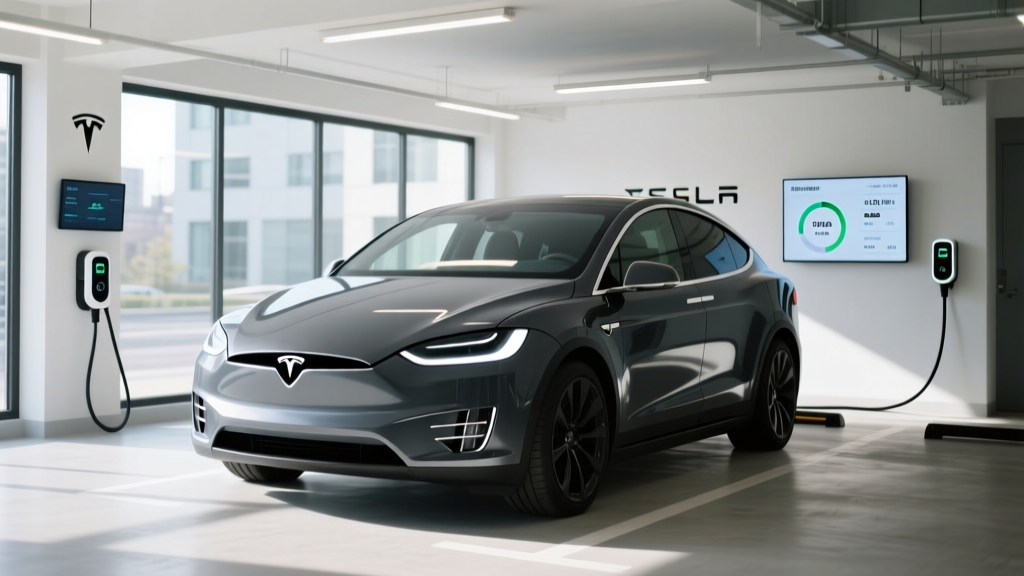
Charging is where the SpaceX-style manufacturing story actually shows up: Tesla's powertrain and Supercharger network are vertically integrated, so the car and the charger are tuned together.
| Level | Power | Miles added per hour |
|---|---|---|
| Level 1 (120V / 12A) | ~1.4 kW | ~4–5 mi/hr |
| Level 2 (240V / 48A Wall Connector) | ~11.5 kW | ~44 mi/hr |
| DC fast (V3 Supercharger) | 250 kW peak | ~180 mi in 15 min (10–80% in ~27 min) |
The 250 kW number is a peak, not an average. The charge curve tapers sharply above ~55% state of charge; plan your road-trip stops around 10–80% and skip the last 20% unless you need it. With a NACS port native to the car, you also gain access to the full Supercharger network, and via adapters, an expanding set of Electrify America and other NACS-opened stations in 2026.
Performance, Ride, and Interior
The Juniper-refresh Model Y rides noticeably quieter than the pre-2025 cars, with retuned dampers, acoustic glass, and ventilated front seats. The 4.8-second 0–60 is quick but not silly — the Performance trim drops that to roughly 3.5 seconds at a $5k+ premium. Steering remains direct if numb, and the 3,800-lb curb weight is well controlled.
Inside, the 15.4-inch center screen runs Tesla's current software with a secondary 8-inch rear touchscreen for climate and media. There is no instrument cluster; speed and nav live in the top-left of the main display, which still divides buyers. Build quality from Austin and Shanghai has closed the gap with legacy rivals, though panel gaps on Fremont cars remain a known complaint.
Pricing, Trims, and the Federal Tax Credit Reality
| Trim | MSRP | Est. after §30D (if eligible) |
|---|---|---|
| Long Range AWD | $44,990 | $37,490 |
| Performance AWD | $51,490 | $43,990 |
| RWD (Standard, if offered) | ~$39,990 | ~$32,490 |
The §30D federal EV tax credit can deliver up to $7,500, and as of 2026 it is available as a point-of-sale transfer to the dealer, effectively a discount at delivery. But eligibility is not automatic:
- Vehicle MSRP must be ≤ $80,000 for SUVs (Model Y qualifies).
- Buyer AGI limits: $150k single / $225k HOH / $300k joint.
- Battery components and critical minerals must meet phased-in domestic-content thresholds that tighten each year — confirm the current VIN-level eligibility on fueleconomy.gov and the IRS clean-vehicle list.
- Credit is non-refundable but transferable at sale, so even low tax-liability buyers can benefit.
Because sourcing rules shift, never assume the full $7,500 until you see the specific VIN's status in writing from Tesla at order time.
Tech, Driver Assists, and the SpaceX/Terafab Connection
Every 2026 Model Y ships with Basic Autopilot (lane-centering + traffic-aware cruise). Full Self-Driving (Supervised) remains an $8,000 option or $99/month subscription and is SAE Level 2 — the driver must remain engaged, eyes on the road, hands on the wheel. Tesla's vision-only stack has improved at intersections and in construction zones, but it is not a robotaxi; Waymo's Level 4 service remains the benchmark for unsupervised driving in geofenced cities.
The "Terafab" and SpaceX overlap is mostly in manufacturing: gigacast front and rear underbodies, 4680-cell structural battery packs on Austin cars, and factory automation patterns borrowed from SpaceX's production philosophy. For the buyer, that translates to lower per-unit cost (hence the aggressive MSRP), stiffer body structure, and a gradually shifting battery chemistry mix.
Pros
- Class-leading Supercharger network access (native NACS)
- Best-in-segment efficiency (~29 kWh/100 mi)
- Strong real-world fast-charge speed, 10–80% in ~27 min
- Quiet, refined cabin post-Juniper refresh
- Over-the-air updates keep feature set current
Cons
- No instrument cluster; touchscreen-heavy UI
- FSD (Supervised) remains Level 2, not autonomous
- Rear visibility compromised by sloping roofline
- Tax-credit eligibility varies by VIN and sourcing — not guaranteed
- Ride still firm on 20" wheels vs. rivals like Ioniq 5
Who the 2026 Model Y Is Actually For
Buy it if: you want the safest bet for long-distance EV travel in the U.S., value efficiency and software polish, and can charge at home on Level 2 most nights. It is the default family-EV answer for a reason.
Look elsewhere if: you prefer a traditional instrument cluster, want Hyundai/Kia's 800V architecture for slightly faster 10–80% DC times, need a third row (Kia EV9), or want a true Level 4 robotaxi experience today (Waymo One, where available).
Frequently Asked Questions
Is there a "Tesla Terafab" or SpaceX-branded EV I can buy in 2026?
No. Terafab refers to Tesla's next-gen manufacturing concept, and SpaceX does not sell cars. The nearest buyable product reflecting that tech is the 2026 Model Y built in Austin with gigacasting and 4680 cells.
What is the real-world range of the 2026 Model Y Long Range?
EPA 320 miles; expect ~270–290 miles on the highway in mild weather, and ~230–250 miles in freezing conditions.
How fast does it charge at home and on DC?
About 44 miles of range per hour on a 48A Level 2 Wall Connector, and 10–80% in roughly 27 minutes on a 250 kW V3 Supercharger (average ~170 kW across the curve).
Does the 2026 Model Y qualify for the federal EV tax credit?
Often yes, up to $7,500 via §30D, but only if your income, the vehicle's MSRP, and the specific VIN's battery-sourcing all meet current IRS rules. Confirm on the IRS and fueleconomy.gov listings before ordering.
Is Tesla Autopilot or FSD actually self-driving?
No. Both are SAE Level 2 driver-assist systems. The driver must supervise at all times. Level 4 unsupervised service is currently offered in the U.S. only by Waymo in select cities.
How does it compare to the Hyundai Ioniq 5 or Ford Mustang Mach-E?
The Ioniq 5 charges slightly faster on 800V DC (10–80% in ~18 min) and rides softer; the Mach-E offers a more traditional cockpit. The Model Y wins on efficiency, Supercharger access, and cargo volume.
Sources: fueleconomy.gov — EPA range and §30D lookup; IRS clean-vehicle manufacturer list; Tesla Model Y configurator.