The Hidden Factor in Tesla Ownership: Service Quality
Most 2026 Tesla Model Y buyers obsess over range, 0-60 times, and Supercharger access — and rightly so. But there's a less-discussed variable that can make or break your ownership experience over five to eight years: the quality of the humans who wrench on your car when something goes wrong. Tesla technician training has evolved significantly since the brand's early days, and understanding how Tesla's service infrastructure works is just as critical as knowing your EPA range sticker.
This review covers the 2026 Tesla Model Y in full technical detail — range, charging, performance, pricing, and tax credit eligibility — while threading in what Tesla's service and technician ecosystem actually looks like for owners in 2026. Because a 320-mile range means little if your nearest qualified service center is three states away.
2026 Tesla Model Y: Core Specifications at a Glance
| Specification | Long Range RWD | Long Range AWD | Performance |
|---|---|---|---|
| EPA Range | 320 mi | 308 mi | 277 mi |
| Battery (usable) | ~75 kWh (NMC) | ~75 kWh (NMC) | ~75 kWh (NMC) |
| Drivetrain | Rear-Wheel Drive | Dual-Motor AWD | Dual-Motor AWD |
| Horsepower | ~346 hp | ~384 hp | ~456 hp |
| 0-60 mph | 6.5 sec | 4.8 sec | 3.5 sec |
| Max DC Fast Charge | 250 kW | 250 kW | 250 kW |
| 10-80% DCFC Time | ~25 min | ~25 min | ~25 min |
| Level 2 Home Charge | 11.5 kW / ~44 mi/hr | 11.5 kW / ~44 mi/hr | 11.5 kW / ~44 mi/hr |
| Efficiency | 123 MPGe / 27 kWh/100mi | 117 MPGe / 29 kWh/100mi | 111 MPGe / 30 kWh/100mi |
| Cargo (rear seats up) | 30.2 cu ft | 30.2 cu ft | 30.2 cu ft |
| Cargo (rear seats folded) | 72.1 cu ft | 72.1 cu ft | 72.1 cu ft |
| Base MSRP | $44,990 | $47,990 | $52,490 |
Source: fueleconomy.gov and Tesla specifications. Figures reflect 2026 model year and may vary with configuration.
Real-World Range: What the EPA Sticker Doesn't Tell You
EPA Estimate: 308 miles
Real-World Highway (70-75 mph, mild weather): ~260–280 miles
Real-World City/Mixed (moderate regen, 45-65 mph): ~285–305 miles
Cold Weather (below 30°F, highway): ~220–250 miles (15–25% loss typical for NMC packs)
Hot Weather (above 95°F, A/C heavy): ~270–290 miles
The Model Y Long Range AWD carries a ~75 kWh usable NMC (nickel manganese cobalt) battery. NMC chemistry delivers higher energy density than LFP, which is why Tesla reserves it for Long Range and Performance trims — but it is more sensitive to extreme temperatures and sustained 100% charges. For daily driving, Tesla recommends an 80% charge limit on NMC packs, which effectively gives you ~246 real-world miles before needing to plug in.
The Long Range RWD, reintroduced for cost-conscious buyers, stretches the EPA figure to 320 miles by shedding the front motor's weight and drivetrain losses. If your commute is highway-dominant and you live in a temperate climate, this trim offers the best range-per-dollar ratio in the lineup.
Charging Speed and Infrastructure: Where Tesla's Network Advantage Shows
| Charging Method | Power (kW) | Approx. Miles Added per Hour | Typical Use Case |
|---|---|---|---|
| Level 1 (120V household) | ~1.4 kW | ~5 mi/hr | Emergency/overnight trickle |
| Level 2 (240V, 48A Wall Connector) | 11.5 kW | ~44 mi/hr | Daily home charging |
| Level 2 (240V, 32A mobile) | 7.7 kW | ~30 mi/hr | Apartment/travel charging |
| DC Fast (Tesla V3 Supercharger) | Up to 250 kW peak | ~1,000+ mi/hr (peak) | Road trips, 10-80% in ~25 min |
| DC Fast (CCS adapter, EA/others) | Up to 150-250 kW | Varies by station | Non-Tesla DCFC networks |
The Model Y's 250 kW peak DC fast-charge rate is competitive but no longer class-leading — the Hyundai Ioniq 5 and Kia EV6 can accept up to 350 kW on compatible chargers. However, Tesla's V3 and V4 Supercharger network remains the most reliable and geographically comprehensive DC fast-charging system in North America. The sustained charge curve peaks around 250 kW up to roughly 40% State of Charge, then tapers progressively. Expect 10-80% in about 25 minutes under ideal conditions (preconditioned battery, V3 stall, moderate ambient temperature).
Home charging at 11.5 kW via the Tesla Wall Connector (hardwired, 60A circuit) replenishes a depleted pack in roughly 7 hours. A standard NEMA 14-50 outlet at 32A delivers about 7.7 kW — slower but sufficient for most daily driving patterns under 60 miles round-trip.
Performance, Ride, and Everyday Drivability
The 2026 Model Y Performance trim hits 0-60 mph in 3.5 seconds with approximately 456 hp from its dual-motor AWD setup. That's sports-car acceleration in a crossover with 72.1 cubic feet of cargo space behind folded rear seats. The Long Range AWD manages 4.8 seconds — genuinely quick for a family hauler — while the RWD base model clocks 6.5 seconds, which is adequate for merging and passing but noticeably more relaxed.
Ride quality has improved with the 2025 refresh (carried into 2026), with revised damper tuning and acoustic glass reducing cabin noise. The cabin remains minimalist: a single 15.4-inch touchscreen handles infotainment, climate, and vehicle settings. Physical controls are scarce — turn signals are on a stalk (restored from the controversial yoke-era button signals), and a rear 8-inch screen serves second-row passengers.
Notable tech includes Tesla's latest Hardware 4 (AI4) computer for Autopilot and the optional Full Self-Driving (Supervised) package. It is critical to understand that FSD remains an SAE Level 2 driver-assistance system — the driver must remain fully engaged, hands on or near the wheel, and eyes on the road at all times. It is not autonomous driving.
Pricing, Tax Credits, and True Cost of Ownership
| Trim | Base MSRP | As-Tested (typical config) | §30D Credit Eligible? | Effective Price (with credit) |
|---|---|---|---|---|
| Long Range RWD | $44,990 | $46,490 (w/ paint, wheels) | Yes — up to $7,500* | ~$37,490–$38,990 |
| Long Range AWD | $47,990 | $50,490 (w/ FSD, paint) | Yes — up to $7,500* | ~$40,490–$42,990 |
| Performance | $52,490 | $55,990 (w/ FSD, wheels) | Yes — up to $7,500* | ~$44,990–$48,490 |
*Federal §30D credit eligibility for 2026 requires: vehicle MSRP under $80,000 (SUVs/crossovers); buyer AGI under $150,000 single / $300,000 joint; battery components and critical minerals meeting phased-in domestic sourcing thresholds. The credit can be transferred to the dealer at point of sale as an instant rebate. Always verify current rules at IRS.gov and consult a tax professional.
All three Model Y trims fall under the $80,000 SUV MSRP cap, making them potentially eligible for the full $7,500 credit — provided your income qualifies and the specific VIN meets the evolving battery-sourcing requirements. Tesla's U.S.-built vehicles (Fremont and Austin plants) have generally maintained strong compliance with §30D critical-mineral and component sourcing rules, but these thresholds tighten annually. Confirm the specific VIN's eligibility on the DOE's clean vehicle credit lookup tool before purchasing.
Tesla Technician Training and the Service Reality
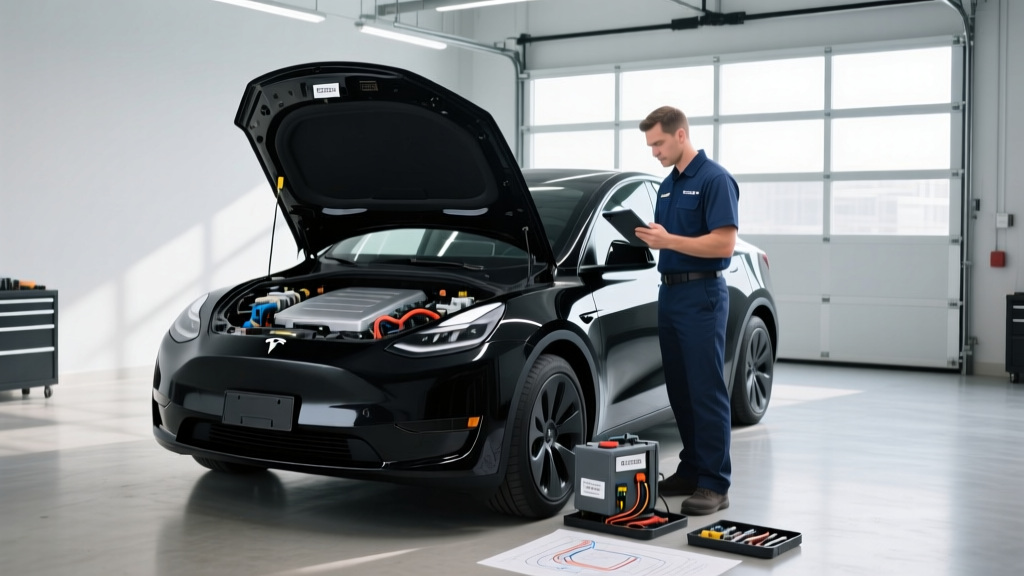
This is where the "Tesla technician training" question becomes personal. Unlike legacy automakers with tens of thousands of independently owned dealerships staffed by ASE-certified mechanics, Tesla operates a direct-to-consumer service model with company-owned Service Centers, mobile service vans, and a limited network of Tesla-Approved Body Shops.
Tesla's in-house technician training program progresses through structured levels. New technicians typically attend Tesla's training facilities (locations include Fremont, Lathrop, and regional hubs) where they complete coursework on high-voltage safety, battery diagnostics, drive unit replacement, thermal management systems, and Tesla-specific software diagnostics. The curriculum is proprietary — there is no third-party equivalent, which means you cannot take a Model Y to an independent shop for high-voltage or powertrain work.
For owners, this creates a specific dynamic:
- Pros: Technicians are specifically trained on your exact vehicle. Software-defined diagnostics mean many issues are identified remotely before you visit. Mobile service handles tire rotations, 12V battery replacements, cabin filter swaps, and minor hardware at your home or office.
- Cons: Service Center wait times in high-population areas can stretch to 2-4 weeks for non-critical issues. Parts availability for collision damage can lag, especially for structural castings. You are locked into Tesla's ecosystem for any high-voltage work.
- Body repair: Tesla-Approved Body Shops receive Tesla-specific training and tooling, but capacity is limited. In rural areas, you may face significant tow distances for collision repair.
The bottom line: Tesla technician training is thorough and vehicle-specific, but the capacity of the service network has not always kept pace with the sales volume. Before buying, check the Tesla app for your nearest Service Center's current wait times and whether mobile service covers your ZIP code.
Warranty, Battery Longevity, and What Service Actually Covers
Tesla's warranty structure for the 2026 Model Y:
- Basic Vehicle: 4 years / 50,000 miles (bumper-to-bumper)
- Battery and Drive Unit: 8 years / 120,000 miles (Long Range) with a minimum 70% capacity retention guarantee
- Restraint System: 5 years / 60,000 miles
The 70% retention threshold over 8 years/120,000 miles is Tesla's contractual floor. In practice, NMC packs in Model Y vehicles have shown average degradation of approximately 10-12% over the first 100,000 miles based on fleet data aggregations — meaning most owners retain ~88-90% capacity at that mark. The battery management system's active thermal management and the recommendation to charge to 80% daily both contribute to this longevity.
Should a battery replacement be needed outside warranty, Tesla's current out-of-pocket pricing for a Model Y pack replacement ranges from approximately $12,000 to $16,000 depending on configuration and labor — a figure worth factoring into long-term ownership cost projections for high-mileage drivers.
Pros, Cons, and Who Should Buy the 2026 Model Y
- Best-in-class Supercharger network access (native NACS, no adapter needed)
- Class-leading cargo space (72.1 cu ft) and front trunk (frunk)
- Strong real-world efficiency (27-30 kWh/100mi)
- Over-the-air updates continuously add features
- Competitive 0-60 performance across all trims
- Strong §30D tax credit eligibility across the lineup
- Service Center capacity can lag in high-demand metro areas
- No Apple CarPlay or Android Auto integration
- 250 kW peak DCFC is outpaced by 800V competitors (Ioniq 5, EV6)
- FSD (Supervised) is expensive ($8,000 or $99/mo) and remains Level 2
- Minimalist interior isn't for everyone — no physical climate knobs
- Body shop network limited for collision repair in rural areas
- Commuters: Long Range RWD offers 320 EPA miles and low running costs; home charging makes fueling effortless.
- Families: 72.1 cu ft cargo, available 7-seat configuration (small third row), and strong safety ratings from NHTSA.
- Road trippers: Supercharger network reliability is unmatched for cross-country travel.
- Not ideal for: Heavy towing (3,500 lb max), rural owners far from Service Centers, or buyers who demand physical dashboard controls and CarPlay.
2026 Model Y vs. Key Competitors
The Model Y's primary rivals include the Hyundai Ioniq 5, Kia EV6, Ford Mustang Mach-E, and the newer Chevrolet Equinox EV. The Ioniq 5 and EV6 charge faster on 350 kW-capable infrastructure (10-80% in ~18 minutes), but their non-Tesla charging networks remain less reliable overall. The Mach-E offers a more conventional interior with physical controls and CarPlay, but trails on efficiency and charging network access. The Equinox EV undercuts on price but offers less performance and a less mature software experience.
The Model Y's moat in 2026 remains the Supercharger network, OTA software maturity, and strong residual values — though the gap is narrowing as competitors adopt NACS and expand their own networks.
Frequently Asked Questions
What is the real-world range of the 2026 Tesla Model Y?
The EPA rates the Long Range AWD at 308 miles. In real-world mixed driving at moderate speeds, expect 260-280 miles on the highway and up to 300 miles in city/commuter use. Cold weather (below 30°F) can reduce range by 15-25%, bringing highway range down to approximately 220-250 miles.
How fast does the Model Y charge at home and on DC fast chargers?
On a Tesla Wall Connector at 11.5 kW (Level 2), the Model Y gains approximately 44 miles of range per hour, fully charging overnight. On a V3 Supercharger at 250 kW peak, 10-80% takes about 25 minutes. The charge curve tapers significantly above 80%, so plan to unplug at 80% on road trips to avoid long waits for the final 20%.
Does the 2026 Model Y qualify for the federal EV tax credit?
Yes, all trims are potentially eligible for up to $7,500 under IRS §30D, as they fall under the $80,000 SUV MSRP cap and are assembled in the U.S. Eligibility depends on your income (under $150K single / $300K joint AGI) and the specific VIN's battery component and critical-mineral sourcing compliance. The credit can be applied as a point-of-sale rebate. Verify at IRS.gov before purchase.
Is the Model Y worth buying over the Ioniq 5 or Mach-E?
If charging network reliability and software experience are top priorities, the Model Y remains the strongest choice. If you value faster peak charging speeds, physical controls, or CarPlay, the Ioniq 5 or Mach-E may be better fits. Test-drive all three and check Service Center proximity for the Tesla before deciding.
How does Tesla technician training compare to traditional dealerships?
Tesla technicians receive proprietary, vehicle-specific training on high-voltage systems, battery diagnostics, and Tesla software. This is more specialized than general ASE certification but means you cannot use independent mechanics for powertrain or battery work. Service quality is generally high, but wait times and service center proximity vary significantly by region.