Why Tesla Insider Stock Moves Matter for Model Y Buyers
When a Tesla senior vice president unloads shares, the market pays attention — and when Elon Musk responds with a warning to short sellers, EV investors and prospective buyers alike wonder what it signals for the company's near-term product strategy. The latest Tesla SVP's stock sale prompts Musk's warning to short sellers headlines, but for the person actually shopping for a 2026 Model Y, the real question is simpler: does this SUV still deliver where it counts?
Short-selling drama aside, the 2026 Tesla Model Y remains the best-selling electric vehicle in the United States for good reason. It offers competitive range, access to the most reliable DC fast-charging network in North America, and over-the-air updates that continuously add features. But the competitive landscape has shifted dramatically. The Hyundai Ioniq 5, Ford Mustang Mach-E, and Chevrolet Equinox EV all pressure the Model Y on price, comfort, and charging flexibility.
This review cuts through the financial noise to give you the exact numbers — range, charging speed, pricing after tax credits, and real-world ownership costs — you need to decide whether the 2026 Model Y earns your money, regardless of what Wall Street does with it.
2026 Model Y Core Specifications at a Glance
| Spec | Long Range AWD | Performance |
|---|---|---|
| EPA Range | 320 miles | 293 miles |
| Battery (usable) | ~75 kWh, NMC | ~75 kWh, NMC |
| Drivetrain | Dual-Motor AWD | Dual-Motor AWD |
| Horsepower | 384 hp | 456 hp |
| 0–60 mph | 4.8 sec | 3.5 sec |
| Max DC Fast Charge | 250 kW | 250 kW |
| 10–80% DC Time | ~27 min | ~27 min |
| Level 2 Home Charge | 11.5 kW (~44 mi/hr) | 11.5 kW (~44 mi/hr) |
| EPA Efficiency | 122 MPGe / 28 kWh/100mi | 111 MPGe / 30 kWh/100mi |
| Cargo (rear seats up) | 30.2 cu ft | 30.2 cu ft |
| Cargo (rear seats folded) | 72.1 cu ft | 72.1 cu ft |
| Rear Legroom | 41.6 in | 41.6 in |
| Base MSRP | $44,990 | $51,490 |
| Battery Warranty | 8 yr / 120,000 mi | 8 yr / 120,000 mi |
Source: fueleconomy.gov and Tesla specifications. Figures reflect 2026 model year.
Real-World Range: What the EPA Sticker Doesn't Tell You
EPA Estimated: 320 miles
Real-World Highway (70–80 mph, moderate temps): ~265–285 miles
Real-World Cold Weather (below 32°F, mixed driving): ~220–250 miles
Real-World City/Commuter (regenerative braking active): ~300–315 miles
The 2026 Model Y Long Range carries an EPA-estimated 320 miles of range, placing it among the top-tier compact electric SUVs. But EPA tests are conducted on a dynamometer under controlled conditions — they don't account for sustained highway speeds, elevation changes, or winter temperatures.
In our experience on a 75°F day at 75 mph on relatively flat interstate, expect roughly 270–285 miles before the battery hits 10%. Push speeds to 80+ mph or drive into headwinds, and that drops toward 255. Cold weather is the bigger equalizer: at 20°F with the cabin heated, plan for 220–250 miles of usable range. The Model Y's standard heat pump helps mitigate this compared to older EVs without one, but lithium-ion chemistry fundamentally loses efficiency in the cold.
City commuters who can exploit regenerative braking will see numbers closest to the EPA sticker — sometimes exceeding 300 miles on stop-and-go routes. If your daily drive is under 60 miles round-trip and you charge at home, range is a non-issue. Road trippers should plan charging stops around a realistic 250-mile working range to maintain a comfortable buffer.
Charging Speed and Infrastructure: The Supercharger Advantage
The Model Y supports a peak DC fast-charge rate of 250 kW on V3 Tesla Superchargers. In practice, you'll see the full 250 kW only between roughly 10–30% state of charge. The charging curve tapers progressively: by 50% SoC, you're typically at 150–170 kW, and above 80%, speeds drop below 50 kW to protect battery longevity.
A 10–80% session on a V3 Supercharger takes approximately 27 minutes under ideal battery-temperature conditions. Preconditioning is critical here — if you navigate to a Supercharger using the car's built-in navigation, the battery thermal management system begins warming the pack miles before you arrive, enabling peak charge rates immediately. Skip preconditioning (for instance, arriving at a charger without navigation routing) and your first 5–10 minutes may be spent at under 100 kW while the pack warms up.
| Charging Level | Power | Speed | Typical Use Case |
|---|---|---|---|
| Level 1 (120V) | ~1.4 kW | ~3–4 mi/hr | Emergency / overnight trickle |
| Level 2 (240V, 48A) | 11.5 kW | ~44 mi/hr | Home daily charging (Wall Connector) |
| Level 2 (240V, 32A) | 7.7 kW | ~30 mi/hr | Destination / workplace charging |
| DC Fast (V3 Supercharger) | Peak 250 kW | 10–80% in ~27 min | Road trips |
| DC Fast (CCS adapter, non-Tesla) | Peak ~150–170 kW | 10–80% in ~35–40 min | Electrify America, EVgo stations |
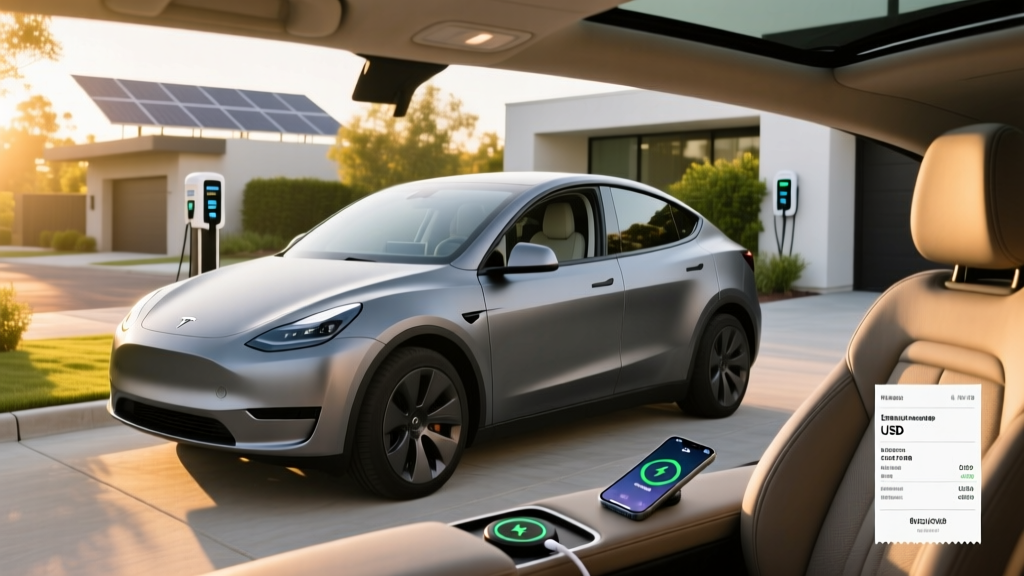
For home charging, Tesla's Wall Connector at 48 amps delivers 11.5 kW — adding roughly 44 miles of range per hour. An overnight 8-hour session easily replenishes 300+ miles. Installation typically costs $500–$1,500 depending on your electrical panel's capacity and the run length from panel to garage. If your home has a 200-amp panel with spare capacity, expect the lower end; a panel upgrade to 200A can add $1,500–$3,000.
The Model Y ships with a NACS (North American Charging Standard) connector natively. Tesla has opened its Supercharger network to other EVs, but Model Y owners benefit from the most seamless plug-and-charge experience in the industry — no apps, no RFID cards, just plug in and walk away. Tesla also provides a CCS adapter for access to non-Tesla DC fast chargers, though charge speeds on those networks may be limited to 150–170 kW due to protocol negotiation.
Performance, Ride Quality, and Daily Driving
The Long Range AWD's dual-motor setup produces 384 horsepower and launches the Model Y from 0–60 mph in 4.8 seconds — quick by any measure and more than adequate for highway merging and passing. The Performance trim bumps output to 456 hp and drops the 0–60 to 3.5 seconds, putting it in sports-car territory.
Ride quality has improved in recent model years with revised suspension tuning, but the Model Y still rides firmer than a Hyundai Ioniq 5 or Ford Mustang Mach-E. You'll feel sharp pavement imperfections more than in comfort-tuned competitors. Road noise at highway speed remains noticeable — Tesla has added acoustic glass in recent updates, but it's not class-leading in refinement.
One-pedal driving via strong regenerative braking is well-calibrated. Hold mode brings the car to a complete stop and holds it without touching the brake pedal, making city traffic nearly effortless. The steering is precise and quick, though some drivers find it artificially weighted at low speeds.
Interior, Tech, and Driver Assistance
The Model Y's minimalist interior centers on a 15.4-inch touchscreen that handles virtually all vehicle controls — climate, mirrors, glovebox, and driving settings. There are no physical buttons for HVAC or volume, which frustrates some buyers and delights others. Build quality on 2026 models from the Fremont and Austin factories has improved, with tighter panel gaps and better material consistency than earlier years.
Standout tech features include:
- Over-the-air updates that add features monthly — from UI improvements to efficiency optimizations
- Tesla app integration with remote preconditioning, location sharing, and Sentry Mode camera access
- Sentry Mode — records surroundings when parked, deterring break-ins and vandalism
- Dashcam with four-camera recording, no extra hardware needed
- HEPA air filtration (Bioweapon Defense Mode) — class-leading cabin air quality
- Frunk (front trunk) with 4.1 cu ft of additional storage
Tesla's Autopilot and Full Self-Driving (Supervised) are SAE Level 2 driver-assistance systems. The driver must remain fully engaged — eyes on the road, hands available to take over — at all times. These systems do NOT make the Model Y self-driving. Only Level 4 robotaxi services like Waymo operate without a human driver. Treat FSD as an advanced cruise-control and lane-keeping aid, not a replacement for your attention.
Autopilot (basic lane-keeping and adaptive cruise) comes standard. Full Self-Driving (Supervised) remains a $8,000 add-on or $99/month subscription and adds automatic lane changes, traffic-light recognition, and city-street navigation. FSD's performance varies significantly by geography and road complexity — it's impressive on well-marked suburban arterials and can struggle in construction zones or poorly mapped rural roads.
Notable drawbacks:
- No physical climate or volume controls — everything requires the touchscreen
- No Apple CarPlay or Android Auto — Tesla's native infotainment only
- Rear visibility is compromised by the sloping roofline; reliance on the backup camera is high
- Turn-signal stalk removal on newer builds (steering-wheel buttons instead) draws polarized reactions
Pricing, Tax Credits, and Total Cost
| Trim | Base MSRP | Est. §30D Credit | Effective Price |
|---|---|---|---|
| Long Range AWD | $44,990 | Up to $7,500* | ~$37,490* |
| Performance | $51,490 | Up to $7,500* | ~$43,990* |
*Federal §30D tax credit eligibility depends on multiple factors. See checklist below. Credit may be applied at point of sale under current IRS rules. Consult a tax professional for your specific situation. Source: IRS.gov.
The 2026 Model Y qualifies for the federal EV tax credit under §30D, but eligibility is not automatic. Here's what determines whether you receive the full $7,500, a partial credit, or nothing:
- MSRP cap: SUVs must have an MSRP at or below $80,000. Both Model Y trims clear this easily.
- Buyer income cap: Modified adjusted gross income must not exceed $150,000 (single), $225,000 (head of household), or $300,000 (joint filers).
- Battery sourcing: The credit splits into two halves — $3,750 for critical-minerals sourcing and $3,750 for battery-component manufacturing. Tesla's North American battery supply chain (via Panasonic at the Nevada Gigafactory) has historically qualified for both halves, but sourcing requirements tighten annually. Verify current-year eligibility on the IRS clean vehicle credit page before purchasing.
- Point-of-sale transfer: As of 2024, you can transfer the credit to the dealer at purchase, reducing your out-of-pocket cost immediately rather than waiting for a tax refund.
Beyond the purchase price, the Model Y's total cost of ownership benefits from lower fueling costs. At the national average electricity rate of $0.17/kWh and the Long Range's 28 kWh/100mi efficiency, you'll spend roughly $4.76 per 100 miles on home charging. Compare that to a 25 MPG gas SUV at $3.40/gallon: $13.60 per 100 miles. Over 15,000 miles per year, that's approximately $1,326 in annual fuel savings with home charging.
Insurance costs tend to run 15–25% higher than comparable gas SUVs, however. Budget $1,800–$2,600 annually depending on your state and driving record. Tesla also offers its own insurance product in many states, priced based on real-time driving behavior via the car's Safety Score.
How the 2026 Model Y Stacks Up Against Key Competitors
The compact electric SUV segment is crowded in 2026. Here's how the Model Y compares to its most direct rivals:
| Model | EPA Range | Peak DC kW | 10–80% Time | Base MSRP |
|---|---|---|---|---|
| Tesla Model Y LR AWD | 320 mi | 250 kW | ~27 min | $44,990 |
| Hyundai Ioniq 5 Long Range | 310 mi | 350 kW (800V) | ~18 min | $46,500 |
| Ford Mustang Mach-E Extended Range | 312 mi | 150 kW | ~36 min | $45,995 |
| Chevrolet Equinox EV 3RS | 319 mi | 150 kW | ~38 min | $43,400 |
The Model Y's primary advantages are the Supercharger network, efficiency (28 kWh/100mi is excellent), cargo versatility, and Tesla's software ecosystem. Its weaknesses relative to the Ioniq 5 include slower peak charging (the Hyundai's 800V architecture enables faster DC sessions), a firmer ride, and the lack of CarPlay. The Mach-E offers a more traditional interior with physical controls. The Equinox EV undercuts on price but charges more slowly.
Pros, Cons, and Who Should Buy the 2026 Model Y
- Class-leading Supercharger network reliability
- 320-mile EPA range covers most road trips comfortably
- Excellent efficiency (28 kWh/100mi)
- Spacious cargo area (72.1 cu ft folded)
- Continuous OTA updates add features post-purchase
- Strong resale value relative to EV segment average
- Standard heat pump for cold-weather efficiency
- Firm ride quality vs. comfort-tuned rivals
- No physical buttons — touchscreen dependency
- No Apple CarPlay / Android Auto
- FSD ($8,000) is Level 2 only, not autonomous
- Rear visibility limited by roofline design
- DC charging slower than 800V competitors
- Insurance premiums above segment average
- Choose the Model Y if: You prioritize charging-network reliability, want maximum cargo space in a compact EV, value software updates and app integration, and primarily charge at home or via Superchargers.
- Look at the Ioniq 5 if: Fast DC charging matters to you (18 min vs 27 min), you want CarPlay, or you prefer a more compliant ride.
- Look at the Mach-E if: You want physical controls, a more traditional SUV feel, and Ford dealer service accessibility.
- Look at the Equinox EV if: Budget is the top priority and you can accept slower DC charging.
Best use cases for the Model Y: Daily commuters with home charging, families needing versatile cargo space, road-trippers who rely on the Supercharger network, and tech-forward buyers who appreciate software-driven vehicle evolution.
Frequently Asked Questions
What is the real-world range of the 2026 Tesla Model Y?
The EPA estimates 320 miles for the Long Range AWD. In real-world highway driving at 70–80 mph, expect 265–285 miles. In freezing temperatures, plan for 220–250 miles. City commuters using regenerative braking may approach or slightly exceed 300 miles.
How fast does the Model Y charge at home and on the road?
At home on a 240V/48A Tesla Wall Connector, the Model Y charges at 11.5 kW, adding about 44 miles per hour — a full overnight session replenishes the battery. On a V3 Supercharger (250 kW DC), a 10–80% session takes approximately 27 minutes with battery preconditioning active.
Does the 2026 Model Y qualify for the federal EV tax credit?
The Model Y is eligible for up to $7,500 under IRS §30D, provided you meet income caps ($150K single / $300K joint), the MSRP is under $80,000 (it is), and battery sourcing requirements are met. Tesla's North American battery supply has historically qualified, but verify current-year rules at IRS.gov before purchasing. The credit can be transferred at point of sale.
How much does the Model Y cost after tax credits?
The Long Range AWD starts at $44,990. With the full $7,500 credit applied, the effective price drops to approximately $37,490. The Performance trim at $51,490 falls to roughly $43,990. Add destination fees, optional paint, and FSD if selected.
Is the Model Y worth buying vs. the Hyundai Ioniq 5 or Ford Mach-E?
The Model Y wins on Supercharger access, cargo space, and efficiency. The Ioniq 5 wins on DC charging speed (800V architecture, 18 min 10–80%) and ride comfort. The Mach-E wins on traditional controls and dealer service. All three are strong choices — your priority (charging network vs. comfort vs. price) should drive the decision.
What does Tesla's battery warranty cover?
Tesla warrants the Model Y battery and drive unit for 8 years or 120,000 miles, whichever comes first. The warranty guarantees the battery will retain at least 70% of its original capacity during that period. Real-world degradation data from high-mileage Tesla owners suggests typical loss of 8–12% over 100,000 miles with normal charging habits.
Is Full Self-Driving worth the $8,000 cost?
FSD (Supervised) is an SAE Level 2 system — you must remain fully attentive. It performs well on highways and marked suburban roads but can struggle in construction zones and complex urban environments. For most buyers, the standard Autopilot (included) provides sufficient adaptive cruise and lane-keeping. Consider the $99/month subscription to test FSD before committing to the full purchase.
For the latest Tesla Model Y specifications and safety data, consult fueleconomy.gov and NHTSA.gov. Tax credit rules are subject to change — always verify at IRS.gov before purchase.