Quick Verdict: Can a Tesla SUV Actually Tow?
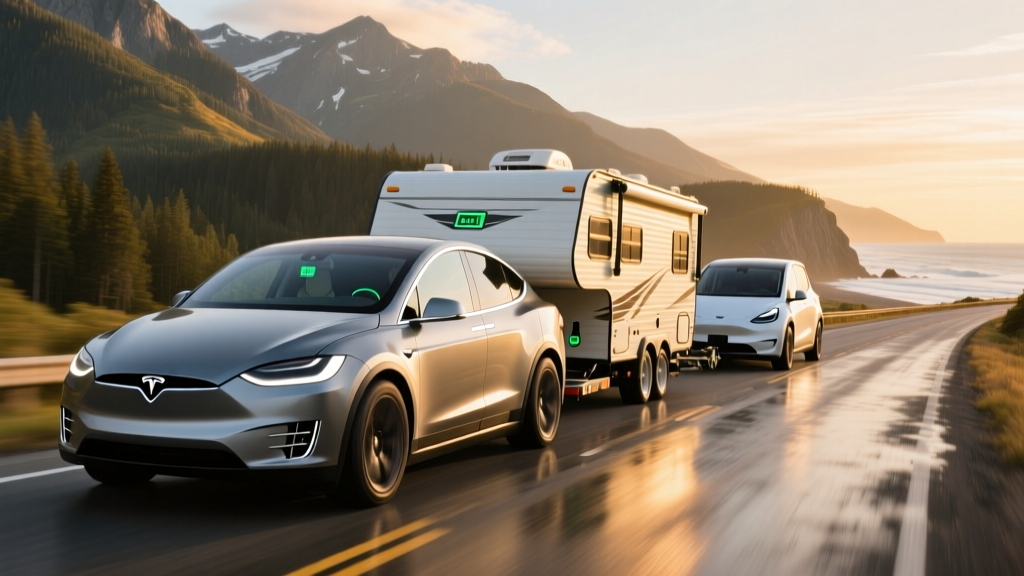
If you're researching Tesla SUV towing, the short answer is yes — but with significant range trade-offs that every buyer should understand before hitching up. Tesla offers two SUVs capable of towing: the Model X (up to 5,000 lbs with the optional tow package) and the Model Y (up to 3,500 lbs). Neither comes standard with a hitch; both require factory-installed tow packages that include wiring harnesses, software-enabled trailer mode, and reinforced cooling.
For light-duty hauling — a small boat, a pair of jet skis, or a compact utility trailer — the Model Y is adequate. For larger campers, horse trailers, or dual-axle cargo trailers, the Model X is the only Tesla SUV that qualifies. But towing at max capacity can slash real-world range by 40-55%, a physics reality no software update can fix.
Tesla SUV Towing Specifications at a Glance
| Specification | Model Y Long Range AWD | Model X Long Range | Model X Plaid |
|---|---|---|---|
| Max Towing Capacity | 3,500 lbs | 5,000 lbs | 5,000 lbs |
| EPA Range (no trailer) | 320 miles | 348 miles | 326 miles |
| Est. Range Towing (max load) | ~145-185 miles | ~160-210 miles | ~145-190 miles |
| Battery Capacity (usable) | 75 kWh (NMC) | 95 kWh (NMC) | 95 kWh (NMC) |
| Drivetrain | Dual Motor AWD | Dual Motor AWD | Tri-Motor AWD |
| Horsepower | 384 hp | 670 hp | 1,020 hp |
| 0-60 mph | 4.8 sec | 3.8 sec | 2.5 sec |
| Efficiency (no trailer) | 27 kWh/100mi (120 MPGe) | 30 kWh/100mi (112 MPGe) | 32 kWh/100mi (105 MPGe) |
| Max DC Fast Charge | 250 kW (CCS/NACS) | 250 kW (NACS) | 250 kW (NACS) |
| 10-80% DCFC Time | ~25 min | ~30 min | ~30 min |
| Level 2 Home Charge | 11.5 kW (~44 mi/hr) | 11.5 kW (~34 mi/hr) | 11.5 kW (~34 mi/hr) |
| Cargo Volume (rear seats up) | 30.2 cu ft | 37.1 cu ft | 37.1 cu ft |
| Cargo Volume (rear seats down) | 72.1 cu ft | 85.1 cu ft | 85.1 cu ft |
| Base MSRP | $48,990 | $79,990 | $94,990 |
| Tow Package Cost | $1,000 | $1,000 | $1,000 |
| Federal Tax Credit (§30D) | Up to $7,500 | Not eligible (MSRP cap) | Not eligible (MSRP cap) |
| Battery/Drive Unit Warranty | 8 yr / 120,000 mi | 8 yr / 150,000 mi | 8 yr / 150,000 mi |
Real-World Range: What Happens When You Hitch Up
EPA Sticker vs. Real-World Towing Range
The EPA range figures above assume no trailer, mixed driving at moderate temperatures. When towing, expect the following real-world reductions:
- Light trailer (under 1,500 lbs, flat terrain): ~20-30% range loss
- Medium trailer (1,500-3,000 lbs, mixed terrain): ~30-45% range loss
- Max capacity trailer (3,500-5,000 lbs, highway speeds): ~45-55% range loss
- Cold weather + towing (below 40°F): Add another 10-15% loss on top
A Model Y Long Range rated for 320 miles EPA may deliver only 150-185 miles when pulling a 3,000 lb camper at 65 mph on the highway. A Model X Long Range at max 5,000 lbs might manage 160-210 miles under similar conditions.
Why such drastic loss? Towing increases aerodynamic drag exponentially at highway speeds, and the added mass demands more energy for acceleration and hill climbing. According to fueleconomy.gov, EVs lose efficiency faster than ICE vehicles when towing because regenerative braking cannot recover energy from a heavy trailer without its own brakes, and the battery must deliver sustained high current.
Cold weather compounds the problem. Lithium-ion batteries operate less efficiently below 40°F, and cabin heating draws additional power. If you're towing a ski boat to a mountain lake in November, plan for range at the lower end of estimates — or less.
Charging Speed: Can You Road-Trip While Towing?
Tesla's Supercharger network remains the strongest advantage for towing road trips. Both the Model X and Model Y use the NACS connector natively and can access over 20,000 Supercharger stalls across North America. However, charging while towing introduces logistical challenges.
| Charging Method | Power / Speed | Towing Considerations |
|---|---|---|
| DC Fast Charge (Supercharger V3) | Peak 250 kW; 10-80% in ~25-30 min | Most Supercharger stalls are pull-through or require unhitching. Plan stops carefully. |
| DC Fast Charge (3rd-party CCS) | 50-150 kW typical | Requires NACS-to-CCS adapter. Fewer pull-through stalls. Slower speeds. |
| Level 2 Home (Wall Connector) | 11.5 kW (~34-44 mi/hr added) | Overnight charge fully replenishes. Best for local towing trips. |
| Level 2 Destination Charger | 7-11.5 kW | Hotels/campgrounds sometimes offer these. Confirm trailer parking availability. |
| Level 1 (120V outlet) | ~1.2 kW (~3-4 mi/hr) | Emergency only. Impractical for towing use cases. |
The charging curve matters when towing. Both SUVs peak at 250 kW only between roughly 10-30% state of charge. Above 50%, the rate tapers significantly, and above 80%, it drops to under 50 kW to protect battery longevity. On a towing road trip, plan to charge from 10-80% and move on rather than waiting for a full 100%, which can add 30+ minutes at the stall.
One critical note: not all Supercharger locations accommodate trailers. Many urban stalls are perpendicular or angled tightly, requiring you to unhitch and park the trailer separately. Tesla's in-car navigation will route you to Superchargers, but it does not always flag trailer-friendly pull-through stalls. Apps like PlugShare and A Better Routeplanner (ABRP) let you filter for pull-through access.
Performance and Drivetrain: Towing Power in Practice
Electric motors deliver instant torque from zero RPM, which gives Tesla SUVs an advantage over many gas-powered competitors when starting from a stop with a heavy trailer. The Model X Plaid's 1,020 hp is absurd overkill for towing, but the dual-motor Long Range's 670 hp provides confident highway merging and hill climbing even at max capacity.
The Model Y's 384 hp is sufficient for its 3,500 lb limit, but you'll feel the strain on steep grades. Tesla's software-enabled Trailer Mode adjusts stability control, acceleration mapping, and regenerative braking calibration when a trailer is connected. It also disables Autopilot and Full Self-Driving (Supervised) — these SAE Level 2 driver-assistance systems are not designed to handle trailer dynamics.
ADAS Limitation Warning: Tesla Autopilot and FSD (Supervised) are SAE Level 2 systems. They require full driver attention and are not self-driving. When towing, Tesla disables these features entirely due to altered vehicle dynamics, increased stopping distance, and trailer sway risk. You must drive manually when a trailer is connected.
Stopping distance increases significantly with a trailer. Tesla's regenerative braking recovers some energy, but trailer brakes (required on most trailers over 1,500 lbs depending on state law) must do the heavy work. Ensure your trailer has electric or surge brakes in good condition — the Tesla's brake system is not designed to stop 8,000+ lbs of combined vehicle and trailer mass alone.
Pricing, Tax Credits, and Total Cost
| Trim | Base MSRP | With Tow Package | §30D Credit | Effective Price |
|---|---|---|---|---|
| Model Y Long Range AWD | $48,990 | $49,990 | Up to $7,500* | ~$42,490* |
| Model X Long Range | $79,990 | $80,990 | $0 (MSRP cap) | $80,990 |
| Model X Plaid | $94,990 | $95,990 | $0 (MSRP cap) | $95,990 |
*Federal tax credit eligibility under IRS §30D is subject to multiple requirements:
- MSRP cap: SUVs/vans/pickups must be under $80,000 MSRP. The Model Y qualifies; the Model X does not.
- Buyer income cap: Modified AGI must not exceed $150,000 (single), $225,000 (head of household), or $300,000 (joint filing).
- Battery sourcing: Increasing percentages of critical minerals and battery components must be sourced from the US or free-trade-agreement countries. Verify current-year compliance on the IRS qualified vehicles list before purchase.
- Point-of-sale transfer: As of 2024, you can transfer the credit to the dealer at purchase, reducing your out-of-pocket cost immediately rather than waiting for tax filing.
The Model Y is the only Tesla SUV that can benefit from the federal credit, making it significantly more accessible for budget-conscious buyers who need light towing. The Model X is ineligible due to its MSRP exceeding the $80,000 SUV cap, regardless of buyer income or battery sourcing.
Tech, Interior, and Ownership Experience
Both Tesla SUVs share the brand's minimalist interior approach: a single 15-inch (Model Y) or 17-inch (Model X) center touchscreen controls nearly all vehicle functions, including climate, navigation, media, and vehicle settings. There is no traditional instrument cluster — speed and range info appears in the upper corner of the main screen.
Standout features relevant to towing:
- Trailer Mode: Automatically adjusts powertrain, stability control, and regen when a hitch is detected
- Hitch Assist camera view: Rear camera zooms to the hitch area for easier trailer connection
- Over-the-air updates: Tesla regularly adds features; towing-related improvements can arrive wirelessly
- Sentry Mode & Dashcam: Records surroundings while parked — useful at campgrounds and trailheads
- Camp Mode: Maintains climate control and power outlets overnight, ideal for trailer camping
Notable drawbacks:
- No physical buttons for climate or volume — everything requires the touchscreen or voice commands
- Model Y rear visibility is compromised by the sloping roofline; a trailer further blocks the rear camera
- Model X falcon-wing rear doors can be problematic in tight campsite spaces or low-clearance garages
- Panel gaps and interior material quality remain inconsistent compared to luxury competitors at similar price points
- Insurance premiums are typically 20-40% higher than equivalent gas SUVs due to repair costs
Who Should Buy a Tesla SUV for Towing?
Choose the Model Y Long Range AWD if:
- You tow under 3,500 lbs (small boat, jet skis, light utility trailer)
- You want federal tax credit eligibility (~$42,500 effective price)
- Your towing trips are within 150 miles of home or along Supercharger-dense corridors
- You prioritize efficiency and lower operating costs over max towing capacity
Choose the Model X Long Range if:
- You need 5,000 lbs capacity (larger camper, horse trailer, dual-axle cargo)
- You value the extra cargo space (85.1 cu ft) and available third-row seating
- MSRP above $80,000 is within your budget and you don't need the federal credit
- You want the most powerful towing-capable EV SUV on the market
Look elsewhere if:
- You regularly tow over 5,000 lbs — consider a Rivian R1S (7,700 lb capacity) or a PHEV like the Jeep Wrangler 4xe
- You tow long distances through charging-desert regions (rural Mountain West, parts of the Dakotas)
- You need integrated trailer brake controller and towing mirrors from the factory
Pros and Cons: Tesla SUVs for Towing
Pros
- Instant torque provides confident starts and merging with a trailer
- Tesla Supercharger network is the most reliable DC fast-charging ecosystem in North America
- Trailer Mode and hitch-assist camera simplify the towing experience
- Lower per-mile energy cost vs. gas when charging at home ($0.04-$0.08/mi vs. $0.18-$0.25/mi for gas SUVs)
- Model Y qualifies for up to $7,500 federal tax credit, reducing effective price significantly
- Over-the-air updates can improve towing software over time
Cons
- Severe range loss when towing (40-55% at max capacity) limits trip flexibility
- Many Supercharger stalls are not pull-through — requires unhitching to charge
- Model X exceeds $80,000 MSRP cap and is ineligible for the federal EV tax credit
- Autopilot and FSD disabled while towing — no driver-assistance on long hauls
- No factory-integrated trailer brake controller; must add aftermarket for electric trailer brakes
- Insurance and repair costs are higher than gas-powered SUV competitors
- Model X falcon-wing doors impractical in tight trailer-parking situations
Frequently Asked Questions
What is the real-world range of a Tesla SUV while towing?
With no trailer, the Model Y Long Range delivers approximately 280-300 real-world highway miles (EPA 320) and the Model X Long Range delivers 300-320 miles (EPA 348). When towing at max capacity on the highway, expect the Model Y to drop to 150-185 miles and the Model X to 160-210 miles. Cold weather below 40°F can reduce these figures by an additional 10-15%.
How fast does a Tesla SUV charge on a road trip?
At a Tesla Supercharger V3 stall, both the Model X and Model Y peak at 250 kW, adding roughly 10-80% charge in 25-30 minutes. However, this assumes no trailer. When towing, you'll need to charge more often due to reduced range, and you may need to unhitch at stalls without pull-through access. Home Level 2 charging at 11.5 kW adds about 34-44 miles per hour and fully replenishes overnight.
Does the Tesla Model X or Model Y qualify for the federal EV tax credit?
Only the Model Y qualifies for up to $7,500 under IRS §30D, because its MSRP is under the $80,000 SUV cap and it meets battery-sourcing requirements (verify on the current IRS qualified vehicle list). The Model X, starting at $79,990 and exceeding $80,000 with the tow package, does not qualify regardless of buyer income. All buyers must also meet income caps ($150K single / $300K joint) and cannot have claimed the credit more than once per VIN.
Is a Tesla SUV worth buying for towing vs. a gas or hybrid SUV?
It depends on your use case. For local towing (under 100 miles round trip from home, where you can recharge overnight), a Tesla SUV offers dramatically lower fuel costs, instant torque, and a refined experience. For long-distance towing (300+ miles through areas with sparse charging), a gas or diesel SUV like the Toyota Sequoia or Ford Expedition offers far greater range and faster refueling. A plug-in hybrid like the Jeep Grand Cherokee 4xe splits the difference with electric-only local driving and gas range for long hauls.
Can I use Autopilot or FSD while towing a trailer?
No. Tesla disables Autopilot and Full Self-Driving (Supervised) when Trailer Mode is active. These are SAE Level 2 driver-assistance systems, and their sensors and algorithms are not calibrated for the altered dynamics, increased length, and sway characteristics of a towed trailer. You must drive manually at all times when towing.
What trailer weight requires brakes when towing with a Tesla?
Most US states require trailer brakes on trailers over 1,500-3,000 lbs (varies by state). Tesla does not include a factory-integrated trailer brake controller, so you'll need an aftermarket controller (such as a Curt or Tekonsha unit) installed by a qualified technician to operate electric trailer brakes. Confirm your state's requirements through your local DMV.
How does the Tesla tow package work?
The $1,000 factory tow package includes a Class III hitch receiver, wiring harness for trailer lights, and software-enabled Trailer Mode. It must be ordered at the time of vehicle purchase — Tesla does not support aftermarket hitch installations without voiding aspects of the warranty. Trailer Mode activates automatically when the vehicle detects a connected trailer wiring harness.