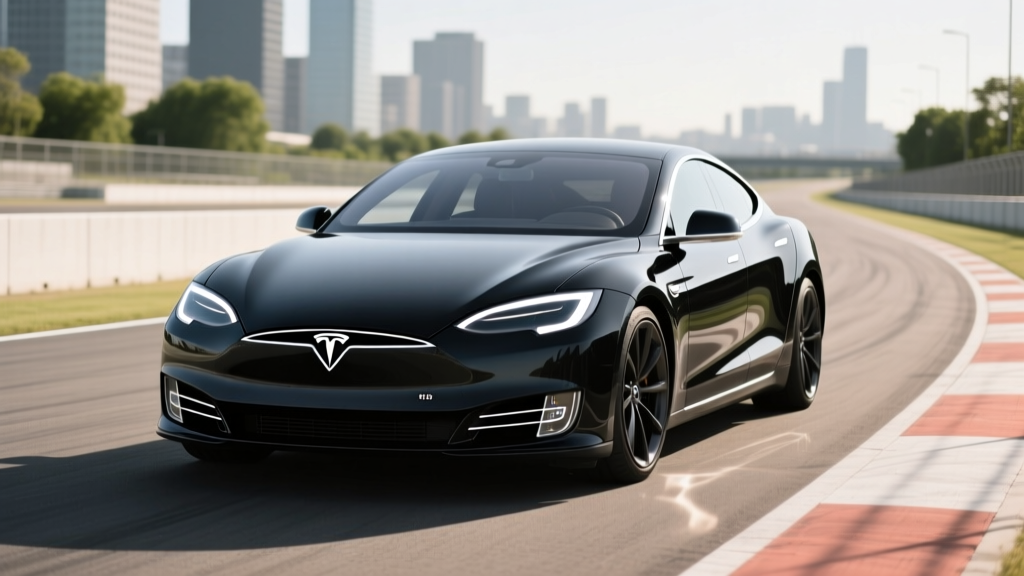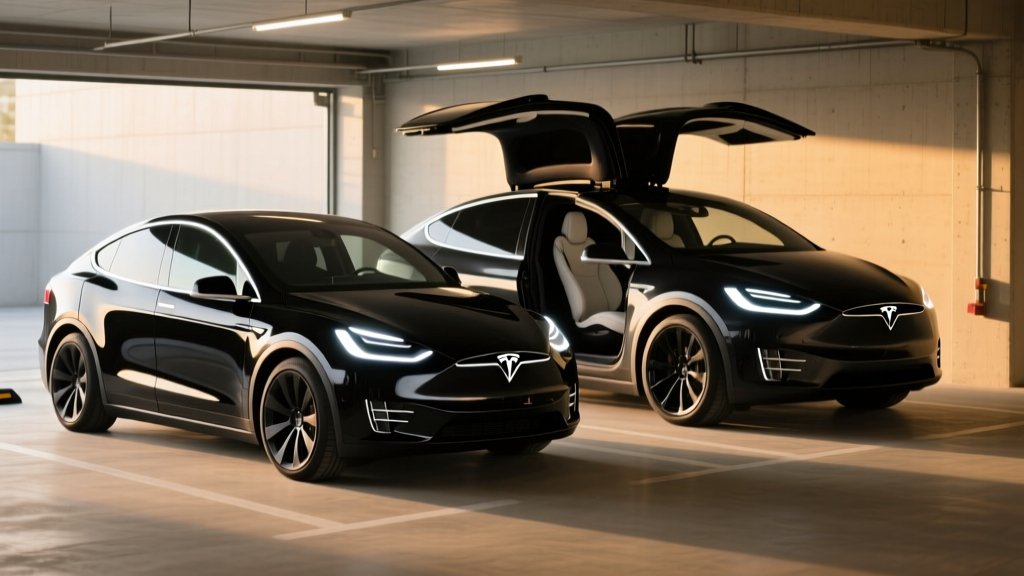
If you've been searching for a black Tesla SUV, you've likely narrowed it down to two candidates: the compact, high-volume Model Y and the flagship, falcon-wing Model X. Both are available in Tesla's signature Solid Black paint ($2,000 premium), both seat up to seven with optional third rows, and both tap into the Supercharger network. But their pricing, range, and day-to-day usability diverge sharply.
This guide breaks down the 2026 lineup with exact EPA figures, real-world range expectations, charging curves, IRS §30D tax-credit eligibility, and cargo dimensions — so you can pick the right black Tesla SUV without guessing.
At a Glance: 2026 Tesla Model Y vs Model X Spec Table
| Spec | 2026 Model Y Long Range AWD | 2026 Model X Long Range AWD |
|---|---|---|
| EPA Range | 320 miles | 335 miles |
| Battery (usable) | ~75 kWh (NMC) | ~95 kWh (NMC) |
| Efficiency | 26 kWh/100 mi (128 MPGe) | 30 kWh/100 mi (111 MPGe) |
| 0-60 mph | 4.8 sec | 3.8 sec |
| Horsepower | 384 hp | 670 hp |
| Drivetrain | Dual-Motor AWD | Dual-Motor AWD |
| Max DC Fast Charge | 250 kW | 250 kW |
| 10-80% DC Time | ~27 min | ~32 min |
| Level 2 Home Rate | 11.5 kW (~44 mi/hr) | 11.5 kW (~34 mi/hr) |
| Cargo (behind 2nd row) | 30.2 cu ft | 41.1 cu ft |
| Cargo (max, seats folded) | 72.1 cu ft | 81.5 cu ft |
| Seating | 5 (7 optional) | 5, 6, or 7 |
| Towing Capacity | 3,500 lb | 5,000 lb |
| Battery Warranty | 8 yr / 120,000 mi | 8 yr / 150,000 mi |
| Base MSRP | $48,590 | $79,990 |
Real-World Range: What the EPA Sticker Doesn't Tell You
Model X Long Range: EPA 335 mi → expect ~280-295 mi highway at 70 mph; ~250 mi in freezing weather.
Tesla's efficiency engineering is class-leading, but physics still applies. The Model Y's lighter curb weight (~4,200 lb) and lower drag coefficient give it a slight real-world edge over the heavier Model X (~5,000 lb), despite the X's larger battery pack. Both vehicles use NMC (nickel manganese cobalt) chemistry in Long Range trims, which offers higher energy density than LFP but is more sensitive to sustained 100% state-of-charge storage. Daily charging to 80-90% is recommended for longevity.
In EPA testing, the Model Y achieves 128 MPGe combined versus the Model X at 111 MPGe. On a road trip from Denver to Moab (roughly 350 miles), the Model Y will need one short Supercharger stop; the Model X can nearly make it in one shot but will arrive with a thin buffer.
Charging Speed: Supercharger, Home, and the Curve Reality
| Charging Level | Model Y Long Range | Model X Long Range |
|---|---|---|
| Level 1 (120V, 12A) | ~1.4 kW / ~5 mi/hr | ~1.4 kW / ~4 mi/hr |
| Level 2 (240V, 48A) | 11.5 kW / ~44 mi/hr | 11.5 kW / ~34 mi/hr |
| DC Fast (V3 Supercharger) | Peak 250 kW / 10-80% ~27 min | Peak 250 kW / 10-80% ~32 min |
| DC Fast (V4 Supercharger) | Up to 250 kW (vehicle-limited) | Up to 250 kW (vehicle-limited) |
Both SUVs peak at 250 kW on DC fast charging, but neither sustains that rate. The charge curve tapers significantly above 50% state-of-charge. In real-world testing at a V3 Supercharger, the Model Y typically averages around 150 kW across the full 10-80% session — meaning the advertised "250 kW" is a peak, not an average. This is standard for NMC packs with Tesla's thermal management, but buyers comparing against Hyundai's E-GMP platform (which sustains higher rates via 800V architecture) should note the difference.
For home charging, both vehicles accept up to 11.5 kW on a 60-amp Level 2 circuit (requiring a 48-amp continuous draw). A full overnight charge from 20% to 80% takes roughly 5 hours in the Model Y and 6.5 hours in the Model X. Installation of a Tesla Wall Connector typically runs $800-$1,500 for equipment and labor on an existing 200-amp panel, according to industry averages.
Pricing, Trims, and Federal Tax Credit Eligibility
| Trim | Base MSRP | Solid Black Add-On | Est. §30D Credit | Effective Price |
|---|---|---|---|---|
| Model Y Long Range AWD | $48,590 | +$2,000 | Up to $7,500* | ~$43,090 |
| Model Y Performance | $52,490 | +$2,000 | Up to $7,500* | ~$46,990 |
| Model X Long Range AWD | $79,990 | +$2,000 | $0 (over MSRP cap) | $81,990 |
| Model X Plaid | $94,990 | +$2,000 | $0 (over MSRP cap) | $96,990 |
*Eligibility for the IRS §30D federal tax credit depends on buyer income caps ($150K single / $300K joint AGI), battery critical-mineral and component sourcing requirements, and point-of-sale transfer availability. The Model Y has historically qualified for the full $7,500 credit due to US final assembly and improving domestic battery sourcing; confirm current-year eligibility on the IRS Clean Vehicle Provisions page before purchasing. The Model X exceeds the $80,000 MSRP cap for SUVs and does not qualify for the new-vehicle credit.
The pricing gap is the single biggest differentiator here. After the federal credit, a black Model Y Long Range can land near $43,000 — competitive with mid-trim Toyota Highlanders. The Model X starts above $81,000 with no federal offset, placing it against luxury rivals like the BMW iX and Rivian R1S.
Interior, Tech, and the Driver-Assist Conversation
Both vehicles share Tesla's minimalist interior architecture: a single 15.4-inch center touchscreen, no traditional instrument cluster, and over-the-air software updates. The Model X adds a rear-seat 8-inch touchscreen for climate and entertainment controls.
Standard Autopilot includes lane-centering and adaptive cruise control — this is an SAE Level 2 driver-assist system, meaning you must keep hands on the wheel and eyes on the road at all times. Tesla's optional Full Self-Driving (Supervised) package ($8,000) adds automated lane changes, traffic-light recognition, and parking assist, but remains Level 2. It is not a self-driving system.
Notable tech differences:
- Model X: Falcon-wing rear doors (power-operated, with ultrasonic obstacle sensing), HEPA air filtration (Bioweapon Defense Mode), and available yoke steering.
- Model Y: Conventional rear doors, standard HEPA filtration on 2026 models, and a more recent interior refresh with ventilated front seats and ambient lighting.
Cargo, Passenger Space, and Family Practicality
For families choosing a black Tesla SUV, cargo and passenger dimensions matter as much as range:
- Model Y: 30.2 cu ft behind the second row, 72.1 cu ft max. Rear legroom is 38.7 inches. The optional third row is tight — suitable for children only. A front trunk (frunk) adds 4.1 cu ft.
- Model X: 41.1 cu ft behind the second row, 81.5 cu ft max. Rear legroom is 40.9 inches. The available third row accommodates adults on short trips. Frunk adds 6.4 cu ft.
The Model X's falcon-wing doors are a genuine advantage in tight parking spaces — they open upward and require less lateral clearance than conventional doors. However, they add mechanical complexity and have been a source of reliability complaints in earlier model years.
Pros, Cons, and the Verdict
Model Y Long Range — Pros
- Best-in-class efficiency (128 MPGe)
- Eligible for up to $7,500 federal tax credit
- Lower cost of ownership; strong resale value
- Supercharger network access included
- Refreshed 2025+ interior with ventilated seats
Model Y Long Range — Cons
- Third row is child-only
- No air suspension option
- Ride quality firm on rough pavement
- DC fast-charge rate capped at 250 kW
Model X Long Range — Pros
- Usable adult-sized third row
- 5,000-lb towing capacity
- Standard adaptive air suspension
- Falcon-wing doors ease child-seat loading
- 670 hp / 3.8-sec 0-60 in a 5,000-lb SUV
Model X Long Range — Cons
- $80K+ MSRP; no federal tax credit
- Falcon-wing door complexity / repair cost
- Higher energy consumption (111 MPGe)
- Larger footprint, harder in tight garages
Who Should Buy Which Black Tesla SUV?
Choose the Model Y if: Your budget is under $55K after credits, you commute daily under 80 miles, you have 1-2 children, and you want the lowest total cost of ownership in the Tesla ecosystem.
Choose the Model X if: You need genuine 7-passenger seating, tow a boat or trailer up to 5,000 lb, value air suspension for ride comfort, and your budget comfortably exceeds $80K.
Frequently Asked Questions
What is the real-world range of a black Tesla Model Y?
The EPA rates the 2026 Model Y Long Range at 320 miles. In real-world highway driving at 70 mph, expect 270-285 miles. In freezing temperatures (below 32°F), range can drop to roughly 240 miles due to battery resistance and cabin heating demands. Preconditioning the battery while plugged in helps mitigate cold-weather losses.
How fast does the Tesla Model X charge at home and on the road?
On a 48-amp Level 2 home charger, the Model X adds about 34 miles of range per hour — a full 20-80% charge takes roughly 6.5 hours. On a V3 Supercharger, it peaks at 250 kW and charges from 10-80% in approximately 32 minutes, though the charge curve tapers significantly above 50% state-of-charge.
Does a black Tesla SUV qualify for the $7,500 federal tax credit?
The Model Y qualifies for up to $7,500 under IRS §30D, provided the buyer meets income caps ($150K single / $300K joint) and the vehicle's battery meets critical-mineral and component-sourcing thresholds. The Model X does not qualify because its MSRP exceeds the $80,000 SUV cap. Always verify current eligibility on the IRS website before purchase.
Is the Model Y worth buying over competitors like the Hyundai Ioniq 5 or Ford Mustang Mach-E?
The Model Y wins on Supercharger network access, software integration, and cargo volume. The Ioniq 5 charges faster on compatible 350-kW chargers (800V architecture, 10-80% in ~18 min). The Mach-E offers a more traditional interior layout. If Supercharger reliability is your top priority for road trips, the Model Y remains the strongest choice in this segment.
What are the biggest drawbacks of the Tesla Model X?
The primary drawbacks are cost (no federal credit, $80K+ MSRP), falcon-wing door mechanical complexity (potential out-of-warranty repair expense), and higher energy consumption versus the Model Y. The Model X also has a larger footprint that can challenge standard single-car garages.
What warranty coverage does Tesla provide on its SUV batteries?
The Model Y battery and drive unit are covered for 8 years or 120,000 miles (whichever comes first), with a minimum 70% capacity retention threshold. The Model X extends that to 8 years or 150,000 miles. Tesla's warranty covers defects and excessive degradation but does not cover damage from improper charging practices or accidents.