Searching for a "Tesla surfboard" setup usually means one of two things: you either want to know if Tesla makes a surfboard (they don't), or you're an EV-driving surfer trying to figure out how to strap a 6-to-9-foot board to a Model 3, Model Y, or Cybertruck without nuking your highway range. This guide is for the latter — a practical, data-driven look at hauling surf gear on a Tesla, the real-world range penalty you'll face, and which Tesla model actually makes the best surf wagon in 2026.
The Surfboard-on-a-Tesla Problem: Aerodynamics Meets Electrons
Electric vehicles are extraordinarily sensitive to aerodynamic drag. Unlike a gas car, where a roof rack might cost you 2–4 MPG on a 350-hp sedan, an EV's efficiency is measured in watt-hours per mile, and any disruption to laminar airflow over the roof directly increases that number. Tesla's vehicles are among the most aerodynamically optimized production cars on the road — the Model 3 posts a drag coefficient (Cd) of roughly 0.219, and the refreshed Model Y sits around 0.23. Strapping a 20-inch-wide surfboard to the roof effectively turns that teardrop into a blunt object.
Based on real-world testing from EV owners and independent efficiency tracking via tools like A Better Routeplanner and TeslaFi, expect a 15–25% range reduction at 70 mph highway speeds with a single shortboard on a roof rack. A longboard or two boards stacked can push that penalty to 30% or more. That's not a rounding error — on a Model Y Long Range with an EPA-estimated 320 miles, a 25% hit drops your realistic highway range to around 240 miles before you need to find a Supercharger.
EPA-estimated range assumes a mix of city and highway driving at moderate temperatures with no cargo accessories. With a surfboard on the roof at sustained 70–75 mph highway speeds, plan for 75–85% of the EPA sticker. In cold weather (below 40°F) with a roof rack, expect 55–65% of EPA range. Always plan charging stops with a 15–20% buffer.
Which Tesla Model Is the Best Surf Wagon in 2026?
Not all Teslas are created equal when it comes to hauling gear. Here's a spec-driven breakdown of the current lineup and how each handles the surfboard mission:
| Spec | Model 3 LR AWD | Model Y LR AWD | Cybertruck AWD |
|---|---|---|---|
| EPA Range | 341 mi | 320 mi | 340 mi |
| Battery (usable) | ~75 kWh (NMC) | ~75 kWh (NMC) | ~123 kWh (NMC) |
| Efficiency (EPA) | 25 kWh/100mi | 27 kWh/100mi | 47 kWh/100mi |
| Cargo (rear seats up) | 23 cu ft | 30 cu ft | ~68 cu ft (bed) |
| Roof Rack Available? | No (glass roof) | Yes (OEM crossbars) | N/A (truck bed) |
| Max DC Fast Charge | 250 kW | 250 kW | 350 kW |
| 10–80% DC Time | ~25 min | ~25 min | ~20 min |
| 0–60 mph | 4.2 sec | 4.8 sec | 3.9 sec |
| Horsepower | 346 hp | 384 hp | 600 hp |
| Base MSRP (2026) | $47,740 | $44,990 | $79,990 |
| Battery Warranty | 8 yr / 120,000 mi | 8 yr / 120,000 mi | 8 yr / 120,000 mi |
Roof Racks vs. Hitch Racks vs. the Truck Bed: The Range Math
Your surfboard transport method matters enormously for highway efficiency. Here's what the physics actually looks like:
Roof Rack (Model Y)
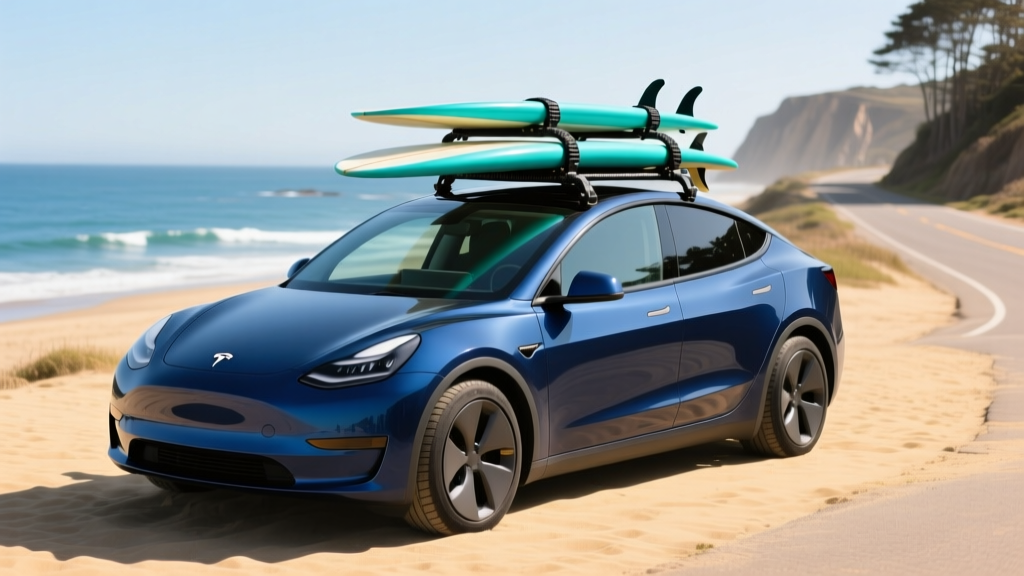
Tesla sells OEM crossbars for the Model Y (approximately $350), and aftermarket options from Thule and Yakima also fit. A single shortboard on roof crossbars adds roughly 4–5 kWh/100mi to your consumption at 70 mph — meaning a Model Y Long Range that normally consumes 27 kWh/100mi jumps to about 31–32 kWh/100mi. That translates to roughly 255–275 miles of real highway range on a full charge, down from ~300 highway miles without the rack.
Two boards stacked? Expect consumption to climb to 34–36 kWh/100mi, dropping realistic range to around 210–225 miles. Still doable on most coastal routes with Supercharger coverage, but you'll add a charging stop to longer sessions.
Hitch-Mounted Rack (Model Y)
The Model Y supports a 1.25-inch hitch receiver (Tesla's OEM hitch is rated for 230 lbs tongue weight and 2,300 lbs towing). A hitch-mounted surf rack — like the SeaSucker Komodo or Inno surf mounts — positions the board behind the vehicle's slipstream, where aerodynamic penalty is significantly lower. Expect only a 5–10% range reduction at highway speeds. This is the efficiency winner for surfers who don't want a truck.
Cybertruck Bed: The Range-Proof Option
The Cybertruck's 6-foot bed swallows shortboards and funboards without any rack hardware. A 6'2" shortboard fits diagonally with the tailgate closed; a 7-foot funboard requires the tailgate down or a bed extender. Because the board sits inside the truck's existing aerodynamic profile (or at least below the roofline), the range penalty is negligible — perhaps 2–3% from the added weight of gear. However, the Cybertruck's baseline efficiency of 47 kWh/100mi means you're already consuming nearly twice the energy per mile of a Model Y, so you'll charge more often regardless.
Charging on Surf Trips: What You'll Actually Experience
Here's where Tesla's Supercharger network becomes the surfer's best friend. Even with a roof-mounted board and a 25% range penalty, the Model Y's access to 250 kW V3 and V4 Superchargers means quick top-ups between sessions.
| Charging Method | Power (kW) | Miles Added/Hour | Notes |
|---|---|---|---|
| Level 1 (120V household) | 1.4 kW | ~4 mi/hr | Emergency only; impractical for surf trips |
| Level 2 (240V home, 48A) | 11.5 kW | ~37 mi/hr | Full charge overnight (~8 hrs) |
| V3 Supercharger | 250 kW peak | ~180 mi in 15 min | 10–80% in ~25 min; tapers above 80% |
| V4 Supercharger | 350 kW peak | ~220 mi in 15 min | Cybertruck capable; Model Y limited to ~250 kW |
Charge curve reality: The 250 kW peak on a Model Y only sustains from roughly 10–30% State of Charge (SoC). Above 50%, the rate drops to ~120 kW, and above 80% it falls below 50 kW. If you're road-tripping with a roof rack and the associated efficiency penalty, plan your Supercharger stops to arrive at 10–15% SoC and depart at 70–80% — this keeps you in the fastest part of the curve and avoids the slow taper above 80%.
For surf trips along the California coast (LA to Santa Cruz, for example), the Model Y Long Range with a roof rack will need one Supercharger stop — roughly 30 minutes — around the midpoint. The Cybertruck, despite its larger battery, will also need one stop due to its higher baseline consumption.
Federal Tax Credit & Pricing: What You'll Actually Pay
Tesla's pricing and federal tax credit eligibility shift frequently. As of early 2026, here's where things stand under IRS §30D clean vehicle credit rules:
| Model | Base MSRP | Under $55K SUV / $80K Truck Cap? | Est. §30D Credit | Effective Price (if eligible) |
|---|---|---|---|---|
| Model 3 Long Range AWD | $47,740 | Yes (sedan cap $55K) | Up to $7,500* | ~$40,240 |
| Model Y Long Range AWD | $44,990 | Yes (SUV cap $80K) | Up to $7,500* | ~$37,490 |
| Cybertruck AWD | $79,990 | Yes (truck cap $80K) | Up to $7,500* | ~$72,490 |
*Critical eligibility caveats: The §30D credit is subject to buyer income caps ($150K single / $300K joint AGI), battery critical-mineral and component sourcing requirements that shift annually, and point-of-sale transfer availability. Tesla's battery sourcing has historically qualified for the full $7,500, but the IRS updates qualifying vehicle lists periodically. Always verify current eligibility on the fueleconomy.gov credit lookup tool before purchasing. Consult a tax professional for your specific situation.
Tesla Model Y: The Surfer's EV Sweet Spot
For most surfers who want an EV daily driver that can also handle weekend sessions, the 2026 Model Y Long Range AWD is the pragmatic pick. Here's why:
Pros
- OEM roof crossbars available — no aftermarket guesswork
- 1.25" hitch receiver supports hitch-mounted surf racks (lower drag)
- 30 cu ft cargo with seats up fits wetsuits, coolers, and bodyboards inside
- 320 mi EPA range absorbs the roof-rack penalty and still delivers 240+ highway miles
- Supercharger network density along coastal corridors (PCH, Hwy 101, I-5)
- ~$37,500 effective price with full §30D credit
- Heat pump standard — less cold-weather range loss than competitors
Cons
- Glass roof means no traditional clamp-on racks — must use Tesla OEM or approved crossbars
- 25% range penalty with roof-mounted boards is significant on 200+ mile trips
- No spare tire — a blowout on a remote surf beach is a flatbed-tow situation
- Panel gaps and paint quality still inconsistent on some builds
- Insurance premiums run 15–25% higher than comparable ICE crossovers
- FSD (Supervised) is not autonomous — SAE Level 2, driver must remain engaged
Standout Tech for the Surf Lifestyle
Tesla's software stack has some genuine utility for surf-specific use cases:
- Sentry Mode & Dog Mode: Leave your gear in the car at a remote beach parking lot. Sentry Mode records any approach or contact, while Dog Mode keeps the cabin climate-controlled for a post-surf pup (and displays a message to concerned passersby).
- Preconditioning via app: Warm or cool the cabin while you're still paddling in. Also preconditioning the battery before a Supercharger stop — the car does this automatically when a Supercharger is set as your navigation destination, which ensures you hit peak charge rates.
- Trip Planner: Tesla's built-in navigation factors in elevation changes, wind, and temperature to estimate energy consumption. Add your roof rack's drag penalty mentally (~20% buffer) and the route planner's Supercharger suggestions remain reliable.
- 15.4" touchscreen: Surf forecast apps (via the built-in browser), Spotify, and YouTube for post-session hangs in the parking lot.
Competitor Check: How Does the Model Y Stack Up for Surfers?
The closest EV alternatives for the surf mission include the Ford Mustang Mach-E (EPA 320 mi, available roof rack, ~$43,995 base) and the Hyundai Ioniq 5 (EPA 305 mi, 800V architecture for faster DC charging, ~$42,600 base). Both are strong, but neither has access to the Supercharger network natively (Ford now has NACS access via adapter; Hyundai's NACS transition is in progress for 2026 models). The IIHS Top Safety Pick+ rating for the Model Y also gives it an edge for families who double-duty the car for school runs and surf trips.
The Cybertruck is the only option that eliminates the roof-rack drag penalty entirely, but its $79,990 starting price and polarizing styling make it a niche choice. For pure surf utility per dollar, the Model Y with a hitch-mounted rack is the efficiency and value winner.
Frequently Asked Questions
Does Tesla make a surfboard?
No. Tesla does not manufacture or sell a surfboard. The brand has sold lifestyle accessories like skateboards and snowboards in limited drops, but no production surfboard exists. If you're looking to transport a surfboard with a Tesla, you'll need roof crossbars (Model Y), a hitch-mounted rack (Model Y with hitch), or a truck bed (Cybertruck).
Can I fit a surfboard inside a Tesla without a rack?
A standard 6'0"–6'4" shortboard will fit diagonally in the cargo area of a Model Y with the rear seats folded, or through the pass-through from the trunk into the cabin. A Model 3's trunk opening is too narrow for most shortboards without angling them carefully. Longboards (8'+) will not fit inside any Tesla sedan or crossover — you'll need an external rack or a Cybertruck bed.
How much range do I lose with a surfboard on the roof?
Expect a 15–25% reduction in highway range at 70 mph with a single board on roof crossbars. Two boards or a wide longboard can push the penalty to 30%+. A hitch-mounted rack behind the vehicle reduces the penalty to roughly 5–10% because the board sits in the vehicle's aerodynamic wake.
Does the Model Y qualify for the $7,500 federal EV tax credit?
The Model Y Long Range qualifies for up to $7,500 under IRS §30D, provided you meet income caps ($300K joint / $150K single AGI), the vehicle's battery sourcing meets current-year critical-mineral and component requirements, and the MSRP is under the $80,000 SUV cap (it is, at ~$44,990). The credit can now be transferred to the dealer at point of sale, reducing your purchase price directly. Always verify current eligibility on fueleconomy.gov before buying.
Is Autopilot useful on long surf road trips?
Tesla's Autopilot (standard) and FSD Supervised (optional, ~$8,000) are SAE Level 2 driver-assistance systems — they handle lane centering, adaptive cruise control, and highway navigation, but you must remain fully attentive with hands on or near the wheel. On a 4-hour drive to a remote break, Autopilot reduces fatigue meaningfully. It is not self-driving, and it will not handle construction zones, unmapped rural roads, or adverse weather without intervention.
What's the best Tesla for a surfer on a budget?
A used 2022–2024 Model Y Long Range, priced in the $30,000–$38,000 range, paired with Tesla OEM crossbars (~$350) and a hitch receiver (~$500 installed), gives you a complete surf-EV setup for under $40,000. Used EVs may qualify for the separate §25E used clean vehicle credit (up to $4,000, subject to income caps and vehicle price limits of $25,000).