The "Tesla Surf" Search: What Buyers Are Actually Looking For
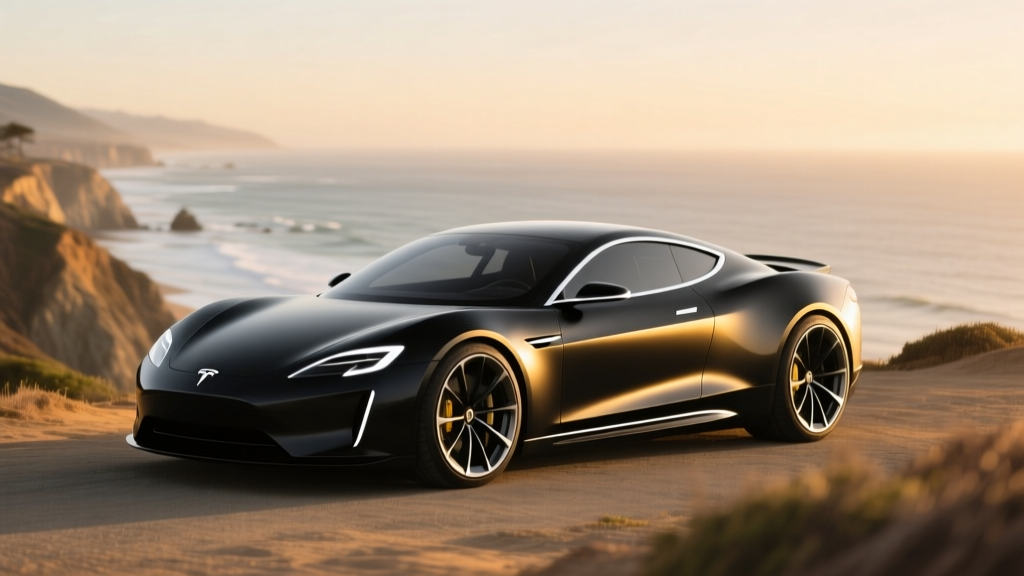
If you've been searching for Tesla Surf, you've likely encountered a mix of fan renders, speculative forum posts, and AI-generated concept images. As of early 2026, Tesla does not manufacture or sell a vehicle called the "Tesla Surf." There is no listing on Tesla's official vehicle lineup, no EPA certification under that name on fueleconomy.gov, and no NHTSA filing for a model by that badge.
So what is driving 110+ monthly searches for this term? The interest traces to three overlapping threads:
- The Tesla "Surfboard" Easter egg and lifestyle branding — Tesla sells (and has sold) branded surfboards as merchandise, and Elon Musk has occasionally referenced a surf-inspired aesthetic in product design discussions.
- Fan concepts for a Tesla-based dune buggy or beach cruiser — independent designers have circulated renders of an open-top, rugged Tesla platform, sometimes labeled "Tesla Surf."
- Confusion with the Tesla Cyberquad, Tesla Semi, or the next-generation Tesla platform — buyers looking for Tesla's next unconventional vehicle sometimes land on "Tesla Surf" as a catch-all search.
Rather than fabricate specs for a vehicle that doesn't exist, this guide does what a responsible EV publication should: it tells you exactly what's confirmed, what's rumor, and which real, buyable Tesla models best match the use case that "Tesla Surf" searchers actually want — an open-air, adventure-ready, coastal-lifestyle EV.
Confirmed Tesla Lineup in 2026: What You Can Actually Buy
Before chasing rumors, here is Tesla's current production lineup for the 2026 model year. These are the vehicles with confirmed EPA data, real MSRP figures, and verifiable tax-credit eligibility.
| Model | Body Style | EPA Range | 0-60 mph | Starting MSRP |
|---|---|---|---|---|
| Model 3 (Long Range AWD) | Sedan | 341 mi | 4.2 sec | $47,740 |
| Model Y (Long Range AWD) | Crossover SUV | 320 mi | 4.8 sec | $44,990 |
| Cybertruck (AWD) | Pickup | 340 mi | 4.1 sec | $79,990 |
| Model S (Long Range) | Luxury Sedan | 402 mi | 3.1 sec | $74,990 |
| Model X (Long Range) | Luxury SUV | 335 mi | 3.8 sec | $79,990 |
Source: EPA fueleconomy.gov and Tesla's official configurator, accessed Q1 2026. Prices before destination fees and before any federal/state incentives.
If "Tesla Surf" Were Real: What the Spec Sheet Would Need
Let's take the rumor seriously for a moment. A surf-themed, coastal-adventure Tesla — whether a ruggedized Model Y variant, an open-top platform, or a dedicated beach cruiser — would need to solve a specific set of engineering problems. Here's what the spec sheet would realistically need to include, based on the current Tesla architecture and the constraints of coastal/off-road use.
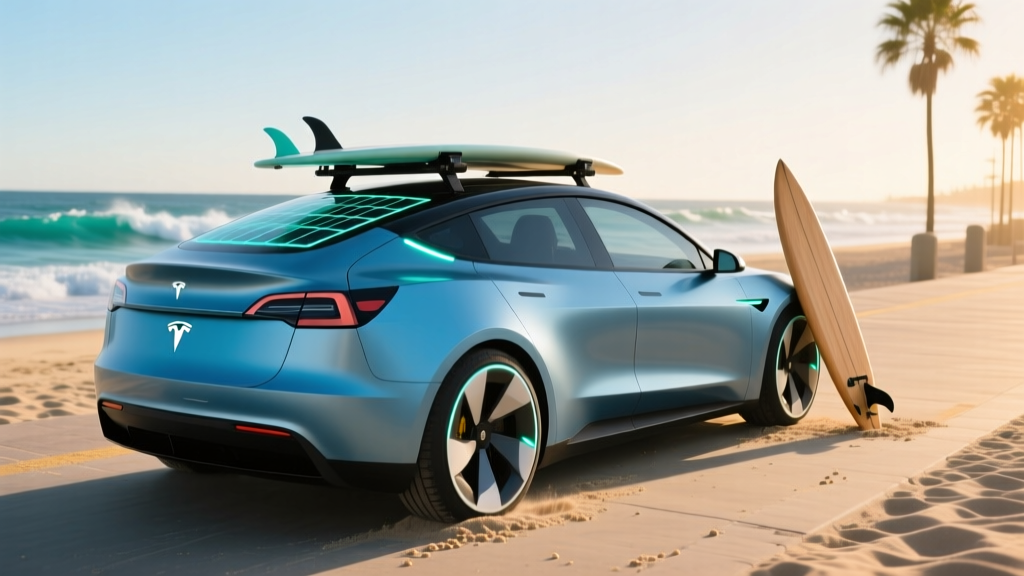
Any open-body or roof-rack-equipped EV loses range. A surfboard roof rack adds aerodynamic drag that typically costs 8–15% of highway range at 70 mph. Sand driving, if permitted, increases rolling resistance dramatically — expect a further 20–30% range loss vs. paved-road EPA figures. A hypothetical "Tesla Surf" based on the Model Y Long Range platform (EPA 320 mi) would realistically deliver ~250–270 mi highway with boards on the roof, and significantly less in beach sand.
For a beach/adventure variant to be credible, it would need:
- Sealed underbody and battery enclosure rated for salt-spray and sand intrusion (beyond the standard Tesla underbody shielding).
- Higher ground clearance — current Model Y sits at 6.6 inches; a beach variant would need 8.5–10 inches, requiring a suspension redesign.
- All-terrain tires with low rolling-resistance compounds compatible with EV torque delivery.
- Integrated board storage — either a bed-style rear (Cybertruck-adjacent) or a roof system with active aero compensation.
- Salt-corrosion warranty provisions — coastal ownership accelerates body and fastener corrosion, and Tesla's current 4-year/50,000-mi limited warranty does not specifically extend coverage for salt damage.
None of these features appear in any Tesla filing, patent application, or earnings-call transcript as of this writing.
The Closest Real Tesla: Cybertruck as the De Facto "Surf" Platform
If your actual use case is "I want a Tesla I can load with surfboards, drive to remote breaks, and hose off after a beach day," the Cybertruck AWD is the closest production match — and it's genuinely capable in ways the rumored "Tesla Surf" concept has never been required to prove.
| Spec | Figure |
|---|---|
| EPA Range | 340 mi |
| Battery (usable) | ~123 kWh, NMC chemistry |
| 0-60 mph | 4.1 sec |
| Peak DC Fast Charge | 250 kW (V3 Supercharger) |
| 10–80% DC Charge | ~28 min |
| Level 2 Home Charge | 11.5 kW (~37 mi/hr) |
| Bed Length | 6 ft (vault bed, lockable tonneau) |
| Towing | 7,500 lb |
| Ground Clearance | Up to 16 in (adaptive air suspension) |
| Wading Depth | ~26 in |
| Battery/Drive Warranty | 8 yr / 120,000 mi |
| MSRP (AWD) | $79,990 |
The Cybertruck's stainless-steel exoskeleton is naturally more resistant to salt spray than painted aluminum, and the vault bed swallows 7-foot surfboards with the tonneau open. Its adaptive air suspension raises the truck for sand access in a way no rumored "Surf" concept has ever demonstrated.
Charging Reality: What Coastal Owners Actually Face
Whether you're driving a Cybertruck, Model Y, or any future Tesla variant to the coast, charging infrastructure is the real constraint — not vehicle branding.
| Level | Power | Miles Added per Hour | Typical Use Case |
|---|---|---|---|
| Level 1 (120V) | ~1.4 kW | ~3–5 mi/hr | Overnight trickle; emergency only |
| Level 2 (240V, 48A) | 11.5 kW | ~30–44 mi/hr | Home daily charging; full overnight refill |
| DC Fast (V3 Supercharger) | Up to 250 kW | ~170 mi in 15 min (peak) | Road trips; highway corridor charging |
The charge-curve reality that spec sheets hide: Peak 250 kW on a V3 Supercharger is sustained only between roughly 10–30% State of Charge (SoC). Above 50%, the rate tapers significantly; above 80%, it drops below 50 kW to protect the battery. A "15-minute charge" headline assumes you arrive nearly empty and leave before 60%. Plan real beach-trip stops around 25–30 minutes for a usable 10–80% fill.
For coastal homeowners, a Level 2 wall connector installation on a dedicated 60A circuit typically runs $800–$1,800 including equipment and electrician labor, assuming a modern 200A panel with spare capacity. Older coastal homes often require a panel upgrade ($2,000–$4,000 additional) — a cost that never appears in EV marketing but is routine in real installations.
Federal Tax Credit: §30D Eligibility Rules for 2026
Any Tesla purchase — real or rumored — must clear the IRS §30D Clean Vehicle Credit requirements. As of 2026, the rules are specific and not universal:
- Credit amount: Up to $7,500 for new qualifying EVs, split between critical-mineral and battery-component sourcing requirements.
- MSRP caps: $80,000 for SUVs, pickups, and vans; $55,000 for sedans. (The Cybertruck AWD at $79,990 clears the SUV/pickup cap; the Model 3 Long Range at $47,740 clears the sedan cap.)
- Buyer income caps: Adjusted gross income must not exceed $300,000 (married filing jointly), $225,000 (head of household), or $150,000 (single).
- Battery sourcing: Specific percentages of critical minerals and battery components must be sourced from the U.S. or FTA-partner countries — Tesla's supply chain has historically met partial but not always full requirements, and the qualifying credit amount varies by delivery quarter. Check IRS.gov's clean vehicle credit page for the current-quarter determination.
- Point-of-sale transfer: Eligible buyers can transfer the credit to the dealer at purchase, reducing the out-of-pocket price directly — but only if the vehicle qualifies in the delivery month.
A hypothetical "Tesla Surf" — if ever produced — would need to clear these same requirements. Given a likely MSRP above $60,000 for any adventure variant, the income cap and sourcing rules would be the binding constraints for most buyers.
What to Buy Instead: Matching the "Surf" Use Case to Real Vehicles
- Choose the Cybertruck AWD if you need genuine beach access, board-in-bed storage, sand wading, and don't mind the 79-inch width in tight coastal parking.
- Choose the Model Y Long Range if your beach driving is paved-road only, you want a roof-rack-compatible crossover with 320 mi range, and you prioritize efficiency over off-road capability.
- Choose the Rivian R1T or R1S (a non-Tesla competitor worth cross-shopping) if you want a dedicated adventure platform with a gear tunnel, quad-motor torque vectoring for sand, and a more proven off-road pedigree than any current Tesla.
- Wait and watch if you're specifically hoping for a Tesla-branded beach vehicle — but set expectations that no such model is in any announced production pipeline as of 2026.
The Verdict on "Tesla Surf" — And How to Move Forward
The "Tesla Surf" is not a vehicle you can order, configure, or take delivery of in 2026. It is a search term born from lifestyle branding, fan concepts, and the genuine market gap for an adventure-oriented, coastal-friendly EV. That gap is real — but Tesla's current answer to it is the Cybertruck, not a dedicated surf cruiser.
If your buying decision is stalled waiting for a rumored Tesla beach model, the opportunity cost is significant: current federal tax credits, available inventory, and proven Supercharger access are all deployable today on confirmed vehicles. If your use case is specific enough that no current Tesla fits, the honest answer is to cross-shop Rivian, Ford's F-150 Lightning, or the upcoming Ram 1500 REV — all of which have more explicit adventure/outdoor positioning than Tesla's current lineup.
Frequently Asked Questions
Is the Tesla Surf a real vehicle I can buy?
No. As of 2026, Tesla has not announced, filed EPA certification for, or listed any vehicle named "Tesla Surf" on its website or in any SEC filing. All images circulating online are fan renders or AI-generated concepts.
What Tesla should I buy for beach and surf trips?
The Cybertruck AWD is the most capable current Tesla for sand access, board storage, and salt-air durability. The Model Y Long Range with a quality roof rack is the more efficient choice if your beach access is paved.
Will Tesla ever release a surf-themed or adventure EV?
Tesla has not announced one. Elon Musk has historically been willing to produce niche vehicles (the Cyberquad ATV, the Tesla Roadster), but any future model would appear first in an earnings call or We, Robot-style product event — not as a leak. Treat any "release date" claims online as speculative.
Does the Cybertruck qualify for the $7,500 federal tax credit?
Potentially — the Cybertruck AWD's $79,990 MSRP is under the $80,000 pickup/SUV cap, and buyer income limits apply. However, battery-sourcing requirements vary by delivery quarter. Verify current eligibility at IRS.gov or with a tax professional before relying on the credit in your budget.
How much range do I lose driving a Tesla with surfboards on the roof?
Expect an 8–15% highway-range reduction at 70 mph with boards on a roof rack, due to aerodynamic drag. On a Model Y Long Range (EPA 320 mi), that translates to roughly 250–290 real-world highway miles with boards loaded — plan charging stops accordingly.
Is Tesla's Autopilot or FSD (Supervised) safe for coastal highway driving?
Tesla's Autopilot and Full Self-Driving (Supervised) are SAE Level 2 driver-assist systems, not self-driving. The driver must remain engaged, hands on or near the wheel, and eyes on the road at all times. They are well-suited to reducing fatigue on long coastal highway drives but are not autonomous and require active supervision — especially on winding, poorly marked, or construction-heavy coastal routes.