Why Tesla's Supply Chain Matters to Buyers
When you plug in a Model Y or Model 3, you're not just tapping into Tesla's engineering — you're drawing on a sprawling network of Tesla suppliers spanning battery cells, power electronics, thermal management, driver-assistance sensors, and raw-material refining. For 2026, that supply chain has shifted dramatically compared to even two years ago: new cell formats, new chemistry mixes, and new geographic sourcing rules all influence what ends up in your driveway — and whether you qualify for the §30D federal EV tax credit.
This guide maps the major Tesla suppliers by component, then ties that sourcing story back to the specs, range, charging, and pricing that matter when you're actually shopping. We'll focus on the two highest-volume vehicles: the 2026 Tesla Model Y Long Range AWD and the 2026 Tesla Model 3 Long Range AWD.
Core Tesla Suppliers by Component (2026)
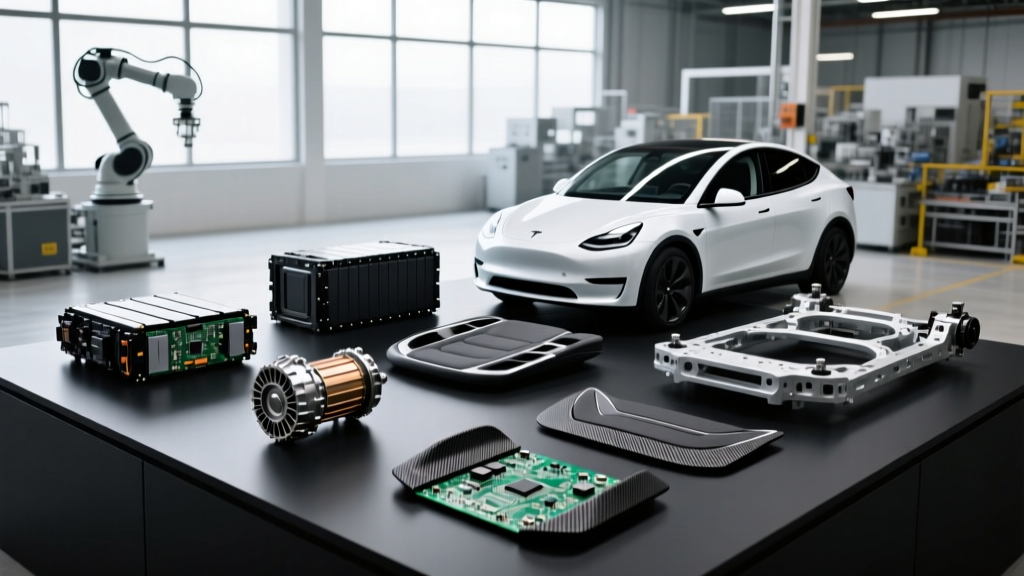
Tesla vertically integrates more than most automakers — it designs its own motors, writes its own FSD stack, and now manufactures 4680 cells in-house at its Texas cathode/cell pilot. But it still relies on external partners for the majority of cell volume, semiconductor packaging, displays, and raw materials. Here's how the major tiers break down for the 2026 model year:
Battery Cells & Cathode Materials
- CATL (China) — Supplies LFP prismatic cells for the Model 3 Standard Range (Rear-Wheel Drive) built at Giga Shanghai and Giga Berlin, and an increasing share of North American RWD units.
- Panasonic (Japan/USA) — Longtime partner; continues to supply 2170 NMC cells from the Sparks, NV Gigafactory and has begun 4680 production for Tesla's North American AWD builds.
- LG Energy Solution (South Korea/USA) — Supplies 2170 NMC cells from its Michigan and Arizona plants, primarily for Model Y Long Range AWD units bound for North America and Europe.
- BYD (China) — Blade-type LFP cells appear in some Model Y RWD units built in Berlin and Shanghai; limited presence in US-market cars as of early 2026.
- Ganfeng Lithium & Albemarle — Lithium refining; Tesla also contracts directly with Piedmont Lithium (US) and IGO (Australia) to satisfy §30D critical-minerals thresholds.
Powertrain, Electronics & Sensors
- STMicroelectronics, Infineon, ON Semiconductor — Silicon-carbide (SiC) MOSFETs in the inverter; SiC is why Tesla's drive units run cooler and more efficiently than older IGBT designs.
- NXP & Texas Instruments — MCUs and power-management ICs across the vehicle ECU network.
- NVIDIA (legacy) / Tesla in-house FSD chip (HW4/HW5) — Tesla designs its own FSD silicon; Samsung Foundry fabricates the HW4/HW5 SoCs.
- LG Display / BOE — 15.4" center touchscreen panels; BOE's share has grown as Tesla diversifies away from single-source risk.
- Brembo / ZF — Brake calipers and steering components.
- Modine / Denso — Heat-pump and Octovalve thermal-management components critical to cold-weather efficiency.
Why This Matters for the §30D Tax Credit
Under current IRS §30D rules, a new EV can qualify for up to $7,500 split into two halves: $3,750 for battery-component manufacturing (North America) and $3,750 for critical-mineral sourcing (US or FTA partner). Cells from Panasonic's Nevada plant and LG's US plants generally satisfy the component test; CATL and BYD cells typically do not for US-built vehicles. Always verify the specific VIN's sourcing on the IRS clean-vehicle credit page before purchase.
2026 Model Y Long Range AWD: Specs & Supply-Chain Notes
| Spec | Value | Supplier / Source Note |
|---|---|---|
| EPA Range | 320 miles | — |
| Battery (usable) | ~78 kWh, NMC | LG 2170 (US) / Panasonic 4680 |
| DC Fast Charge Peak | 250 kW | CCS/NACS via Supercharger |
| 10–80% DCFC Time | ~27 min | — |
| Level 2 (11.5 kW) | ~44 mi/hr | — |
| 0–60 mph | 4.8 sec | Dual-motor AWD |
| Horsepower | ~384 hp combined | Tesla in-house drive units |
| MPGe (combined) | 122 MPGe | EPA |
| Cargo (rear seats up) | 30.2 cu ft | — |
| Cargo (rear seats folded) | 72.1 cu ft | — |
| Base MSRP | $48,990 | Before destination/credit |
| Warranty (battery) | 8 yr / 120,000 mi | ≥70% retention |
2026 Model 3 Long Range AWD: Specs & Supply-Chain Notes
| Spec | Value | Supplier / Source Note |
|---|---|---|
| EPA Range | 346 miles | — |
| Battery (usable) | ~77 kWh, NMC | Panasonic / LG 2170 |
| DC Fast Charge Peak | 250 kW | NACS native |
| 10–80% DCFC Time | ~25 min | — |
| Level 2 (11.5 kW) | ~46 mi/hr | — |
| 0–60 mph | 4.2 sec | Dual-motor AWD |
| Horsepower | ~384 hp combined | Tesla in-house |
| MPGe (combined) | 132 MPGe | EPA |
| Cargo (trunk + frunk) | 23.1 cu ft total | — |
| Rear Legroom | 35.2 in | — |
| Base MSRP | $47,740 | Before destination/credit |
| Warranty (battery) | 8 yr / 120,000 mi | ≥70% retention |
Charging Speeds in Practice
Peak kW is a headline number; the charge curve is what you actually live with. Both the Model Y and Model 3 LR AWD peak at 250 kW on V3/V4 Superchargers, but that peak holds only between roughly 10–30% state of charge. The curve tapers to ~120 kW by 50% and ~60 kW by 75% — typical of NMC chemistry managed conservatively to protect long-term cell health.
| Charging Level | Power | Miles Added per Hour | Typical Use |
|---|---|---|---|
| Level 1 (120V) | ~1.4 kW | ~4–5 mi/hr | Emergency top-up |
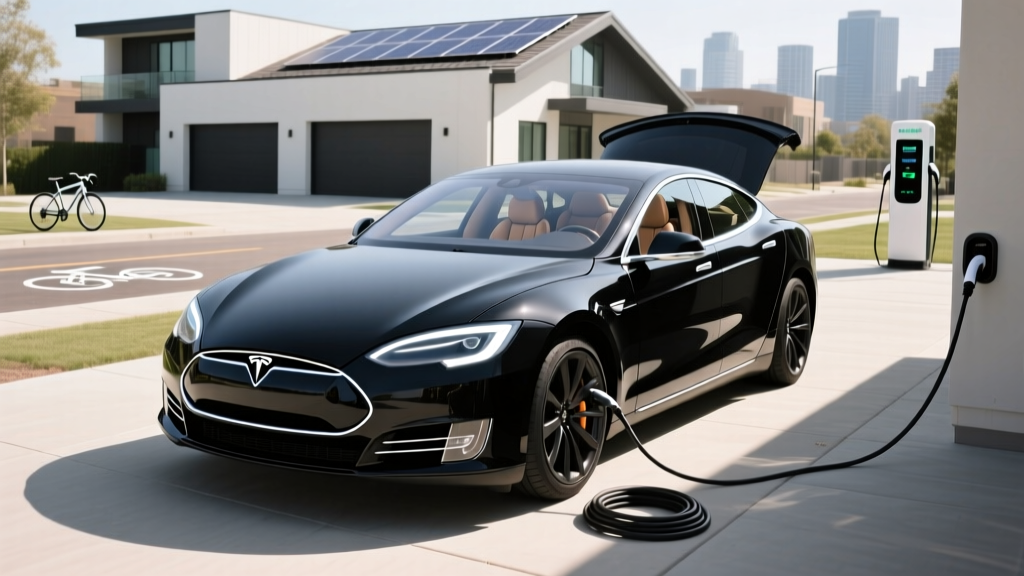
| Level 2 (240V / 48A) | 11.5 kW | ~44–46 mi/hr | Overnight home |
| DC Fast (V3 Supercharger) | up to 250 kW | ~1,000 mi/hr peak | Road trips |
Pricing, Tax Credits & Total Out-of-Pocket
Tesla's US pricing has stabilized after several years of volatility, but §30D eligibility remains VIN- and batch-dependent because of battery-sourcing rules tied to the IRS critical-minerals and component tests.
| Trim | MSRP | Est. §30D Credit | Effective Price |
|---|---|---|---|
| Model 3 LR AWD | $47,740 | Up to $7,500 | ~$40,240 |
| Model 3 RWD (LFP) | $38,990 | $0–$3,750 (varies) | ~$35,240–$38,990 |
| Model Y LR AWD | $48,990 | Up to $7,500 | ~$41,490 |
| Model Y RWD (LFP) | $42,990 | $0–$3,750 (varies) | ~$39,240–$42,990 |
Key §30D caveats (2026): Buyer AGI caps ($150K single / $300K joint), SUV MSRP cap of $80,000 (sedan $55,000), and the battery-component + critical-minerals tests. Point-of-sale transfer is allowed, so the credit can come off at delivery rather than waiting for tax filing. Confirm eligibility with your tax professional and the dealer's VIN-level disclosure.
Standout Tech & Notable Drawbacks
Pros
- Supercharger network — still the most reliable DC network in North America
- OTA updates continually add features (adaptive regen profiles, UI overhauls)
- Heat pump standard on all trims — meaningful winter range advantage
- Best-in-class MPGe for Model 3 LR AWD (132 MPGe per fueleconomy.gov)
- HW4/HW5 FSD stack with improved camera resolution and neural-net inference
Cons
- FSD (Supervised) remains SAE Level 2 — full attention required at all times
- Minimalist interior: no instrument cluster, turn signals on steering wheel
- Service-center capacity still lags sales volume in many metro areas
- LFP RWD trims may not qualify for full §30D credit due to CATL/BYD cell sourcing
- Ride quality on 19"/20" wheels can be firm on broken pavement
Who These EVs Suit Best
Model Y LR AWD — Families, gear-haulers, and anyone who needs 72+ cu ft of cargo and a functional tow rating (3,500 lb). It's the default crossover pick if you want Supercharger access and don't want to cross-shop Hyundai/Kia charging logistics.
Model 3 LR AWD — Commuters and road-trippers prioritizing efficiency and range per dollar. Its 346-mi EPA rating and 132 MPGe make it one of the longest-range, most efficient AWD sedans on the market — ideal if you don't need SUV cargo space.
Model 3/Y RWD (LFP) — Budget-focused buyers who can charge daily to 100% without degradation concerns. LFP chemistry tolerates full charges better than NMC, but you trade AWD grip, ~60 mi of range, and potentially some tax-credit eligibility.
Frequently Asked Questions
What is the real-world range of these Teslas?
Model Y LR AWD delivers ~270–290 mi highway in mild weather, ~220–240 mi in freezing temps vs. its 320-mi EPA. Model 3 LR AWD delivers ~290–310 mi mild-weather highway, ~240–260 mi cold, vs. its 346-mi EPA. Preconditioning and moderate speeds close the gap.
How fast do they charge at home and on the road?
Level 2 at 11.5 kW adds ~44–46 miles per hour — a full overnight recharge. DC fast charging peaks at 250 kW with 10–80% in roughly 25–27 minutes, though the curve tapers significantly above 60% SoC.
Does the 2026 Model Y or Model 3 qualify for the federal EV tax credit?
Long Range AWD variants with Panasonic/LG US-built cells typically qualify for the full $7,500 under §30D, subject to buyer income caps and the MSRP ceiling. RWD LFP variants using imported CATL/BYD cells often qualify for only the $3,750 component half or none at all. Always verify at the point of sale.
Are Tesla's suppliers more "Chinese" than other automakers?
For LFP cells on RWD trims, yes — CATL and BYD are dominant. For AWD Long Range trims sold in North America, the cell supply is predominantly US- or Korea-sourced (Panasonic Nevada, LG Michigan/Arizona). Critical-mineral sourcing is globally diversified but increasingly routed through FTA partners to satisfy §30D.
Is it worth buying vs. Hyundai Ioniq 5 or BMW i4?
If Supercharger reliability and OTA evolution are priorities, Tesla still leads. If you prefer a traditional instrument cluster, physical controls, and 800V charging (Ioniq 5 N), cross-shop aggressively. The Ioniq 5 peaks at ~350 kW on compatible chargers and hits 10–80% in ~18 min, but real-world Supercharger-equivalent network access matters more than peak kW for most owners.
What's the battery warranty?
8 years / 120,000 miles on Long Range AWD with a minimum 70% capacity-retention threshold. RWD LFP carries the same term. Replacement cost out of warranty is typically $12,000–$18,000 depending on pack, though most packs outlast the warranty period with 10–15% degradation over 150k miles.