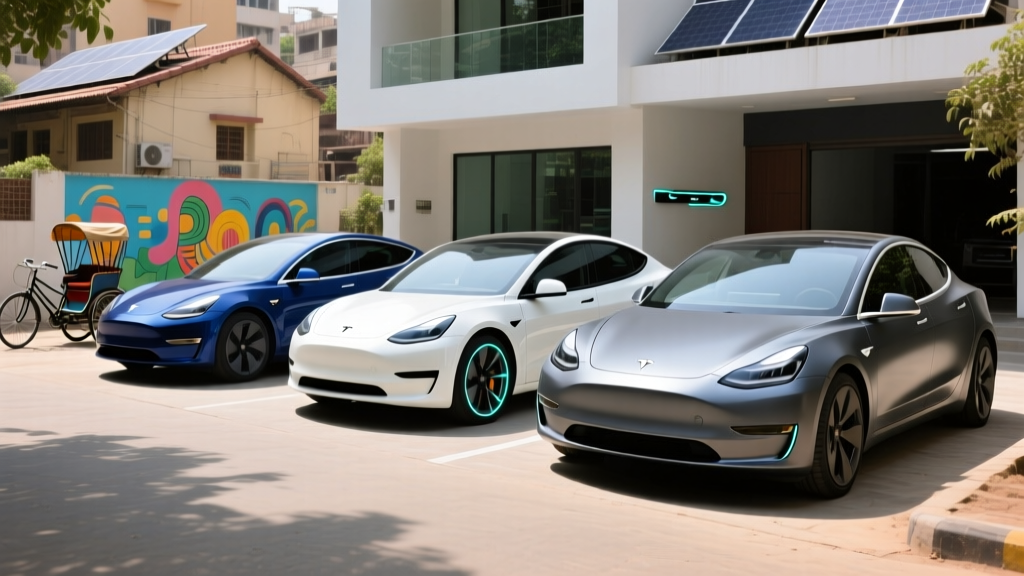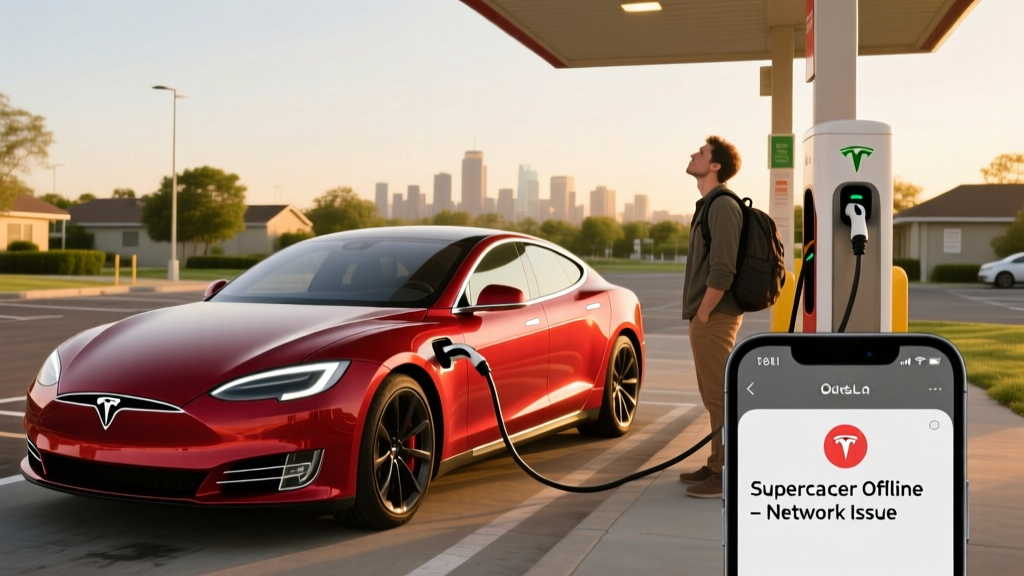
For the better part of a decade, the Tesla Supercharger network has been the gold standard of EV charging — reliable, fast, and ubiquitous. But as Tesla opens its stalls to non-Tesla EVs via NACS adoption and the network scales past 70,000 connectors globally, Tesla outage events have become a growing concern for owners who depend on the ecosystem for road trips and daily charging alike.
This isn't a panic piece. Tesla's Supercharger uptime still leads the industry at roughly 99.5%+ per the company's own reporting. But when a regional outage hits — whether from grid failures, software glitches, or severe weather — Tesla owners who have never needed a backup plan can find themselves stranded. In this guide, we break down what causes Tesla outages, how to prepare, and how the 2026 Tesla lineup's specs (range, charging, and battery chemistry) factor into your resilience strategy.
What Causes a Tesla Supercharger Outage?
Supercharger outages are rare but not random. Understanding the root causes helps you anticipate and plan around them:
- Grid-level power failures: Regional blackouts or utility load-shedding can take an entire Supercharger station offline. This is most common during extreme heat events (Texas, Arizona) or winter storms.
- ISP/network connectivity loss: Superchargers require internet connectivity for authentication and billing. A fiber cut or ISP outage can disable a station even when power is available.
- Software/firmware deployments: Tesla occasionally pushes over-the-air updates to Supercharger hardware. A botched rollout can temporarily brick stalls — this happened at several V4 stations in early 2025.
- Physical damage: Vehicle collisions, flooding, or vandalism can take individual stalls or entire sites offline.
- Demand overloads: During peak holiday travel, some stations throttle charge speeds or implement virtual queues rather than going fully offline — but the user experience is functionally similar to an outage.
The key insight: most Tesla outages are localized (single station or region), not network-wide. A true system-wide Tesla outage is extraordinarily rare. Your backup plan should focus on having alternatives within a 20-40 mile radius of your regular routes.
Tesla Model Y (2026): Range, Charging & Outage Resilience
The 2026 Tesla Model Y remains the best-selling EV in the U.S. and the vehicle most affected by any Tesla outage, simply due to its volume. Here's how its specs translate to real-world outage survivability:
| Spec | Long Range AWD | Performance | Rear-Wheel Drive |
|---|---|---|---|
| EPA Range | 320 miles | 298 miles | 310 miles |
| Battery (usable) | ~75 kWh (NMC) | ~75 kWh (NMC) | ~60 kWh (LFP) |
| Max DC Fast Charge | 250 kW | 250 kW | 170 kW |
| 10–80% DC Time | ~27 min | ~27 min | ~35 min |
| Level 2 Home Rate | 11.5 kW (~44 mi/hr) | 11.5 kW (~44 mi/hr) | 11.5 kW (~44 mi/hr) |
| 0–60 mph | 4.8 sec | 3.5 sec | 6.5 sec |
| Horsepower | 384 hp | 456 hp | 295 hp |
| Drivetrain | Dual-Motor AWD | Dual-Motor AWD | RWD |
| MPGe (combined) | 122 MPGe | 111 MPGe | 130 MPGe |
| Efficiency | 28 kWh/100mi | 30 kWh/100mi | 26 kWh/100mi |
| Base MSRP | $48,990 | $53,990 | $44,990 |
| Battery Warranty | 8 yr / 120,000 mi | 8 yr / 120,000 mi | 8 yr / 100,000 mi |
Your Tesla Outage Backup Plan: Non-Tesla DC Fast Charging
The single biggest change in Tesla outage preparedness between 2022 and 2026 is the proliferation of NACS (North American Charging Standard) across the industry. As of 2026, virtually every major automaker has adopted NACS, and networks like Electrify America, EVgo, and ChargePoint have added NACS connectors alongside CCS1 at many stations.
But here's what matters for Tesla owners specifically: your car has a NACS port natively. You can charge at any NACS-equipped non-Tesla station with zero adapters. And for CCS1 stations that haven't converted, Tesla sells a CCS adapter (~$175) that unlocks thousands of additional stalls.
| Network | Connector | Typical Peak kW | Tesla Compatibility |
|---|---|---|---|
| Electrify America | NACS + CCS1 | 150–350 kW | Direct (NACS stalls) or CCS adapter |
| EVgo | NACS + CCS1 | 100–350 kW | Direct (NACS stalls) or CCS adapter |
| ChargePoint | NACS + CCS1 | 62.5–400 kW | Direct or adapter |
| Mercedes-Benz HPC | NACS + CCS1 | Up to 400 kW | Open to all EVs, NACS available |
| Ionna (BMW/GM/Honda/Hyundai/Kia/Mercedes/Stellantis) | NACS + CCS1 | 150–350 kW | Open to all, rolling out through 2028 |
Pro tip: Download the PlugShare or ChargeHub app and filter for NACS stations along your regular routes before you need them. During a Tesla outage, the Tesla app will sometimes surface nearby third-party chargers, but having your own pre-researched list is far more reliable.
Home Charging: Your Best Outage Insurance
The truth is that 80–90% of Tesla owners do the vast majority of their charging at home. If you have a properly installed Level 2 home charger, a Supercharger outage is an inconvenience for road trips — not a daily crisis.
Tesla's Wall Connector delivers up to 11.5 kW on a 48-amp circuit, adding roughly 44 miles of range per hour of charging. An overnight charge (8 hours) replenishes approximately 350 miles — more than a full battery for any Model Y or Model 3 variant.
If you're still relying on a standard 120V outlet (Level 1), you're adding only 3-5 miles per hour — adequate for low-mileage commuters but not a realistic outage backup. A Level 2 installation typically costs $800–$2,500 including the Wall Connector ($475), electrician labor, and permits, with higher costs if your panel needs a 200-amp upgrade.
During a widespread Supercharger outage, home-charged Teslas simply keep running. The outage only affects owners who depend on public charging — apartment dwellers without home charging, road-trippers, and high-mileage drivers without overnight access.
Tesla Outage Impact by Model: Model 3, Model S, Model X, Cybertruck
Not all Teslas weather an outage equally. Battery size and efficiency determine how long you can operate between charges when Superchargers are down:
| Model | EPA Range | Battery (kWh) | Real-World Highway | Cold-Weather Est. |
|---|---|---|---|---|
| Model 3 LR AWD | 341 mi | ~75 kWh (NMC) | 280–305 mi | 235–265 mi |
| Model Y LR AWD | 320 mi | ~75 kWh (NMC) | 260–285 mi | 220–250 mi |
| Model S LR | 402 mi | ~95 kWh (NMC) | 330–360 mi | 280–310 mi |
| Model X LR | 348 mi | ~95 kWh (NMC) | 280–310 mi | 240–270 mi |
| Cybertruck AWD | 340 mi | ~123 kWh (NMC) | 270–300 mi | 230–260 mi |
The Model S Long Range is the most outage-resilient vehicle Tesla sells, thanks to its 402-mile EPA rating and large battery. Even in cold weather, you're looking at 280+ real-world miles — enough to wait out a 1-2 day regional outage without materially changing your driving habits.
The Cybertruck is a paradox: it has the largest battery (~123 kWh) but also the worst efficiency due to its weight and aerodynamics. Real-world highway range falls well short of the EPA sticker, making it the most vulnerable to an outage if you drive aggressively or tow.
Federal Tax Credit & Pricing: Does a Tesla Still Qualify?
As of 2026, Tesla's eligibility for the IRS §30D federal EV tax credit depends on the specific model, your income, and evolving battery-sourcing requirements. Here's the current landscape:
| Model | Base MSRP | MSRP Cap Met? | Est. Credit | Key Caveat |
|---|---|---|---|---|
| Model 3 RWD | $38,990 | Yes (<$55k sedan) | Up to $7,500 | Battery sourcing rules apply — verify on IRS list |
| Model 3 LR AWD | $44,990 | Yes | Up to $7,500 | Critical mineral requirements may reduce to $3,750 |
| Model Y LR | $48,990 | Yes (<$80k SUV) | Up to $7,500 | Check current IRS eligible-vehicles list |
| Model Y Perf. | $53,990 | Yes | Up to $7,500 | Same sourcing caveats |
| Model S | $79,990 | Yes (barely) | Up to $7,500 | MSRP close to $80k cap — options may push over |
| Model X | $84,990 | No (over $80k) | $0 | Exceeds SUV MSRP cap |
| Cybertruck | $79,990 | Borderline | Varies | Classification and MSRP-dependent |
Income caps still apply: Modified adjusted gross income (MAGI) must not exceed $150,000 (single), $225,000 (head of household), or $300,000 (joint). The credit can now be transferred at point of sale as an instant discount, per IRS point-of-sale transfer rules.
Battery-sourcing rules are the wildcard. Since 2024, the credit has been split into two halves ($3,750 each): one for critical-mineral sourcing and one for battery-component manufacturing. As of 2026, foreign-entity-of-concern (FEOC) restrictions further tighten eligibility. Always check the fueleconomy.gov EV tax credit page for the most current Tesla eligibility before purchasing.
Pros and Cons: Tesla Ownership in an Outage Context
Pros
- Supercharger network still has highest uptime and coverage in North America
- Native NACS port means no adapter needed at growing number of third-party NACS stations
- Industry-leading efficiency (kWh/100mi) means less frequent charging
- Over-the-air updates continuously improve charging speed and battery management
- Heat pump standard on all models reduces cold-weather range loss vs. older EVs
- Extensive Supercharger route-planning built into navigation
Cons
- Single-network dependency: no native CCS port limits backup options without adapter
- Supercharger openings to non-Tesla EVs increasing congestion at popular stations
- No physical buttons or redundant displays — if the touchscreen fails, you lose HVAC and nav
- Model Y RWD's LFP battery charges slower (170 kW peak) and loses more range in extreme cold
- Service center wait times remain long in many metro areas
- FSD (Supervised) remains a Level 2 system requiring full driver attention despite the name
Who Should Buy a Tesla (and Who Should Have a Backup Plan)?
Best suited for Tesla: Homeowners with Level 2 charging access who drive 30-80 miles daily and take 2-4 road trips per year. For this profile, a Supercharger outage is a minor inconvenience — you charge at home nightly and only need public charging on long trips, where rerouting to an alternate station adds 15-30 minutes at worst.
Highest outage risk: Apartment dwellers without home charging, rideshare drivers covering 150+ miles daily, and rural drivers whose nearest Supercharger is 60+ miles away. If you fall into these categories, invest in a CCS adapter, identify 2-3 backup DC fast-charging locations on your regular routes, and consider a Tesla with the largest battery you can afford (Model S LR or Model Y LR over the RWD variant).
Family buyers: The Model Y's 76 cu ft of cargo space (rear seats folded) and available 7-seat configuration make it the default family EV. But if your family relies on a single vehicle and you lack home charging, evaluate whether a PHEV like the Toyota RAV4 Prime (42 miles electric + gas backup) offers better outage resilience for your specific situation.
Frequently Asked Questions
How often do Tesla Supercharger outages actually happen?
Tesla reports network uptime above 99.5%, meaning the average stall is down less than 44 hours per year. However, localized outages (individual stations) occur more frequently — typically lasting 2-8 hours. Multi-station regional outages affecting an entire metro area are rare, occurring perhaps 1-2 times per year in areas prone to grid stress.
Can I charge my Tesla at non-Tesla stations during an outage?
Yes. As of 2026, many Electrify America, EVgo, ChargePoint, and Mercedes-Benz HPC stations have NACS connectors that work directly with your Tesla's native port. For CCS1-only stations, Tesla's CCS adapter (~$175) unlocks access. Download PlugShare and filter by connector type to map your options in advance.
Does Tesla notify you about Supercharger outages?
The Tesla app and in-car navigation will show stations as "temporarily unavailable" or display reduced stall counts. However, notification is reactive — the outage must occur before you're alerted. Third-party apps like PlugShare often surface user-reported outages faster. For planned maintenance, Tesla sometimes posts advance notices in the vehicle's navigation.
What's the best Tesla model for outage resilience?
The Model S Long Range (402 miles EPA, ~95 kWh battery) offers the longest buffer. If you're buying a Model Y, the Long Range AWD (320 miles EPA) outperforms the RWD variant (310 EPA but smaller LFP battery with worse cold-weather performance) for outage survivability.
Does a Tesla qualify for the $7,500 federal tax credit in 2026?
It depends on the model, your income, and current battery-sourcing rules. The Model 3 and Model Y generally qualify (MSRP under caps), while the Model X does not (exceeds $80k SUV cap). Income limits apply ($150k single / $300k joint). Always verify on the fueleconomy.gov tax credit page and consult a tax professional before relying on credit eligibility.
Is FSD (Supervised) affected by Tesla outages?
No. FSD (Supervised) is a Level 2 driver-assistance system that runs on the vehicle's onboard computer and cameras — it does not require Supercharger connectivity or cloud access to function. However, map data and routing features may be limited during broader Tesla server outages. Remember: FSD is not self-driving; you must remain fully engaged at all times.