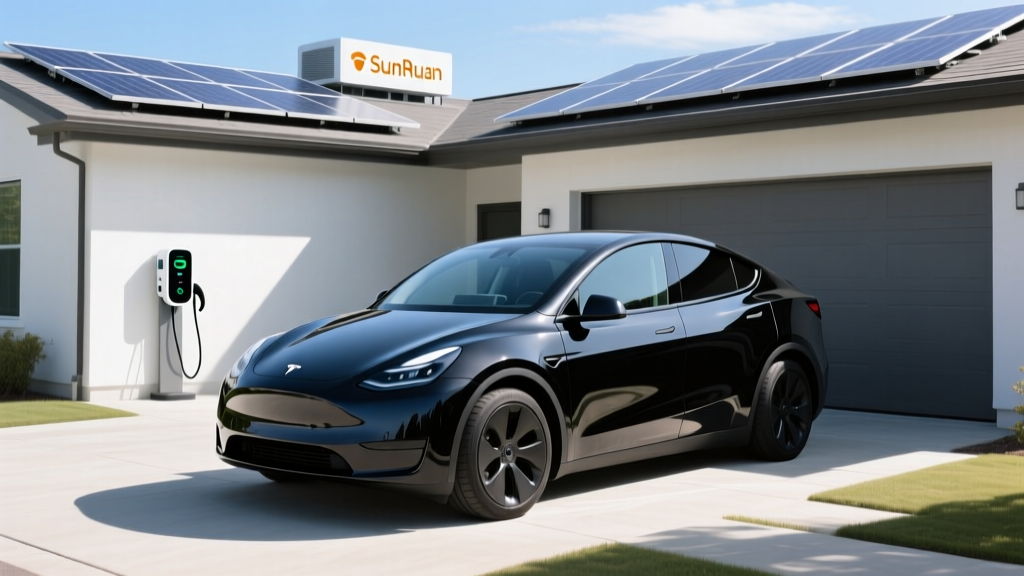
The search for "Tesla Sunrun" almost always points to one practical question: Can I pair a Sunrun home solar system with my Tesla to charge on sunshine instead of grid power? The short answer is yes — but the economics, hardware compatibility, and daily charging math require a clear-eyed look. This guide uses the 2026 Tesla Model Y Long Range AWD as the reference vehicle and pairs it with a realistic Sunrun residential solar + battery setup to answer what actually works on a Tuesday afternoon in January, not just a sunny Saturday in July.
2026 Tesla Model Y Long Range AWD: The Specs That Matter
Before layering solar into the equation, we need the exact energy profile of the vehicle. The 2026 Model Y Long Range AWD (Juniper refresh) carries a 78.1 kWh usable NMC (nickel-manganese-cobalt) battery pack, delivers an EPA-estimated 320 miles of range, and posts a combined 122 MPGe (27 kWh/100 mi). Dual-motor all-wheel drive produces roughly 384 horsepower and a 4.8-second 0-60 mph time.
| Spec | Value |
|---|---|
| EPA Range | 320 miles |
| Battery (usable) | 78.1 kWh, NMC |
| Efficiency | 122 MPGe / 27 kWh/100 mi |
| Drivetrain | Dual-motor AWD |
| 0-60 mph | 4.8 sec |
| Peak DC Fast Charge | 250 kW (10-80% ~25 min) |
| Level 2 (11.5 kW onboard) | ~44 mi/hr |
| Base MSRP | $48,990 |
| Battery Warranty | 8 yr / 120,000 mi (≥70% retention) |
What Sunrun Actually Brings to the Table
Sunrun is a national residential solar installer that primarily operates under lease and power-purchase agreements (PPAs), though cash and loan purchases are available in select markets. A typical Sunrun system for an EV-owning household runs 8-12 kW of panels paired with a Sunrun Battery (currently a 13.5 kWh unit similar in capacity to the Tesla Powerwall 3). The company also offers EV charger integration through partner hardware.
Here is where a common confusion surfaces: Tesla and Sunrun are separate companies with separate ecosystems. Tesla sells its own Solar Roof and Powerwall products directly. Sunrun uses multi-brand panels (REC, Canadian Solar, Qcells depending on region) and its own branded battery. The two don't "talk" through a unified app — but electrically, they absolutely can work together through your home's main service panel.
The Daily Charging Math: Solar vs. Your Driving Habits
A 10 kW Sunrun array in a moderate-sun state (Colorado, North Carolina, Pennsylvania) produces roughly 35-45 kWh per day on an annualized basis — more in summer, less in winter. The Model Y Long Range consumes about 27 kWh per 100 miles, meaning a typical daily solar yield covers roughly 130-165 miles of driving in peak season and 80-110 miles in winter.
For a commuter driving 30-40 miles round trip, a properly sized Sunrun system can supply 100% of annual driving energy. Road-trip-heavy owners will still rely on grid top-ups or the Supercharger network (now open to NACS-equipped non-Teslas as well).
| Scenario | Solar kWh/day | Equiv. Model Y Miles |
|---|---|---|
| Summer, 10 kW system (AZ/CA) | 55-65 kWh | 200-240 mi |
| Shoulder season (spring/fall) | 35-45 kWh | 130-165 mi |
| Winter, northern tier | 18-25 kWh | 65-90 mi |
Charging Hardware: What Plugs Into What
The 2026 Model Y ships with a NACS (North American Charging Standard) port. For home Level 2 charging, you have three realistic paths when pairing with a Sunrun system:
- Tesla Wall Connector (48A / 11.5 kW): Native NACS, fastest residential option, adds ~44 miles of range per hour. Requires a 60A dedicated circuit.
- Sunrun-recommended Level 2 charger (typically ChargePoint Home Flex or similar, J1772): Requires a NACS adapter (included with 2026 Model Y) or an aftermarket NACS-terminated cable. Caps at 40A/9.6 kW on most partner units.
- Level 1 (120V standard outlet): Adds ~3-4 miles per hour — only viable as emergency trickle, not a daily strategy.
The solar inverter feeds your main breaker panel; the EV charger draws from that same panel. When solar production exceeds home load, the surplus effectively charges the car. When it doesn't (nighttime, cloudy stretches), you pull from the Sunrun battery (if equipped) or the grid.
2026 Pricing, Tax Credits, and Total Outlay
The 2026 Model Y Long Range AWD starts at $48,990 before destination. A typical as-tested build with FSD (Supervised) and 19" wheels lands near $55,000. Under current IRS §30D rules, the Model Y qualifies for up to $7,500 in federal clean-vehicle credit — but only if the buyer meets income caps ($300k joint / $150k single), the vehicle MSRP stays under the $80,000 SUV cap (it does), and battery critical-mineral and component sourcing thresholds are satisfied for the 2026 model year. The credit is transferable to the dealer at point of sale, effectively reducing the purchase price on day one.
| Configuration | MSRP | After $7,500 §30D |
|---|---|---|
| Base LR AWD | $48,990 | ~$41,490* |
| LR AWD + FSD Supervised | ~$54,990 | ~$47,490* |
*Assumes full eligibility; verify battery-sourcing status at purchase and consult a tax professional.
On the solar side, a Sunrun system purchased outright qualifies for the 30% federal residential clean-energy credit (IRC §25D), stacking with the EV credit. A 10 kW system at roughly $30,000 pre-credit becomes ~$21,000 after the 30% ITC. Sunrun lease/PPA customers do NOT receive this credit — Sunrun retains it.
Pros and Cons of the Tesla + Sunrun Combo
- Home charging on near-zero marginal-cost solar kWh
- Stacks §30D (vehicle) and §25D (solar) credits if purchased
- Sunrun battery provides backup power during outages
- Model Y's 320-mi EPA range handles most daily needs without grid draw
- Supercharger network access for road trips
- Two separate ecosystems — no unified Tesla+Sunrun app
- Sunrun lease/PPA forfeits the 30% solar tax credit to Sunrun
- Winter solar production may cover <50% of driving energy
- Panel install requires roof suitability and potential panel upgrade
- Upfront system cost ($21k-$35k after credits) has long payback
Who Should Actually Pair a Tesla With Sunrun Solar?
- Choose Tesla + Sunrun solar if: You own a sun-exposed roof, drive <60 miles/day on average, plan to stay in the home 7+ years, and can purchase (not lease) the system to capture §25D.
- Choose Tesla alone (grid charging) if: You rent, have heavy tree cover, live in a low-sun region, or move frequently. A time-of-use utility plan may beat solar economics.
- Consider Tesla's own Solar Roof + Powerwall if: You want single-vendor integration through the Tesla app and are replacing a roof anyway.
Frequently Asked Questions
What is the real-world range of the 2026 Model Y Long Range?
EPA rates it at 320 miles. Expect 275-290 miles on flat 75-mph highway driving, and 230-255 miles in cold weather with cabin heat running. City driving with regen can approach or slightly exceed the EPA number.
How fast does the Model Y charge at home and on DC fast chargers?
On a Level 2 Tesla Wall Connector (11.5 kW), the Model Y gains roughly 44 miles of range per hour — a full 10-80% top-up takes about 5.5 hours. On DC fast charging, it peaks at 250 kW and reaches 10-80% in approximately 25 minutes, though the charge curve tapers significantly above 60% SoC.
How much does the 2026 Model Y cost after tax credits?
Base MSRP is $48,990. With full §30D eligibility (income, MSRP, and battery-sourcing requirements met), the effective price drops to approximately $41,490 via point-of-sale transfer.
Does the 2026 Model Y qualify for the federal EV tax credit?
Yes, conditionally. The Model Y is under the $80,000 SUV MSRP cap. Buyer income must not exceed $300k (joint) or $150k (single). Battery critical-mineral and component sourcing percentages must meet 2026 thresholds per IRS §30D. Confirm eligibility at the point of sale.
Is a Tesla + Sunrun combo worth it versus competitors?
If your priority is lowest cost-per-mile over a decade of ownership and you have roof access, solar-paired EV charging is hard to beat. If you value ecosystem simplicity, Tesla's own Powerwall + Solar Roof or a utility TOU plan with a Hyundai Ioniq 5 or Ford Mustang Mach-E may be more practical. The Model Y's NACS port, Supercharger access, and 320-mile range remain strong advantages regardless of your solar choice.