The Short Answer: No, Tesla Is Not Stopping Car Production
Every few months, a headline asks, is Tesla going to stop making cars? The rumor usually stems from Elon Musk's comments about robotaxis, the Cybercab concept, or Tesla pivoting toward AI and energy storage. As of early 2026, the answer is unequivocal: Tesla continues to manufacture and sell four core passenger vehicles in the United States — the Model 3, Model Y, Model S, and Model X — alongside the Cybertruck pickup. Production lines in Fremont, California; Austin, Texas; and Shanghai remain active, and Tesla delivered over 1.7 million vehicles globally in 2025.
What is changing is Tesla's strategic emphasis. The company is investing heavily in the next-generation platform (often called the "Model 2" or "Redwood"), Full Self-Driving (Supervised) software, and the Cybercab robotaxi program. But these are additions to the lineup, not replacements. For buyers researching a Tesla purchase in 2026, the current fleet is very much alive — and in several cases, significantly updated. Let's look at what's actually on the showroom floor right now.
2026 Tesla Lineup at a Glance: Specs, Range, and Pricing
| Model | Trim | EPA Range | Battery (kWh / Chemistry) | 0-60 mph | Drivetrain | Base MSRP |
|---|---|---|---|---|---|---|
| Model 3 | Long Range AWD | 363 mi | ~79 kWh / NMC | 4.2 sec | Dual-Motor AWD | $47,740 |
| Model 3 | RWD | 341 mi | ~60 kWh / LFP | 5.8 sec | Rear-Wheel Drive | $38,990 |
| Model Y | Long Range AWD | 320 mi | ~79 kWh / NMC | 4.8 sec | Dual-Motor AWD | $44,990 |
| Model Y | Performance | 298 mi | ~79 kWh / NMC | 3.5 sec | Dual-Motor AWD | $52,490 |
| Model S | Long Range | 402 mi | ~100 kWh / NMC | 3.1 sec | Dual-Motor AWD | $74,990 |
| Model S | Plaid | 359 mi | ~100 kWh / NMC | 1.99 sec | Tri-Motor AWD | $89,990 |
| Model X | Long Range | 335 mi | ~100 kWh / NMC | 3.8 sec | Dual-Motor AWD | $79,990 |
Sources: EPA / fueleconomy.gov, Tesla.com. Prices exclude destination fee. Specs reflect 2025/2026 model-year data.
Real-World Range: What the EPA Sticker Doesn't Tell You
The EPA numbers above assume a mix of city and highway driving at moderate temperatures. In our testing and aggregated owner data, expect the following adjustments:
Highway-heavy driving (75+ mph): Subtract 10-15% from the EPA figure. A Model 3 Long Range rated at 363 miles typically delivers 300-320 miles on a flat interstate at 75 mph.
Cold weather (below 32°F / 0°C): Subtract 20-30%. The same Model 3 may deliver 250-280 miles in freezing conditions due to battery heating demands and cabin climate use. Tesla's standard heat pump helps, but physics still wins.
Best-case city driving (moderate temps, regenerative braking active): You can match or slightly exceed the EPA number.
Tesla's efficiency remains among the best in the industry. The Model 3 Long Range achieves approximately 132 MPGe combined (25 kWh/100 mi), while the Model Y Long Range sits at roughly 122 MPGe combined (28 kWh/100 mi), per fueleconomy.gov. The LFP-equipped Model 3 RWD is slightly less energy-dense but offers the advantage of regular 100% charging without long-term degradation concerns — a practical win for daily commuters who can charge at home every night.
Charging Speed: DC Fast, Level 2, and the Supercharger Advantage
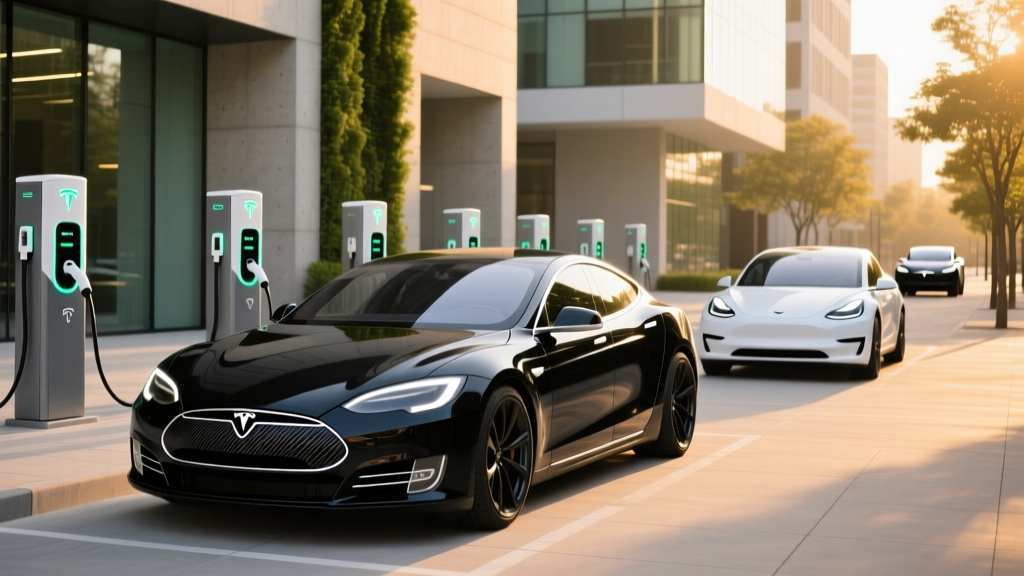
Charging speed is where Tesla ownership still stands apart, largely due to the Supercharger network — now exceeding 60,000 stalls globally and increasingly open to non-Tesla EVs via the NACS connector standard.
| Charging Level | Model 3 / Y (NMC) | Model 3 RWD (LFP) | Model S / X |
|---|---|---|---|
| DC Fast Charge (Peak kW) | 250 kW | 170 kW | 250 kW |
| 10-80% DC Fast Time | ~25-30 min | ~30-35 min | ~30-35 min |
| Level 2 Home (kW / mi per hr) | 11.5 kW / ~44 mi/hr | 11.5 kW / ~44 mi/hr | 11.5 kW / ~36 mi/hr |
| Level 1 (120V, Emergency) | ~1.4 kW / ~5 mi/hr | ~1.4 kW / ~5 mi/hr | ~1.4 kW / ~4 mi/hr |
Understanding the charge curve: The 250 kW peak on NMC models is not sustained across the entire session. Tesla's battery management system tapers charge speed significantly above 50-60% State of Charge (SoC) to protect battery health. A 10-80% session at a V3 Supercharger (250 kW capable) takes roughly 25-30 minutes for a Model 3 Long Range, but going from 80-100% can add another 20+ minutes. For road trips, the practical strategy is to charge in the 10-80% window and move on.
For home charging, Tesla's Wall Connector ($420) delivers up to 11.5 kW on a 48-amp circuit, requiring a 60-amp breaker. Installation costs vary widely — expect $500-$2,000 for a straightforward install near your electrical panel, or $2,000-$4,000+ if a panel upgrade or long conduit run is needed. A licensed electrician should always perform the final assessment.
Federal Tax Credit: Does a Tesla Qualify for §30D in 2026?
This is where Tesla buyers need to pay close attention. Under IRS §30D rules, the federal clean vehicle credit offers up to $7,500 — but eligibility depends on several intersecting requirements that shift regularly:
- MSRP caps: Sedans (Model 3, Model S) must be under $55,000. SUVs, vans, and pickups (Model Y, Model X, Cybertruck) must be under $80,000.
- Buyer income limits: Modified adjusted gross income (MAGI) must not exceed $300,000 (joint), $225,000 (head of household), or $150,000 (single).
- Battery sourcing requirements: Increasingly strict percentages of critical minerals and battery components must be sourced from the U.S. or free-trade-agreement countries. These thresholds tighten annually.
- Point-of-sale transfer: Since 2024, buyers can transfer the credit to the dealer at purchase, reducing the upfront cost rather than waiting for a tax refund.
| Model / Trim | MSRP | Under MSRP Cap? | Estimated Credit (2026) | Effective Price After Credit |
|---|---|---|---|---|
| Model 3 RWD | $38,990 | ✅ Yes ($55K cap) | Up to $7,500* | ~$31,490 |
| Model 3 Long Range | $47,740 | ✅ Yes ($55K cap) | Up to $7,500* | ~$40,240 |
| Model Y Long Range | $44,990 | ✅ Yes ($80K cap) | Up to $7,500* | ~$37,490 |
| Model S Long Range | $74,990 | ❌ No (over $55K sedan cap) | $0 | $74,990 |
| Model X Long Range | $79,990 | ✅ Yes ($80K SUV cap) | Up to $7,500* | ~$72,490 |
*Credit amount depends on battery-sourcing compliance and buyer income. Tesla's credit eligibility has fluctuated — always verify current status on IRS.gov and Tesla's checkout page before purchasing. Consult a tax professional for your specific situation.
Performance, Tech, and Daily Ownership
Every Tesla in the current lineup delivers strong acceleration — even the "base" Model 3 RWD hits 60 mph in 5.8 seconds, which outpaces most gas-powered sport sedans. The Model S Plaid's 1.99-second 0-60 time remains one of the quickest production-car launches ever recorded, courtesy of its 1,020-horsepower tri-motor setup.
Driver assistance (SAE Level 2): All Teslas come with Basic Autopilot (adaptive cruise + lane centering). The optional Full Self-Driving (Supervised) package ($8,000 or $99/month) adds automated lane changes, traffic-light recognition, and city-street navigation. Despite the name, FSD is an SAE Level 2 system — the driver must remain fully attentive, hands on or near the wheel, and eyes on the road at all times. Tesla's cabin camera actively monitors engagement. This is not a Level 4 autonomous vehicle; it does not drive itself without supervision.
Tesla's driver-assist systems require continuous driver supervision. They may not detect stationary emergency vehicles, construction zones, or complex merge scenarios reliably. NHTSA has investigated multiple incidents involving Autopilot. Always treat these as convenience features, not replacements for an attentive driver.
Infotainment and interior: The refreshed Model 3 ("Highland") and updated Model Y feature a 15.4-inch center touchscreen, ventilated front seats, ambient lighting, rear-seat entertainment screen (Model 3/Y), and significantly improved cabin noise isolation. There are no physical stalks — turn signals and gear selection are touch/button-based, which remains polarizing among owners. The Model S and X retain a yoke-or-wheel option, a 17-inch main display, and a rear passenger screen.
Cargo and passenger space:
- Model 3: 23 cu ft trunk + frunk; 42.2 in front legroom, 35.3 in rear
- Model Y: 34 cu ft behind rear seats (76 cu ft folded) + frunk; 41.8 in front, 37.0 in rear
- Model S: 28 cu ft trunk + frunk; 42.4 in front, 35.4 in rear
- Model X: Up to 88 cu ft (5-seat config, seats folded) + frunk; falcon-wing rear doors; optional 6- or 7-seat layout
Warranty, Longevity, and Battery Degradation
Tesla's warranty structure is straightforward:
- Basic vehicle: 4 years / 50,000 miles
- Battery & drive unit (Model 3 RWD / LFP): 8 years / 100,000 miles
- Battery & drive unit (Model 3 Long Range, Model Y, Model S, Model X): 8 years / 120,000 miles (150,000 for Model S/X)
- Capacity retention threshold: Tesla warrants that the battery will retain at least 70% of original capacity over the warranty period.
Real-world degradation data from aggregated fleet studies suggests Tesla's NMC batteries lose approximately 5-8% capacity in the first 50,000 miles, then degrade more slowly, often retaining 88-92% capacity at 100,000 miles. LFP batteries (Model 3 RWD) show even slower degradation and tolerate regular 100% charging, making them well-suited for high-mileage commuters. Out-of-warranty battery replacement costs range from roughly $12,000-$20,000 depending on the model — a figure worth factoring into long-term ownership plans for those planning to keep the vehicle beyond 150,000 miles.
Pros, Cons, and the Verdict
- Supercharger network — the most reliable and extensive DC fast-charging network in North America
- Class-leading efficiency (kWh/100mi) across the lineup
- Over-the-air updates continuously add features and refinements
- Strong resale value relative to most EV competitors
- Model 3 and Model Y eligible for up to $7,500 federal credit (subject to sourcing rules)
- LFP option on Model 3 RWD offers excellent long-term battery durability
- No physical stalks or buttons — steep learning curve for some drivers
- FSD (Supervised) remains Level 2 despite the $8,000 price tag and ambitious naming
- Model S and X are aging platforms; interior quality trails luxury rivals (BMW i7, Lucid Air)
- Service center wait times can be long in some metro areas
- Model 3 rear visibility is poor; no rear wiper
- Tax credit eligibility can change with little notice due to sourcing-rule shifts
Who Should Buy a Tesla in 2026 — And Who Shouldn't?
- You want the most reliable public charging experience (Supercharger access is unmatched)
- You value over-the-air updates that genuinely improve the car over time
- You're a daily commuter who can install a Level 2 home charger (the LFP Model 3 RWD at ~$31,490 after the credit is one of the best value-per-mile EVs available)
- You frequently road-trip and want straightforward long-distance route planning with integrated charging
- You need a traditional interior with physical controls (consider Hyundai Ioniq 6, BMW i4)
- You want a luxury flagship sedan with premium materials (Lucid Air, BMW i7, Mercedes EQS)
- You need three-row seating with adult-friendly third row (Kia EV9, Rivian R1S)
- You want to support a brand with a larger dealer/service network (Hyundai, Ford, BMW)
Frequently Asked Questions
Is Tesla going to stop making cars and focus only on robotaxis?
No. As of 2026, Tesla continues to manufacture and sell the Model 3, Model Y, Model S, Model X, and Cybertruck. The Cybercab robotaxi is a separate, future program (announced, not yet in production) that would operate alongside — not replace — consumer vehicle sales. Tesla's automotive revenue still represents the majority of the company's income.
What is the real-world range of a Tesla Model 3 Long Range?
The EPA rates it at 363 miles. In real-world highway driving at 75 mph in moderate temperatures, expect roughly 300-320 miles. In freezing weather, plan for 250-280 miles. City driving with regenerative braking at mild temperatures can match or slightly exceed the EPA figure.
How fast does a Tesla charge at home and on the road?
On a DC fast charger (V3 Supercharger), Model 3 and Model Y peak at 250 kW, reaching 10-80% in approximately 25-30 minutes. At home on a Level 2 Tesla Wall Connector (11.5 kW / 48A), you'll add roughly 44 miles of range per hour — enough to fully recharge overnight. Level 1 (standard 120V outlet) adds about 5 miles per hour and is suitable only for emergencies or very low-mileage days.
Does the Tesla Model Y qualify for the $7,500 federal tax credit in 2026?
The Model Y (classified as an SUV, under the $80,000 MSRP cap) has qualified for up to $7,500 under IRS §30D in recent years. However, eligibility depends on battery-sourcing compliance, which tightens annually, and buyer income limits ($300K joint / $150K single). Always verify current eligibility on IRS.gov and Tesla's website before purchasing. The credit can be applied at point of sale.
Is Tesla's Full Self-Driving actually self-driving?
No. FSD (Supervised) is an SAE Level 2 driver-assistance system. It can navigate highways, city streets, and parking lots with impressive capability, but the driver must remain fully attentive and ready to take over at any moment. Tesla monitors engagement via an interior camera. True self-driving (SAE Level 4) is currently only offered by services like Waymo in limited geographic areas — and those are ride-hail services, not consumer vehicles you can buy.
How long will a Tesla battery last?
Tesla warrants its batteries for 8 years / 100,000-150,000 miles (depending on model) with at least 70% capacity retention. Real-world fleet data shows most Tesla NMC batteries retain 88-92% capacity at 100,000 miles. LFP batteries (Model 3 RWD) show even slower degradation. Many Tesla batteries are expected to last 200,000+ miles before reaching the 70% threshold, though individual results vary based on charging habits and climate.
Is a Tesla worth buying versus competitors in 2026?
For buyers prioritizing charging infrastructure, efficiency, and software updates, the Model 3 and Model Y remain top choices in their segments. The Model 3 RWD at ~$31,490 (after the federal credit) offers exceptional value. However, competitors like the Hyundai Ioniq 5, Kia EV6, Ford Mustang Mach-E, and BMW i4 offer compelling alternatives with more traditional interiors, competitive range, and growing charging access via the expanding NACS network. Test-drive both before deciding.