Why "Tesla Stolen" Searches Are Surging in 2026
Searches for "Tesla stolen" have climbed steadily as EV adoption accelerates and thieves adapt their methods. The good news for Tesla owners: recovery rates for stolen Teslas remain among the highest of any vehicle brand, thanks to always-connected telemetry, GPS tracking, and remote immobilization features baked into every car. According to the National Highway Traffic Safety Administration (NHTSA) and independent theft databases, Tesla's integrated connectivity gives law enforcement a significant advantage in tracking and recovering stolen vehicles compared to conventional cars.
But theft isn't just about joyrides. Catalytic converter theft doesn't apply to EVs, but keyless relay attacks, valet-mode abuse, and even towing scams have emerged as vectors. This guide breaks down Tesla's anti-theft technology, what to do if your Tesla is stolen, and pairs that security analysis with a comprehensive review of the most popular target: the 2026 Tesla Model Y.
Tesla's Anti-Theft & Recovery Technology Explained
Every Tesla vehicle ships with a suite of security features that operate 24/7, whether you're behind the wheel or parked across town:
- Sentry Mode: Uses the car's external cameras to monitor surroundings when parked. Triggers recording and alerts your phone if a threat is detected. Clips are saved to a USB drive or Tesla's cloud (with Premium Connectivity).
- Pin to Drive: Requires a personal PIN code on the touchscreen before the car can be driven, even if a valid key fob or phone key is present.
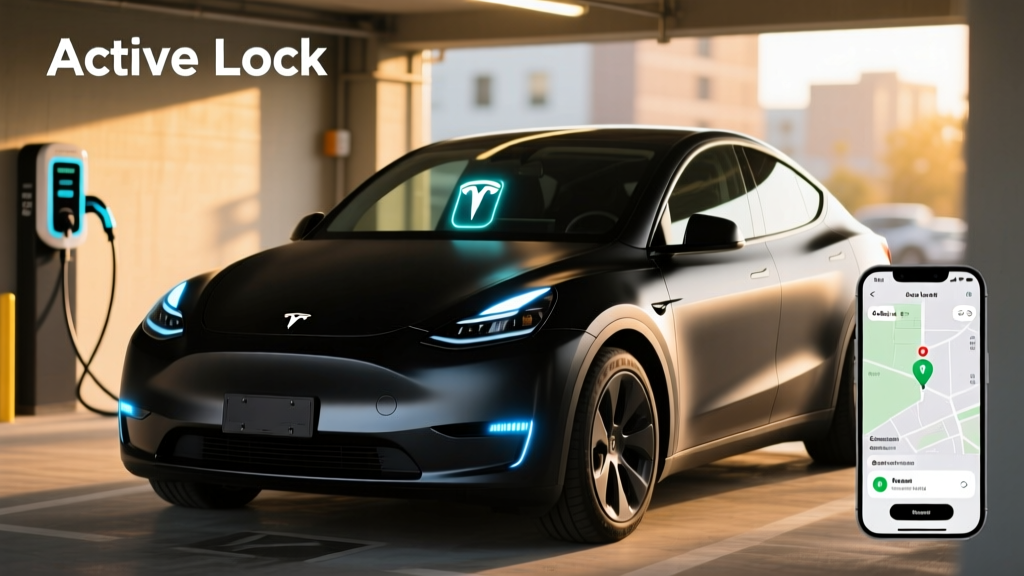
- GPS Tracking & Remote Immobilization: Tesla's app allows owners (and law enforcement, with proper authorization) to track a vehicle's real-time location. Tesla can remotely disable the vehicle so it cannot restart once stopped.
- Valet Mode: Restricts speed, locks the glovebox and frunk, and hides personal data when handing your car to a valet.
- Phone Key + Bluetooth Proximity: Eliminates traditional key fobs that are vulnerable to relay attacks. The car only unlocks when your authenticated phone is in close proximity.
What to Do If Your Tesla Is Stolen
If you discover your Tesla missing, follow these steps in order:
- Open the Tesla app immediately. Check the vehicle's last known GPS location. If the car is still transmitting, you'll see real-time movement.
- Call 911. Provide the GPS coordinates from the app to law enforcement. File a police report — you'll need the report number for insurance.
- Contact Tesla Support. Request remote immobilization. Tesla can disable the vehicle so it cannot be restarted once it comes to a stop. Provide your police report number.
- Enable Lost Mode in the Tesla app. This locks the vehicle, displays a custom message on the screen with your contact info, and prevents unauthorized profile changes.
- Notify your insurance company within 24 hours. Provide the police report and any Sentry Mode footage.
Recovery rate context: Multiple insurance industry reports and law enforcement data suggest Tesla recovery rates exceed 80%, significantly above the industry average of roughly 50-60% for all vehicles. The always-on cellular connection and GPS are the primary reasons.
2026 Tesla Model Y: The Most-Targeted Tesla, Fully Reviewed
The Model Y is Tesla's best-selling vehicle and, by volume, the most frequently reported stolen Tesla model simply because there are far more of them on the road. Here's a complete spec breakdown for the 2026 model year.
| Spec | Long Range AWD | Performance |
|---|---|---|
| EPA Range | 320 miles | 293 miles |
| Battery (usable) | ~75 kWh (NMC) | ~75 kWh (NMC) |
| Drivetrain | Dual-Motor AWD | Dual-Motor AWD |
| Horsepower | 384 hp | 456 hp |
| 0-60 mph | 4.8 sec | 3.5 sec |
| Max DC Fast Charge | 250 kW | 250 kW |
| 10-80% DC Time | ~25 min | ~25 min |
| Level 2 Home Rate | 11.5 kW (44 mi/hr) | 11.5 kW (44 mi/hr) |
| Efficiency | 122 MPGe / 28 kWh/100mi | 111 MPGe / 30 kWh/100mi |
| Cargo (rear seats up) | 30.2 cu ft | 30.2 cu ft |
| Cargo (rear seats folded) | 72.0 cu ft | 72.0 cu ft |
| Rear Legroom | 38.0 in | 38.0 in |
| Base MSRP | $44,990 | $48,990 |
| Battery/Drive Warranty | 8 yr / 120,000 mi | 8 yr / 120,000 mi |
Source: fueleconomy.gov and Tesla specifications. Specs reflect 2026 model year estimates.
Charging Speed: DC Fast & Home Level 2
Charging speed remains a top concern for EV buyers. The 2026 Model Y uses a NACS (North American Charging Standard) connector natively, giving it access to the full Tesla Supercharger network — the most reliable DC fast-charging network in the U.S. — without adapters.
| Level | Power (kW) | Miles Added/Hour | Notes |
|---|---|---|---|
| Level 1 (120V) | ~1.4 kW | ~4-5 mi/hr | Emergency/trickle only |
| Level 2 (240V, 48A) | 11.5 kW | ~44 mi/hr | Full overnight charge in ~8 hrs |
| DC Fast (V3 Supercharger) | Peak 250 kW | ~200 mi in 15 min | 10-80% in ~25 min; tapers above 80% |
| DC Fast (V4 Supercharger) | Peak 250 kW* | ~200 mi in 15 min | *Model Y limited by vehicle architecture |
Charging curve reality: The 250 kW peak rate is sustained only between roughly 10-30% State of Charge (SoC). Above 50%, the rate drops significantly — expect ~100 kW at 60% and ~50 kW above 80%. This is normal lithium-ion behavior, not a Tesla limitation. Always precondition the battery (the car does this automatically when a Supercharger is set as your navigation destination) to achieve peak rates.
Pricing, Tax Credits & Ownership Cost
| Item | Long Range AWD | Performance |
|---|---|---|
| Base MSRP | $44,990 | $48,990 |
| Destination Fee | $1,390 | $1,390 |
| As-Tested (w/ FSD, Red Paint) | ~$55,380 | ~$59,380 |
| §30D Federal Credit (max) | Up to $7,500 | Up to $7,500 |
| Effective Price (after max credit) | ~$38,880 | ~$42,880 |
- MSRP Cap: SUVs (including Model Y) must have an MSRP ≤ $80,000. Both Model Y trims qualify.
- Buyer Income Cap: Modified AGI must not exceed $150,000 (single), $225,000 (head of household), or $300,000 (joint). Check IRS.gov for current rules.
- Battery Sourcing: Critical minerals and battery components must meet phased-in domestic-sourcing thresholds. Tesla's U.S.-built battery packs have largely met these requirements for the Model Y, but verify at the point of sale — rules tighten annually.
- Point-of-Sale Transfer: As of 2024+, you can transfer the credit to the dealer at purchase, reducing your out-of-pocket cost immediately rather than waiting for tax filing.
- Tax Liability: The credit is non-refundable. You must have sufficient federal tax liability to claim it (if not using the point-of-sale transfer option). Consult a tax professional.
Standout Tech, Drawbacks & Autopilot Reality
Standout features:
- 15.4" touchscreen handles all vehicle controls, navigation, media, and gaming (Steam integration for parked entertainment).
- Over-the-air (OTA) updates regularly add features — the car genuinely improves after purchase.
- Sentry Mode + Dashcam provide 24/7 security recording, directly relevant to theft prevention.
- Tesla Supercharger network — 6,000+ U.S. stations with unmatched uptime and plug-and-charge simplicity.
- Heat pump standard — improves cold-weather range and cabin heating efficiency.
Notable drawbacks:
- No physical instrument cluster or stalks — turn signals are on the steering wheel, speed is shown on the center screen. Divisive among buyers.
- FSD (Supervised) is SAE Level 2 — not self-driving. You must keep hands on the wheel and eyes on the road at all times. Despite the "Full Self-Driving" name, it cannot navigate without active supervision.
- No Apple CarPlay / Android Auto — Tesla's proprietary infotainment only.
- Rear visibility is compromised by the sloping roofline; the backup camera is essential.
Who Should Buy the 2026 Model Y?
- You want access to the most reliable DC fast-charging network (Superchargers) for road trips.
- You need crossover cargo space (30.2 cu ft rear seats up, 72 cu ft folded) for family duty.
- You prioritize security features (Sentry Mode, GPS tracking, remote immobilization) in a theft-conscious market.
- You value OTA updates that add functionality over time.
- You want Apple CarPlay or a traditional instrument cluster (consider Hyundai Ioniq 5 or Kia EV6).
- You need more than 320 miles of EPA range for frequent 300+ mile single-leg trips (consider Lucid Air or Chevy Silverado EV Max Range).
- You want a third row — the Model Y's optional third row is extremely tight and best for small children only.
Pros & Cons at a Glance
- Class-leading Supercharger network access
- Excellent theft recovery via GPS + remote disable
- 250 kW DC fast charging with reliable V3 infrastructure
- Spacious cargo area (72 cu ft max)
- OTA updates add features post-purchase
- Heat pump standard for cold-weather efficiency
- Strong §30D tax credit eligibility
- No Apple CarPlay / Android Auto
- Steering-wheel turn signals take adjustment
- FSD is Level 2 only — not autonomous
- Rear visibility limited by roofline
- Insurance premiums above segment average
- Ride quality firm on 20" wheels
Is the Model Y Worth It vs. Key Competitors?
The Model Y competes directly with the Hyundai Ioniq 5, Kia EV6, Ford Mustang Mach-E, and the refreshed Nissan Ariya. Here's how it stacks up on the metrics that matter:
- Charging infrastructure: Tesla wins decisively. Superchargers have superior uptime and coverage. Competitors rely on Electrify America, EVgo, and ChargePoint — improving but still inconsistent in rural areas.
- Range efficiency: The Model Y's 122 MPGe is among the best in the segment. The Ioniq 5 and EV6 offer similar range but slightly lower efficiency.
- Interior quality: The Ioniq 5 and EV6 offer more conventional, material-rich interiors. Tesla's minimalist cabin is polarizing — some love it, others find it sparse.
- Theft security: Tesla's integrated GPS, Sentry Mode, and remote immobilization give it an edge. Most competitors offer basic GPS tracking through connected services but lack Tesla's depth of integration.
- Price after credit: At ~$38,880 (Long Range AWD after max credit), the Model Y is competitive with similarly equipped Ioniq 5 and EV6 models, though those offer faster 800V charging architecture (10-80% in ~18 min vs Tesla's ~25 min).
Frequently Asked Questions
What is the real-world range of the 2026 Tesla Model Y?
The EPA rates the Long Range AWD at 320 miles. In real-world highway driving at 70+ mph, expect 270-290 miles. In freezing weather (below 32°F), range can drop to 220-250 miles. The heat pump helps, but cold chemistry and cabin heating always reduce range.
How fast does the Model Y charge at home and on the road?
At home on a 240V Level 2 charger (48A), the Model Y adds about 44 miles of range per hour, reaching a full charge overnight in roughly 8 hours. On a V3 Supercharger, it peaks at 250 kW and charges 10-80% in approximately 25 minutes, though the rate tapers significantly above 80% SoC.
How much does the Model Y cost after federal tax credits?
The Long Range AWD starts at $44,990 + $1,390 destination. With the maximum $7,500 §30D federal credit (subject to income, MSRP, and battery-sourcing eligibility — see IRS.gov), the effective price drops to approximately $38,880. The Performance trim starts at $48,990, or ~$42,880 after the max credit.
Does the 2026 Tesla Model Y qualify for the $7,500 federal EV tax credit?
It is eligible, but your personal eligibility depends on your modified adjusted gross income (≤$150K single / $300K joint), the vehicle's MSRP (must be ≤$80K for SUVs — both trims qualify), and current battery-sourcing requirements, which tighten annually. You can transfer the credit to the dealer at point of sale for an immediate price reduction. Always verify with the IRS and your tax professional before purchasing.
Are Teslas easy to steal?
No. Teslas are among the hardest vehicles to steal and keep stolen. The always-on cellular connection, GPS tracking, Sentry Mode, Pin to Drive, and remote immobilization make recovery rates significantly higher than the industry average. Most theft attempts involve opportunistic break-ins rather than full vehicle theft.
Is Tesla's FSD actually self-driving?
No. FSD (Supervised) is an SAE Level 2 driver-assistance system. You must remain fully engaged — hands on the wheel, eyes on the road — at all times. It can handle highway lane changes, on-ramps, and some city streets, but it requires constant human supervision and can make errors. Only Level 4 systems (like Waymo robotaxis) operate without a driver.