Why Stockton, CA Is a Strong Tesla Market in 2026
Stockton sits at the crossroads of Northern California's most traveled corridors — I-5 to Sacramento, Highway 99 south to Modesto and Fresno, and I-580 west toward the Bay Area. For EV buyers, that geography makes Tesla ownership compelling: the Tesla Supercharger network blankets every one of those routes, and Stockton's mild Central Valley winters mean less cold-weather range loss than buyers face in colder states. If you're searching for a Tesla in Stockton, CA, you're in one of the best regions in the country to own one.
This guide covers every current Tesla model available to Stockton-area buyers in the 2026 model year, with exact EPA range figures, real-world expectations, charging speeds, pricing after federal tax credits, and the local charging infrastructure you'll rely on. We'll also flag which models qualify for the IRS §30D federal tax credit — a detail that changes frequently and depends on your income, the vehicle's MSRP, and battery-component sourcing rules.
Tesla Model Lineup at a Glance: Specs & Pricing
Tesla's 2026 lineup spans four consumer vehicles. Here's how they stack up on the numbers that matter most.
| Spec | Model 3 Long Range AWD | Model Y Long Range AWD | Model S Long Range | Model X Long Range |
|---|---|---|---|---|
| EPA Range | 341 mi | 320 mi | 402 mi | 335 mi |
| Battery (usable) | ~79 kWh (NMC) | ~79 kWh (NMC) | ~95 kWh (NMC) | ~95 kWh (NMC) |
| Drivetrain | Dual-Motor AWD | Dual-Motor AWD | Dual-Motor AWD | Dual-Motor AWD |
| Horsepower | ~384 hp | ~384 hp | ~670 hp | ~670 hp |
| 0–60 mph | 4.2 sec | 4.8 sec | 3.1 sec | 3.8 sec |
| Peak DC Charge | 250 kW | 250 kW | 250 kW | 250 kW |
| 10–80% DC Time | ~28 min | ~28 min | ~33 min | ~33 min |
| Level 2 Rate | 11.5 kW (~44 mi/hr) | 11.5 kW (~44 mi/hr) | 11.5 kW (~34 mi/hr) | 11.5 kW (~34 mi/hr) |
| MPGe (combined) | 131 MPGe | 122 MPGe | 120 MPGe | 102 MPGe |
| Cargo (rear seats up) | 23 cu ft | 30 cu ft (+ 4 cu ft frunk) | 28 cu ft | 42 cu ft (5-seat) |
| Base MSRP | $47,740 | $48,240 | $79,990 | $84,990 |
Sources: fueleconomy.gov, Tesla.com. Prices exclude destination fee. Specs reflect 2026 model year.
Real-World Range: What Stockton Drivers Actually Get
The EPA sticker is a useful baseline, but your actual range depends on speed, elevation, temperature, and climate-control use. Stockton's summer highs routinely exceed 95°F, which means heavy A/C use can reduce range by 5–10%. Winter lows in the 40s are mild by national standards, so cold-weather range loss is minimal — typically 5–8%, versus 20–30% in sub-freezing climates.
Model 3 Long Range: EPA 341 mi → expect ~290–310 mi on Highway 99 at 70 mph; ~275–295 mi in summer heat with A/C.
Model Y Long Range: EPA 320 mi → expect ~270–290 mi highway; ~260–280 mi loaded with passengers and cargo in summer.
Model S Long Range: EPA 402 mi → expect ~340–370 mi highway; the largest battery in the lineup provides a comfortable buffer for Stockton-to-Lake Tahoe trips (≈160 mi one way).
Model X Long Range: EPA 335 mi → expect ~280–305 mi highway; the heavier SUV body and optional 22" wheels reduce efficiency.
For Stockton commuters running daily loops to Modesto (≈30 mi), Lodi (≈15 mi), or even Sacramento (≈50 mi), even the Model Y leaves substantial range headroom. You'll charge at home overnight and rarely need a mid-week top-up. The bigger question for road-trippers is charging speed on longer hauls — which we cover next.
Charging Speed & Stockton-Area Infrastructure
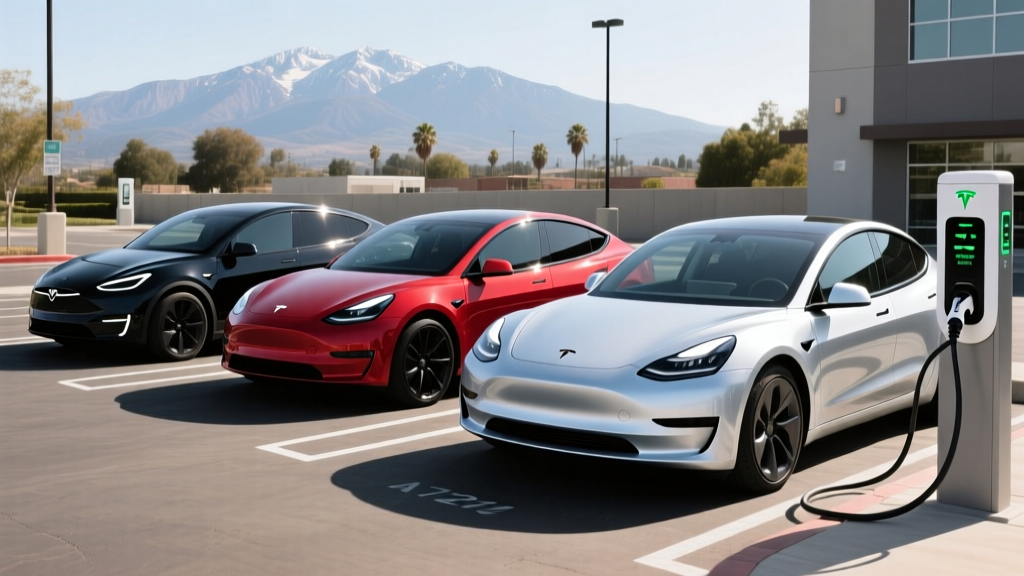
Tesla's NACS (North American Charging Standard) connector is now the industry standard, and Tesla Superchargers remain the most reliable DC fast-charging network in the U.S. Here's what charging looks like across all three levels.
| Level | Power | Miles Added per Hour | Typical Cost | Use Case |
|---|---|---|---|---|
| Level 1 (120V) | ~1.4 kW | ~3–5 mi/hr | $0.18–$0.28/kWh (PG&E residential) | Emergency/top-up only |
| Level 2 (240V home) | 11.5 kW | ~34–44 mi/hr | $0.18–$0.28/kWh (PG&E residential) | Daily overnight charging |
| DC Fast (Supercharger V3) | Up to 250 kW | ~175–220 mi in 15 min | $0.33–$0.48/kWh | Road trips |
DC Fast Charging: The Curve Reality
Tesla advertises a peak charge rate of 250 kW on V3 Superchargers, but that peak only holds between roughly 10–30% state of charge (SoC). Above 50%, the rate tapers to ~100 kW; above 80%, it drops below 50 kW. This is normal lithium-ion behavior — the battery management system slows current to protect cell longevity.
For a Model 3 or Model Y, a 10–80% session takes approximately 28 minutes. The larger Model S and Model X batteries need about 33 minutes for the same swing. If you're running a Stockton-to-San Francisco trip (≈85 mi one way), a 10-minute stop at the Tracy or Livermore Supercharger adds more than enough range to complete the round trip.
Local Supercharger & Destination Charging
Stockton has multiple Supercharger stations within and around city limits, including locations near the I-5 and Robinhood Drive corridor. Additional V3/V4 stations line I-5 every 40–60 miles in both directions, making road trips to Redding, Bakersfield, or Los Angeles straightforward. For a full map and live availability, check the Tesla app or Tesla's Supercharger page.
PG&E, Stockton's utility, offers EV-specific time-of-use (TOU) rates that can lower home charging costs to the $0.10–$0.15/kWh range during off-peak overnight hours — making a full Model 3 charge cost roughly $8–$12, versus $45–$55 for an equivalent tank of gas.
Federal Tax Credit Eligibility: What Actually Qualifies
The IRS §30D Clean Vehicle Credit offers up to $7,500 for qualifying new EVs — but eligibility is not guaranteed. Here's the 2026 framework for Tesla buyers:
- MSRP cap: Sedans (Model 3, Model S) must have an MSRP ≤ $55,000; SUVs/pickups (Model Y, Model X) must be ≤ $80,000.
- Buyer income cap: Modified AGI ≤ $150,000 (single), ≤ $300,000 (married filing jointly), ≤ $225,000 (head of household).
- Battery sourcing: Increasingly strict critical-mineral and battery-component sourcing requirements apply. Vehicles with components from "foreign entities of concern" (FEOC) may lose partial or full credit eligibility.
- Point-of-sale transfer: You can transfer the credit to the dealer at purchase, reducing your out-of-pocket cost immediately rather than waiting for a tax refund.
| Model | Base MSRP | Est. §30D Credit | Effective Price | Credit Status |
|---|---|---|---|---|
| Model 3 Long Range AWD | $47,740 | Up to $7,500 | ~$40,240 | Qualifies (MSRP under $55K cap) |
| Model Y Long Range AWD | $48,240 | Up to $7,500 | ~$40,740 | Qualifies (SUV, MSRP under $80K cap) |
| Model S Long Range | $79,990 | $0 | $79,990 | Exceeds $55K sedan MSRP cap |
| Model X Long Range | $84,990 | $0 | $84,990 | Exceeds $80K SUV MSRP cap |
Source: IRS §30D guidelines. Eligibility depends on your tax situation and current-year sourcing rules. Consult a tax professional before purchasing.
Tesla Technology: Autopilot, FSD, and the Infotainment Edge
Every Tesla ships with a 15.4-inch center touchscreen (Model 3/Y) or 17-inch (Model S/X) running Tesla's proprietary infotainment OS — no Apple CarPlay or Android Auto, but native navigation, Spotify, Netflix (while parked), and over-the-air (OTA) updates that add features post-purchase.
Autopilot vs. Full Self-Driving (Supervised)
Both Autopilot (standard) and FSD Supervised ($8,000 one-time or $99/month) are SAE Level 2 systems. The driver must remain fully engaged — hands on or near the wheel, eyes on the road — at all times. Neither system makes the vehicle self-driving. Tesla's camera-only "Tesla Vision" approach handles lane centering, adaptive cruise, automatic lane changes, and traffic-light recognition, but it does not replace the driver.
- Operate without driver supervision
- Handle all weather conditions (heavy rain, fog, construction zones)
- Replace attentive driving on unfamiliar roads
- Guarantee zero interventions — expect multiple takeovers per trip
For Stockton commuters on well-marked Highway 99 or I-5, Autopilot reduces fatigue on repetitive stretches. FSD adds automatic navigation-guided lane changes and city-street stoplight handling, but the supervision requirement is non-negotiable for safety.
Pros, Cons & Ownership Verdict
Pros
- Supercharger network — the most reliable DC fast-charging ecosystem in the U.S.
- Class-leading efficiency — Model 3 achieves 131 MPGe combined, lowering per-mile fuel cost
- OTA updates — features improve after purchase without dealer visits
- Strong resale value relative to non-Tesla EVs
- Stockton's mild winters minimize cold-weather range loss
- Point-of-sale tax credit transfer reduces upfront cost on Model 3/Y
Cons
- No Apple CarPlay or Android Auto — Tesla's walled-garden infotainment isn't for everyone
- Minimalist interior — Model 3/Y rely almost entirely on the touchscreen (no physical buttons for climate, mirrors, or glovebox)
- FSD Supervised is expensive and still requires full driver attention
- Insurance costs tend to run 15–25% higher than comparable gas vehicles
- Model S/X priced above federal tax credit caps
- Service center wait times can stretch weeks in high-demand areas
Who Should Buy a Tesla in Stockton?
Model 3 Long Range suits solo commuters and couples who want maximum efficiency and range for the lowest entry price. At ~$40,240 after the tax credit, it competes directly with the Hyundai Ioniq 6 and BMW i4 on price while offering superior charging infrastructure.
Model Y Long Range is the family pick. 30 cu ft of cargo space, available third-row seating (small children only), and the same powertrain efficiency make it the top-selling EV in America for good reason. School runs, Costco hauls, and Highway 99 commutes are effortless.
Model S and Model X are for buyers who want flagship performance (0–60 in 3.1 sec for Model S) and premium space. The tax credit won't apply, so budget accordingly. The Model X's falcon-wing doors and available six-seat layout make it distinctive, but the price premium over Model Y is steep.
Battery Warranty & Long-Term Ownership Costs
Tesla covers the battery and drive unit for 8 years or 120,000 miles (Model 3/Y) and 8 years or 150,000 miles (Model S/X), whichever comes first, with a guaranteed minimum 70% capacity retention. Real-world degradation data from fleet analytics shows Tesla NMC batteries retaining approximately 88–92% capacity at 100,000 miles — well above the warranty threshold.
A full battery replacement outside warranty currently costs between $12,000 and $20,000 depending on the model, though most owners never need one. Tesla's LFP (lithium iron phosphate) batteries, used in the base Model 3 RWD, offer even longer cycle life and can be charged to 100% daily without degradation concerns — a trade-off for slightly lower energy density and range.
For a Stockton owner charging primarily at home on PG&E's off-peak TOU rate (~$0.12/kWh), annual "fuel" cost for 12,000 miles of driving runs approximately $450–$550 — versus $1,500–$1,800 for a comparable gas vehicle at $4.00/gallon and 28 MPG combined.
Frequently Asked Questions
What is the real-world range of a Tesla in Stockton, CA?
Stockton's mild climate helps. Expect the Model 3 Long Range to deliver 290–310 miles on highway trips at 70 mph, and 275–295 miles in peak summer heat with A/C running. The Model Y Long Range delivers 270–290 miles under similar conditions. Cold-weather loss in Stockton's 40°F winter mornings is minimal — around 5–8% — compared to 20–30% in colder northern states.
How fast does a Tesla charge at home and on the road?
At home on a 240V Level 2 connection (11.5 kW), you'll add roughly 34–44 miles of range per hour, depending on the model. A full overnight charge from 20% to 90% takes 6–8 hours. On a V3 Supercharger, a 10–80% session takes about 28 minutes (Model 3/Y) or 33 minutes (Model S/X), though charge speed tapers significantly above 80% SoC to protect battery health.
How much does a Tesla cost after federal tax credits?
The Model 3 Long Range AWD ($47,740 MSRP) and Model Y Long Range AWD ($48,240 MSRP) both qualify for up to $7,500 in federal tax credits under IRS §30D, assuming you meet income requirements (≤$150K single, ≤$300K joint) and the vehicle meets battery-sourcing rules. That brings effective pricing to approximately $40,240 and $40,740, respectively. The Model S and Model X exceed MSRP caps and do not qualify for the new-vehicle credit.
Is buying a Tesla worth it vs. competitors like Hyundai Ioniq 5 or Ford Mustang Mach-E?
Tesla's advantages are the Supercharger network, OTA updates, efficiency, and strong resale value. Competitors like the Hyundai Ioniq 5 offer 800V architecture (faster peak charging), physical buttons, and Apple CarPlay. The Ford Mustang Mach-E offers a more traditional SUV feel. If charging-infrastructure reliability is your top priority and you're comfortable with Tesla's touchscreen-centric interior, Tesla remains the strongest all-around package in Stockton.
Does a Tesla qualify for California state incentives too?
California offers additional incentives including the Clean Fuel Rebate (amount varies by program year and funding availability) and access to HOV/carpool lanes with a Clean Air Vehicle decal for qualifying EVs. Check the California Energy Commission and your local air district for current program details, as amounts and availability change.
Where is the nearest Tesla Service Center to Stockton?
Tesla operates service centers and mobile service in the broader Central Valley and Sacramento region. Mobile Rangers handle many common repairs (12V battery, tire rotation, minor body) at your home or workplace. For larger service needs, the Sacramento and Fremont service centers are the closest full facilities. Wait times for appointments can run 1–3 weeks depending on demand, a factor worth considering for ownership planning.