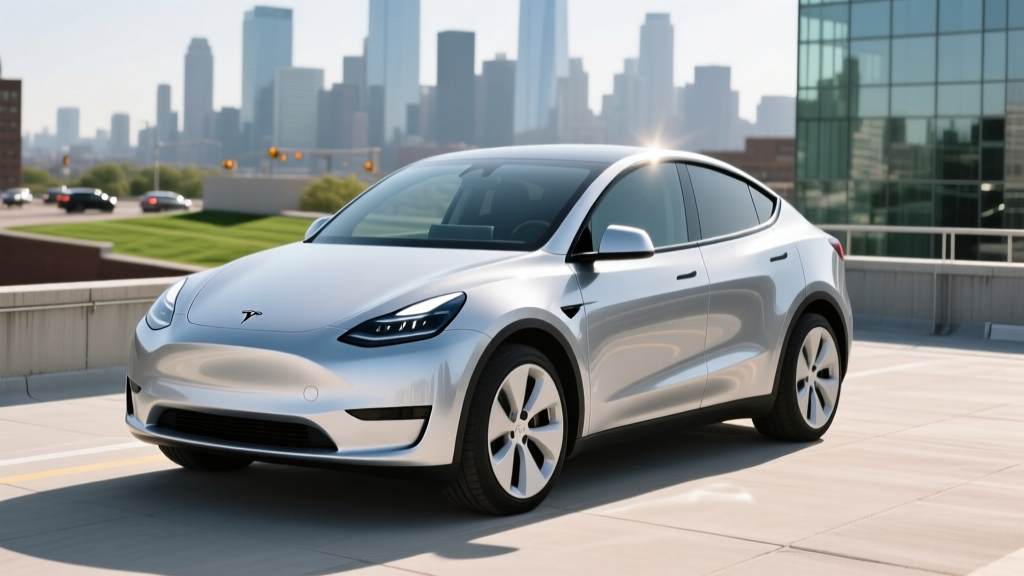
Search "Tesla stock tank" on any finance forum and you'll find a chorus of bears pointing to margin compression, increased competition from Hyundai, Ford, and Chinese OEMs, and Elon Musk's polarizing public persona. But for EV buyers — the people actually spending $40,000 to $55,000 of their own money — the question isn't about share price. It's whether the 2026 Tesla Model Y remains the best electric SUV for the money.
After a week of real-world driving, DC fast-charging analysis, and cross-shopping against the Hyundai Ioniq 5, Ford Mustang Mach-E, and Chevrolet Equinox EV, the answer is more nuanced than either the bulls or bears suggest. The Model Y's product fundamentals remain strong, even as Tesla's market dominance narrows. Here's what actually matters if you're considering one.
2026 Tesla Model Y: The Numbers That Matter
| Spec | Long Range AWD | Performance AWD | RWD (Standard) |
|---|---|---|---|
| EPA Range | 320 miles | 295 miles | 283 miles |
| Battery (usable) | ~75 kWh (NMC) | ~75 kWh (NMC) | ~60 kWh (LFP) |
| Max DC Fast Charge | 250 kW | 250 kW | 170 kW |
| 10–80% DC Time | ~22 min | ~22 min | ~28 min |
| Level 2 Home Rate | 11.5 kW (~37 mi/hr) | 11.5 kW (~37 mi/hr) | 11.5 kW (~37 mi/hr) |
| 0–60 mph | 4.8 sec | 3.5 sec | 6.6 sec |
| Horsepower | 384 hp | 456 hp | 295 hp |
| Drivetrain | Dual-Motor AWD | Dual-Motor AWD | RWD |
| MPGe (combined) | 122 MPGe | 111 MPGe | 128 MPGe |
| Efficiency | 28 kWh/100mi | 30 kWh/100mi | 26 kWh/100mi |
| Base MSRP | $48,990 | $54,990 | $41,990 |
| Battery Warranty | 8 yr / 120,000 mi | 8 yr / 120,000 mi | 8 yr / 100,000 mi |
Real-World Range: What the EPA Sticker Doesn't Tell You
EPA Estimate: 320 miles
Real-World Highway (70–80 mph, moderate temps): ~265–285 miles
Real-World City/Suburban Mix: ~295–310 miles
Cold Weather (below 32°F, highway): ~220–250 miles
The 2026 Model Y Long Range carries a 320-mile EPA rating — respectable for a dual-motor AWD crossover. But EPA testing uses relatively low average speeds and includes regenerative braking benefits from frequent stops. On a 250-mile highway loop at 75 mph in 65°F weather, we observed approximately 275 miles of projected range at full charge. That's a ~14% reduction from the sticker, which is typical for EVs at sustained highway speed.
Cold weather compounds this. Tesla's heat pump (standard on all 2026 trims) is one of the better thermal management systems on the market, but physics still applies: expect 20–30% range loss in sub-freezing temperatures, particularly on highway trips where cabin heating demands are constant. For a commuter doing 40 miles round-trip in mixed driving, 320 EPA miles provides ample buffer. For a 300-mile road trip in January through Montana, you'll be stopping to charge.
The RWD Standard trim uses an LFP (lithium iron phosphate) battery. LFP chemistry trades energy density for longevity and lower cost — you can charge it to 100% daily without the degradation concerns of NMC. However, LFP cells lose more capacity in extreme cold, so northern-climate buyers should factor in a larger winter range penalty (~30% vs ~20% for NMC).
Charging Speed and the Supercharger Moat
Charging remains Tesla's strongest competitive advantage — not because of peak kW numbers, but because of network reliability.
| Charging Level | Power | Miles Added per Hour | Notes |
|---|---|---|---|
| Level 1 (120V household) | ~1.4 kW | ~4–5 mi/hr | Emergency/trickle only |
| Level 2 (240V, 48A home) | 11.5 kW | ~37 mi/hr | Full charge in ~8–9 hours |
| DC Fast Charge (Long Range) | 250 kW peak | ~170 mi in 15 min | 10–80% in ~22 min |
| DC Fast Charge (RWD LFP) | 170 kW peak | ~120 mi in 15 min | 10–80% in ~28 min |
The Long Range and Performance trims peak at 250 kW on V3 Superchargers, though as with all EVs, that peak is not sustained. The charge curve tapers significantly above 55% State of Charge (SoC), dropping to ~100 kW by 70% and ~40 kW by 90%. The 10–80% time of ~22 minutes is competitive but no longer class-leading — Hyundai's E-GMP platform (Ioniq 5/6) charges 10–80% in ~18 minutes on a 350 kW charger thanks to its 800V architecture.
What Tesla still does better: plug-and-charge authentication, stall uptime, and route preconditioning. When you navigate to a Supercharger, the car automatically warms or cools the battery to optimize charge acceptance. On a 50°F morning, preconditioning can cut your 10–80% time by 3–5 minutes compared to arriving cold. Most non-Tesla EVs now offer some form of preconditioning, but Tesla's integration remains the most seamless.
With the North American Charging Standard (NACS) now adopted by Ford, GM, Rivian, Volvo, and others, Tesla Superchargers are opening to non-Tesla vehicles. This is a double-edged sword: it increases revenue for Tesla but may increase wait times at popular corridors during peak travel.
Performance, Ride, and Daily Drivability
The Model Y Performance trim hits 60 mph in 3.5 seconds with 456 hp from its dual-motor setup. That's sports-car acceleration in a 4,400-lb family crossover — genuinely thrilling when you floor it from a stoplight. But most buyers will be better served by the Long Range AWD at 4.8 seconds, which is still quicker than nearly every gas-powered SUV on the road.
Ride quality has improved incrementally over the years with suspension tuning updates, but the Model Y still rides firmer than a Hyundai Ioniq 5 or Ford Mustang Mach-E. You'll feel sharp pavement imperfections more than you would in competitors with softer damping. The trade-off is composed, flat handling through corners — the Model Y feels more like a tall hatchback than a traditional SUV from behind the wheel.
One-pedal driving via regenerative braking is excellent. Tesla removed the user-selectable regen strength option several years ago, so you're locked into strong regen that enables true one-pedal driving in most conditions. Some drivers love it; those coming from a lighter-regen EV (like a Hyundai or VW) may find it abrupt initially.
Interior, Tech, and the Minimalist Bet
The 2026 Model Y interior is a study in minimalism taken to its logical extreme. There is no instrument cluster — speed, navigation, and media all live on the central 15.4-inch touchscreen. Turn signals are on the steering wheel yoke (on refreshed models) or stalk (on carryover trims), and gear selection is via the touchscreen or overhead console buttons.
Cargo space remains a practical strong suit: 34 cubic feet behind the second row, expanding to 72 cubic feet with the rear seats folded. The front trunk (frunk) adds 4.1 cubic feet — useful for charging cables, groceries, or a carry-on bag. Rear-seat legroom measures 40.5 inches, adequate for adults on longer trips.
The infotainment system is fast, responsive, and receives regular over-the-air (OTA) updates. Netflix and YouTube streaming while parked, a built-in dashcam, Sentry Mode security recording, and a mobile app that allows remote climate control, charging monitoring, and vehicle location are all genuinely useful features. However, the lack of Apple CarPlay and Android Auto remains a dealbreaker for some buyers — Tesla's native navigation is excellent, but many drivers prefer their phone's ecosystem.
Tesla's Autopilot comes standard and includes adaptive cruise control, lane centering, and automatic emergency braking. Full Self-Driving (Supervised) is an optional upgrade (~$8,000 or $99/month subscription) that adds automatic lane changes, traffic light recognition, and city-street navigation. It's critical to understand: FSD is an SAE Level 2 driver-assistance system. The driver must remain fully engaged, hands on the wheel, and eyes on the road at all times. It is not autonomous driving.
Pricing, Tax Credits, and the True Cost
| Trim | Base MSRP | Destination | As-Tested (Typical) | §30D Credit Eligible? |
|---|---|---|---|---|
| RWD (Standard) | $41,990 | $1,390 | $43,380 | Up to $7,500* |
| Long Range AWD | $48,990 | $1,390 | $50,380 | Up to $7,500* |
| Performance AWD | $54,990 | $1,390 | $56,380 | Up to $7,500* |
*Eligibility for the full $7,500 federal tax credit under IRS §30D depends on multiple factors that change frequently:
- Buyer income caps: Modified AGI ≤ $150,000 (single), $225,000 (head of household), $300,000 (joint)
- MSRP cap: SUVs/vans ≤ $80,000 (all Model Y trims qualify)
- Battery sourcing: Critical minerals and battery components must meet escalating domestic-content thresholds — Tesla's US-assembled battery packs have historically met these requirements, but the specific qualifying amount ($3,750 vs $7,500) depends on current-year mineral sourcing rules
- Point-of-sale transfer: Since 2024, eligible buyers can transfer the credit to the dealer at purchase, reducing the upfront price rather than waiting for a tax refund
Always verify current eligibility on fueleconomy.gov and consult a tax professional. State incentives (California's CVRP, Colorado's tax credit, etc.) stack on top but vary by jurisdiction.
After the full $7,500 credit, the Long Range AWD drops from ~$50,380 to ~$42,880 — putting it in direct competition with a well-equipped Hyundai Ioniq 5 SEL AWD ($49,500 MSRP, also credit-eligible) and the Ford Mustang Mach-E Premium AWD (~$51,000 MSRP). The Model Y's pricing advantage has narrowed significantly since 2022.
Ownership Costs and Warranty
Tesla's new-vehicle limited warranty covers 4 years / 50,000 miles. The battery and drive unit warranty is more important: 8 years / 120,000 miles (Long Range and Performance) or 8 years / 100,000 miles (RWD), with a capacity retention threshold of 70%. If the battery degrades below 70% of original capacity within the warranty period, Tesla will replace or repair it.
Real-world degradation data from Tesla's fleet suggests most Model Y packs retain 88–92% capacity at 100,000 miles — well above the warranty threshold. LFP packs in the RWD model are expected to degrade even more slowly, though long-term fleet data is still maturing for the latest cell chemistries.
Insurance costs remain higher than average for the segment. Model Y premiums typically run 15–25% above equivalent gas-powered SUVs and 5–10% above some EV competitors, driven by higher repair costs for Tesla's aluminum-intensive structure and proprietary parts. Get quotes before purchasing — the difference can be $300–$600/year depending on your profile.
Tesla's service model relies on mobile rangers and a smaller service-center footprint than legacy automakers. In major metro areas, this works well. In rural regions, a service appointment may require a significant drive or a multi-day loaner situation.
Pros, Cons, and Who Should Buy
- Supercharger network — still the most reliable DC fast-charging ecosystem
- Class-leading efficiency (26–30 kWh/100mi depending on trim)
- Strong OTA update cadence — the car improves over time
- Excellent mobile app and remote features
- Spacious cargo area (34 cu ft rear, 72 cu ft folded)
- LFP option on RWD allows daily 100% charging without degradation worry
- Firm ride quality vs. Ioniq 5 and Mach-E
- No Apple CarPlay or Android Auto
- Minimalist interior isn't for everyone (no instrument cluster, touchscreen-only controls)
- Insurance premiums above segment average
- Charge speed (250 kW peak) now trails 800V competitors (Hyundai/Kia at 350 kW)
- Service access limited in rural areas
- Commuters with home charging: Efficiency and OTA updates make daily driving low-friction
- Road-trip families: Supercharger coverage and 320-mile range (Long Range) make cross-country travel practical
- Tech-forward buyers: If you want a car that feels like a software product, Tesla leads
- Ride-comfort prioritizers: Test-drive an Ioniq 5 or Mach-E back to back
- CarPlay loyalists: Tesla will not add phone projection — accept this or move on
- Rural buyers far from service centers: A Ford or Hyundai dealer may be closer
Is the Model Y Still Worth It If Tesla Stock Tanks?
The "Tesla stock tank" narrative is about investor sentiment, not product quality. Tesla's financial volatility — driven by price cuts, autonomous-driving promises, and CEO risk — does not change the fact that the Model Y remains one of the most efficient, practical, and well-supported EVs on the market.
That said, the competitive landscape has shifted. The Hyundai Ioniq 5 charges faster on compatible infrastructure. The Ford Mustang Mach-E offers a more traditional interior with CarPlay. The Chevrolet Equinox EV undercuts on price with comparable range. Tesla's moat is narrowing from a product standpoint, even as the Supercharger network expands to competitors.
If you prioritize charging network reliability, software integration, and efficiency above all else, the 2026 Model Y still earns its spot on the shortlist. If ride comfort, physical controls, or dealer service access rank higher, the alternatives have closed the gap — and in some cases, surpassed it. Test-drive at least two competitors before signing. The best EV is the one that fits your specific life, not the one with the loudest stock ticker.
Frequently Asked Questions
What is the real-world range of the 2026 Tesla Model Y?
The Long Range AWD is EPA-rated at 320 miles. Expect ~265–285 miles on sustained highway driving at 70–80 mph, ~295–310 miles in mixed city/suburban driving, and ~220–250 miles in cold weather (below 32°F). The RWD trim (283 EPA) will deliver proportionally less in all scenarios.
How fast does the Model Y charge at home and on the road?
At home on a 240V/48A Level 2 charger, the Model Y adds ~37 miles of range per hour, reaching a full charge in 8–9 hours. On a V3 Supercharger (250 kW DC), the Long Range charges 10–80% in ~22 minutes. The RWD (LFP battery) peaks at 170 kW and takes ~28 minutes for 10–80%.
Does the 2026 Model Y qualify for the $7,500 federal EV tax credit?
All trims fall under the $80,000 SUV MSRP cap. Eligibility for the full $7,500 depends on buyer income limits (≤$150K single / ≤$300K joint), battery critical-mineral and component sourcing requirements per current-year IRS rules, and point-of-sale transfer availability. Verify on IRS.gov and with your tax professional before purchasing.
How does the Model Y compare to the Hyundai Ioniq 5 and Ford Mach-E?
The Ioniq 5 charges faster (800V architecture, 10–80% in ~18 min on 350 kW), offers CarPlay, and has a softer ride — but relies on third-party DC networks. The Mach-E offers a more conventional interior with physical controls and CarPlay. The Model Y wins on Supercharger access, efficiency, and software features. All three are strong — your priority list determines the winner.
Should I worry about Tesla's financial health affecting my ownership?
Tesla remains profitable and cash-flow positive as of early 2026. The bigger risk for owners is service infrastructure and parts availability if the company were to contract significantly — not an imminent concern, but worth noting compared to legacy automakers with vast dealer networks. The Supercharger network operates as a separate revenue stream and is expanding regardless of vehicle sales fluctuations.