Tesla Stock Dropped — Does That Make the 2026 Model Y a Better Buy?
If you've followed financial headlines recently, you've seen that Tesla stock dropped significantly through early 2026, pressured by slowing global EV demand growth, increased competition from Hyundai, Kia, and Chinese automakers, and margin compression from aggressive price cuts. But for prospective EV buyers, market turbulence creates a different calculus: lower MSRPs, better incentives, and a product that remains one of the most efficient electric SUVs on the road.
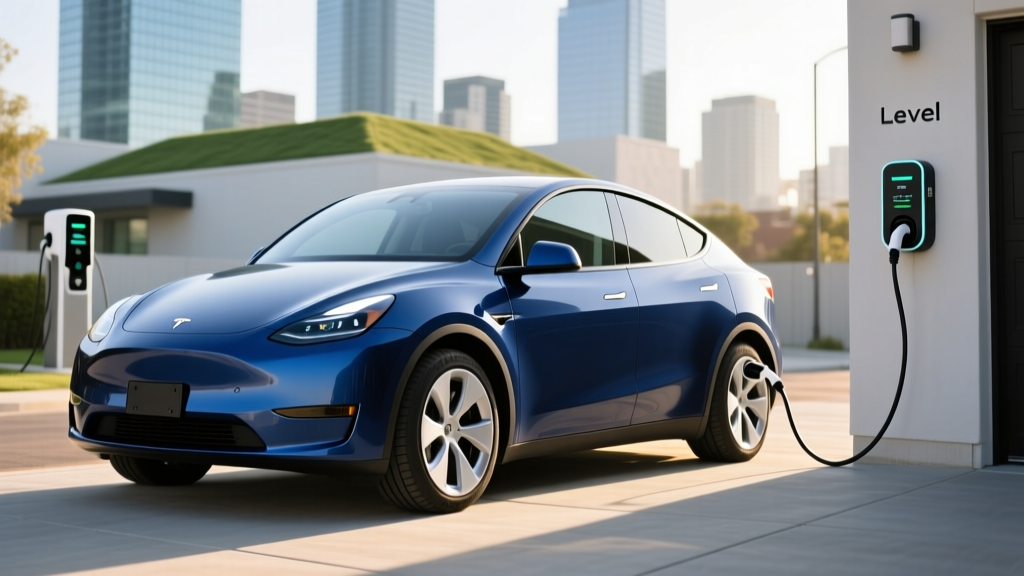
The 2026 Tesla Model Y — now in its second year after the "Juniper" refresh — is the vehicle we're evaluating here. With revised pricing starting at $44,990, a proven 75 kWh (usable) LFP or NMC battery pack depending on trim, and access to the largest fast-charging network in North America, the Model Y still sets the benchmark in its class. Below, we break down every spec that matters to real buyers.
Range, Efficiency, and Real-World Expectations
The 2026 Model Y Long Range AWD carries an EPA-estimated range of 320 miles on its 75 kWh (usable) NMC battery pack. The Rear-Wheel-Drive base model, which uses a CATL-sourced LFP (lithium iron phosphate) pack of approximately 60 kWh usable, is rated at 263 miles EPA. Efficiency for the Long AWD trim lands at 122 MPGe combined, or roughly 27 kWh/100 mi, per fueleconomy.gov.
EPA 320 mi (Long Range AWD) — expect ~270–290 mi on sustained highway driving at 70–75 mph, and ~230–250 mi in sub-freezing winter conditions due to cabin heating demand and increased battery resistance. The LFP RWD model (EPA 263 mi) typically delivers ~220 mi highway, ~185 mi in cold weather. Tesla's heat pump helps mitigate winter losses compared to older EVs, but physics still applies.
The LFP chemistry in the RWD trim trades energy density for longevity and cost. LFP cells tolerate regular 100% charging without accelerated degradation — Tesla actually recommends periodic full charges for LFP packs to maintain cell balancing. NMC in the Long Range and Performance trims offers more range per kilogram but benefits from daily charge limits around 80–90% for long-term health.
Charging Speed: DC Fast, Level 2, and the Supercharger Advantage
Charging remains one of Tesla's strongest competitive moats. The 2026 Model Y supports up to 250 kW peak DC fast charging on V3 Superchargers and compatible CCS/NACS third-party stations. In practice, the charge curve peaks briefly near 250 kW between 10–25% state of charge (SoC), then tapers progressively. Expect a 10–80% charge in approximately 25–27 minutes at a V3 Supercharger.
| Charging Level | Power / Rate | Miles Added Per Hour | Typical Use Case |
|---|---|---|---|
| Level 1 (120V) | ~1.4 kW | ~3–4 mi/hr | Emergency / overnight trickle |
| Level 2 (240V, 48A) | 11.5 kW | ~37 mi/hr | Home daily charging (Wall Connector) |
| DC Fast (V3 Supercharger) | Up to 250 kW peak | ~170 mi in 15 min | Road trips, rapid top-ups |
| DC Fast (V4 Supercharger) | Up to 250 kW (cable-limited) | Similar to V3 | Newer station deployments |
At home, the Tesla Wall Connector on a 60A circuit (48A continuous) delivers 11.5 kW, adding roughly 37 miles of range per hour — enough to fully replenish the Long Range overnight in about 8–9 hours. The onboard charger is limited to 11.5 kW (48A), so upgrading to a 80A circuit provides no additional benefit for the Model Y.
One ownership practicality: Tesla's NACS connector is now the North American standard, and adapters for legacy CCS stations are included. The Supercharger network's reliability — typically 95%+ uptime — remains a meaningful advantage over Electrify America or EVgo in rural corridors.
Performance, Drivetrain, and Ride Quality
The 2026 Model Y lineup spans three trims with distinct performance profiles:
| Spec | RWD (Base) | Long Range AWD | Performance AWD |
|---|---|---|---|
| 0–60 mph | 6.6 sec | 4.8 sec | 3.5 sec |
| Horsepower | ~295 hp | ~384 hp | ~456 hp |
| Drivetrain | RWD (single motor) | AWD (dual motor) | AWD (dual motor) |
| EPA Range | 263 mi | 320 mi | 293 mi |
| Battery (usable) | ~60 kWh (LFP) | ~75 kWh (NMC) | ~75 kWh (NMC) |
| Top Speed | 135 mph | 135 mph | 155 mph |
The Juniper refresh brought meaningful ride-quality improvements: revised suspension tuning, acoustic glass, and improved isolation make the 2026 Model Y noticeably quieter and more composed over rough pavement than pre-2025 models. The Performance trim's adaptive dampers firm up appropriately in Sport mode but remain livable in Comfort.
Regenerative braking remains single-mode (strong regen whenever you lift off the accelerator), enabling effective one-pedal driving in most conditions. Tesla removed the user-adjustable regen setting several model years ago, which some buyers still find limiting.
Interior, Cargo Space, and Technology
The minimalist interior centers on a 15.4-inch touchscreen that controls virtually every vehicle function — climate, mirrors, glovebox, and drive settings. The Juniper update added a rear 8-inch touchscreen for passengers, ventilated front seats, ambient lighting, and power-folding second-row seats.
Cargo capacity stands at 30.2 cu ft behind the second row and 72.1 cu ft with the rear seats folded. The front trunk (frunk) adds another 4.1 cu ft, useful for charging cables or a small bag. Rear legroom measures 40.5 inches, adequate for adults on longer trips.
On the tech front, Tesla's infotainment remains best-in-class for responsiveness and over-the-air update frequency. Navigation with real-time Supercharger routing and battery preconditioning is seamless. However, the absence of Apple CarPlay and Android Auto continues to frustrate some buyers who prefer phone-mirrored interfaces.
Autopilot, FSD Supervised, and Safety
Tesla Autopilot and Full Self-Driving (Supervised) are SAE Level 2 driver-assistance systems. The driver must remain fully engaged, hands on the wheel (or providing torque input), and eyes on the road at all times. These systems do NOT make the vehicle self-driving. Only Level 4 services like Waymo operate without a human driver in defined geographic zones.
Standard Autopilot includes Traffic-Aware Cruise Control and Autosteer (lane-centering on divided highways). The optional FSD (Supervised) package — $8,000 one-time or $99/month — adds automatic lane changes, navigation-guided on/off-ramp maneuvers, traffic-light and stop-sign recognition, and Autopark. In our experience, FSD performs well on well-marked highways but still requires frequent driver interventions in construction zones, unmapped intersections, and adverse weather.
Safety ratings remain strong: the Model Y earned a 5-star overall rating from NHTSA and was named an IIHS Top Safety Pick with Good ratings across all crashworthiness categories.
Pricing, Trims, and Federal Tax Credit Eligibility
| Trim | Base MSRP | Est. After §30D Credit | Destination |
|---|---|---|---|
| RWD (LFP) | $44,990 | ~$37,490* | $1,390 |
| Long Range AWD | $48,990 | ~$41,490* | $1,390 |
| Performance AWD | $53,990 | ~$46,490* | $1,390 |
*Estimated prices assume full $7,500 federal tax credit eligibility. Actual credit depends on individual circumstances.
- MSRP cap: SUVs must be ≤ $80,000 (all Model Y trims qualify)
- Buyer income cap: AGI ≤ $150,000 (single) / $225,000 (head of household) / $300,000 (joint)
- Battery sourcing: Critical minerals and battery components must meet phased-in percentage thresholds from US or FTA-partner countries — Tesla's shifting supply chain means eligibility can change month to month
- Point-of-sale transfer: Eligible buyers can apply the credit as an instant rebate at purchase rather than waiting for tax filing
- Verify current status: Check fueleconomy.gov and consult a tax professional before purchase — sourcing rules are subject to change
Tesla's price cuts throughout 2025–2026 — partly responsible for the stock drop — have actually improved the Model Y's value proposition. A Long Range AWD at ~$41,490 after the credit undercuts comparably equipped competitors like the Hyundai Ioniq 5 AWD and Ford Mustang Mach-E Premium.
Warranty and Long-Term Ownership
Tesla covers the Model Y with a 4-year/50,000-mile basic vehicle warranty and an 8-year/120,000-mile battery and drive unit warranty (Long Range and Performance). The RWD trim's battery warranty is 8-year/100,000 miles. The warranty guarantees the battery will retain at least 70% of its original capacity during the coverage period.
Real-world degradation data from Tesla's fleet suggests NMC packs typically lose 8–12% capacity over the first 100,000 miles, then degrade more slowly. LFP packs tend to degrade less overall (5–8% over similar mileage) but may show more variability in state-of-charge estimation. Out-of-warranty battery replacement costs remain high — approximately $12,000–$16,000 depending on pack size and labor.
Pros, Cons, and Who Should Buy
- Class-leading efficiency (122 MPGe combined)
- Supercharger network access — best public charging reliability
- Strong real-world range (270–290 mi highway, LR AWD)
- Spacious cargo area (72.1 cu ft max) with practical frunk
- Excellent OTA updates and infotainment responsiveness
- Competitive pricing after tax credit (~$41,490 LR AWD)
- 5-star NHTSA safety rating
- No Apple CarPlay or Android Auto
- FSD ($8,000) still requires constant driver supervision
- Single-mode regen braking (not adjustable)
- Panel-gap and paint quality inconsistency reported by some owners
- Service center wait times can stretch weeks in high-demand markets
- Insurance premiums above segment average
- Choose the Model Y if: You want maximum Supercharger access for road trips, value efficiency and cargo space, and prefer a tech-forward ownership experience with frequent OTA improvements.
- Look at competitors if: You need Apple CarPlay (Hyundai Ioniq 5), want a more traditional interior layout (Kia EV6), prioritize ride comfort over performance (Chevrolet Equinox EV), or need a third row (Kia EV9).
- Best trim for commuters: RWD at $44,990 — lowest cost, LFP longevity, sufficient range for daily drives under 50 miles round-trip.
- Best trim for road trips: Long Range AWD at $48,990 — 320 mi EPA, dual-motor traction in rain/snow, fastest 10–80% charging.
Frequently Asked Questions
What is the real-world range of the 2026 Tesla Model Y?
The Long Range AWD delivers approximately 270–290 miles on highway trips at 70–75 mph, and around 230–250 miles in freezing conditions. The RWD model returns roughly 220 miles highway. Both fall short of their EPA ratings (320 and 263 miles, respectively) in sustained high-speed or cold-weather driving — a pattern consistent across all EVs.
How fast does the Model Y charge at home and on the road?
At home on a Level 2 Wall Connector (11.5 kW / 48A), the Model Y adds about 37 miles of range per hour, fully charging overnight. On DC fast charging, it peaks at 250 kW and charges from 10–80% in approximately 25–27 minutes at a V3 Supercharger. The charge curve tapers significantly above 80%, so plan to unplug at 80% on road trips for optimal time efficiency.
Does the 2026 Model Y qualify for the $7,500 federal tax credit?
All Model Y trims fall under the $80,000 SUV MSRP cap, so the vehicle itself qualifies. However, buyer eligibility depends on income limits (≤$150K single / ≤$300K joint), and battery-component/critical-mineral sourcing requirements that can change. As of early 2026, most Model Y configurations have qualified, but always verify on fueleconomy.gov and with a tax professional before purchase.
Is the Model Y worth buying vs. the Hyundai Ioniq 5 or Ford Mach-E?
The Model Y wins on charging infrastructure (Supercharger access), efficiency, and cargo volume. The Ioniq 5 offers 800V architecture for faster peak charging on compatible stations, Apple CarPlay, and a more distinctive design. The Mach-E provides a more traditional driving feel and Ford dealer service access. If road-trip charging reliability is your top priority, the Model Y remains the default choice.
Why did Tesla stock drop, and does it affect my purchase?
Tesla stock declined in 2025–2026 due to margin pressure from price cuts, increasing global EV competition, and slower-than-expected FSD monetization. For buyers, this has translated to lower MSRPs and better value. Tesla's service network and Supercharger infrastructure remain intact, and the company's financial position, while under pressure, does not currently threaten parts or software support for existing vehicles.
How long will the Model Y battery last?
Tesla warranties the battery for 8 years / 100,000–120,000 miles (depending on trim) at 70% minimum capacity retention. Fleet data suggests most NMC packs retain 88–92% capacity at 100,000 miles, while LFP packs often retain 92–95%. Out-of-warranty replacement costs approximately $12,000–$16,000 — a figure to consider for second-owner purchases or very high-mileage plans.