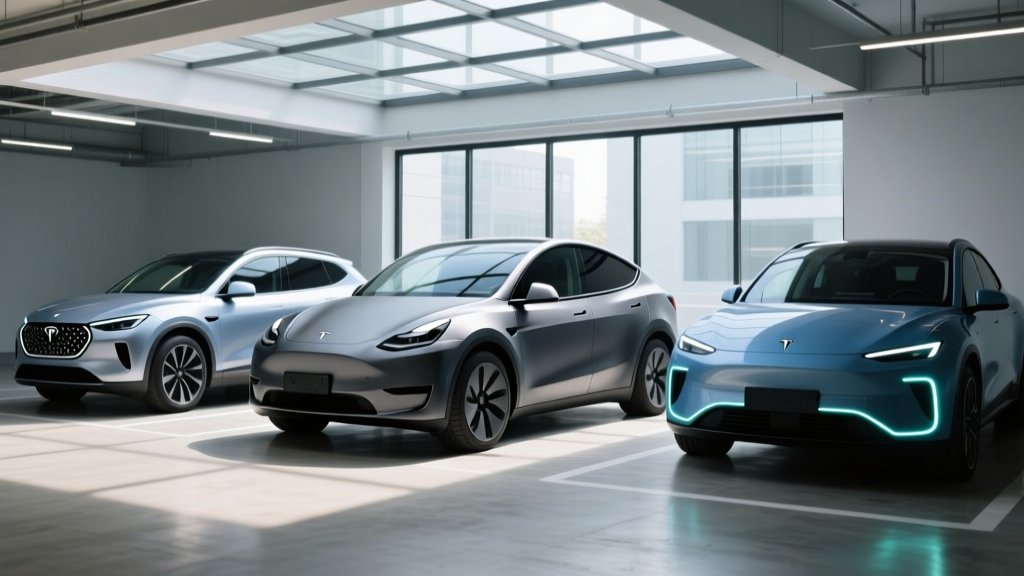
If you've been Googling "station wagon Tesla" hoping to find a long-roof, low-slung electric wagon wearing the Tesla badge, here's the blunt answer: Tesla does not currently sell a station wagon in the United States. Not in 2026, and not since the company stopped producing the original Roadster-era concepts. What Tesla does sell is the Model Y — a compact electric crossover that functionally replaces the station wagon in Tesla's lineup and in the garages of millions of American families who would have bought a wagon a decade ago.
The Model Y's tall hatchback body, flat load floor, and optional third-row seat give it the cargo versatility that wagon buyers crave, wrapped in a crossover silhouette that dominates today's market. Below, we review the 2026 Tesla Model Y through the lens of what a station-wagon shopper actually needs: real-world range, charging speed, cargo dimensions, ownership economics, and whether it holds up against dedicated EV wagons from rival brands.
2026 Tesla Model Y: Core Specs at a Glance
| Specification | Model Y Long Range AWD | Model Y Performance |
|---|---|---|
| EPA Range | 308 miles | 277 miles |
| Battery (usable) | ~75 kWh, NMC | ~75 kWh, NMC |
| Drivetrain | Dual-Motor AWD | Dual-Motor AWD |
| Horsepower | ~384 hp | ~456 hp |
| 0–60 mph | 4.8 seconds | 3.5 seconds |
| MPGe (combined) | 122 MPGe | 111 MPGe |
| Efficiency | 28 kWh/100 mi | 30 kWh/100 mi |
| Max DC Fast Charge | 250 kW (peak) | 250 kW (peak) |
| 10–80% DC Charge Time | ~25 minutes | ~25 minutes |
| Level 2 Home Charge | 11.5 kW (~44 mi/hr) | 11.5 kW (~44 mi/hr) |
| Cargo (rear seats up) | 30.2 cu ft | 30.2 cu ft |
| Cargo (rear seats folded) | 72.0 cu ft | 72.0 cu ft |
| Rear Legroom | 38.2 inches | 38.2 inches |
| Base MSRP | $44,990 | $48,990 |
| Battery/Drive Unit Warranty | 8 yr / 120,000 mi | 8 yr / 120,000 mi |
Source: fueleconomy.gov, Tesla official specifications. Figures reflect the refreshed "Juniper" Model Y introduced for the 2025 model year and carried into 2026.
Real-World Range: What the EPA Sticker Doesn't Tell You
EPA estimate: 308 miles
Real-world highway (70–75 mph, moderate climate): ~250–275 miles
Real-world cold weather (below 32°F, highway): ~200–230 miles
Real-world city/mixed driving (mild climate): ~280–310 miles
The 308-mile EPA figure on the Long Range AWD is legitimate for mixed driving in mild conditions. Tesla's heat pump and efficient drivetrain help it achieve strong city and suburban numbers. However, sustained highway speeds above 70 mph cut range noticeably — expect roughly 15–18% reduction on a 75-mph interstate cruise.
Cold weather compounds this. Lithium-ion batteries lose available capacity in freezing temperatures, and cabin heating draws significant energy even with the heat pump. In our experience and consistent with third-party testing, a Model Y Long Range driven at highway speeds in 20°F weather will deliver roughly 200–230 miles before you need to find a charger. If you live in the upper Midwest or Northeast, budget accordingly.
The Performance trim's 277-mile EPA rating reflects stickier tires and more aggressive tuning. Expect roughly 225–250 miles real-world highway in fair weather.
Charging Speed: Supercharger Network Advantage
| Charging Method | Power | Miles Added per Hour | Notes |
|---|---|---|---|
| Level 1 (120V outlet) | ~1.4 kW | ~3–5 mi/hr | Emergency/trickle only |
| Level 2 (240V home) | 11.5 kW | ~44 mi/hr | Full charge overnight (~7 hrs) |
| DC Fast (Supercharger V3) | 250 kW peak | ~162 mi in 15 min | 10–80% in ~25 min; tapers above 80% |
| DC Fast (CCS adapter at third-party) | Up to 150–250 kW | Varies by station | Requires Tesla CCS adapter (included) |
The Model Y charges via Tesla's proprietary NACS connector, which is now the industry standard — Ford, GM, Rivian, Hyundai, and most other automakers have adopted NACS for their North American vehicles starting in 2025–2026. This means the Model Y accesses the Tesla Supercharger network natively, which remains the most reliable and widespread DC fast-charging network in the U.S. with over 20,000 stalls nationwide.
At a V3 Supercharger (250 kW capable), the Model Y peaks around 250 kW but sustains that rate only briefly. The charge curve tapers progressively above 50% state of charge. A 10–80% session takes roughly 25 minutes. Plan for 30–35 minutes if you're charging from a very low state of charge to 90% for a long road trip leg.
For home charging, a Tesla Wall Connector on a 60-amp circuit delivers the full 11.5 kW (48 amps), adding about 44 miles of range per hour. Most owners charge overnight and wake up with a full battery every morning. A standard 14-50 outlet on a 50-amp circuit delivers about 32 miles per hour — still sufficient for daily needs.
Cargo, Space, and the Wagon Comparison
This is where station-wagon seekers need to pay attention. The Model Y offers 30.2 cubic feet behind the second row and 72.0 cubic feet with the rear seats folded flat. That cargo volume rivals or exceeds many traditional wagons:
- Subaru Outback: 32.5 / 75.7 cu ft (gas)
- Audi A4 Allroad: 24.8 / 64.8 cu ft (gas)
- Volvo V60 Cross Country: 23.2 / 50.9 cu ft (gas/PHEV)
- Mercedes E-Class Wagon: 35.0 / 64.0 cu ft (gas)
The Model Y's hatchback opening is wide, the load floor is flat, and the under-floor storage area adds useful concealed space. The optional third-row seat (a $2,000 add on Long Range) fits small children but is impractical for adults and eliminates some under-floor cargo space.
Where a true wagon wins: a lower load-in height makes loading heavy items easier, and the lower roofline improves aerodynamics. The Model Y's crossover ride height gives it a taller center of gravity, though its battery pack placement keeps handling surprisingly composed.
Rear-seat passengers get 38.2 inches of legroom — competitive with midsize sedans and adequate for most adults on longer trips. Headroom is generous thanks to the tall roof. The full glass roof creates an airy cabin but offers no shade panel in the refreshed Juniper generation, which some owners find uncomfortable in direct summer sun.
Pricing, Trims, and Federal Tax Credit Eligibility
| Trim | Base MSRP | Est. After §30D Credit* | Destination |
|---|---|---|---|
| Model Y Long Range AWD | $44,990 | $37,490 | $1,390 |
| Model Y Performance | $48,990 | $41,490 | $1,390 |
*Estimated price assumes full $7,500 federal tax credit under IRS §30D. Eligibility is not automatic — see checklist below.
- MSRP cap: Vehicle must have an MSRP at or below $80,000 for SUVs/crossovers (Model Y qualifies)
- Buyer income cap: Modified AGI must not exceed $150,000 (single), $225,000 (head of household), or $300,000 (joint filers)
- Battery sourcing: At least 50% of battery components must be manufactured/assembled in North America; critical minerals must meet threshold percentages from U.S. or FTA-partner sourcing
- Point-of-sale transfer: Buyers can elect to transfer the credit to the dealer at purchase, reducing the out-of-pocket price immediately
- Final assembly: Vehicle must undergo final assembly in North America (Model Y is built in Austin, TX and Fremont, CA)
The Model Y has consistently qualified for the full $7,500 credit through recent model years due to Tesla's U.S. manufacturing and battery supply chain adjustments. However, critical-mineral sourcing thresholds tighten annually under the Inflation Reduction Act. Always verify current eligibility on the fueleconomy.gov tax credit page before purchasing, and consult a tax professional regarding your personal eligibility.
Tech, Driver Assistance, and What's Missing
The 2026 Model Y comes standard with Tesla's 15.4-inch center touchscreen running Tesla's proprietary infotainment OS. There are no physical buttons for climate, mirrors, or glovebox — everything routes through the screen. This minimalist approach is either refreshing or maddening depending on your preference, but the system is responsive and receives frequent over-the-air updates.
Tesla Autopilot is standard and includes adaptive cruise control, lane-keeping assist, and automatic emergency braking. This is an SAE Level 2 driver-assistance system — you must keep your hands on the wheel and eyes on the road at all times.
Full Self-Driving (Supervised) remains an $8,000 add-on (or $99/month subscription as of early 2026). It adds automatic lane changes, navigation-based driving, traffic-light recognition, and enhanced parking features. Despite the name, FSD Supervised still requires active driver oversight and does not make the car autonomous.
Notable drawbacks for wagon-minded buyers:
- No physical buttons or knobs — turn-signal stalks were removed in the Juniper refresh, replaced with steering-wheel buttons
- No Apple CarPlay or Android Auto — Tesla uses its own ecosystem exclusively
- No spare tire — only a tire-repair kit
- Glass roof lacks a retractable shade in the 2025+ refresh
- Ride quality is firm; road noise is noticeable on rough pavement
Model Y vs. the Competition: Is There a Better EV Wagon?
| Feature | Tesla Model Y LR AWD | Audi A6 e-tron Avant* | Volvo V60 Recharge (PHEV) |
|---|---|---|---|
| Type | BEV Crossover | BEV Wagon | PHEV Wagon |
| EPA Range | 308 mi | ~300 mi (est.) | 41 mi electric + 400+ mi gas |
| Cargo Volume | 72.0 cu ft | ~53 cu ft (est.) | 50.9 cu ft |
| Base MSRP | $44,990 | ~$72,000 (est.) | $51,095 |
| DC Fast Charge | 250 kW | 270 kW | N/A (PHEV) |
| Federal Credit | $7,500 | Likely $7,500 | $3,750 (PHEV, if eligible) |
| Availability | On sale now | Limited U.S. availability | On sale now |
*Audi A6 e-tron Avant specs are preliminary/estimated based on European announcements. U.S. availability and pricing remain limited as of early 2026.
The honest truth: if you want a true electric station wagon — a low-roof, long-roof BEV — the U.S. market offers almost nothing in 2026. The Audi A6 e-tron Avant is stunning but expensive and barely available stateside. The Porsche Taycan Cross Turismo is technically a lifted wagon but starts above $100,000. The Volvo V60 Recharge is a plug-in hybrid, not a full EV.
For most buyers searching "station wagon Tesla," the Model Y is the pragmatic answer. It delivers wagon-grade cargo space, excellent range, access to the best charging network in North America, and a price point that undercuts European alternatives by $25,000 or more. It's not a wagon in silhouette, but it does everything a wagon does — and in several metrics, it does it better.
Pros and Cons
- 308-mile EPA range is among the best in its class
- Tesla Supercharger network reliability is unmatched
- 72 cu ft cargo volume rivals gas-powered wagons
- Qualifies for $7,500 federal tax credit (verify eligibility)
- Strong performance — 4.8s 0–60 in Long Range trim
- Over-the-air updates continuously add features
- Excellent efficiency at 28 kWh/100 mi
- Not a true station wagon — crossover ride height and styling
- No physical buttons; turn signals moved to steering wheel
- No Apple CarPlay or Android Auto
- Firm ride and noticeable road noise
- Glass roof has no retractable shade
- Third-row seat is child-only and eats cargo space
- Insurance costs run 15–25% higher than comparable gas crossovers
Who Should Buy the Model Y (and Who Should Look Elsewhere)
- You need 300+ miles of range and reliable DC fast charging for road trips
- Cargo versatility matters more than wagon aesthetics
- You can install Level 2 home charging and want to wake up "full" daily
- You want a sub-$40,000 effective price after tax credits
- You value OTA software updates and a strong Supercharger network
- You specifically want a low-slung wagon profile (check the used market for a Model S, which is a liftback/sedan but has a larger hatch)
- You need physical buttons, CarPlay, or a traditional instrument cluster
- You tow frequently (the Model Y is rated for 3,500 lbs, but towing cuts range by 40–50%)
- You want a PHEV bridge — the Volvo V60 Recharge or Toyota RAV4 Prime may suit better
Frequently Asked Questions
Does Tesla make a station wagon?
No. Tesla does not produce a station wagon as of 2026. The Model Y crossover is the closest equivalent in Tesla's lineup, offering wagon-comparable cargo space (72 cu ft with seats folded) in a crossover body style. The Model S is a liftback sedan with a hatch, not a wagon.
What is the real-world range of the Tesla Model Y?
The Long Range AWD is EPA-rated at 308 miles. In real-world highway driving at 70–75 mph, expect 250–275 miles. In cold weather (below freezing), highway range drops to approximately 200–230 miles. City and mixed driving in mild conditions can meet or slightly exceed the EPA estimate.
How fast does the Model Y charge at home and on the road?
At home on a 240V Level 2 charger, the Model Y accepts up to 11.5 kW, adding roughly 44 miles of range per hour (full charge in ~7 hours). On a Tesla V3 Supercharger, it peaks at 250 kW DC and charges from 10–80% in approximately 25 minutes. Charging speed tapers significantly above 80% state of charge.
Does the Model Y qualify for the $7,500 federal EV tax credit?
The Model Y has qualified for the full $7,500 credit under IRS §30D through recent model years, as it is assembled in the U.S. and meets battery-sourcing thresholds. However, buyer income caps apply ($150K single / $300K joint), and critical-mineral sourcing rules tighten annually. Verify current eligibility on fueleconomy.gov before purchasing. The credit can be transferred to the dealer at point of sale to reduce your purchase price directly.
Is the Model Y worth buying over a gas station wagon?
Financially, the Model Y Long Range at ~$37,490 after the federal credit competes directly with loaded versions of the Subaru Outback and Toyota RAV4 Hybrid. Over five years, fuel savings (electricity vs. gasoline) and reduced maintenance typically offset any insurance premium increase. The trade-offs are firm ride quality, no physical controls, and dependence on charging infrastructure for road trips.
What's the warranty coverage on the Model Y battery?
Tesla covers the Model Y's battery pack and drive units for 8 years or 120,000 miles (whichever comes first), with a minimum 70% capacity retention threshold. The basic vehicle limited warranty is 4 years or 50,000 miles. Tesla's battery warranty is competitive with the industry standard set by Hyundai (10yr/100K) and slightly behind it in duration but matched in mileage threshold.
Will Tesla ever release an actual station wagon?
There are no confirmed plans from Tesla for a dedicated station wagon. Tesla's next expected vehicles include a more affordable compact model and the Cybercab robotaxi, neither of which is a wagon. If a true EV wagon is a priority, the Audi A6 e-tron Avant (limited U.S. availability) or the Porsche Taycan Cross Turismo (premium pricing) are the closest alternatives.