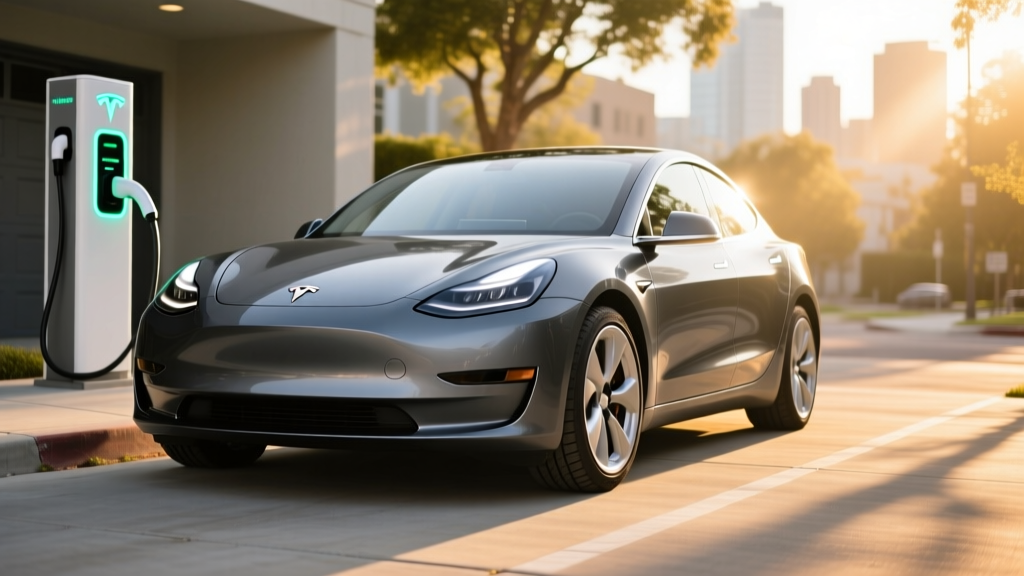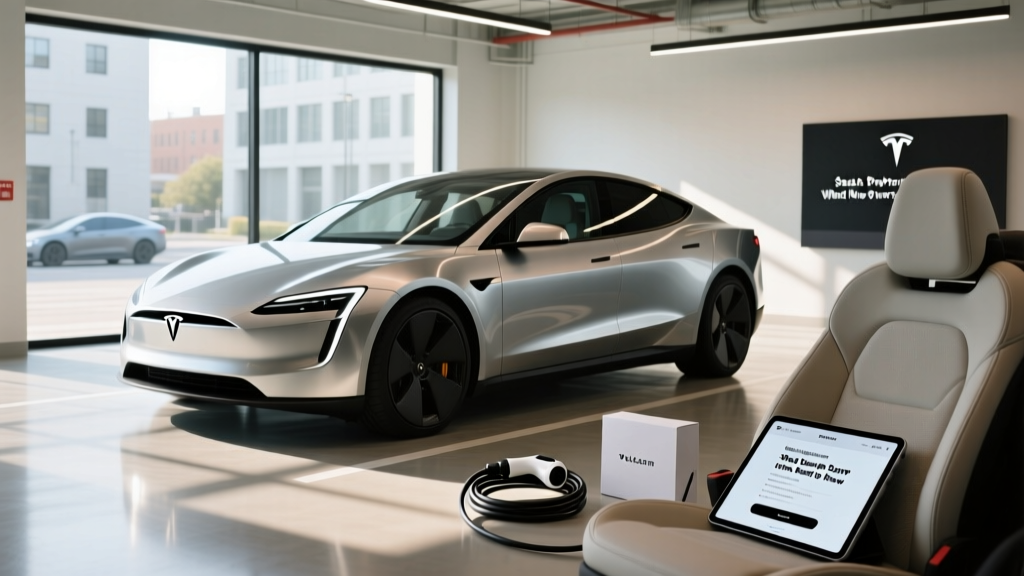
If you have just taken delivery of a new Model 3 or Model Y — or are about to — the Tesla Start Program is the onboarding experience Tesla uses to bridge the gap between signing your paperwork and confidently driving, charging, and maintaining your EV. Unlike legacy automakers that hand you a key fob and a paper manual, Tesla leans on an in-app digital curriculum supplemented by delivery specialists at the delivery center.
This guide breaks down exactly what the Tesla Start Program covers in 2026, where new owners commonly stumble, and the real-world numbers (range, charging speed, tax-credit math) you need to validate what the onboarding materials claim.
What the Tesla Start Program Actually Is
The Tesla Start Program is not a single event. It is a sequenced onboarding flow that begins before you pick up your car and continues through your first 30 days of ownership. It includes:
- Pre-delivery prep: A checklist inside the Tesla app covering insurance binding, trade-in finalization, payment clearing, and home-charger installation status.
- Delivery-day walkthrough: A 30–45 minute session with a delivery specialist covering vehicle controls, regenerative braking behavior, charging-port operation, and basic Autopilot activation.
- In-app tutorials: Short video modules that unlock after delivery, covering topics from trip planning with the navigation system to understanding the charge curve at a Supercharger.
- 30-day check-in: A follow-up prompt in the app asking about charging satisfaction, service questions, and FSD (Supervised) trial enrollment if your vehicle is equipped.
The program's goal is practical: Tesla's service-center capacity is limited, so the better owners self-serve routine questions, the lower the support burden. That makes the Start Program genuinely useful — but also incomplete on the topics that matter most to first-time EV buyers, namely real-world range expectations and home-charging costs.
Range Reality Check: What the Start Program Doesn't Emphasize
- EPA estimated range: 363 miles
- Real-world highway (70 mph, 72°F): ~300–320 miles
- Real-world mixed city/highway (moderate climate): ~330–350 miles
- Cold-weather highway (30°F, cabin heat on): ~240–270 miles
Source: fueleconomy.gov. Real-world figures based on aggregated owner data and independent testing; your results will vary with terrain, speed, HVAC use, and tire condition.
The Start Program's in-app tutorials quote the EPA sticker figure, which is the legally required number. What new owners need to internalize is that highway driving at 75+ mph reduces range by roughly 12–18% versus the EPA combined cycle, and that cold weather with resistive cabin heating can cut range by 25–35%. The Model 3's heat pump (standard since 2021) mitigates this significantly compared to older resistive-heater EVs, but physics still applies.
If your daily commute is 60 miles round-trip and you charge at home nightly, none of this matters operationally. If you plan to road-trip the I-70 corridor in January, plan for 250 miles between Supercharger stops, not 360.
Specs at a Glance: 2026 Model 3 Long Range AWD
| Attribute | Value |
|---|---|
| EPA estimated range | 363 miles |
| Battery capacity (usable) | ~79 kWh, NMC chemistry |
| Efficiency | 132 MPGe combined / 25 kWh per 100 mi |
| Drivetrain | Dual-motor AWD |
| Horsepower | ~384 hp (combined) |
| 0–60 mph | 4.2 seconds |
| Max DC fast-charge rate | 250 kW (peak) |
| 10–80% DC fast-charge time | ~25 minutes |
| Level 2 home charge rate | 11.5 kW (~44 mi/hr) |
| Cargo volume (rear seats up) | 23 cu ft |
| Rear legroom | 35.2 inches |
| Base MSRP (incl. destination) | $47,740 |
| Battery & drivetrain warranty | 8 years / 120,000 miles |
The 2026 Model 3 Long Range uses an NMC (nickel manganese cobalt) battery pack. This chemistry delivers higher energy density than LFP (lithium iron phosphate), which is why the Long Range achieves 363 miles in a relatively compact sedan. The trade-off: Tesla recommends daily charging to 80–90% for NMC longevity, reserving 100% charges for road trips. The base Model 3 RWD, by contrast, uses LFP and can be charged to 100% daily without accelerated degradation — a meaningful ownership difference the Start Program glosses over.
Charging Speed: What New Owners Misunderstand
| Level | Power | Miles Added | Best Use Case |
|---|---|---|---|
| Level 1 (120V household) | ~1.4 kW | ~4 mi/hr | Emergency top-up only |
| Level 2 (240V, 48A Wall Connector) | 11.5 kW | ~44 mi/hr | Daily home charging |
| DC Fast (Supercharger V3) | Peak 250 kW | Up to 175 mi in 15 min | Road trips |
A common gap in the Start Program's tutorials: they quote the peak DC fast-charge rate (250 kW) without explaining the charge curve. The Model 3 Long Range will sustain roughly 200–250 kW from 10% to about 40% state of charge, then taper progressively. By 70% SoC, you are likely pulling 80–100 kW; by 85%, under 50 kW. This is why the 10–80% time is ~25 minutes, but 10–100% would take closer to 45 minutes.
Preconditioning matters. If you navigate to a Supercharger using the car's built-in navigation, the battery management system will warm the pack en route, enabling peak charge rates on arrival. If you drive to a Supercharger without nav preconditioning — especially in cold weather — your initial charge rate may be half the peak for the first several minutes.
For home charging, Tesla's Wall Connector ($420 hardware) on a 60A circuit delivers the full 11.5 kW the Model 3's onboard charger can accept. A typical installation by a licensed electrician runs $800–$2,000 depending on panel proximity and whether your home's electrical panel needs a service upgrade (a 200A panel is generally sufficient; older 100A panels may require a $2,000–$4,000 upgrade).
Pricing, Trims, and the Federal Tax Credit
| Trim | Base MSRP | §30D Credit Eligibility | Effective Price (if eligible) |
|---|---|---|---|
| Model 3 RWD (LFP) | $40,240 | Up to $7,500 (sourcing dependent) | ~$32,740 |
| Model 3 Long Range AWD | $47,740 | Up to $7,500 (sourcing dependent) | ~$40,240 |
| Model 3 Performance | $54,240 | Up to $7,500 (sourcing dependent) | ~$46,740 |
All Model 3 trims fall under the IRS §30D MSRP cap of $55,000 for sedans, making them theoretically eligible for the full $7,500 federal credit. However, eligibility depends on three criteria that change periodically:
- Buyer income caps: Adjusted gross income must not exceed $150,000 (single), $225,000 (head of household), or $300,000 (joint filing).
- Battery critical-mineral sourcing: A percentage of critical minerals must be sourced from the U.S. or FTA partners. This threshold increases annually.
- Battery-component manufacturing: A percentage of battery components must be manufactured or assembled in North America.
As of 2026, the Model 3 RWD (with its LFP battery from CATL) has faced partial-credit disqualification in prior years due to Chinese-sourced minerals. The Long Range AWD's NMC pack, with more North American and FTA-partner sourcing, has historically qualified for the full $7,500. Tesla's checkout page and the fueleconomy.gov tax credit lookup show current eligibility — always verify before purchase, as sourcing rules shift.
Since 2024, buyers can transfer the credit to the dealer at point of sale, reducing the purchase price directly rather than waiting to claim it on a tax return. Tesla participates in this transfer mechanism.
Tech, Driver Assists, and What the Start Program Covers
The Start Program devotes significant tutorial time to two features:
Autopilot (standard): Tesla's baseline driver-assist system includes Traffic-Aware Cruise Control and Autosteer (lane centering). This is an SAE Level 2 system — you must keep your hands on the wheel and eyes on the road at all times. The car monitors steering-torque input and will escalate warnings (chime, visual alert, then disengagement) if it detects inattention.
FSD (Supervised): Available as a $8,000 one-time purchase or $99/month subscription, FSD adds Navigate on Autopilot (automatic highway interchanges), Auto Lane Change, Autopark, and traffic-light/stop-sign recognition. Despite the "Full Self-Driving" name, this remains SAE Level 2 — fully supervised by the driver at all times. The Start Program includes a specific module on FSD's limitations, which is important: the system can and does make errors at construction zones, faded lane markings, and unprotected left turns.
Other tech highlights covered in the Start Program:
- 15.4-inch center touchscreen running Tesla's proprietary infotainment OS (no Apple CarPlay or Android Auto)
- Over-the-air (OTA) software updates that can add features or modify vehicle behavior
- Sentry Mode (parked-camera security recording)
- Dog Mode and Camp Mode (climate-maintenance settings for parked vehicle)
Pros, Cons, and Who This EV Suits
- Supercharger network — 50,000+ stalls globally, highest reliability of any public charging network
- Class-leading efficiency (25 kWh/100mi) means lower per-mile charging cost
- Strong 0–60 performance (4.2s) without a performance-trim price premium
- OTA updates add features post-purchase
- Low maintenance: no oil changes, minimal brake wear due to regen
- No Apple CarPlay / Android Auto — Tesla's UI is the only interface
- Rear-seat space (35.2" legroom) is tighter than competing midsize sedans
- Panel-gap and paint-quality inconsistencies still reported by some owners
- Insurance premiums often 15–30% higher than comparable ICE sedans
- Service-center wait times can stretch weeks in high-volume metro areas
Who the Model 3 Long Range suits best: Tech-comfortable commuters and couples who want a single-vehicle solution for daily driving and 300-mile road trips. The Supercharger network makes it the most practical EV for apartment dwellers who rely on public charging. It is less ideal for families needing rear-facing car seats (rear legroom is the constraint) or anyone who wants CarPlay integration.
Who should consider competitors instead: The Hyundai Ioniq 6 offers comparable range (361 mi) with CarPlay and a more traditional interior. The BMW i4 eDrive40 trades some range for superior build quality and driving dynamics. The Chevrolet Equus (if available in your market) offers more interior volume at a lower entry price.
Maximizing the Tesla Start Program: A Practical Checklist
- Before delivery: Install your Level 2 home charger (or confirm workplace/public charging access). The Start Program assumes you have a charging plan; arriving home with 40% battery and no charger is a preventable stress.
- At delivery: Ask the specialist to demonstrate regenerative braking behavior in the lot — the one-pedal driving feel takes 1–2 days of adjustment if you are coming from an ICE vehicle.
- Week 1: Complete the in-app tutorials on trip planning. Learn to use the built-in navigation's Supercharger routing — it accounts for elevation, temperature, and charge-curve taper, which third-party apps sometimes approximate less accurately.
- Week 2: If you purchased FSD, activate it on a familiar highway route in low-traffic conditions. Build a mental model of where it performs well (well-marked divided highways) and where it requires intervention (merges, construction zones, rural roads).
- Month 1: Review your charging cost data in the app. Most owners find home charging at $0.12–$0.18/kWh translates to $0.03–$0.05 per mile — roughly one-quarter the fuel cost of a 28-MPG gas sedan at $3.50/gallon.
Frequently Asked Questions
Does the Tesla Start Program cost extra?
No. It is included with every new Tesla delivery at no additional charge. It is not a subscription or a premium service tier — it is Tesla's standard onboarding process.
What is the real-world range of the 2026 Model 3 Long Range?
The EPA estimates 363 miles. Expect ~300–320 miles on sustained highway driving at 70–75 mph in moderate temperatures, and ~240–270 miles in freezing weather with cabin heat. City driving with frequent regenerative braking often matches or slightly exceeds the EPA figure.
How fast does the Model 3 charge at home and on the road?
At home on a Level 2 Wall Connector (11.5 kW), you add roughly 44 miles per hour — a full overnight charge from 20% to 90% takes about 5 hours. On a V3 Supercharger, the peak rate is 250 kW with a 10–80% time of approximately 25 minutes, though the charge curve tapers significantly above 60% SoC.
Does the 2026 Model 3 qualify for the $7,500 federal EV tax credit?
The Model 3 Long Range AWD and Performance trims have historically qualified for the full $7,500 under §30D. The RWD trim's LFP battery has faced partial disqualification in some years due to critical-mineral sourcing rules. Always verify current eligibility on fueleconomy.gov or with a tax professional before purchase. Buyer income caps also apply.
Is the Tesla Start Program the same as FSD?
No. The Start Program is Tesla's ownership onboarding experience (tutorials, delivery walkthrough, check-ins). FSD (Full Self-Driving, Supervised) is a separately purchased driver-assist software feature. The Start Program includes tutorials about FSD but does not include the feature itself.
What are the biggest drawbacks new owners report?
The most common complaints during the 30-day Start Program check-in are: (1) no Apple CarPlay or Android Auto, (2) rear-seat legroom tighter than expected, (3) learning curve for regen braking, and (4) service-center appointment availability in some metro areas. Most owners report high satisfaction with driving dynamics and charging convenience.