Quick Verdict: Connectivity Meets the Road
Tesla's integration of Starlink satellite internet into its 2026 vehicle lineup represents a meaningful shift in how EVs stay connected beyond cellular coverage. While Tesla internet satellites don't change the driving dynamics of a Model Y Long Range AWD, they solve a persistent ownership pain point: dead zones on rural highways, remote trailheads, and cross-country road trips where LTE drops entirely. This review examines the 2026 Tesla Model Y Long Range AWD — Tesla's volume seller and the primary beneficiary of Starlink-backed connectivity — through the lens of range, charging, performance, pricing, and what satellite internet actually delivers for daily drivers.
| Spec | Value |
|---|---|
| EPA Range | 320 miles |
| Battery Capacity | 78.1 kWh usable (NMC) |
| Drivetrain | Dual-Motor AWD |
| Horsepower | 384 hp combined |
| 0–60 mph | 4.8 seconds |
| Peak DC Fast Charge | 250 kW |
| 10–80% DC Charge Time | ~27 minutes |
| Level 2 Home Charge Rate | 11.5 kW (~44 mi/hr) |
| MPGe (Combined) | 122 MPGe |
| Efficiency | 28 kWh/100 mi |
| Cargo Volume | 76.2 cu ft (rear seats folded) |
| Rear Legroom | 41.6 in |
| Battery Warranty | 8 years / 120,000 miles |
| Base MSRP | $44,990 |
Range & Efficiency: EPA vs. the Real World
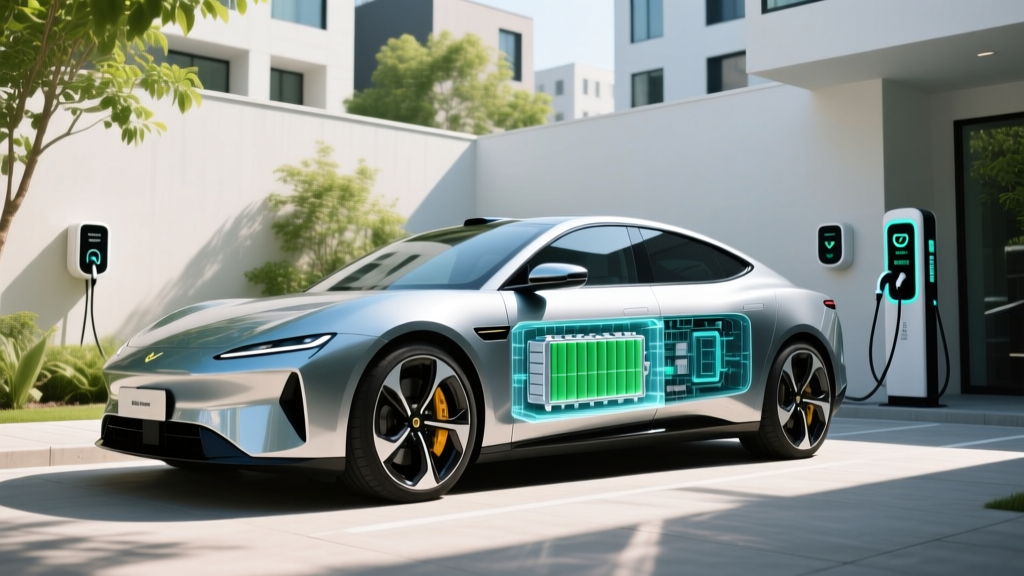
The 2026 Model Y Long Range AWD carries an EPA-estimated 320 miles of range from its 78.1 kWh usable NMC battery pack. That figure is competitive within the midsize electric crossover segment, though real-world results depend heavily on conditions.
EPA 320 mi — Expect 270–290 mi on sustained highway driving at 70+ mph. In freezing temperatures (below 32°F), plan for 220–260 mi due to cabin heating demand and reduced battery chemistry efficiency. City/regenerative driving can match or slightly exceed the EPA sticker.
Efficiency lands at 28 kWh per 100 miles (122 MPGe combined per EPA). The Model Y's heat pump — standard since the 2021 refresh — mitigates some cold-weather loss compared to resistance-heated competitors, but physics still wins in sub-zero conditions. If your commute involves mountain passes or sustained 80 mph interstate runs, budget 15–20% below the sticker number for trip planning.
Charging: Supercharger Network + Starlink Reliability
Charging speed remains one of the Model Y's strongest practical attributes. The 2026 Long Range AWD peaks at 250 kW on DC fast chargers (Tesla V3/V4 Superchargers), achieving a 10–80% charge in approximately 27 minutes. The charge curve is well-managed: you'll sustain 200+ kW through roughly 45% SoC before tapering begins, then a gradual ramp-down through 80%.
| Charge Level | Power | Speed / Time |
|---|---|---|
| Level 1 (120V household) | ~1.4 kW | ~3–4 mi/hr |
| Level 2 (240V / Wall Connector) | 11.5 kW | ~44 mi/hr (full charge ~8 hr) |
| DC Fast Charge (Supercharger) | 250 kW peak | 10–80% in ~27 min |
Here's where Tesla internet satellites add practical value: Supercharger stalls in remote areas — think I-70 through Kansas, rural Montana, or desert stretches of I-10 — often suffer from poor cellular coverage. Starlink-backed connectivity ensures the vehicle can authenticate charging sessions, pull real-time stall availability, and download OTA firmware updates even when your phone shows zero bars. It also means navigation rerouting around charger outages works without cellular dependency.
For home charging, Tesla's Wall Connector at 11.5 kW delivers roughly 44 miles of range per hour of charging. A typical overnight session (8 hours on a 48-amp circuit) replenishes the full battery. Installation costs vary — expect $800–$2,000 total depending on panel capacity and conduit runs. A licensed electrician should verify your panel has headroom for a 60-amp breaker before purchase.
Performance & Drivetrain
The dual-motor AWD powertrain produces 384 combined horsepower, launching the Model Y Long Range to 60 mph in 4.8 seconds. That's brisk for a 4,400-lb crossover and sufficient for confident highway merging. The instant torque delivery characteristic of electric motors makes the car feel quicker than the number suggests in 0–30 mph urban acceleration.
Ride quality in the 2026 model benefits from Tesla's ongoing suspension tuning revisions. The Juniper-refreshed chassis is noticeably more compliant over expansion joints than 2023-era Model Ys, though it still favors firmness over plushness compared to a Hyundai Ioniq 5 or Ford Mustang Mach-E. Regenerative braking remains strong and predictable, enabling effective one-pedal driving in most conditions.
Starlink Satellite Internet: What It Actually Does
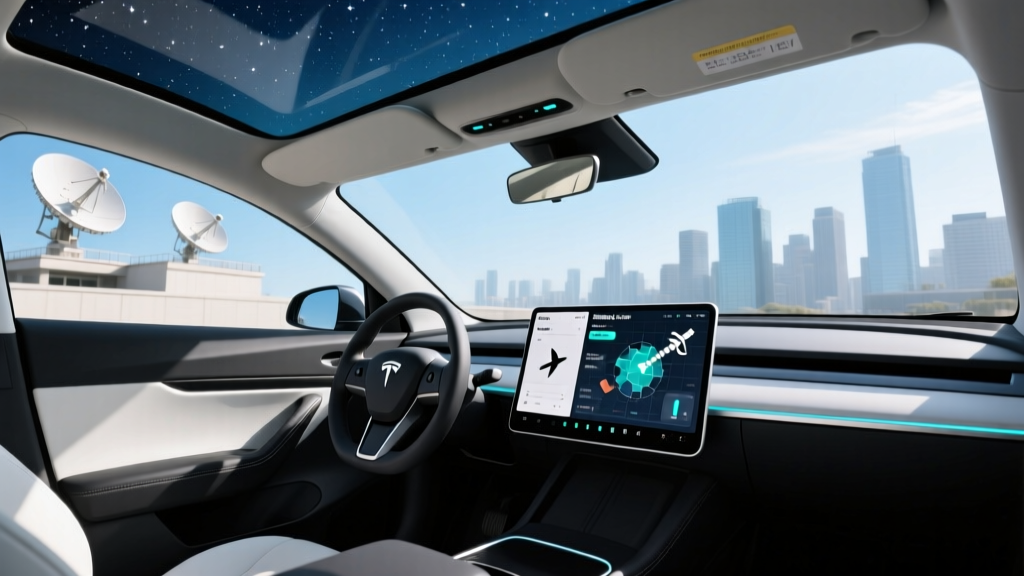
Let's address the keyword directly. Tesla internet satellites refer to Tesla's leveraging of SpaceX's Starlink low-earth-orbit constellation to provide connectivity for Tesla vehicles in areas where traditional cellular networks fail. As of 2026, this integration primarily supports:
- Navigation & traffic data in cellular dead zones — real-time rerouting without phone tethering
- OTA (over-the-air) software updates downloaded reliably regardless of location
- Streaming media — Spotify, YouTube (while parked), and Netflix with lower buffering in remote areas
- Sentry Mode clip uploads — security footage uploads even from rural driveways or trailhead parking
- Supercharger session authentication — plug-and-charge billing without cellular handshake delays
This is not a replacement for your home broadband, and it does not turn the car into a mobile Wi-Fi hotspot for laptops (Tesla's Premium Connectivity subscription covers the vehicle's own systems). Latency from LEO satellites sits around 25–45 ms — fine for streaming and navigation, but not competitive with fiber for real-time gaming. The practical benefit is reliability: your car stays connected where other EVs lose their data link entirely.
Tesla's Premium Connectivity subscription ($9.99/month or $99/year as of 2026) covers satellite data, live traffic visualization, satellite-view maps, video streaming, and the Caraoke feature. Without it, basic navigation and phone-as-key still function, but streaming and live map overlays do not.
Interior, Tech & Cargo Space
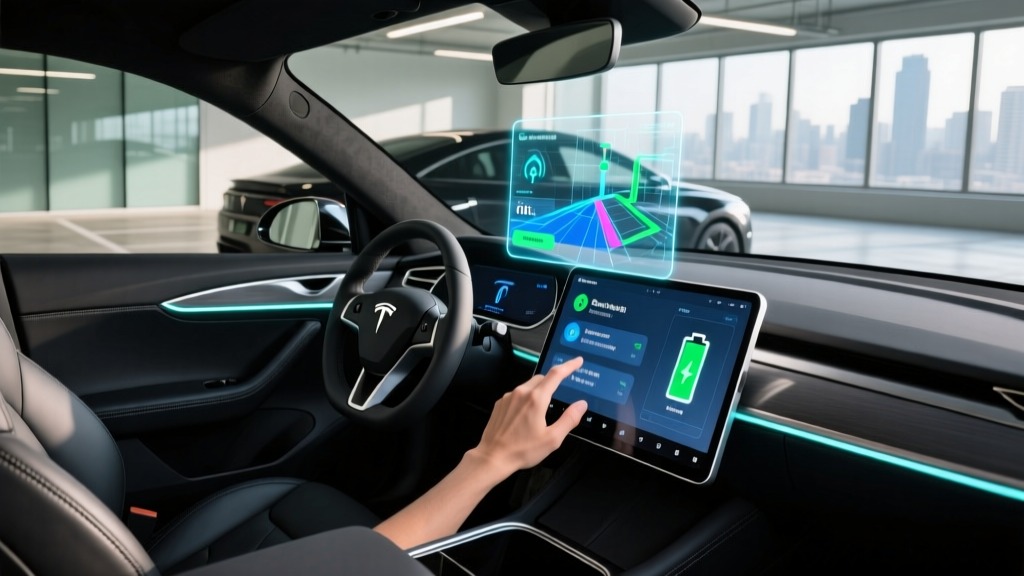
The 2026 Model Y's Juniper-refreshed interior is materially improved over prior years. Ventilated front seats, ambient lighting, a rear-seat touchscreen for climate and media control, and power-folding second-row seats are now standard on Long Range trims. The 15.4-inch center touchscreen runs Tesla's latest software with responsive touch input and an improved voice assistant.
Cargo capacity remains a segment strength: 76.2 cubic feet with the second row folded, or 30.2 cu ft behind the rear seats. The front trunk (frunk) adds 4.1 cu ft for charging cables or a small bag. Rear legroom measures 41.6 inches — adequate for adults on longer trips, though the sloping roofline cuts into headroom for passengers over 6 feet.
Driver assistance comes via Tesla's Autopilot (standard) or Full Self-Driving Supervised ($8,000 one-time or $99/month). To be clear: FSD is an SAE Level 2 system — it requires continuous driver supervision and does not make the vehicle self-driving. It handles lane changes, traffic-light recognition, and navigation-guided highway ramps competently, but you must keep hands on the wheel and eyes on the road. Only Level 4 services like Waymo operate without a driver engaged.
Pricing, Trims & Federal Tax Credit Eligibility
The 2026 Model Y is offered in three primary trims:
| Trim | MSRP | §30D Credit Eligibility | Effective Price (if eligible) |
|---|---|---|---|
| Long Range RWD | $42,990 | Up to $7,500 | ~$35,490 |
| Long Range AWD | $44,990 | Up to $7,500 | ~$37,490 |
| Performance AWD | $48,990 | Up to $7,500 | ~$41,490 |
Federal tax credit eligibility under IRS §30D requires meeting several conditions simultaneously:
- MSRP cap: SUVs/crossovers must be at or below $80,000 (all Model Y trims qualify)
- Buyer income cap: AGI ≤ $150,000 single / $300,000 joint filers
- Battery sourcing: Critical minerals and battery components must meet phased-in percentages from US or FTA-partner countries — Tesla's supply chain has largely complied for 2026, but verify at purchase
- Point-of-sale transfer: The credit can be applied at purchase, reducing your out-of-pocket cost immediately rather than waiting for tax filing
An as-tested Long Range AWD with FSD Supervised and a pearl white multi-coat paint upgrade lands around $54,000 before any credit. Consult a tax professional to confirm your specific eligibility — rules are subject to legislative changes and individual circumstances vary.
Warranty & Long-Term Ownership
Tesla provides an 8-year / 120,000-mile battery and drive unit warranty for the Model Y Long Range, with a capacity retention threshold of 70%. If the battery degrades below 70% of original capacity within that period, Tesla covers repair or replacement. The basic vehicle limited warranty covers 4 years / 50,000 miles.
NMC battery chemistry in the Long Range offers higher energy density (enabling the 320-mile range in a compact pack) but is more sensitive to sustained 100% SoC storage than LFP chemistry. Tesla recommends daily charging to 80–90% and only charging to 100% before long trips. Long-term degradation data from Tesla fleet analytics suggests most NMC packs retain 88–92% capacity at 100,000 miles — well within the warranty threshold.
Insurance costs remain a consideration: Model Y premiums average 15–25% higher than comparable ICE crossovers due to repair costs and Tesla's direct-estimation collision repair network. Get a quote before purchasing to avoid surprises.
Pros, Cons & Who Should Buy
- 320-mile EPA range covers most commutes and road-trip segments comfortably
- 250 kW Supercharger access with the most reliable public charging network in the US
- Starlink satellite connectivity eliminates dead-zone anxiety on rural routes
- Class-leading cargo volume (76.2 cu ft) for a midsize electric crossover
- OTA updates continuously add features post-purchase
- Strong efficiency (28 kWh/100 mi) keeps per-mile charging cost low
- Highway and cold-weather range drops are real — plan for 220–270 mi in adverse conditions
- FSD Supervised ($8,000) is expensive for an SAE Level 2 system requiring driver attention
- No Apple CarPlay or Android Auto — Tesla's native infotainment is the only option
- Insurance premiums run higher than segment average
- Rear headroom compromised by coupe-like roofline for tall passengers
- Premium Connectivity subscription ($99/yr) required for satellite features
Best for: Tech-forward commuters and road-trippers who regularly drive through areas with inconsistent cellular coverage. The combination of Supercharger infrastructure, satellite-backed connectivity, and 320-mile range makes the Model Y Long Range AWD especially practical for drivers in the Mountain West, rural Midwest, or anyone who frequently leaves metro areas. Families will appreciate the cargo space, though those with tall teenagers should test-fit rear-seat comfort.
Consider alternatives if: You need Apple CarPlay (look at Hyundai Ioniq 5 or Ford Mach-E), want a softer ride (Kia EV6), or prioritize maximum rear-seat headroom (VW ID.4). If you exclusively drive in well-covered urban areas, the Starlink connectivity advantage is less impactful.
Frequently Asked Questions
What is the real-world range of the 2026 Tesla Model Y Long Range?
The EPA rates it at 320 miles. In real-world highway driving at 70–80 mph, expect 270–290 miles. In freezing weather with cabin heat active, plan conservatively for 220–260 miles. City driving with regenerative braking can match or slightly exceed the EPA figure.
How fast does the Model Y charge at home and on the road?
On a Level 2 home charger (11.5 kW / 48-amp circuit), you'll add roughly 44 miles per hour — a full overnight charge takes about 8 hours. On a Tesla V3/V4 Supercharger, the Model Y peaks at 250 kW DC and charges from 10% to 80% in approximately 27 minutes.
Does the 2026 Model Y qualify for the $7,500 federal EV tax credit?
It can, but eligibility depends on your income (≤$300,000 AGI for joint filers / ≤$150,000 single), the vehicle's MSRP (must be ≤$80,000 for SUVs — all Model Y trims qualify), and battery-sourcing requirements. The credit can be transferred at point of sale. Always verify current IRS §30D rules and consult a tax professional.
How do Tesla internet satellites (Starlink) improve the ownership experience?
Starlink LEO satellite connectivity ensures the vehicle maintains a data connection in areas without cellular coverage. This enables reliable navigation rerouting, OTA updates, streaming, Sentry Mode uploads, and Supercharger session authentication in rural and remote areas. It requires an active Premium Connectivity subscription ($99/year).
Is the Model Y worth buying over the Hyundai Ioniq 5 or Ford Mustang Mach-E?
The Model Y wins on Supercharger network access, cargo volume, satellite connectivity, and software integration. The Ioniq 5 offers faster 800V charging (~18 min 10–80%), Apple CarPlay, and a more comfortable ride. The Mach-E provides a more traditional crossover feel and strong handling. Your decision should hinge on charging-network preference, infotainment ecosystem, and whether satellite connectivity matters for your driving patterns.
What is the battery warranty on the 2026 Model Y?
Tesla covers the battery and drive unit for 8 years or 120,000 miles (whichever comes first) with a 70% minimum capacity retention guarantee. The basic vehicle warranty covers 4 years or 50,000 miles.