Quick Verdict: The Entry-Level Tesla Still Punches Hard
The 2026 Tesla Model 3 Rear-Wheel Drive remains the most affordable way into the Tesla ecosystem, starting at $38,990 before incentives. With an EPA-estimated 363 miles of range from a 60 kWh LFP battery, it outdistances most rivals in its price bracket. But the base trim ships with Tesla Standard Connectivity — a package that strips away satellite maps, live traffic visualization, and in-car streaming. For many buyers, that trade-off is perfectly acceptable. For others, it's a dealbreaker hiding in the fine print.
This review covers the full ownership picture: real-world range, charging speeds, tax-credit math, and exactly what Standard Connectivity includes versus what you surrender.
Range, Battery, and Real-World Efficiency
The 2026 Model 3 RWD uses a 60 kWh usable lithium iron phosphate (LFP) battery pack. LFP chemistry trades some energy density for superior cycle life, thermal stability, and the ability to charge routinely to 100% without accelerating degradation — a significant daily-use advantage over NMC packs.
Real-World Expectation: ~290–320 miles at sustained highway speeds (70–80 mph); ~240–270 miles in sub-30°F winter conditions with cabin heating. City driving with regenerative braking can match or slightly exceed the EPA figure.
| Attribute | Value |
|---|---|
| EPA Range | 363 miles |
| Battery (usable) | 60 kWh, LFP chemistry |
| Efficiency | 132 MPGe combined / 25 kWh per 100 mi |
| Motor / Drivetrain | Single motor, RWD |
| Horsepower | 271 hp |
| 0–60 mph | 5.8 seconds |
| Max DC Fast Charge | 170 kW (peak) |
| 10–80% DC Charge Time | ~25 minutes |
| Level 2 Home Charge Rate | 11.5 kW (~44 mi/hr) |
| Cargo Volume | 23 cu ft (rear trunk + frunk) |
| Rear Legroom | 35.3 inches |
| Battery Warranty | 8 years / 100,000 miles (70% retention) |
| Base MSRP | $38,990 |
The LFP pack's tolerance for 100% daily charging means your usable daily range is genuinely close to 363 miles — unlike NMC packs where Tesla recommends an 80% daily limit, effectively reducing their usable capacity. According to fueleconomy.gov, the Model 3 RWD's 132 MPGe combined places it among the most efficient EVs sold in the U.S.
Charging Speed: DC Fast, Level 2, and Level 1
Charging performance is where the Model 3 RWD's LFP pack shows a minor limitation compared to Long Range variants. Peak DC fast-charge rate is 170 kW, and the charge curve tapers noticeably after 60% state of charge. Expect a 10–80% session to take approximately 25 minutes at a V3 Supercharger or equivalent 180+ kW CCS/NACS station.
| Level | Power | Miles Added Per Hour | Typical Use Case |
|---|---|---|---|
| Level 1 (120V) | ~1.4 kW | ~5 mi/hr | Emergency / overnight trickle |
| Level 2 (240V, 48A) | 11.5 kW | ~44 mi/hr | Home daily charging |
| DC Fast (NACS) | 170 kW peak | ~700 mi/hr (peak) | Road trips, Superchargers |
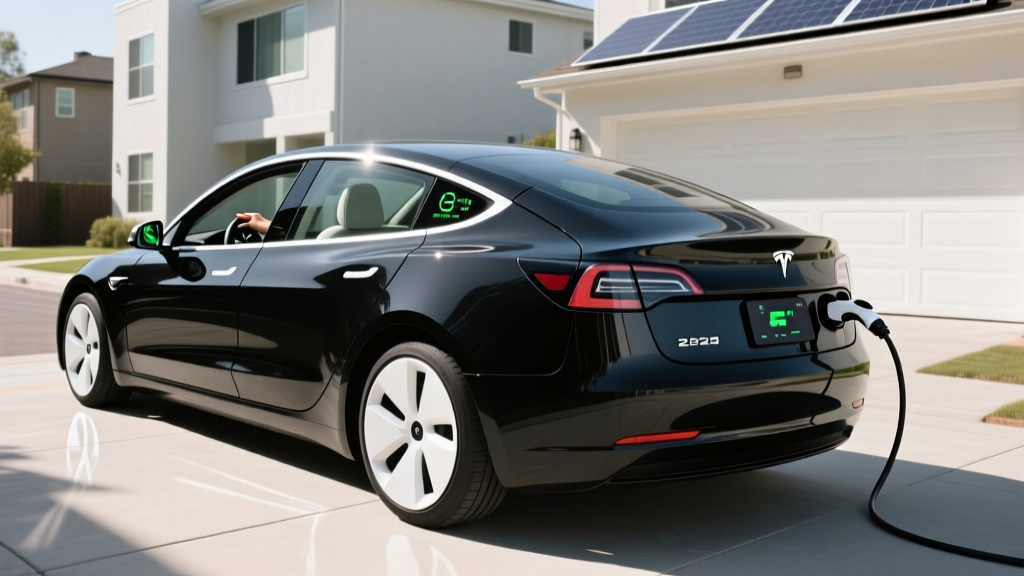
At home on a 240V/48A Level 2 circuit (such as a Tesla Wall Connector or equivalent NACS unit), the onboard charger accepts up to 11.5 kW, replenishing a full battery in roughly 5.5 hours. Most owners charging overnight from 20% to 100% will wake to a full pack every morning. Level 1 charging from a standard outlet is viable only for low-mileage commuters adding ~50 miles overnight.
What Tesla Standard Connectivity Actually Includes
Every new Tesla ships with Standard Connectivity at no extra cost. Here's what that covers — and what it omits:
Standard Connectivity includes:
- Turn-by-turn navigation with basic map view
- Bluetooth and Wi-Fi music streaming from your phone
- Over-the-air (OTA) software updates via Wi-Fi
- Remote app access (climate control, location, charging status)
- Basic voice commands
- Dashcam and Sentry Mode recording
Standard Connectivity omits (requires Premium at $9.99/month or $99/year):
- Satellite-imagery map tiles
- Live traffic visualization on the map
- In-car music streaming (Spotify, Tidal, etc.) without phone tethering
- Video streaming (Netflix, YouTube, Twitch) while parked
- Caraoke with lyrics display
- Web browser access
For commuters who mount their phone for Spotify and don't need satellite maps, Standard Connectivity is entirely adequate. Navigation still functions — you simply see a flat, simplified map rather than photorealistic terrain. The $99/year Premium upsell is worthwhile primarily for families who use in-car entertainment during charging stops or for drivers who rely on live traffic overlays for route optimization.
Pricing, Trims, and Federal Tax Credit Eligibility
The 2026 Model 3 lineup is structured as follows:
| Trim | Base MSRP | Est. Price After §30D Credit | Drivetrain |
|---|---|---|---|
| RWD (Standard Range) | $38,990 | ~$31,490* | Rear-Wheel Drive |
| Long Range AWD | $45,990 | ~$38,490* | Dual-Motor AWD |
| Performance | $52,990 | ~$45,490* | Dual-Motor AWD |
*Estimated price assumes full $7,500 federal tax credit applied at point of sale. Eligibility is not guaranteed.
The Model 3 RWD qualifies for the IRS §30D Clean Vehicle Credit — up to $7,500 — provided the buyer meets all current requirements. Per IRS guidelines, these include:
- MSRP cap: Vehicle base price must not exceed $55,000 (sedans). All Model 3 trims clear this.
- Income cap: Modified AGI ≤ $150,000 (single), $225,000 (head of household), $300,000 (joint).
- Battery sourcing: Critical minerals and battery components must meet phased-in domestic/free-trade sourcing thresholds. Tesla's shifting supply chain means eligibility can change mid-year — always verify the specific VIN on the IRS eligible vehicle list before purchase.
- Point-of-sale transfer: Buyers can elect to transfer the credit to the dealer, reducing the purchase price at closing rather than waiting for a tax refund.
A typical as-tested Model 3 RWD with Midnight Cherry Red paint ($2,000), 19-inch Nova wheels ($1,500), and Premium Connectivity ($99/yr) lands around $42,589 before credit — or approximately $35,089 after the full $7,500 point-of-sale reduction.
Performance, Ride, and Interior
The single rear motor delivers 271 hp and a 5.8-second 0–60 mph time — brisk for a daily commuter and competitive with turbocharged gas sedans. RWD means the rear end can step out on wet or icy roads with aggressive throttle input, but Tesla's traction control intervenes quickly. Drivers in snow-belt states should weigh the AWD Long Range variant.
Interior materials received a refresh in the current generation: ventilated front seats, ambient lighting, a rear-seat touchscreen for climate and media, and improved sound insulation. Cargo space totals 23 cubic feet across the rear trunk and front trunk (frunk), enough for two carry-on bags and a week's groceries. Rear legroom at 35.3 inches is adequate for adults on shorter trips but tighter than a Hyundai Ioniq 6 or BMW i4.
The 15.4-inch center touchscreen handles all vehicle controls — there are no physical buttons for climate, mirrors, or glovebox. New owners typically adapt within a week, but the lack of physical stalks (turn signals are now steering-wheel buttons) remains polarizing.
Driver Assistance: Autopilot and FSD Supervised
Standard Autopilot (included) provides adaptive cruise control and lane-centering on highways. Enhanced Autopilot ($6,000) adds automatic lane changes, Navigate on Autopilot, and Smart Summon. Full Self-Driving (Supervised) at $8,000 adds traffic-light and stop-sign recognition with automatic responses, plus city-street autosteer. None of these remove the driver's legal and practical responsibility to supervise.
Who Should Buy the Model 3 RWD — And Who Shouldn't
- You commute under 60 miles round-trip and can charge at home
- You want 300+ miles of range under $40,000 before incentives
- You value OTA updates and the Supercharger network
- You prefer LFP chemistry for long-term 100% daily charging
- You regularly drive in snow/ice and need AWD (consider Long Range or an Ioniq 5 AWD)
- You need back-seat space for tall teenagers or rear-facing car seats
- You want physical buttons, Apple CarPlay, or Android Auto
- You tow anything (Model 3 is not rated for towing in the U.S.)
- 363-mile EPA range — class-leading at this price
- LFP battery tolerates daily 100% charging
- Access to Tesla Supercharger network (17,000+ U.S. stalls)
- Low running costs: ~$0.04–0.06/mile on home electricity
- Strong resale value and OTA feature updates
- Standard Connectivity lacks satellite maps and live traffic
- No Apple CarPlay or Android Auto
- Rear seat is tighter than midsize competitors
- RWD only — no AWD option on base trim
- Turn-signal buttons on steering wheel require adaptation
Frequently Asked Questions
What is the real-world range of the 2026 Model 3 RWD?
The EPA rates it at 363 miles. In real-world highway driving at 70–80 mph, expect 290–320 miles. In freezing temperatures with cabin heat, plan for 240–270 miles. City driving with regenerative braking can approach or match the EPA sticker.
How fast does the Model 3 RWD charge?
On a DC fast charger, it peaks at 170 kW and reaches 10–80% in approximately 25 minutes. At home on a 240V Level 2 charger, it accepts 11.5 kW, adding about 44 miles of range per hour — a full charge takes roughly 5.5 hours.
Does the Model 3 RWD qualify for the $7,500 federal EV tax credit?
It can, subject to IRS §30D rules. The buyer must meet income caps ($150K single / $300K joint), the vehicle MSRP must be under $55,000 (it is), and battery-critical-mineral sourcing must meet current-year thresholds. Always verify VIN eligibility on the IRS website before purchasing, as sourcing rules shift periodically.
What does Tesla Standard Connectivity leave out?
You lose satellite map imagery, live traffic overlays on the navigation map, native in-car music and video streaming, the web browser, and Caraoke with lyrics. Navigation, Bluetooth audio, OTA updates, and app remote features all still work. Premium Connectivity costs $99/year to restore the missing features.
Is the Model 3 RWD worth it versus a Hyundai Ioniq 6 or Chevrolet Equinox EV?
The Model 3 RWD wins on range (363 vs. 361 for the Ioniq 6 SE, ~315 for the Equinox EV) and Supercharger network access. The Ioniq 6 offers a more traditional interior with physical controls and slightly faster 10–80% charging at 350 kW-capable chargers. The Equinox EV undercuts on price but trails in efficiency. If Supercharger access and software ecosystem matter to you, the Model 3 is the stronger pick. If you prefer physical buttons and AWD availability at this price point, the Ioniq 6 or Ioniq 5 may suit better.
What is the battery warranty?
Tesla covers the Model 3 RWD battery and drive unit for 8 years or 100,000 miles, whichever comes first, with a guaranteed minimum 70% capacity retention over that period. LFP chemistry historically shows slower degradation than NMC, meaning most owners will exceed the 70% threshold well beyond the warranty period.