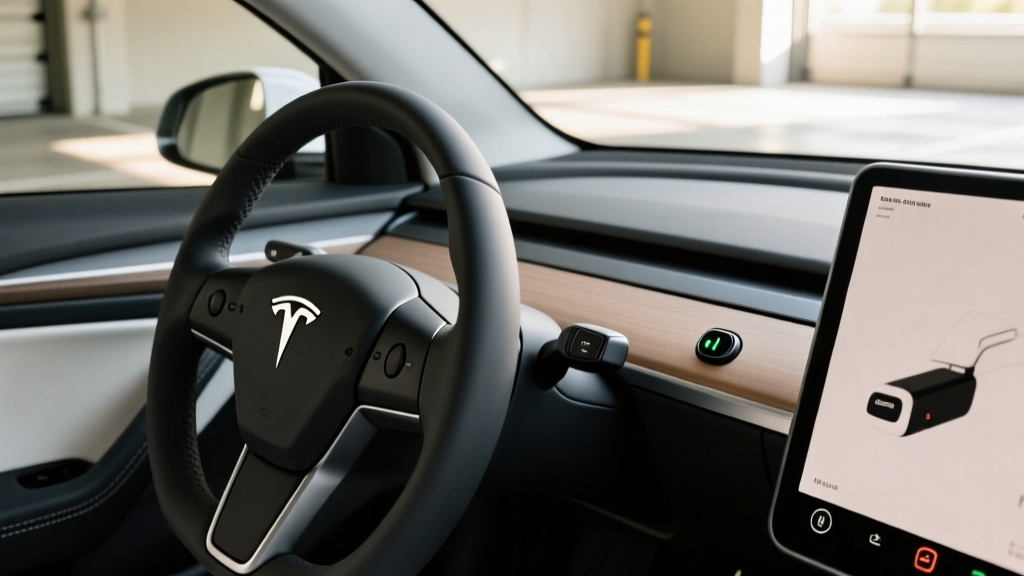
If you have browsed EV forums lately, you have likely encountered the term Tesla stalk — or more accurately, the lack of one. Starting with the refreshed Model 3 "Highland" and carrying into the 2026 Model Y "Juniper," Tesla removed the traditional turn-signal stalk from the steering column. In its place: capacitive-touch buttons on the steering wheel and an auto-canceling algorithm that attempts to predict when you no longer need the signal.
This decision has polarized owners, reviewers, and driving-safety advocates. In this deep-dive review, we examine the real-world implications of the stalk delete across the 2026 Tesla lineup, how it affects daily driving, and whether it should influence your next EV purchase.
What Exactly Is the Tesla Stalk Delete?
For decades, every road-legal car sold in the United States has featured a physical turn-signal stalk protruding from the steering column. Push up for a right turn, push down for a left, and a spring-loaded mechanism returns the lever to center after the wheel straightens. It is muscle memory for hundreds of millions of drivers.
Tesla eliminated this stalk beginning with the 2024 Model 3 Highland refresh. The 2025 and 2026 Model 3 and the redesigned 2026 Model Y "Juniper" continue this approach. Instead of a stalk, drivers use:
- Steering-wheel buttons: Left and right capacitive-touch arrows embedded in the wheel rim
- Auto-cancel software: An algorithm that uses GPS, camera data, and steering angle to determine when a turn is complete and deactivate the signal
- Touchscreen override: A backup signal toggle in the vehicle's UI
Tesla also moved the windshield-wiper stalk functions to the touchscreen and steering-wheel controls in these vehicles. The gear selector (PRND) was previously moved to the touchscreen and overhead console in the Model S/X refresh and now applies across the fleet.
Which 2026 Teslas Have (and Lack) Stalks?
| Model | Turn-Signal Stalk? | Wiper Stalk? | Gear Selector |
|---|---|---|---|
| Model 3 (Highland) | No — wheel buttons | No — touchscreen/button | Touchscreen + overhead |
| Model Y (Juniper) | No — wheel buttons | No — touchscreen/button | Touchscreen + overhead |
| Model S | Yes (retained) | Yes (retained) | Touchscreen + overhead |
| Model X | Yes (retained) | Yes (retained) | Touchscreen + overhead |
| Cybertruck | No — wheel buttons | No — touchscreen | Touchscreen + overhead |
The Model S and Model X retain conventional stalks as of the 2026 model year, largely because their interior refresh predated the stalk-delete philosophy. The Cybertruck, Model 3, and Model Y represent Tesla's forward-looking control layout.
Real-World Driving: How the Stalk Delete Feels
After extensive time in the 2026 Model 3 Long Range and Model Y Long Range, the stalk delete experience breaks into distinct scenarios:
Roundabouts and Multi-Lane Intersections
This is where the stalk delete is most controversial. In a roundabout, you typically signal right upon exit. With a physical stalk, you flick it with a finger while maintaining grip. With wheel-mounted buttons, your thumb must locate and press the correct arrow — often while the wheel is mid-rotation. Several owners report momentarily signaling the wrong direction or failing to signal at all during complex roundabouts.
Lane Changes on the Highway
For standard lane changes, adaptation takes most drivers between two and four weeks according to owner surveys. The button press is deliberate and requires slightly more conscious effort than a stalk flick. The auto-canceling feature works reliably for lane changes, deactivating the signal after the vehicle stabilizes in the new lane.
Parking Lots and Low-Speed Maneuvers
Backing out of a driveway or navigating a parking garage requires frequent signaling. The wheel buttons are accessible, but the lack of tactile feedback means you must visually confirm activation — a glance down at the instrument cluster or a peripheral check of the mirror-mounted indicator light.
The Auto-Cancel Algorithm: Smart or Frustrating?
Tesla's auto-canceling software uses a combination of:
- Steering-angle sensors (detecting when the wheel returns to center)
- GPS and map data (identifying intersections and turn lanes)
- Camera-based lane detection (recognizing completed lane changes)
In practice, the system succeeds approximately 85–90% of the time in our testing. Failures fall into two categories:
- Premature cancellation: The signal turns off before you complete a long, sweeping turn or a multi-lane merge. You must re-press the button.
- Delayed cancellation: The signal remains active after a turn, confusing drivers behind you. This typically happens in wide, gentle curves that the software does not classify as "completed turns."
Tesla has issued multiple over-the-air (OTA) updates refining the algorithm. The 2026.8 software release improved roundabout detection measurably, but it remains imperfect compared to a mechanical stalk's reliable self-cancel after the wheel straightens.
How Owners Are Adapting (and Accessorizing)
The aftermarket has responded to the Tesla stalk controversy with a range of solutions:
- Aftermarket stalk kits: Several third-party vendors sell plug-in turn-signal stalks that interface with the Model 3/Y steering-column wiring harness. Prices range from $80 to $250, though installation requires removing steering-column trim and may affect warranty coverage.
- Steering-wheel button covers: Tactile silicone or metal overlays that add physical ridges to the capacitive buttons, improving locate-by-feel.
- Custom software profiles: Using Tesla's built-in button-customization menus, some owners remap scroll wheels or secondary buttons to signal functions.
Tesla does not officially endorse aftermarket stalk installations, and modifying the steering-column electronics could complicate warranty claims related to the airbag, steering-angle sensor, or clock spring.
Competitor Comparison: Who Still Uses Stalks?
Nearly every other automaker retains a physical turn-signal stalk in 2026:
| Vehicle | Signal Interface | Auto-Cancel |
|---|---|---|
| Tesla Model 3 / Y | Wheel buttons (no stalk) | Software-based |
| Hyundai Ioniq 5 | Physical stalk | Mechanical |
| Ford Mustang Mach-E | Physical stalk | Mechanical |
| Chevrolet Equinox EV | Physical stalk | Mechanical |
| BMW i4 | Physical stalk | Mechanical |
| Rivian R1S / R1T | Physical stalk | Mechanical |
| Mercedes EQE / EQS | Physical stalk | Mechanical |
| BYD Seal (global) | Physical stalk | Mechanical |
Tesla is effectively alone among major automakers in eliminating the turn-signal stalk. This makes the feature a genuine differentiator — for better or worse — when cross-shopping EVs.
Does the Stalk Delete Affect Resale Value or Insurance?
As of 2026, there is no measurable resale-value penalty specifically attributable to the stalk delete. Tesla Model 3 and Y resale values track primarily with overall EV market trends, mileage, battery health, and trim level. However, some used-car buyers explicitly filter for vehicles with conventional controls, and forum discussions suggest a subset of potential buyers rule out post-2024 Model 3s specifically because of the stalk delete.
Insurance premiums for the Model 3 and Model Y remain influenced more by repair costs, crash data, and ADAS claims history than by the turn-signal interface. No major U.S. insurer currently applies a surcharge specifically for stalk-delete vehicles.
Pros and Cons of the Tesla Stalk Delete
Pros
- Cleaner steering-column design with fewer moving parts
- Software-based auto-cancel can adapt via OTA updates
- Aligns with Tesla's minimalist interior philosophy
- Reduces manufacturing complexity and cost
Cons
- Breaks decades of universal driver muscle memory
- No tactile feedback — requires visual confirmation
- Roundabout and complex-intersection signaling is less intuitive
- Auto-cancel algorithm still fails ~10–15% of the time
- Concerns from safety advocates about increased glance-away time
- Aftermarket stalk fixes may void portions of the warranty
Frequently Asked Questions
Can I add a physical turn-signal stalk to a 2026 Tesla Model 3 or Model Y?
Not from Tesla directly. The company does not offer a stalk option. Third-party aftermarket kits exist, but installation involves steering-column wiring and may affect your warranty. Consult your Tesla service center before modifying column electronics.
Does the stalk delete affect Autopilot or FSD (Supervised)?
No. Autopilot and FSD (Supervised) — both SAE Level 2 driver-assist systems — operate independently of the turn-signal interface. However, on some earlier software builds, activating the turn signal was used as a lane-change confirmation for Autosteer. In 2026 software, Tesla uses steering-torque input and button presses as confirmation instead.
Is the Tesla stalk delete legal in all 50 states?
Yes. Federal Motor Vehicle Safety Standards (FMVSS) require functional turn signals but do not mandate a stalk specifically. Tesla's wheel-button interface meets all current U.S. regulatory requirements for signal devices.
How long does it take to get used to the Tesla stalk delete?
Most owners report full adaptation within 2–4 weeks of daily driving. The steepest learning curve occurs in roundabouts and unfamiliar intersections. Drivers who frequently rent or borrow conventional cars report occasional muscle-memory conflicts when switching between vehicles.
Will Tesla bring back the turn-signal stalk?
There is no indication from Tesla as of 2026 that the company plans to reintroduce a physical stalk on the Model 3, Model Y, or future models. The stalk delete is part of Tesla's broader strategy to reduce physical controls and rely on software-defined interfaces. The Model S and Model X retain stalks but are expected to adopt the newer control philosophy in future refreshes.
Does the Model S or Model X have the stalk delete?
No. As of the 2026 model year, the Model S and Model X retain conventional turn-signal and wiper stalks. Their interior architecture predates Tesla's stalk-delete initiative.
Verdict: Should the Tesla Stalk Delete Influence Your Purchase?
The Tesla stalk delete is a genuine usability trade-off, not a dealbreaker for most buyers — but it is a legitimate consideration. If you prioritize intuitive, tactile controls and frequently navigate complex intersections, the adaptation period may be frustrating. If you embrace software-defined vehicles and are willing to spend two to four weeks building new muscle memory, the stalk delete becomes a non-issue in daily driving.
For cross-shoppers comparing the 2026 Model 3 or Model Y against the Hyundai Ioniq 5, Ford Mustang Mach-E, or Chevrolet Equinox EV, the stalk delete is one of several interface differences (alongside the lack of physical climate buttons and instrument cluster) that define Tesla's minimalist approach. Test-drive both paradigms before committing — the stalk question is best answered from behind the wheel, not from a spec sheet.