If you have ever sat in a Tesla at a Supercharger and wondered why the built-in Spotify app sounds different from your phone, or whether streaming music drains your battery on a long road trip, you are not alone. The intersection of Tesla and Spotify is one of the most-searched ownership topics in the EV world — and for good reason. Tesla's native Spotify integration behaves differently than Bluetooth streaming, and understanding those differences (along with the vehicles' core specs) matters when you are deciding which Tesla to buy in 2026.
This guide covers exactly how Spotify works inside Tesla's infotainment system, then delivers the full range, charging, performance, pricing, and federal tax-credit picture for every Tesla currently on sale.
How Tesla and Spotify Actually Work Together
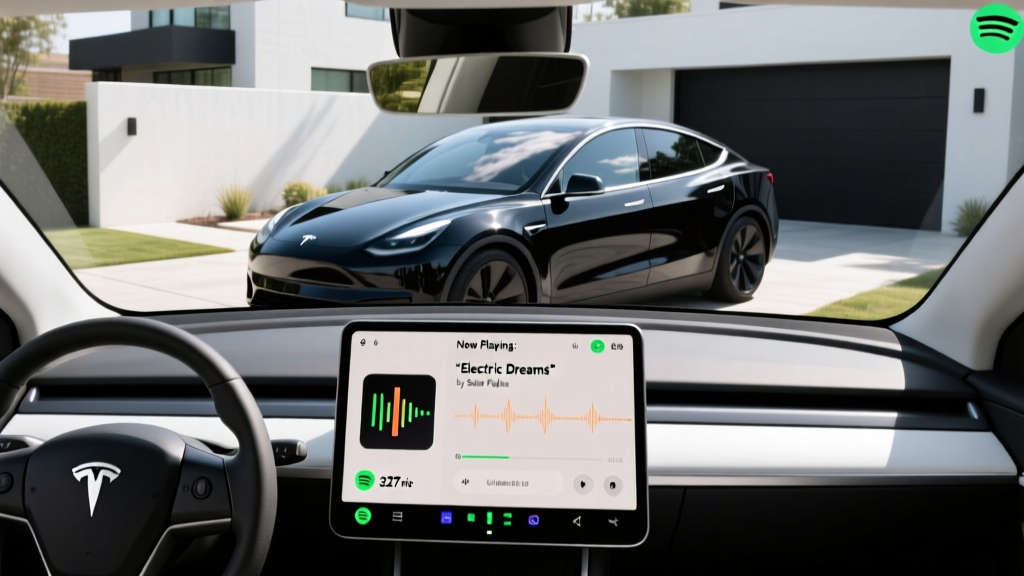
Tesla integrates Spotify natively into its infotainment system — no phone required. Unlike Bluetooth audio passthrough, which compresses your stream twice (once on the phone, once over Bluetooth), the native Spotify app pulls audio directly over Tesla's LTE or Wi-Fi connection. This means:
- Higher audio fidelity: The native app streams at Spotify's full mobile quality without Bluetooth codec bottlenecks.
- Voice and steering-wheel control: You can say "Play Discover Weekly" or skip tracks via the steering wheel buttons.
- Spotify Connect handoff: Start a playlist on your phone, and it appears in the car's Spotify app via Spotify Connect — no pairing needed.
- Offline limitations: Tesla's Spotify app does not support offline downloads. If you drive through a cell dead zone, music stops unless you switch to a downloaded phone playlist over Bluetooth.
Premium subscribers get full playlist access, lyrics display (where available), and personalized mixes. Free-tier Spotify accounts work but are limited to shuffle mode with ads, just like on any mobile device.
Does Streaming Spotify Affect Your Tesla's Range?
The short answer: barely. Tesla's audio amplifier and infotainment processor draw roughly 50–100 watts combined during music streaming. On a 4-hour highway drive consuming ~15 kWh, that represents less than 0.5% of total energy use. The real range killers are speed, elevation, temperature, and HVAC — not your playlist.
What does matter is how Spotify integration affects your charging-stop experience. At a Supercharger, you can stream music, watch Netflix, or game on the Tesla's central display while you wait out the 10–80% charge. This makes the Tesla Supercharger network feel more like a lounge than a gas station — a genuine quality-of-life advantage.
2026 Tesla Lineup: Range, Battery & Charging Specs
Below is a consolidated spec table for every Tesla model currently available in the US market. All figures reflect 2026 model-year data.
| Spec | Model 3 RWD | Model 3 Long Range AWD | Model Y Long Range AWD | Model S Plaid | Model X Long Range |
|---|---|---|---|---|---|
| EPA Range | 272 mi | 363 mi | 330 mi | 396 mi | 326 mi |
| Battery (usable kWh) | 60 kWh (LFP) | 79 kWh (NMC) | 79 kWh (NMC) | 100 kWh (NMC) | 100 kWh (NMC) |
| Peak DC Charge Rate | 170 kW | 250 kW | 250 kW | 250 kW | 250 kW |
| 10–80% DC Time | ~28 min | ~25 min | ~25 min | ~27 min | ~30 min |
| Level 2 Home Rate | 11.5 kW (~44 mi/hr) | 11.5 kW (~44 mi/hr) | 11.5 kW (~44 mi/hr) | 11.5 kW (~44 mi/hr) | 11.5 kW (~44 mi/hr) |
| Efficiency (MPGe) | 132 MPGe | 131 MPGe | 122 MPGe | 120 MPGe | 105 MPGe |
| kWh/100 mi | 25 | 26 | 28 | 28 | 32 |
Sources: fueleconomy.gov, Tesla spec sheets.
Charging Deep Dive: Supercharger, Home & Connector Details
All 2026 Teslas sold in North America use the NACS (North American Charging Standard) connector — the same plug used by the Tesla Supercharger network. Tesla opened its Supercharger network to non-Tesla EVs (via a built-in CCS adapter or native NACS on newer Fords, Rivians, and others), but Tesla owners still get the most seamless plug-and-charge experience.
DC Fast Charging (Supercharger & Third-Party)
Tesla's V3 Superchargers deliver up to 250 kW peak, while V4 cabinets (rolling out at new locations) support up to 350 kW — though no current Tesla model can accept the full 350 kW. Real-world charging follows a taper curve:
- 10–40% SoC: Near-peak rate (200–250 kW on Long Range/Plaid models)
- 40–60% SoC: Gradual taper to ~150 kW
- 60–80% SoC: Steeper taper to ~75–100 kW
- Above 80%: Dramatic slowdown — plan to unplug at 80% on road trips
The LFP Model 3 RWD peaks at 170 kW and sustains that rate longer in the curve, making its average charge speed closer to the NMC models despite a lower peak number.
Home Level 2 Charging
Every 2026 Tesla includes an onboard charger rated at 11.5 kW (48 amps). On a 240-volt / 60-amp circuit with a Tesla Wall Connector or any J1772/NACS Level 2 unit, you add roughly 44 miles of range per hour — enough to fully replenish any Tesla overnight. A typical Level 2 home installation runs $500–$1,500 for the charger plus $800–$2,500 for electrician labor, depending on panel proximity and whether your home needs a 200-amp service upgrade.
Performance, Cargo & Interior Space
| Spec | Model 3 RWD | Model 3 LR AWD | Model Y LR AWD | Model S Plaid | Model X LR |
|---|---|---|---|---|---|
| 0–60 mph | 5.8 sec | 4.2 sec | 4.8 sec | 1.99 sec | 3.8 sec |
| Horsepower | 271 hp | 346 hp | 384 hp | 1,020 hp | 670 hp |
| Drivetrain | RWD | Dual-Motor AWD | Dual-Motor AWD | Tri-Motor AWD | Dual-Motor AWD |
| Cargo (rear seats up) | 23 cu ft | 23 cu ft | 30 cu ft | 28 cu ft | 42 cu ft |
| Cargo (seats folded) | 65 cu ft | 65 cu ft | 72 cu ft | 79 cu ft | 88 cu ft |
| Frunk | 3.1 cu ft | 3.1 cu ft | 4.1 cu ft | 5.3 cu ft | 6.6 cu ft |
| Rear Legroom | 35.2 in | 35.2 in | 41.6 in | 39.6 in | 40.9 in |
The Model Y remains the volume seller for a reason: it offers crossover ride height, 30 cu ft of cargo space behind the second row, and available 7-seat configuration — all while sharing much of the Model 3's efficient powertrain. The Model 3 refresh (known internally as "Highland" and subsequent updates) brought a quieter cabin, ventilated seats, ambient lighting, and a rear touchscreen for passengers — all of which enhance the Spotify listening experience with reduced road noise.
2026 Pricing & Federal Tax Credit Eligibility
| Model | Base MSRP | As-Tested (Popular Config) | §30D Credit Eligible? |
|---|---|---|---|
| Model 3 RWD | $38,990 | $42,490 (w/ paint + wheels) | Up to $7,500* |
| Model 3 Long Range AWD | $45,490 | $49,990 | Up to $7,500* |
| Model Y Long Range AWD | $44,990 | $50,490 | Up to $7,500* |
| Model S | $79,990 | $89,990 | No (exceeds MSRP cap) |
| Model X | $84,990 | $94,990 | No (exceeds MSRP cap) |
*Federal tax credit eligibility under IRS §30D depends on multiple requirements:
- MSRP caps: Sedans (Model 3) must be under $55,000; SUVs/trucks (Model Y) under $80,000.
- Buyer income caps: AGI must not exceed $150,000 (single), $225,000 (head of household), or $300,000 (joint).
- Battery sourcing: The credit splits into two $3,750 halves — one for critical-mineral sourcing and one for battery-component manufacturing. Tesla's US-built LFP and NMC batteries have progressively met more of these requirements, but exact eligibility varies by build date and battery pack revision. Always confirm the VIN-specific credit on the IRS portal before purchase.
- Point-of-sale transfer: As of 2024, buyers can transfer the credit to the dealer at purchase, reducing the sale price directly rather than waiting for a tax refund.
The Model S and Model X exceed the §30D MSRP caps and do not qualify for the new-vehicle credit. However, a used Model S or X (model year at least 2 years old, purchased from a dealer for under $25,000) may qualify for the up-to-$4,000 used EV credit under §25E, subject to separate income limits.
Autopilot, FSD & Infotainment: The Tech Picture
Every 2026 Tesla ships with Basic Autopilot, which includes Traffic-Aware Cruise Control and Autosteer (lane-centering on highways). This is an SAE Level 2 driver-assistance system — you must keep your hands on the wheel and eyes on the road at all times.
The infotainment system runs on Tesla's custom AMD Ryzen processor with 16 GB of RAM, delivering a responsive interface for Spotify, navigation, and the growing app ecosystem (Netflix, YouTube, Arcade games). The 15.4-inch center display (Model 3/Y) or 17-inch display (Model S/X) handles climate, media, and vehicle settings — there are no physical buttons for these functions, which some buyers love and others find distracting while driving.
A notable tech advantage: Tesla's over-the-air (OTA) updates regularly add features post-purchase. Recent updates have improved Spotify's search interface, added podcast support within the native app, and introduced spatial audio processing for the premium sound system.
Warranty Coverage
| Coverage | Model 3 / Model Y | Model S / Model X |
|---|---|---|
| Basic Vehicle | 4 years / 50,000 mi | 4 years / 50,000 mi |
| Battery & Drive Unit | 8 years / 120,000 mi (RWD) 8 years / 120,000 mi (LR AWD) | 8 years / 150,000 mi |
| Battery Retention Guarantee | ≥70% capacity over warranty period | ≥70% capacity over warranty period |
Tesla's battery warranty guarantees that the pack will retain at least 70% of its original capacity over the warranty term. Real-world degradation data from fleet operators and owner surveys suggests most Tesla NMC packs lose roughly 5–8% capacity in the first 50,000 miles, then plateau. LFP packs in the Model 3 RWD show even slower degradation, with many owners reporting less than 5% loss at 60,000 miles. Tesla recommends charging LFP batteries to 100% at least weekly (unlike NMC, where daily charging to 80% is preferred for longevity).
Who Should Buy Which Tesla?
Choose the Model 3 RWD ($38,990) if: You commute under 50 miles daily, have reliable home charging, want the lowest entry price with tax-credit potential, and don't need AWD. The LFP battery's durability is a plus for high-mileage drivers.
Choose the Model 3 Long Range AWD ($45,490) if: You need 300+ real-world highway miles, all-weather AWD, and faster DC charging — without stepping up to the larger Model Y.
Choose the Model Y Long Range AWD ($44,990) if: You need cargo space for a family, prefer a higher seating position, or want the optional third row. It is the best-selling EV in America for a reason.
Choose the Model S or Model X if: Budget is not a constraint and you want flagship performance (1,020 hp Plaid), premium materials, air suspension, and maximum range. Understand that these do not qualify for the federal new-vehicle credit.
Pros & Cons at a Glance
- Class-leading Supercharger network (20,000+ stalls in North America)
- Native Spotify integration with no phone needed
- OTA updates add features after purchase
- Strong efficiency (25–32 kWh/100 mi across lineup)
- Best-in-class DC fast-charge speeds for NMC models
- Point-of-sale tax credit transfer reduces upfront cost
- No physical buttons — all controls on touchscreen
- Spotify app lacks offline download support
- Build quality inconsistency (panel gaps, paint) still reported
- FSD (Supervised) is expensive and remains Level 2
- Insurance premiums run 20–40% higher than comparable ICE vehicles
- Model S/X priced out of federal tax credit eligibility
Frequently Asked Questions
Can I use Spotify on a Tesla without a phone?
Yes. Tesla's native Spotify app streams directly over the car's LTE connection. You only need a Spotify account — no phone pairing or Bluetooth required for basic playback. However, you cannot download playlists for offline use in the car.
What is the real-world range of a Tesla Model 3 Long Range?
The EPA rates it at 363 miles. In real-world highway driving at 70–75 mph, expect roughly 310–325 miles. In winter conditions below freezing, plan for 260–290 miles depending on HVAC use and whether you precondition the battery.
How fast does a Tesla charge at a Supercharger?
Long Range and Plaid models peak at 250 kW on V3 Superchargers, achieving a 10–80% charge in approximately 25 minutes. The LFP Model 3 RWD peaks at 170 kW with a 10–80% time of about 28 minutes. Charging slows significantly above 80% — plan to unplug and drive on road trips.
Do all Teslas qualify for the $7,500 federal tax credit?
No. Only the Model 3 and Model Y fall under the §30D MSRP caps ($55,000 for sedans, $80,000 for SUVs). Even then, eligibility depends on buyer income limits, battery critical-mineral sourcing, and component manufacturing requirements. Check the IRS clean vehicle credit page and confirm your specific VIN before purchase.
Is Tesla's Spotify better than Bluetooth audio from my phone?
For audio quality and convenience, yes — the native app avoids Bluetooth compression and integrates with voice commands and steering-wheel controls. For flexibility (podcasts from other apps, offline playback, audiobooks), Bluetooth streaming from your phone remains useful as a backup.
Is a Tesla worth buying over a Hyundai Ioniq 5 or Ford Mustang Mach-E?
Tesla's advantages are the Supercharger network, efficiency (more miles per kWh), and software ecosystem. The Ioniq 5 offers faster peak charging (up to 350 kW on 800V architecture) and a more conventional interior with physical controls. The Mach-E offers a more traditional driving feel. If Supercharger access and native Spotify integration are priorities, Tesla retains a clear edge in 2026.