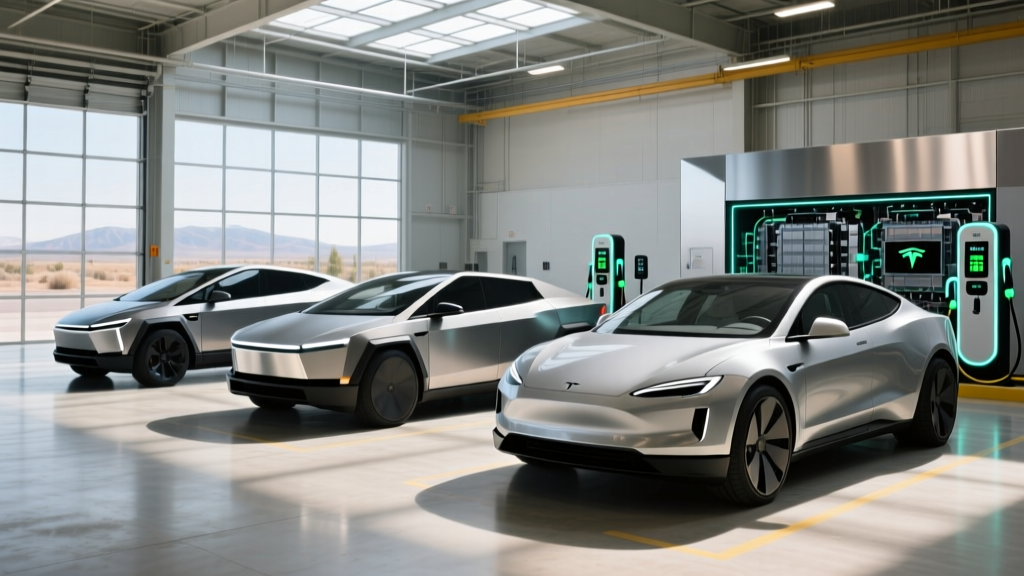
Sparks, Nevada, sits in the heart of Tesla's manufacturing footprint. The Gigafactory Nevada—officially Giga Nevada, located just east of Sparks in the Tahoe-Reno Industrial Center—produces the battery cells and drive units that power some of the most popular EVs on American roads. For local buyers, that proximity raises practical questions: Which Tesla models actually benefit from Nevada-built components? What does ownership look like in the high-desert climate? And do the numbers still pencil out in 2026?
This guide profiles the two Tesla models most relevant to Sparks and greater Reno buyers—the 2026 Model Y Long Range AWD and the 2026 Model 3 Long Range AWD—with a focus on real-world range in Northern Nevada conditions, charging infrastructure along the I-80 corridor, and current federal tax credit eligibility under IRS §30D.
2026 Tesla Model Y Long Range AWD: The Sparks Family Hauler
The Model Y remains Tesla's volume seller and the most common Tesla on Nevada roads. The 2026 Long Range AWD variant uses a dual-motor all-wheel-drive powertrain producing approximately 384 horsepower, with a 0–60 mph time of 4.8 seconds. It rides on an NMC (nickel manganese cobalt) lithium-ion battery pack with approximately 75 kWh of usable capacity.
| Spec | Value |
|---|---|
| EPA Estimated Range | 320 miles |
| Battery (Usable) | ~75 kWh, NMC chemistry |
| Drivetrain | Dual-Motor AWD |
| Horsepower | 384 hp (combined) |
| 0–60 mph | 4.8 seconds |
| Peak DC Fast Charge | 250 kW (V3 Supercharger) |
| 10–80% DC Charge Time | ~27 minutes |
| Level 2 Home Charge Rate | 11.5 kW (~44 mi/hr) |
| Efficiency | 122 MPGe / 28 kWh/100mi |
| Cargo Volume (rear seats up) | 30.2 cu ft |
| Cargo Volume (rear seats folded) | 72.1 cu ft |
| Rear Legroom | 37.0 inches |
| Battery Warranty | 8 years / 120,000 miles (70% retention) |
| Base MSRP | $48,990 (before destination) |
2026 Tesla Model 3 Long Range AWD: The Efficient Commuter
For buyers who don't need crossover cargo space, the refreshed Model 3 Long Range AWD offers more range per dollar. It uses a similar dual-motor AWD setup with approximately 366 horsepower and a 0–60 mph time of 4.2 seconds. The battery is an NMC pack with roughly 75 kWh usable.
| Spec | Value |
|---|---|
| EPA Estimated Range | 341 miles |
| Battery (Usable) | ~75 kWh, NMC chemistry |
| Drivetrain | Dual-Motor AWD |
| Horsepower | 366 hp (combined) |
| 0–60 mph | 4.2 seconds |
| Peak DC Fast Charge | 250 kW (V3 Supercharger) |
| 10–80% DC Charge Time | ~25 minutes |
| Level 2 Home Charge Rate | 11.5 kW (~48 mi/hr) |
| Efficiency | 131 MPGe / 26 kWh/100mi |
| Trunk + Frunk Volume | 23.0 cu ft (trunk) + 3.1 cu ft (frunk) |
| Rear Legroom | 35.2 inches |
| Battery Warranty | 8 years / 120,000 miles (70% retention) |
| Base MSRP | $45,990 (before destination) |
Charging in Sparks and Along the I-80 Corridor
Both the Model Y and Model 3 Long Range AWD support peak DC fast charging at 250 kW on Tesla V3 Superchargers. However, peak rate is not sustained rate. The charge curve tapers significantly above 50% state of charge (SoC). Here's what charging actually looks like in practice:
| Charging Level | Power / Rate | Time or Miles Added |
|---|---|---|
| Level 1 (120V standard outlet) | ~1.2 kW | ~3–4 miles per hour |
| Level 2 (240V, 48A Wall Connector) | 11.5 kW | ~44–48 miles per hour; full charge in ~7–8 hours |
| DC Fast Charge (V3 Supercharger, 250 kW peak) | Up to 250 kW | 10–80% in ~25–27 min; 175+ miles in 15 min (ideal conditions) |
| DC Fast Charge (V2 Supercharger, 150 kW peak) | Up to 150 kW | 10–80% in ~35–40 min |
Home charging setup in Sparks: Most Sparks homeowners can install a Tesla Wall Connector on a 60-amp circuit (requiring a 240V / 60A breaker). Installation costs typically range from $800 to $2,500 depending on panel proximity and whether a service upgrade from 100A to 200A is needed. Nevada's dry climate means outdoor-rated installations are straightforward, but always use a licensed electrician and pull a permit through the City of Sparks building department.
Public Supercharger access: The Sparks/Reno metro area has multiple Supercharger stations, including locations near the Outlet Center and along I-80. For road trips east toward Elko or west toward Sacramento, V3 Superchargers are spaced roughly every 120–150 miles along I-80, well within either vehicle's real-world range. Preconditioning the battery (automatic when you navigate to a Supercharger via the Tesla app or in-car nav) is essential for achieving peak charge rates—skip it and you may see only 80–120 kW instead of 250 kW.
Standout Tech and Notable Drawbacks
Both models come equipped with Tesla's 15.4-inch center touchscreen running the latest Tesla OS, which handles navigation, media, climate, and vehicle settings without physical buttons. Apple CarPlay and Android Auto remain unavailable—Tesla's proprietary interface is the only option. Over-the-air (OTA) updates continuously add features.
Driver assistance: Basic Autopilot (traffic-aware cruise control and lane centering) is standard. Full Self-Driving (Supervised) remains an $8,000 add-on or $99/month subscription. FSD is a SAE Level 2 system—it assists with steering, acceleration, and braking, but the driver must remain fully engaged and hands-on at all times. It is not autonomous driving.
Notable drawbacks:
- No Apple CarPlay or Android Auto support
- Minimalist interior lacks physical climate/media controls—everything routes through the touchscreen
- Rear visibility in the Model Y is compromised by the sloping roofline; a camera-based mirror option is not available
- Insurance premiums in Nevada tend to run 15–25% higher for Teslas than comparable non-EV crossovers due to repair cost data
- No Heads-Up Display (HUD) in either model
Pricing, Trims, and Federal Tax Credit Eligibility
Understanding what you'll actually pay requires navigating Tesla's trim structure and the current IRS §30D federal EV tax credit rules. Here's the breakdown for 2026:
| Model / Trim | Base MSRP | Estimated Out-the-Door* | §30D Credit Eligible? |
|---|---|---|---|
| Model 3 Long Range AWD | $45,990 | ~$47,500 (incl. destination) | Potentially up to $7,500 — see rules below |
| Model 3 Performance | $52,990 | ~$54,500 | Potentially up to $7,500 |
| Model Y Long Range AWD | $48,990 | ~$50,500 | Potentially up to $7,500 |
| Model Y Performance | $52,490 | ~$54,000 | Potentially up to $7,500 |
*Destination and order fees included. Excludes state/local taxes, registration, and optional add-ons.
§30D Federal Tax Credit Rules (2026): The credit is split into two halves of $3,750 each, based on battery component manufacturing and critical mineral sourcing requirements. Eligibility also depends on:
- MSRP caps: Vans, SUVs, and pickup trucks (including Model Y, classified as an SUV) must have an MSRP at or below $80,000. Sedans (Model 3) must be at or below $55,000. All trims listed above clear these caps.
- Buyer income limits: Modified adjusted gross income (MAGI) must not exceed $150,000 (single), $225,000 (head of household), or $300,000 (joint filers).
- Battery sourcing: Both the Model Y and Model 3 use battery cells produced at Giga Nevada (Panasonic-manufactured), which helps satisfy the North American battery-component requirement. Critical mineral sourcing requirements tighten annually—check the DOE/FuelEconomy.gov eligible vehicle list at time of purchase, as eligibility can change mid-year.
- Point-of-sale transfer: As of 2024, buyers can transfer the credit to the dealer at point of sale, reducing the purchase price directly rather than waiting for a tax refund. Tesla participates in this program.
Who Should Buy a Tesla in Sparks, Nevada?
The Model Y Long Range AWD is best for: Families needing cargo space for ski gear, camping equipment, or weekly Costco runs. The 72.1 cu ft of cargo volume (seats folded) handles bulkier loads. Dual-motor AWD provides confident traction on I-80 in winter storms and on the Mt. Rose Highway to Lake Tahoe. If your household has one vehicle and it needs to do everything, the Model Y is the pragmatic choice.
The Model 3 Long Range AWD is best for: Commuters covering the Sparks-to-Reno or Sparks-to-Carson City corridor daily, drivers who prioritize range and efficiency over cargo space, and buyers looking to minimize cost per mile. The 341-mile EPA rating and 131 MPGe rating make it one of the most efficient AWD EVs available. It's also the better pick if you plan to use public DC charging frequently—the slightly smaller, lighter sedan charges marginally faster.
Neither model is ideal for: Buyers who need Apple CarPlay, prefer physical buttons, want a traditional dealership service experience, or tow heavy loads (the Model Y is rated for 3,500 lbs towing—adequate for a small utility trailer but not a full-size camper).
Tesla vs. Key Competitors in the Sparks Market
The Model Y and Model 3 don't exist in a vacuum. Here's how they stack up against alternatives available in Northern Nevada:
| Vehicle | EPA Range | Peak DC Charge | Base MSRP | Key Advantage |
|---|---|---|---|---|
| Tesla Model Y LR AWD | 320 mi | 250 kW | $48,990 | Supercharger network, OTA updates |
| Hyundai Ioniq 5 Limited AWD | 290 mi | 350 kW (800V) | $52,500 | Faster peak charging, CarPlay |
| Ford Mustang Mach-E Premium AWD | 300 mi | 150 kW | $51,995 | Dealer service network, CarPlay |
| Tesla Model 3 LR AWD | 341 mi | 250 kW | $45,990 | Range per dollar, efficiency |
| BMW i4 xDrive40 | 307 mi | 205 kW | $57,900 | Build quality, CarPlay, HUD |
Tesla's Supercharger network remains the most reliable public charging ecosystem in rural Nevada. While the Hyundai Ioniq 5 charges faster at compatible 350 kW Electrify America stations, those stations are sparse along I-80 in Nevada. For Sparks residents who road-trip frequently on corridors with limited non-Tesla DC infrastructure, the Supercharger advantage is tangible.
Ownership Costs and Warranty Coverage
Both the Model Y and Model 3 Long Range AWD come with Tesla's standard warranty:
- Basic Vehicle Limited Warranty: 4 years / 50,000 miles
- Battery & Drive Unit Warranty: 8 years / 120,000 miles, with a guaranteed minimum 70% battery capacity retention over that period
Nevada's dry, moderate climate is relatively favorable for battery longevity compared to extreme-heat states like Arizona or extreme-cold states like Minnesota. Tesla's active thermal management system (liquid cooling/heating) further mitigates degradation. Data from long-term fleet studies suggest NMC packs in Tesla vehicles typically retain 85–90% capacity at 100,000 miles under normal use patterns.
Charging cost vs. gasoline: At Nevada's average residential electricity rate of approximately $0.13/kWh (NV Energy), fully charging a 75 kWh battery at home costs roughly $9.75. That equates to about $0.03–0.04 per mile. A comparable gasoline AWD crossover getting 25 MPG at $3.80/gallon costs $0.15 per mile—roughly 4× more per mile on fuel alone.
Frequently Asked Questions
What is the real-world range of the Tesla Model Y in Sparks, Nevada?
The EPA rates the 2026 Model Y Long Range AWD at 320 miles. In real-world Northern Nevada driving—highway speeds on I-80, elevation changes, and seasonal temperature swings—expect 260–280 miles in mild weather and 220–245 miles in winter cold. Preconditioning and using seat heaters instead of cabin heat in winter can recover 10–15 miles of range.
How fast does a Tesla charge at home in Sparks?
With a Tesla Wall Connector on a 60-amp / 240V circuit, both the Model Y and Model 3 Long Range AWD charge at 11.5 kW, adding roughly 44–48 miles of range per hour. A full overnight charge (8 hours) restores approximately 350+ miles—more than either vehicle's full battery capacity. Installation by a licensed electrician in Sparks typically costs $800–$2,500 depending on panel location and whether a service upgrade is needed.
Does the Tesla Model Y qualify for the $7,500 federal tax credit?
It can, but eligibility depends on multiple factors. The Model Y's MSRP falls under the $80,000 SUV cap. The buyer must meet income limits ($150K single / $300K joint). And the battery must satisfy critical mineral and component sourcing requirements—which Giga Nevada-built packs generally do. Always verify current eligibility on fueleconomy.gov before purchasing, as sourcing rules tighten annually.
Is it worth buying a Tesla in Sparks vs. a Hyundai Ioniq 5 or Ford Mach-E?
If you prioritize the most reliable public charging network for road trips along I-80 or US-395, Tesla's Supercharger ecosystem is a significant advantage in Nevada. If you value Apple CarPlay, faster peak charging at non-Tesla stations, or a traditional dealership service experience, the Ioniq 5 or Mach-E may be better fits. For pure range-per-dollar and efficiency, the Model 3 Long Range AWD is hard to beat at its price point.
How does Giga Nevada affect Tesla ownership in Sparks?
Giga Nevada produces battery cells and drive units for Tesla vehicles, though final vehicle assembly occurs at Giga Texas (Model Y) and Giga Shanghai/Fremont (Model 3, depending on market). The local manufacturing presence means strong regional service familiarity and a robust Supercharger network. However, Sparks does not have a Tesla Service Center—owners typically use the Reno service center or Tesla's mobile ranger service for at-home repairs.
Are Teslas reliable in Nevada winters?
Dual-motor AWD Teslas handle Nevada winters well, with strong traction control and a low center of gravity from the floor-mounted battery pack. The main winter concern is range reduction (15–25% in cold weather), not drivability. Preconditioning the battery while plugged in and using the Tesla app to warm the cabin before departure mitigate cold-weather impacts significantly.