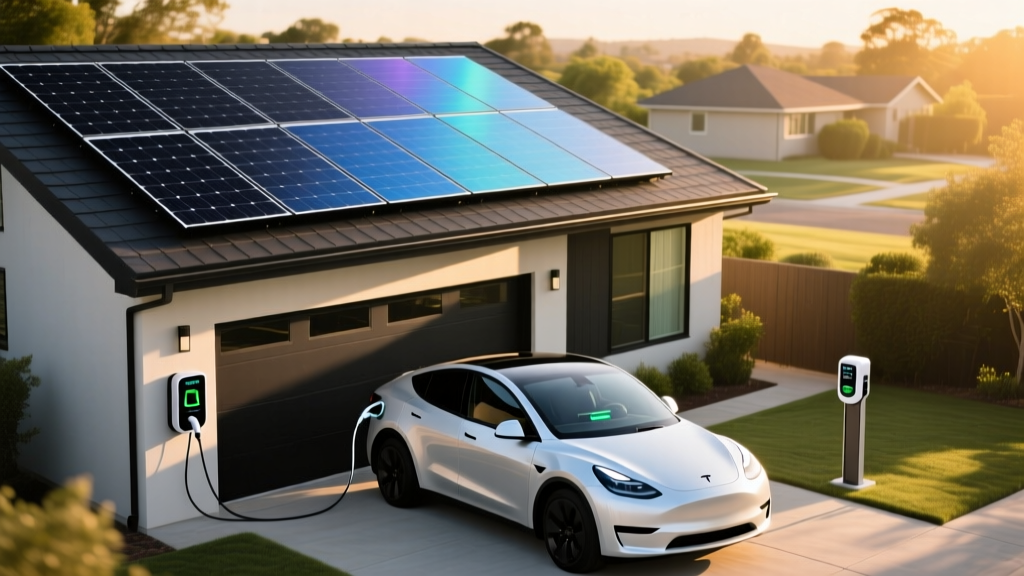
Searches for Tesla roof tiles cost often come from EV owners looking to offset their home-charging electricity with solar. The idea is compelling: a sleek, integrated solar roof that powers both your house and your electric vehicle. But the reality involves steep upfront pricing, long payback periods, and important trade-offs versus conventional solar panels. This guide breaks down exactly what the Tesla Solar Roof costs in 2026, how it pairs with EV ownership, and whether the math works.
Tesla Solar Roof: What It Actually Is
The Tesla Solar Roof is not a traditional rack-mounted solar panel system. Instead, it replaces your entire roof with a mix of active solar tiles (which generate electricity) and inactive architectural tiles (which look identical but don't produce power). The aesthetic appeal is the primary selling point — from the street, it looks like a premium slate or shingle roof rather than a field of blue-black panels.
Tesla offers the Solar Roof in a single product line as of 2026, with pricing that varies based on roof complexity, square footage, local permitting, and the ratio of active to inactive tiles. The system typically pairs with one or two Powerwall 3 home batteries (13.5 kWh each), which enable time-of-use shifting, backup power during outages, and optimized EV charging from stored solar energy.
Breaking Down the Tesla Roof Tiles Cost
Tesla's pricing has historically been opaque, and the final cost depends heavily on your roof's size, pitch, number of stories, and local labor rates. Here's what buyers are reporting in 2026:
| Component | Estimated Cost | Notes |
|---|---|---|
| Solar Roof tiles + install (1,500 sq ft roof) | $35,000–$48,000 | Varies by active tile ratio |
| Solar Roof tiles + install (2,500 sq ft roof) | $50,000–$72,000 | Larger homes, multi-story |
| Powerwall 3 (each) | $8,000–$11,000 installed | Most installs need 1–2 units |
| Permitting, inspection, utility interconnection | $1,500–$4,000 | Varies widely by jurisdiction |
| Electrical panel upgrade (if needed) | $1,500–$3,500 | Older homes may need 200A service |
| Total (typical 2,000 sq ft home, 1 Powerwall) | $45,000–$65,000 | Before any incentives |
For context, a conventional rack-mounted solar panel system of equivalent capacity (roughly 8–12 kW) typically costs $20,000–$30,000 before incentives. The Tesla Solar Roof premium is substantial — often 1.5x to 2.5x the cost of traditional panels for similar energy production.
Federal Tax Credit and State Incentives
The federal Residential Clean Energy Credit (IRC §25D) covers 30% of the total installed cost of a solar roof system, including labor, through 2032. This is distinct from the §30D EV tax credit — it applies to your home solar investment, not a vehicle purchase.
- 30% federal credit: On a $55,000 system, that's a $16,500 credit against your federal tax liability
- State incentives: Vary widely — some states offer additional credits, rebates, or SREC (Solar Renewable Energy Certificate) payments. Check your state energy office for current programs.
- Utility net metering: Availability and compensation rates depend on your local utility. Some states have reduced or eliminated retail-rate net metering, which significantly impacts payback.
EV Charging Economics: Can Solar Tiles Pay for Your Miles?
The core question for EV owners: how much driving can a Tesla Solar Roof actually offset? Let's run the numbers with realistic assumptions.
| Metric | Value |
|---|---|
| Typical Tesla Solar Roof output (10 kW system) | 12,000–15,000 kWh/year |
| Average household electricity use | ~10,500 kWh/year (EIA data) |
| EV charging demand (12,000 mi/yr at 3 mi/kWh) | ~4,000 kWh/year |
| Total home + EV demand | ~14,500 kWh/year |
| Net surplus or deficit (varies by climate) | Approximately break-even to slight surplus |
In sun-rich states (Arizona, California, Texas), a well-oriented 10 kW Solar Roof can produce enough to cover both household loads and moderate EV driving. In cloudier regions (Pacific Northwest, Northeast), expect a deficit that requires grid supplementation.
Real-world charging cost comparison:
- Home Level 2 charging from grid (national avg $0.16/kWh): ~$0.053/mile
- Home Level 2 charging from solar (amortized over 25-yr system life): ~$0.02–$0.03/mile
- DC fast charging (public, avg $0.35–$0.48/kWh): ~$0.12–$0.16/mile
- Gasoline vehicle (avg $3.40/gal, 28 MPG combined): ~$0.12/mile
Solar-charged EV driving is the cheapest per mile, but the upfront investment to get there is enormous compared to simply plugging into grid power at home.
Powerwall Pairing: Why It Matters for EV Owners
A Powerwall 3 (13.5 kWh usable capacity, 11.5 kW continuous output) adds critical functionality:
- Time-of-use optimization: Store solar during midday, charge your EV overnight from battery when grid rates peak
- Backup power: Keep your Level 2 charger running during grid outages (critical for those in storm-prone areas)
- Load management: Run your EV charger without tripping your main panel when other large loads (HVAC, dryer) are active
One Powerwall 3 can fully recharge a smaller EV battery (e.g., a 60 kWh pack at 80% depth of discharge provides ~10.8 kWh to the car). For larger packs or multiple EVs, two Powerwalls may be necessary.
Tesla Solar Roof vs. Conventional Solar Panels for EV Charging
| Factor | Tesla Solar Roof | Conventional Panels |
|---|---|---|
| Cost (10 kW, 2,000 sq ft) | $45,000–$65,000 | $20,000–$30,000 |
| Aesthetics | Integrated, looks like premium roofing | Visible rack-mounted panels |
| Efficiency per tile/panel | ~20% (lower due to inactive tiles) | 21–23% (modern monocrystalline) |
| Roof replacement included? | Yes — replaces entire roof | No — mounts on existing roof |
| Install timeline | 1–3 weeks (often delayed) | 1–3 days |
| Warranty (tiles) | 25-year weatherization, power | 25-year performance (most brands) |
| Payback period (with 30% credit) | 12–20 years | 6–10 years |
Installation Reality: Timelines and Pain Points
Tesla's Solar Roof installation has been plagued by delays since the product's launch. While the company has improved logistics, buyers in 2026 should still expect:
- Design and permitting: 4–12 weeks from signed contract to approved plans
- Installation: 1–3 weeks on-site (weather dependent, complex roofs take longer)
- Utility interconnection approval (PTO): 2–8 weeks after install before you can turn the system on
- Total timeline: 3–6 months from contract to energized system is common
Common owner complaints include communication gaps, rescheduled install dates, and difficulty getting post-install service for individual tile issues. The Tesla app provides monitoring once the system is active, but getting there can test your patience.
Warranty and Longevity
Tesla warrants the Solar Roof tiles for:
- 25 years on weatherization (leaks, wind resistance)
- 25 years on power production (guaranteed minimum output)
- Powerwall 3: 10-year warranty with unlimited cycles when paired with solar
These terms are competitive with conventional solar, though the integrated nature of the roof means a single tile failure could require more complex service than swapping a panel on a rack.
Who Should Consider a Tesla Solar Roof for EV Charging?
| Choose Tesla Solar Roof If… | Choose Conventional Panels If… |
|---|---|
| Your roof needs full replacement now | Your roof has 10+ years of life left |
| HOA or local rules restrict visible panels | No aesthetic restrictions apply |
| You prioritize integrated aesthetics over ROI | You want the fastest payback on solar investment |
| You're building new construction | You want installation completed in days, not months |
| You're already deep in the Tesla ecosystem (vehicle, Powerwall, app) | You want competitive bids from multiple installers |
Frequently Asked Questions
How much does a Tesla Solar Roof cost for a 2,000 sq ft home?
Expect $45,000–$65,000 before incentives for a typical 2,000 sq ft home with one Powerwall. After the 30% federal tax credit, the net cost drops to roughly $31,500–$45,500. Exact pricing depends on roof complexity, active tile ratio, and local labor rates.
Can a Tesla Solar Roof fully power my EV charging?
In sunny climates with a properly sized system (10+ kW), yes — a Solar Roof can produce enough surplus beyond household needs to cover 12,000+ miles of EV driving annually. In cloudier regions or with high household loads, expect to supplement with grid power, especially in winter months.
Is the Tesla Solar Roof worth it vs. regular solar panels?
Strictly on economics, no — conventional panels cost 40–60% less for equivalent energy production and offer faster payback. The Solar Roof justifies its premium only when you need a full roof replacement, face aesthetic restrictions, or value the integrated look enough to pay the difference.
Does adding a Tesla Solar Roof increase my home's value?
Studies from Lawrence Berkeley National Laboratory and Zillow suggest solar adds 3–4% to home value. The Tesla Solar Roof's aesthetic integration may command a slightly higher premium in design-conscious markets, but the full installation cost is unlikely to be recouped at resale.
How long does Tesla Solar Roof installation take?
From signed contract to energized system, plan for 3–6 months. The physical installation takes 1–3 weeks, but design approval, permitting, and utility Permission to Operate (PTO) add significant lead time.
What happens if a solar tile breaks or stops working?
Tesla's 25-year warranty covers tile defects and power degradation. However, owners report that getting service for individual tile issues can involve long wait times. Unlike rack-mounted panels where a single unit can be swapped quickly, tile replacement may require working within the integrated roof system.
Sources: IRS Residential Clean Energy Credit, U.S. EIA electricity pricing data, Tesla Solar Roof product documentation. Pricing estimates based on owner-reported data and installer quotes as of early 2026; actual costs vary by location and project specifics.