Quick Verdict: Tesla Solar Roof Shingles in 2026
Tesla's Solar Roof — the product that replaces conventional roofing with integrated photovoltaic glass shingles — remains one of the most visually compelling solar options for EV owners who want to charge on sunshine. But in 2026, the economics have shifted. Tesla now prices the Solar Roof at roughly $42,000–$68,000 before incentives for a typical 2,000 sq ft home, depending on roof complexity and the ratio of active (power-producing) to inactive (cosmetic) tiles. That's a steep premium over conventional rack-mounted panels, which deliver more wattage per dollar.
This isn't an EV review in the traditional sense — Tesla doesn't make a car called "Roof Shingle." But for the growing number of EV owners researching how to pair home solar with Level 2 charging, the Tesla Solar Roof is a frequent search target. Below, we break down what it actually costs, what it produces, how it compares to traditional panels, and whether it can realistically offset the electricity your EV consumes at home.
What Are Tesla Solar Roof Shingles?
Tesla's Solar Roof (now in its third generation, sometimes referred to as V3) uses tempered-glass tiles that either contain photovoltaic cells (active tiles) or mimic their appearance without generating power (inactive tiles). The system replaces your entire roof — it's not panels bolted on top of existing shingles. Tesla pairs the roof with a Powerwall 3 home battery (13.5 kWh usable capacity per unit, stackable) and integrates everything through the Tesla app.
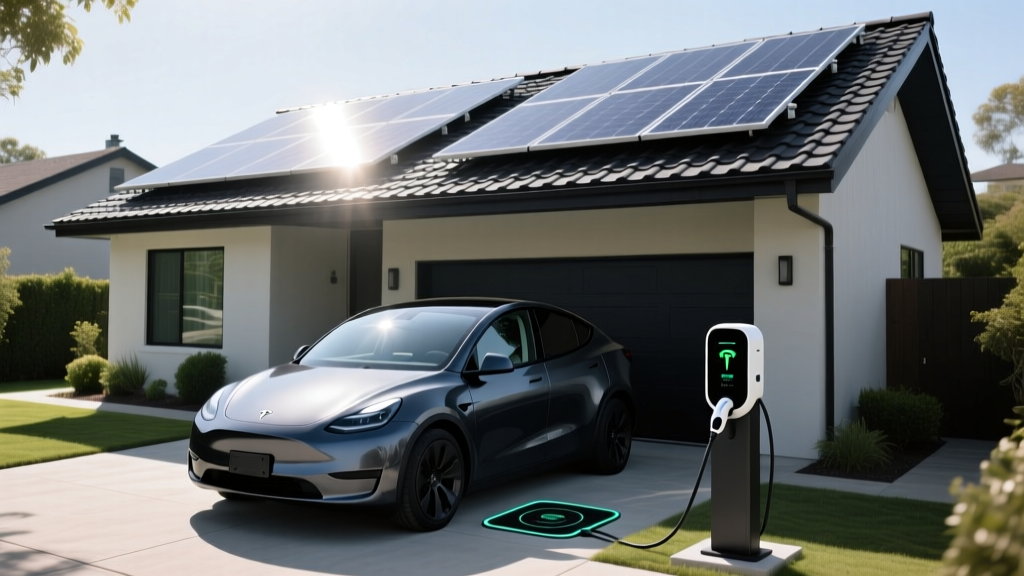
The appeal is clear: a sleek, low-profile roof that generates electricity without the visual bulk of traditional solar panels. For EV owners, the pitch is even more attractive — generate your own power, store it in a Powerwall, and charge your Tesla (or any EV) without touching the grid.
But the reality involves trade-offs that Tesla's marketing doesn't emphasize.
Specs at a Glance: Tesla Solar Roof (2026 Pricing)
| Attribute | Detail |
|---|---|
| Active Tile Efficiency | ~20.5% (per Tesla specs) |
| System Size (Typical Home) | 8 kW – 16 kW DC |
| Estimated Annual Production | 10,000 – 20,000 kWh (varies by region, tilt, shading) |
| Inactive Tile Warranty | 50 years (weatherization) |
| Active Tile / Power Warranty | 25 years (minimum 70% output retention) |
| Powerwall 3 Capacity | 13.5 kWh usable per unit |
| Powerwall 3 Continuous Output | 11.5 kW (single unit) |
| Typical Installed Cost (2026) | $42,000 – $68,000 before incentives |
| Federal Solar Tax Credit (ITC) | 30% of total system cost (IRS §25D) |
| Cost After 30% ITC | ~$29,400 – $47,600 |
Note: The federal solar tax credit falls under IRS §25D (Residential Clean Energy Credit), not the §30D EV credit. It covers 30% of solar and battery installation costs through 2032, with no annual cap. Consult a tax professional for eligibility.
Real-World Output: Can Tesla Shingles Power Your EV Charger?
A typical EV driven 12,000 miles per year at 3.5 miles per kWh consumes roughly 3,400 kWh annually — about 9.3 kWh per day. A 10 kW Tesla Solar Roof in a sun-rich state like Arizona or Texas can produce 40–50 kWh on a peak summer day, easily covering daily driving needs with surplus to spare.
Tesla's production estimates assume optimal tilt, minimal shading, and favorable weather. In practice, expect 10–20% less output than the quoted figure in the first year, especially if your roof pitch isn't ideal (many residential roofs sit at 18–22° rather than the optimal 30–35° for solar in the continental US). Snow cover, dust accumulation, and partial shading from trees further reduce yield. A 12 kW system quoted at 16,500 kWh/year may realistically produce 13,200–14,800 kWh in year one.
For EV charging specifically: a Level 2 home charger (typically 7.7 kW to 11.5 kW) draws significant instantaneous power. You won't be charging directly off solar panels in real time — solar production peaks midday, while most EV owners charge overnight. That's where the Powerwall battery becomes essential: store midday solar, discharge it into your car at night. A single Powerwall 3 (13.5 kWh) can deliver roughly one full charge for a compact EV like the Tesla Model 3 RWD (57.5 kWh battery) or about 40% of a Model S's 100 kWh pack.
Tesla Solar Roof vs. Traditional Panels: The Cost Reality
This is where the Tesla Solar Roof faces its toughest scrutiny. Traditional rack-mounted solar panels from established brands (REC, Canadian Solar, Qcells) paired with a separate roofer deliver more energy per dollar. Here's how the math works in 2026:
| Metric | Tesla Solar Roof | Conventional Panels + New Roof |
|---|---|---|
| System Cost (10 kW, pre-incentive) | $52,000 – $60,000 | $28,000 – $38,000 (panels) + $12,000–$18,000 (new roof) |
| Cost per Watt | $5.20 – $6.00/W | $2.80 – $3.80/W (panels only) |
| Panel Efficiency | ~20.5% | 21–23% (premium mono PERC/TOPCon) |
| Aesthetics | Integrated, low-profile | Visible rack-mounted panels |
| Installation Complexity | Full roof replacement required | Panels on existing or new roof |
| Battery Integration | Seamless (Powerwall 3) | Any brand battery (Enphase, Franklin, Tesla) |
| Warranty | 25 yr power / 50 yr weather | 25 yr panel / 10–12 yr inverter typical |
The critical insight: if your existing roof is in good condition, conventional panels win on cost by a wide margin — potentially $20,000+ less for the same energy output. The Tesla Solar Roof only makes financial sense if you already need a full roof replacement. In that scenario, the cost gap narrows because you're bundling a new roof and solar into one project.
Charging Your EV on Tesla Solar: What the Numbers Look Like
Let's model a realistic scenario for a Tesla Model Y Long Range (EPA 310-mile range, ~75 kWh usable battery) charged at home on a Tesla Solar Roof system:
- System: 12 kW DC Tesla Solar Roof with one Powerwall 3
- Location: Sacramento, CA (5.5 peak sun hours average)
- Daily solar production: ~52 kWh (annual average, lower in winter)
- Daily household load (non-EV): ~20 kWh
- Daily EV consumption (35 mi commute, 3.2 mi/kWh real-world): ~11 kWh
- Net daily surplus: ~21 kWh → exported to grid or stored
In this scenario, the Solar Roof comfortably covers both household and EV energy needs through spring, summer, and early fall. Winter production drops 30–40%, and you'll likely pull from the grid during December–January unless you add a second Powerwall or reduce driving.
For owners who drive more aggressively, tow frequently, or live in northern states with fewer sun hours, the math tightens. A 40-mile daily commute in Minnesota in January will require grid supplementation regardless of roof size.
Federal Tax Credits and Incentives
The Tesla Solar Roof qualifies for the 30% Residential Clean Energy Credit (IRS §25D), which covers solar panels, solar shingles, and battery storage (including Powerwall) through 2032. There is no annual dollar cap and no income phase-out for this credit — unlike the §30D EV tax credit, which has MSRP caps and buyer income limits.
- System cost: $55,000 (typical 12 kW with Powerwall)
- 30% ITC credit: $16,500
- Net cost after federal credit: $38,500
Some states and utilities layer additional incentives on top — California's SGIP rebate for battery storage, for example, can return $2,000–$3,500 for a Powerwall installation. Check DSIRE (Database of State Incentives for Renewables & Efficiency) for your specific jurisdiction. These local incentives vary widely and change frequently.
If you're also buying a Tesla vehicle, note that the EV tax credit (§30D) and the solar credit (§25D) are separate. You can claim both in the same tax year if you qualify for each independently. Refer to the IRS clean vehicle credit page for EV eligibility rules.
Pros and Cons of Tesla Solar Roof Shingles
Pros
- Sleek, integrated aesthetics — no visible panels or racks
- Replaces entire roof (new weatherization + solar in one project)
- Seamless Tesla app integration with Powerwall and Tesla EV charging
- 50-year weatherization warranty on tiles
- Powerwall 3 provides backup power during outages
- Qualifies for 30% federal ITC with no income cap
Cons
- Significantly higher cost per watt than conventional panels
- Lower efficiency than premium rack-mounted panels (20.5% vs 22–23%)
- Requires full roof replacement — not an add-on to existing shingles
- Installation delays historically common (weeks to months)
- Active tile ratio affects output — complex roofs need more inactive (non-producing) tiles
- Repair/replacement of individual tiles more complex than swapping a panel
- Not cost-effective if your current roof is in good condition
Who Should Consider Tesla Solar Roof Shingles?
Best fit: Homeowners who need a full roof replacement anyway, live in sun-rich states, drive an EV with moderate daily mileage (under 40 miles), and value aesthetics over maximum cost efficiency. If you're already planning a $15,000–$20,000 roof job and want solar, bundling with Tesla's integrated system simplifies the project into one contractor relationship.
Not ideal for: Homeowners with newer roofs (less than 10 years old), tight budgets, or high energy demands (large homes, frequent EV towing, heat pumps running in cold climates). In these cases, conventional panels deliver 20–40% more energy for 40–60% less money.
For apartment dwellers or renters: Solar shingles aren't an option. Look into community solar programs or workplace charging to reduce your EV's grid dependency.
Frequently Asked Questions
How long does Tesla Solar Roof installation take?
Tesla quotes 1–3 weeks for the physical installation, but the total timeline from contract to commissioning often stretches to 2–5 months due to permitting, utility interconnection approval, and supply chain logistics. Complex roofs with many dormers, valleys, or steep pitches take longer.
Can Tesla Solar Roof shingles charge my EV directly?
Not in real time. Solar production peaks midday, while most EV charging happens overnight. The system charges your Powerwall battery during the day, and the Powerwall (or the grid) supplies power to your Level 2 charger at night. The Tesla app lets you schedule charging to align with solar production or battery availability.
What happens to Tesla Solar Roof output in winter or cloudy weather?
Expect a 30–50% drop in daily production during winter months in northern US states, driven by shorter days, lower sun angle, and potential snow cover. Cloudy days reduce output to 10–25% of peak capacity. A properly sized system with battery storage accounts for this seasonal variation.
Does the Tesla Solar Roof qualify for the $7,500 EV tax credit?
No. The Solar Roof qualifies for the 30% Residential Clean Energy Credit (IRS §25D), which is a separate and often more valuable credit. The $7,500 credit applies only to qualifying electric vehicles under IRS §30D, subject to MSRP, income, and battery-sourcing requirements.
Is the Tesla Solar Roof worth it vs. traditional panels in 2026?
Financially, conventional panels win for most homeowners — especially those with roofs in good condition. The Tesla Solar Roof justifies its premium primarily when you need a full roof replacement and prioritize aesthetics. Run the numbers for your specific roof size, pitch, and local electricity rate before committing.
How does the Powerwall 3 affect EV charging?
The Powerwall 3's 11.5 kW continuous output can sustain most Level 2 home chargers (typically 7.7–11.5 kW) during an outage or off-peak period. A single Powerwall stores 13.5 kWh — enough for roughly 40–45 miles of EV range in a Tesla Model Y. For full-battery EV charges during outages, stacking two Powerwalls (27 kWh total) provides more headroom.