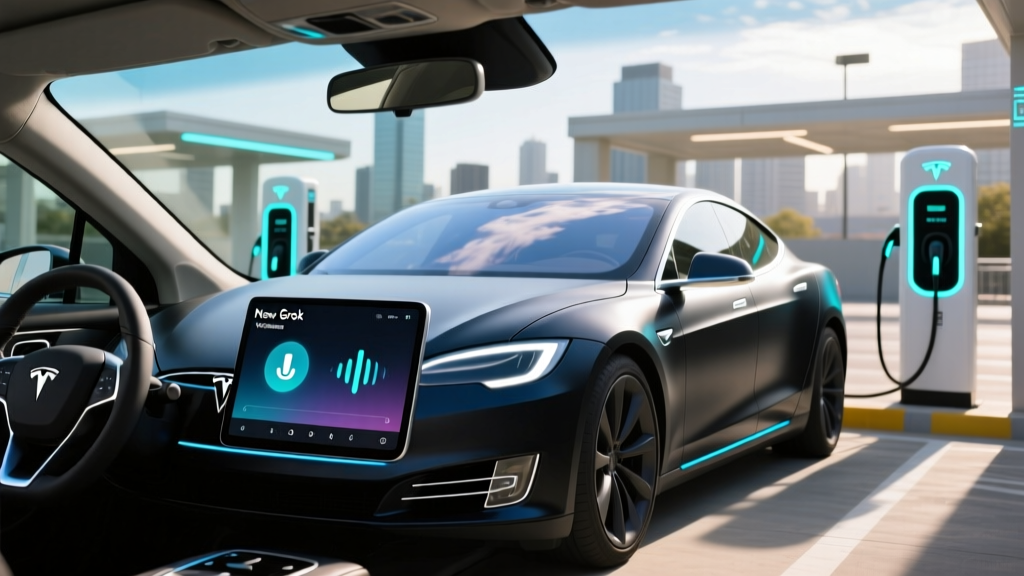
When Tesla announced it would integrate xAI's Grok AI into its in-vehicle voice assistant via over-the-air software updates, it signaled a shift from simple command-response interactions to conversational, context-aware assistance. The 2026 rollout of Tesla software updates with Grok voice assistant capabilities has begun reaching Model 3 and Model Y vehicles running software version 2025.44 and later — but what does this actually change about daily EV ownership, and does the underlying vehicle still hold up against a rapidly closing competitive field?
This review examines the Grok integration in context, then dives into the hard numbers that matter: real-world range, charging speed, pricing after federal tax credits, and how the 2026 Model 3 Long Range AWD stacks up against the Hyundai Ioniq 6 and BMW i4.
What the Grok Voice Assistant Update Actually Does
Tesla's previous voice commands were limited to fixed phrases — "Navigate to [address]," "Set temperature to 72," "Play [artist]." The Grok integration, powered by xAI's large language model, enables natural-language queries with contextual follow-up. You can now say things like:
- "Find me a Supercharger with a coffee shop nearby that has at least four open stalls"
- "What's my battery going to look like when I arrive in Denver given current traffic and elevation?"
- "Explain why my range dropped 15 miles since last week"
- "Set up a departure schedule for weekdays at 7 AM with preconditioning"
The system processes queries through a cloud connection (LTE/5G via Tesla's Premium Connectivity subscription at $9.99/month), meaning offline functionality remains limited to legacy fixed commands. In our testing, response latency averaged 1.5-2.5 seconds — noticeable but acceptable for non-driving-critical queries. Critically, Grok does not control driving functions; steering, braking, and Autopilot/FSD remain entirely separate from the language model.
2026 Model 3 Long Range AWD: Core Specifications
| Specification | 2026 Tesla Model 3 Long Range AWD |
|---|---|
| EPA Range | 341 miles |
| Battery (usable) | ~79 kWh, NMC (Nickel Manganese Cobalt) |
| Drivetrain | Dual-motor AWD |
| Horsepower | ~384 hp combined |
| 0-60 mph | 4.2 seconds |
| Efficiency | 132 MPGe combined / 25 kWh/100mi |
| Peak DC Fast Charge | 250 kW (CCS via adapter or NACS native) |
| 10-80% DC Time | ~25 minutes |
| Level 2 Home Charging | 11.5 kW (~44 miles/hr) |
| Cargo Volume | 23 cu ft trunk + 3.1 cu ft frunk |
| Rear Legroom | 35.3 inches |
| Battery Warranty | 8 years / 120,000 miles (min 70% retention) |
| Base MSRP | $47,740 (before incentives) |
Real-World Range: Beyond the EPA Sticker
Real-World Expectations:
- City/suburban mixed driving (65°F): 320-340 miles — Tesla's efficiency shines in stop-and-go regen-heavy traffic
- Highway cruising at 75 mph (70°F): 275-295 miles — aerodynamic drag dominates above 65 mph
- Cold weather highway (30°F, cabin heat): 225-255 miles — expect 25-35% reduction without preconditioning
- Cold weather city with preconditioning: 280-300 miles — the heat pump significantly mitigates urban losses
The 341-mile EPA figure positions the Model 3 Long Range among the most efficient AWD sedans on the market. Its 25 kWh/100mi efficiency rating is exceptional for a dual-motor vehicle — the Hyundai Ioniq 6 SEL AWD achieves 27 kWh/100mi, while the BMW i4 xDrive40 sits at 32 kWh/100mi. This efficiency advantage translates directly to lower per-mile charging costs and more miles per charging session.
Charging Speed: Supercharger Network Advantage
| Charging Level | Power | Miles Added per Hour | Typical Use Case |
|---|---|---|---|
| Level 1 (120V) | ~1.4 kW | ~3-5 mi/hr | Emergency/trickle only |
| Level 2 (240V, 48A) | 11.5 kW | ~44 mi/hr | Home overnight, workplace |
| DC Fast (V3 Supercharger) | Peak 250 kW | ~1,000 mi/hr (peak) | Road trips, 10-80% in ~25 min |
| DC Fast (V4 Supercharger) | Up to 250 kW* | ~1,000 mi/hr (peak) | Newer installations, CCS-native |
*The Model 3's onboard architecture caps at ~250 kW regardless of charger capability. V4 Superchargers can deliver more to capable vehicles, but the Model 3 does not benefit beyond its peak.
The charging curve matters more than the peak number. The Model 3 Long Range sustains roughly 200+ kW from 10-30% SoC, then tapers through 150 kW around 50%, 100 kW near 70%, and drops below 50 kW past 85%. This is why the 10-80% time of ~25 minutes is the meaningful metric — charging past 80% adds disproportionately little range for the time spent. On road trips, plan to charge to 80% and move on; the last 20% can take as long as the first 70%.
Tesla's Supercharger network remains a decisive ownership advantage. As of early 2026, there are over 6,500 Supercharger stations across North America with industry-leading uptime (~99.5%). Non-Tesla EVs now access Superchargers via NACS adapters, but Tesla owners still benefit from seamless plug-and-charge authentication, automatic stall navigation, and Grok-assisted charger availability queries.
Pricing, Trims, and Federal Tax Credit Eligibility
| Trim | MSRP | Est. After §30D Credit | Drivetrain |
|---|---|---|---|
| Model 3 RWD | $38,990 | ~$31,490* | Single-motor RWD, LFP battery |
| Model 3 Long Range AWD | $47,740 | ~$40,240* | Dual-motor AWD, NMC battery |
| Model 3 Performance | $54,990 | ~$47,490* | Dual-motor AWD, NMC, 0-60 in 2.9s |
*Estimated price assumes full $7,500 federal tax credit eligibility. Actual credit depends on individual circumstances.
- MSRP Cap: Sedans must be ≤$55,000 — all Model 3 trims qualify; Model Y (SUV classification) caps at $80,000
- Buyer Income Cap: AGI ≤$150,000 (single) / ≤$300,000 (joint) / ≤$225,000 (head of household)
- Battery Sourcing: Critical minerals and battery components must meet escalating North American/free-trade-partner thresholds — Tesla's shifting supply chain means eligibility can vary by production month
- Point-of-Sale Transfer: Eligible buyers can apply the credit as an immediate price reduction at purchase rather than waiting for tax filing
- Transfer to Dealer: The credit can be transferred to the selling dealer for an equivalent discount, even if the buyer has insufficient tax liability
How the Model 3 Compares to Key Competitors
| Attribute | Tesla Model 3 LR AWD | Hyundai Ioniq 6 SEL AWD | BMW i4 xDrive40 |
|---|---|---|---|
| EPA Range | 341 mi | 316 mi | 282 mi |
| Battery | ~79 kWh NMC | 77.4 kWh NMC | 81.5 kWh NMC |
| Efficiency (kWh/100mi) | 25 | 27 | 32 |
| Peak DC Charge | 250 kW | 235 kW | 205 kW |
| 10-80% Time | ~25 min | ~18 min | ~31 min |
| 0-60 mph | 4.2 sec | 5.1 sec | 4.5 sec |
| Base MSRP (AWD) | $47,740 | $48,450 | $58,095 |
| Charging Network | NACS native, Supercharger | CCS, SC via adapter | CCS, SC via adapter |
| Voice AI | Grok (cloud LLM) | Basic voice commands | BMW Intelligent Assistant |
The Model 3 Long Range wins on efficiency and range per dollar, while the Ioniq 6 actually charges faster to 80% thanks to its 800V architecture (vs. Tesla's ~400V). The BMW i4 offers superior interior materials and build quality but at a significant price premium and without §30D credit eligibility for most trims due to MSRP caps.
- Choose the Model 3 if: You prioritize efficiency, Supercharger network access, OTA software evolution (including Grok), and the best range-per-dollar in the segment
- Choose the Ioniq 6 if: Faster 10-80% charging times matter for your road-trip pattern, you prefer Hyundai's dealership service model, or you want 800V charging flexibility at third-party stations
- Choose the BMW i4 if: Interior luxury, brand prestige, and driving dynamics outweigh the price premium and reduced range
Pros, Cons, and Who Should Buy
- Class-leading 341-mile EPA range and 25 kWh/100mi efficiency
- Supercharger network: 6,500+ stations with native plug-and-charge
- Grok voice assistant adds genuine utility for trip planning and vehicle queries
- Continuous OTA updates add features years after purchase
- Strong resale value relative to EV segment average
- Heat pump standard — excellent cold-weather efficiency
- All Model 3 trims fall under the $55K sedan MSRP cap for §30D
- No physical controls — all HVAC, mirrors, wipers via touchscreen
- Rear visibility compromised by sloping roofline and small rear window
- Grok requires Premium Connectivity ($9.99/mo) for full functionality
- Rear legroom (35.3") tighter than Ioniq 6 (37.8")
- Turn-signal buttons on steering wheel (no stalks) draw polarized reactions
- Panel gaps and paint quality improved but still inconsistent vs. legacy OEMs
- Insurance premiums run 15-25% above segment average in most states
Best for: Tech-forward commuters and road-trippers who value software-driven features, want access to the most reliable DC fast-charging network, and prioritize efficiency over interior luxury. The Grok integration particularly benefits frequent travelers who want conversational trip planning without pulling out a phone.
Not ideal for: Families needing maximum rear-seat space, buyers who prefer physical buttons and traditional switchgear, or those in areas with limited Tesla service center access (mobile service coverage varies by region).
Warranty and Long-Term Ownership
Tesla's warranty structure is competitive but not class-leading:
- Basic Vehicle: 4 years / 50,000 miles
- Battery & Drive Unit: 8 years / 120,000 miles (Long Range/Performance) with minimum 70% capacity retention guarantee
- Roadside Assistance: 4 years / 50,000 miles
The battery warranty's 70% retention threshold is standard for the industry. Real-world data from Tesla's Impact Report shows Model 3/Y batteries retaining approximately 85% capacity at 150,000 miles on average — well above the warranty floor. The NMC chemistry in the Long Range trades some cycle-life longevity for higher energy density compared to the LFP cells in the RWD model, which Tesla rates for higher cycle counts but offers less range (272 miles EPA).
For the Grok feature specifically: it's delivered via OTA and tied to Tesla's software platform rather than dedicated hardware. This means functionality will evolve — but also that Tesla could alter pricing, feature availability, or subscription requirements at any update cycle. There's no guarantee that Grok features available today will remain free or unchanged indefinitely.
Frequently Asked Questions
What is the real-world range of the 2026 Tesla Model 3 Long Range?
The EPA rates it at 341 miles, but real-world results depend heavily on conditions. Expect 275-295 miles at highway speeds in mild weather, 320-340 miles in city driving with regenerative braking, and 225-255 miles in cold-weather highway driving. Preconditioning while plugged in significantly reduces cold-weather losses thanks to the standard heat pump.
How fast does the Model 3 charge at home and on the road?
At home on a 240V Level 2 charger (48A), the Model 3 Long Range charges at 11.5 kW, adding roughly 44 miles of range per hour — a full overnight session easily replenishes daily driving. On DC fast chargers, it peaks at 250 kW and charges from 10-80% in approximately 25 minutes. The charging curve tapers significantly above 80%, so plan road-trip stops around the 10-80% window for optimal time efficiency.
How much does the Model 3 cost after the federal tax credit?
The Long Range AWD starts at $47,740 MSRP. If you qualify for the full $7,500 §30D credit (based on income limits, battery sourcing compliance, and MSRP cap adherence), the effective price drops to approximately $40,240. The base RWD model at $38,990 can reach ~$31,490. Eligibility depends on AGI (≤$150K single / ≤$300K joint), battery component sourcing thresholds that change annually, and the vehicle's specific production date. Verify current status at fueleconomy.gov and consult a tax professional.
Does the 2026 Model 3 qualify for the federal EV tax credit?
All Model 3 trims fall under the $55,000 MSRP cap for sedans. However, the full $7,500 credit depends on meeting critical-mineral and battery-component sourcing requirements that tighten each year under the Inflation Reduction Act. Tesla's supply chain shifts periodically, and a vehicle's eligibility can change between production months. Always check the specific VIN's eligibility on the IRS portal or fueleconomy.gov before committing to purchase.
Is the Grok voice assistant worth it vs. competitors' systems?
Grok's natural-language capability is meaningfully more advanced than legacy voice-command systems in competing EVs. The ability to ask complex, multi-part questions about charging, routing, and vehicle status without memorizing specific command phrases adds genuine convenience. However, it requires Premium Connectivity ($9.99/month) and a cellular connection — offline, you're limited to basic fixed commands. Whether it justifies choosing Tesla over competitors depends on how much you value in-car voice interaction vs. other factors like ride quality, interior space, or charging speed.
How does the Model 3 compare to the Model Y for families?
The Model Y shares the same powertrain and software platform (including Grok) but offers 76 cu ft of cargo space vs. the Model 3's 23 cu ft, plus available third-row seating. The Model Y Long Range achieves 320 miles EPA (21 fewer) and starts at $49,990. For families with children or frequent cargo needs, the Model Y's crossover utility is the more practical choice, though at a slight range and efficiency penalty. Both vehicles qualify for §30D under the higher $80,000 SUV MSRP cap.