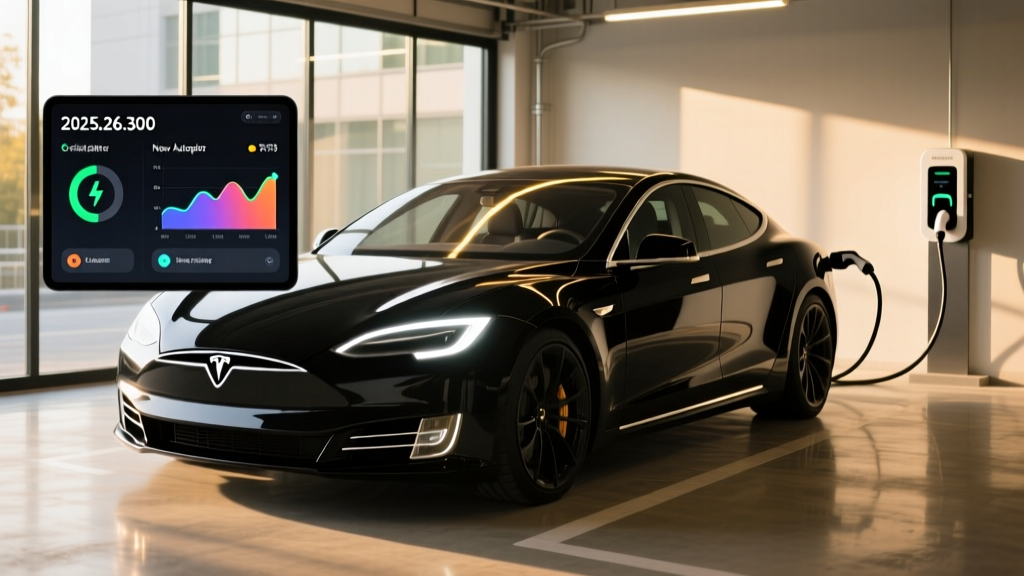
Over-the-air software updates are one of the defining ownership experiences of a Tesla. Unlike legacy automakers that require dealer visits for firmware patches, Tesla pushes improvements — and occasionally regressions — directly to your driveway. Tesla software update 2025.26.300 has been rolling out to Model 3, Model Y, Model S, and Model X fleets, and owners are digging into its changelog for meaningful changes to range, charging behavior, infotainment, and Autopilot/FSD (Supervised).
This article reviews what's in 2025.26.300, how it affects real-world driving and efficiency across the current Tesla lineup, and whether you should install it immediately or wait for community feedback. We also revisit the core hardware specs — EPA range, battery chemistry, charging speeds, and pricing — that define what the software is running on.
What's New in Tesla Software Update 2025.26.300
Tesla's release notes for 2025.26.300 are characteristically brief, but community teardowns and owner reports have identified several changes worth knowing about:
- FSD (Supervised) v13 refinements: Smoother lane changes in dense urban traffic, improved handling of unprotected left turns, and reduced phantom braking events in low-light conditions. FSD remains an SAE Level 2 system — the driver must remain fully engaged at all times.
- Energy app recalibration: The projected range graph now factors in recent elevation changes and ambient temperature more aggressively, giving owners a more realistic range forecast on the instrument display.
- Charge preconditioning logic: Navigation-routed preconditioning for Superchargers now begins earlier in cold weather (below 35°F / 2°C), which should improve charge-curve sustainment at stalls rated above 150 kW.
- Theater and gaming: New titles added to the in-car gaming library and a refreshed UI for theater mode while parked.
- Dashcam and Sentry Mode: Minor clip-saving reliability fixes addressing reports of truncated footage on 2024–2025 hardware.
- Tire-pressure monitoring: More granular TPMS readouts and faster cold-weather alert thresholds.
Which Tesla Models Receive 2025.26.300
The update targets vehicles running the 2025.x software branch, which includes the current-production lineup. The table below summarizes the key hardware specs of the models most likely to receive this build, using EPA and manufacturer data current as of the 2026 model year.
| Spec | Model 3 LR AWD | Model Y LR AWD | Model S LR | Model X LR |
|---|---|---|---|---|
| EPA Range | 363 mi | 320 mi | 402 mi | 335 mi |
| Battery (usable) | ~79 kWh, NMC | ~79 kWh, NMC | ~100 kWh, NMC | ~100 kWh, NMC |
| Peak DC Charge | 250 kW | 250 kW | 250 kW | 250 kW |
| 10–80% DC Time | ~27 min | ~27 min | ~35 min | ~35 min |
| Level 2 Rate | 11.5 kW / ~44 mi/hr | 11.5 kW / ~44 mi/hr | 11.5 kW / ~44 mi/hr | 11.5 kW / ~44 mi/hr |
| 0–60 mph | 4.2 sec | 4.8 sec | 3.1 sec | 3.8 sec |
| Drivetrain | Dual-motor AWD | Dual-motor AWD | Dual-motor AWD | Dual-motor AWD |
| MPGe (combined) | 134 MPGe | 123 MPGe | 124 MPGe | 111 MPGe |
| Base MSRP | $47,740 | $48,630 | $79,990 | $84,990 |
Source: EPA fueleconomy.gov and Tesla's official spec pages. Model 3 RWD (LFP battery, ~272 mi EPA) receives the same software build but with different thermal-management behavior.
Real-World Range: What the EPA Number Doesn't Tell You
Software update 2025.26.300's energy-app recalibration doesn't add physical range, but it does make the projected-range readout more honest. Earlier 2025.x builds were criticized for optimistic forecasts on mountain routes; the new algorithm weighs the last 25 miles of driving more heavily and applies elevation data from the navigation route. For road-trippers using A Better Routeplanner alongside the native nav, this closes the gap meaningfully.
If you drive a Model 3 RWD with the LFP (lithium iron phosphate) battery, note that LFP cells tolerate regular 100% charging better than NMC, but they are more sensitive to cold. Preconditioning via scheduled departure is even more important in winter on LFP packs to preserve regen braking and charging speed.
Charging Speed and the Preconditioning Change
| Charging Level | Power (kW) | Miles Added per Hour | Notes |
|---|---|---|---|
| Level 1 (120V household) | ~1.4 kW | ~5 mi/hr | Emergency/trickle only |
| Level 2 (240V home Wall Connector) | 11.5 kW | ~44 mi/hr | Full overnight charge in 7–9 hrs |
| DC Fast (V3 Supercharger) | Peak 250 kW | ~200 mi in 15 min | Tapers sharply above 60% SoC |
| DC Fast (V4 / CCS adapter) | Up to 250 kW | Similar to V3 | CCS adapter required for non-Tesla stalls |
Tesla's peak 250 kW figure is just that — a peak. The charge curve on the current Model 3/Y NMC pack sustains roughly 200–230 kW only up to ~40% SoC, then tapers to ~120 kW near 60%, and drops below 50 kW past 80%. The 10–80% time of ~27 minutes is realistic at a V3 Supercharger when the pack is preconditioned.
The 2025.26.300 preconditioning tweak matters most in cold climates. By initiating battery heating earlier on nav-routed Supercharger trips, Tesla is targeting better charge-curve sustainment in the first 10 minutes at the stall — where most of the energy is transferred. Owners in the Upper Midwest and New England have reported 3–5 minute improvements in 10–80% times at sub-freezing ambient temperatures following this update.
Does Your Tesla Still Qualify for the Federal Tax Credit?
Federal EV tax credit rules under IRS §30D remain strict and change periodically. As of the current tax year, eligibility hinges on several requirements that buyers must verify before purchase:
- MSRP caps: $55,000 for sedans (Model 3), $80,000 for SUVs/pickups (Model Y, Model X). Model S and Model X Plaid trims above these caps are ineligible.
- Buyer income caps: AGI limits of $150,000 (single), $225,000 (head of household), $300,000 (married filing jointly).
- Battery sourcing and critical minerals: A percentage of battery components must be manufactured or assembled in North America, and critical minerals must be sourced from the U.S. or FTA partners. Tesla's U.S.-built vehicles have generally met these thresholds, but the exact qualifying percentage can shift annually.
- Point-of-sale transfer: Buyers can transfer the credit to the dealer at purchase to reduce the out-of-pocket price, rather than waiting for tax filing.
| Model / Trim | Base MSRP | Est. After $7,500 Credit | Credit Eligible? |
|---|---|---|---|
| Model 3 RWD | $38,990 | ~$31,490 | Yes (verify sourcing) |
| Model 3 LR AWD | $47,740 | ~$40,240 | Yes |
| Model Y LR AWD | $48,630 | ~$41,130 | Yes |
| Model Y Performance | $53,130 | ~$45,630 | Yes |
| Model S LR | $79,990 | $79,990 | No — above cap for sedans |
| Model X LR | $84,990 | ~$77,490 | Yes (under $80k SUV cap) |
Always verify current eligibility at IRS.gov clean vehicle credits and consult a tax professional. Rules and sourcing requirements can change between model years.
Interior, Tech, and the Software-Defined Experience
Tesla's cabin remains minimalist, with nearly every function routed through the central 15.4-inch touchscreen (Model 3/Y) or 17-inch display (Model S/X). Build quality on the current Model 3 "Highland" refresh and Model Y has improved measurably over 2022–2023 production, with better panel gaps, acoustic glass, and ventilated front seats.
Cargo volume: Model Y offers 30 cu ft behind the second row (76 cu ft folded), making it one of the most practical compact electric SUVs. Model 3's trunk is 23 cu ft — adequate for two suitcases but tight for family road trips. Model X remains the segment leader at up to 91 cu ft with both rows folded, plus the signature (if rarely practical) falcon-wing rear doors.
Legroom: Model 3 rear legroom is 35.2 inches; Model Y is 41.6 inches — a meaningful advantage for families with rear-facing car seats. Model S/X offer limo-class rear space at 40+ inches.
Driver assist: Basic Autopilot is standard (adaptive cruise + lane centering). FSD (Supervised) remains an $8,000 option or $99/month subscription as of the latest pricing. It is a Level 2 system — impressive on highways and increasingly competent in city traffic, but not autonomous.
Warranty and Long-Term Battery Outlook
Tesla's warranty coverage is competitive with the EV segment:
- Basic vehicle: 4 years / 50,000 miles
- Battery and drive units: 8 years / 100,000 miles (Model 3 RWD); 8 years / 120,000 miles (Model 3 LR, Model Y, Model S, Model X)
- Capacity retention threshold: 70% of original capacity during the warranty period
Real-world degradation data from large owner datasets (Recurrent, Teslanomics) shows NMC packs in current Teslas averaging ~8–12% degradation at 100,000 miles, with most of the loss occurring in the first 20,000 miles before leveling off. LFP packs in the Model 3 RWD show slower early degradation but require regular 100% charges to maintain cell balancing — follow Tesla's in-app guidance.
Out-of-warranty battery replacement remains expensive: roughly $12,000–$16,000 for a Model 3/Y pack and $18,000–$22,000 for Model S/X, based on service-center estimates. This is the long-tail cost risk every EV buyer should budget for.
Pros, Cons, and the Competition
Pros
- Best-in-class Supercharger network (now opening to NACS adapters on rival EVs)
- Class-leading efficiency (MPGe) and real-world range per kWh
- Continuous OTA improvements like 2025.26.300
- Strong resale value relative to non-Tesla EVs
- Spacious Model Y cargo area for the footprint
Cons
- Minimalist cabin not for everyone — no physical buttons, no CarPlay
- FSD (Supervised) still requires full driver attention; $8k is steep
- Service-center wait times remain a pain point in many metro areas
- Ride quality firm on Model 3/Y vs Hyundai Ioniq 5, BMW i4
- Model S/X pricing pushes above federal credit caps
Is it worth buying vs key competitors? The Model Y remains the default choice for buyers who prioritize charging infrastructure and efficiency. The Hyundai Ioniq 5 and Kia EV6 offer faster 800V peak charging (~18 min 10–80% at 350 kW stalls) and a more traditional cabin, but their public-charging experience outside the Tesla network is less consistent. The BMW i4 and Ford Mustang Mach-E are credible alternatives for driving dynamics, but neither matches Tesla's software cadence or Supercharger reliability.
Frequently Asked Questions
What is the real-world range of current Tesla models?
Expect 290–310 highway miles from a Model 3 LR AWD in mild weather (EPA 363 mi), 250–270 from a Model Y LR AWD (EPA 320 mi), and roughly 20–30% less in freezing temperatures across the lineup.
How fast does a Tesla charge at home and on the road?
At home on a 240V Wall Connector at 11.5 kW, you'll add ~44 miles per hour — a full overnight charge in 7–9 hours. On a V3 Supercharger, peak rate is 250 kW with 10–80% in ~27 minutes when preconditioned.
Does Tesla software update 2025.26.300 improve range?
Not directly — it recalibrates the projected-range display to be more accurate and improves cold-weather preconditioning, which can preserve charge-curve speed at Superchargers in winter.
How much does a Tesla cost after tax credits?
A Model 3 RWD starts around $38,990 and can drop to ~$31,490 with the full $7,500 federal credit, subject to buyer income, MSRP caps, and battery-sourcing rules. Verify at IRS.gov before purchase.
Does my Tesla qualify for the federal EV tax credit?
Most Model 3 and Model Y trims currently qualify; Model S does not (above the $55k sedan cap); Model X LR qualifies (under the $80k SUV cap). Buyer AGI limits and battery-sourcing requirements also apply.
Is FSD (Supervised) actually self-driving?
No. FSD is an SAE Level 2 driver-assistance system. You must remain engaged, eyes on the road, hands on the wheel. It is not autonomous.
For the latest safety ratings, check NHTSA and IIHS. Tesla's official spec and software-release pages remain the primary source for production changes.