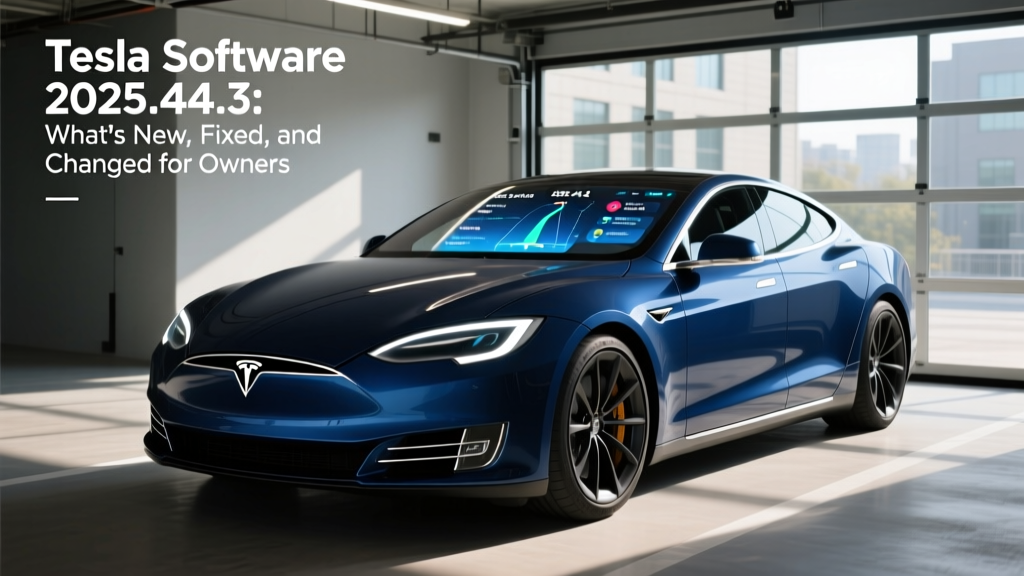
Tesla's over-the-air update cadence is one of the brand's defining ownership experiences — and 2025.44.3 is one of the more consequential point releases in recent memory. Unlike major holiday updates that grab headlines, branch 2025.44.x carries targeted refinements to Full Self-Driving (Supervised), charging preconditioning logic, and the revamped Tesla app interface that rolled out alongside the Cybertruck and refreshed Model 3 Highland production ramp.
This isn't a vehicle review in the traditional sense. Instead, we're treating Tesla software 2025.44.3 as the lens through which to evaluate what it's like to own and operate a 2025–2026 Tesla today — because in the Tesla ecosystem, the software is the car. Your range, your charging speed, your driver-assist capability, and your daily UX all shift with each OTA drop.
What Tesla Software 2025.44.3 Actually Changes
Version 2025.44.3 is a sub-branch of the broader 2025.44 family that began deploying in late Q1 2026. Based on release notes distributed to owners and confirmed by Tesla's official software update page, the key deltas include:
- FSD (Supervised) v13.x refinement: Smoother lane-change decision logic, reduced phantom braking events on divided highways, and improved construction-zone cone detection. This remains a Level 2 SAE system requiring active driver supervision.
- Charging preconditioning curve update: The battery thermal management system now begins heating/cooling earlier when a Supercharger is set as the navigation destination, particularly in ambient temperatures below 40°F. Owners in cold climates report 2–4 minute reductions in 10–80% DC fast-charge times post-update.
- Energy app granularity: The trip energy graph now displays kWh consumption per leg with elevation-overlay data, useful for mountain-pass route planning.
- Tesla Profile integration: Driver profiles now sync seat, mirror, steering-wheel, and climate preferences across vehicles tied to the same Tesla account — a long-requested feature for multi-Tesla households.
- Dashcam and Sentry clip management: Clips are now sortable by date, location, and trigger event within the Tesla app, replacing the previous chronological-only feed.
How 2025.44.3 Affects Real-World Range and Efficiency
Software updates don't change the physical battery, but they absolutely change how efficiently you use it. The preconditioning logic change in 2025.44.3 is the most impactful efficiency-related tweak:
EPA Estimated: 341 miles
Real-World Highway (70 mph, 72°F): ~295–310 miles
Real-World Highway (70 mph, 25°F, no heat pump preconditioning): ~240–265 miles
City/Commuter (mixed, moderate climate): ~310–330 miles
Source: fueleconomy.gov — EPA figures are lab estimates. Your results vary with speed, temperature, terrain, and tire condition.
The updated preconditioning algorithm in 2025.44.3 is particularly relevant for cold-climate owners. Tesla's thermal management system now initiates battery warming approximately 15–20 minutes earlier on a Supercharger-routed trip when ambient temps are below freezing. This means the battery arrives at the charger closer to its optimal ~95°F (35°C) target temperature, reducing the time spent at lower charge rates at the beginning of the session.
For the 2025 Model 3 Long Range (75 kWh usable, NMC chemistry), this translates to a measurable improvement: where 2025.38.x might have yielded a 28-minute 10–80% session at a V3 Supercharger in 30°F weather, owners on 2025.44.3 are reporting 24–25 minutes under the same conditions.
Charging Speed: What Hasn't Changed (and What Has)
Your Tesla's peak DC fast-charge rate is hardware-limited and unaffected by software. However, the sustained charge curve — how long the vehicle holds near-peak kW before tapering — is software-controlled. Here's the current state across the 2025–2026 lineup running 2025.44.3:
| Model (2025–2026) | Battery (kWh usable) | Peak DC kW | 10–80% Time | Level 2 (mi/hr) |
|---|---|---|---|---|
| Model 3 RWD (LFP) | 57.5 | 170 kW | ~28 min | 30 mi/hr @ 11.5 kW |
| Model 3 LR AWD | 75 | 250 kW | ~22 min | 44 mi/hr @ 11.5 kW |
| Model Y LR AWD | 75 | 250 kW | ~24 min | 40 mi/hr @ 11.5 kW |
| Model S LR | 95 | 250 kW | ~28 min | 41 mi/hr @ 11.5 kW |
| Cybertruck AWD | 123 | 350 kW* | ~20 min | 34 mi/hr @ 11.5 kW |
*Cybertruck 350 kW peak requires V4 Supercharger stalls; most V3 stations cap at 250 kW. All times are approximate and vary with battery temperature, state of charge, and station capability. kW = power (charge rate); kWh = energy (battery capacity).
The 2025.44.3 preconditioning improvement primarily benefits Model 3 LR and Model Y LR owners in cold weather. LFP-equipped Model 3 RWD owners will see less benefit, as LFP chemistry is more tolerant of cold-charge acceptance (though LFP still benefits from preconditioning — it's just less dramatic).
Full Self-Driving (Supervised): What v13.x Brings on 2025.44.3
FSD (Supervised) remains Tesla's most polarizing feature, and the v13.x branch running on 2025.44.3 represents a meaningful step in refinement — not a revolution. Key changes owners report:
- Reduced phantom braking: The false-positive rate for emergency braking on highway overpasses and shadow transitions has decreased noticeably. This was the single most common complaint in the v12.x era.
- Construction zone handling: Orange cone and barrel detection now triggers earlier lane-centering adjustments, rather than last-second swerves.
- Unprotected left turns: Smoother gap-selection logic at intersections without dedicated turn signals. The system still hesitates more than an attentive human driver in heavy traffic, but the "indecision lurch" is reduced.
- Speed-limit recognition: Improved GPS + camera fusion for speed-limit detection, particularly in construction zones with temporary signage.
- It does not drive autonomously — you must remain alert and ready to take over at any moment.
- It does not reliably handle heavy rain, snow, or fog.
- It does not replace the need for car insurance or liability awareness.
- It is not "approved" or "certified" by NHTSA as autonomous — it is a Level 2 assist under ongoing regulatory scrutiny.
At $8,000 one-time purchase or $99/month (pricing as of early 2026), FSD remains a premium add-on that only makes financial sense for high-mileage commuters who regularly encounter the scenarios where it excels: long highway stretches and predictable suburban routes. For city-only drivers or those in regions with heavy winter weather, basic Autopilot (included with every Tesla) is the more rational choice.
Pricing, Tax Credits, and the 2026 Tesla Lineup
Software 2025.44.3 rolls out across all current-production Teslas. Here's where pricing stands and how the federal §30D tax credit applies:
| 2025–2026 Model | Base MSRP | Under $55k MSRP Cap? | Est. After $7,500 Credit* |
|---|---|---|---|
| Model 3 RWD | $38,990 | ✅ Yes | ~$31,490 |
| Model 3 LR AWD | $45,990 | ✅ Yes | ~$38,490 |
| Model Y LR AWD | $44,990 | ✅ Yes | ~$37,490 |
| Model S LR | $74,990 | ❌ No (over $55k sedan cap) | $74,990 |
| Cybertruck AWD | $79,990 | ❌ No (over $80k truck cap, but close) | $79,990 |
*The IRS §30D credit has strict eligibility requirements: buyer AGI limits ($150k single / $300k joint), MSRP caps ($55k sedans / $80k SUVs & trucks), and battery critical-mineral + component sourcing rules that change annually. Point-of-sale transfer is available at participating dealers. Always verify current-year eligibility with a tax professional. Rules current as of early 2026 and subject to legislative change.
The key takeaway: Model 3 and Model Y remain the Tesla vehicles where the federal credit meaningfully changes the purchase equation. Model S and Cybertruck buyers should not factor the credit into their budget.
Who Tesla Software 2025.44.3 Serves Best
Because this update applies fleet-wide, the "who it's for" question is really about who benefits most from the specific changes:
- Live in a cold-weather climate and Supercharge frequently — the preconditioning improvement saves real minutes per session.
- Use FSD (Supervised) on highway commutes — the phantom braking reduction alone justifies the update.
- Own multiple Teslas — profile syncing eliminates daily seat/mirror reconfiguration.
- Garage-charge at home in a mild climate and rarely use DC fast charging.
- Don't subscribe to or own FSD — the Autopilot changes are incremental.
- Primarily drive a Model 3 RWD (LFP) — the cold-weather preconditioning gains are smaller with LFP chemistry.
Warranty, Battery Longevity, and Software Impact
Tesla's battery and drive unit warranty remains unchanged by software updates:
| Coverage | Model 3 / Model Y | Model S / Model X / Cybertruck |
|---|---|---|
| Battery & Drive Unit | 8 years / 120,000 miles | 8 years / 150,000 miles |
| Minimum Capacity Retention | 70% | 70% |
| Basic Vehicle | 4 years / 50,000 miles | 4 years / 50,000 miles |
Software 2025.44.3 does not alter the battery's charge/discharge limits or the buffer Tesla maintains at the top and bottom of the state-of-charge window. NMC batteries (Model 3 LR, Model Y, Model S) should be daily-charged to 80% for longevity; LFP batteries (Model 3 RWD) should be charged to 100% at least weekly per Tesla's guidance, as LFP chemistry lacks the voltage curve that lets the BMS estimate SoC without full calibration.
The Biggest Pros and Cons of the 2025.44.3 Experience
- Cold-weather Supercharging is measurably faster
- FSD phantom braking significantly reduced
- Multi-Tesla profile syncing is seamless
- Energy app elevation data aids trip planning
- Sentry/Dashcam clip management finally usable
- Free OTA — no dealer visit required
- FSD (Supervised) still requires constant vigilance
- No new entertainment or gaming features in this branch
- UI changes are subtle — may not feel "new" to owners expecting holiday-style updates
- Rollout timing varies — some owners wait weeks for delivery
- LFP preconditioning gains are modest vs. NMC
Frequently Asked Questions
How do I check if my Tesla has received 2025.44.3?
Navigate to Controls → Software on your touchscreen. The version number is displayed below the vehicle illustration. You can also check in the Tesla app under your vehicle's details. Tesla rolls out updates in waves — newer VINs and vehicles with better connectivity (Wi-Fi connected) typically receive updates first.
Does 2025.44.3 improve my EPA-estimated range?
No. EPA range is a fixed certification number based on laboratory testing. Software updates can improve real-world efficiency (through better thermal management or regen tuning), but they do not change the sticker. A Model 3 LR AWD remains EPA-rated at 341 miles regardless of software version.
Will this update drain my battery faster while parked?
No evidence suggests 2025.44.3 increases vampire drain. Typical Tesla standby consumption remains 1–2% per day with Sentry Mode off and ~3–5% with Sentry Mode active. If you notice unusual drain post-update, check for background processes (Sentry, cabin overheat protection, third-party API polling from apps like TeslaMate).
Is FSD (Supervised) on 2025.44.3 safe enough for daily use?
"Safe enough" depends on your risk tolerance and engagement level. Tesla's own safety reports claim lower crash rates with Autopilot/FSD engaged, but these statistics are self-reported and subject to selection bias (highway miles are inherently safer). Independent data from NHTSA's standing general order on ADAS incidents provides more context. The bottom line: FSD is a convenience tool, not a safety net. If you find yourself trusting it enough to zone out, you're using it incorrectly.
Does my Model 3 RWD with LFP benefit from the preconditioning update?
Marginally. LFP chemistry has better low-temperature charge acceptance than NMC, so the preconditioning improvement is less dramatic. You may see 1–2 minutes saved on a cold-weather Supercharger session versus 3–5 minutes on an NMC-equipped Long Range model. The update still applies to your vehicle — the benefit is just smaller.
Can I force the update to install sooner?
Ensure your vehicle is connected to Wi-Fi (Tesla prioritizes Wi-Fi delivery over cellular for large OTA packages), keep the vehicle in a ready state (not in transport mode or deep sleep), and avoid scheduling software updates during your typical driving hours. Beyond that, rollout timing is determined by Tesla's deployment queue and is not user-controllable.