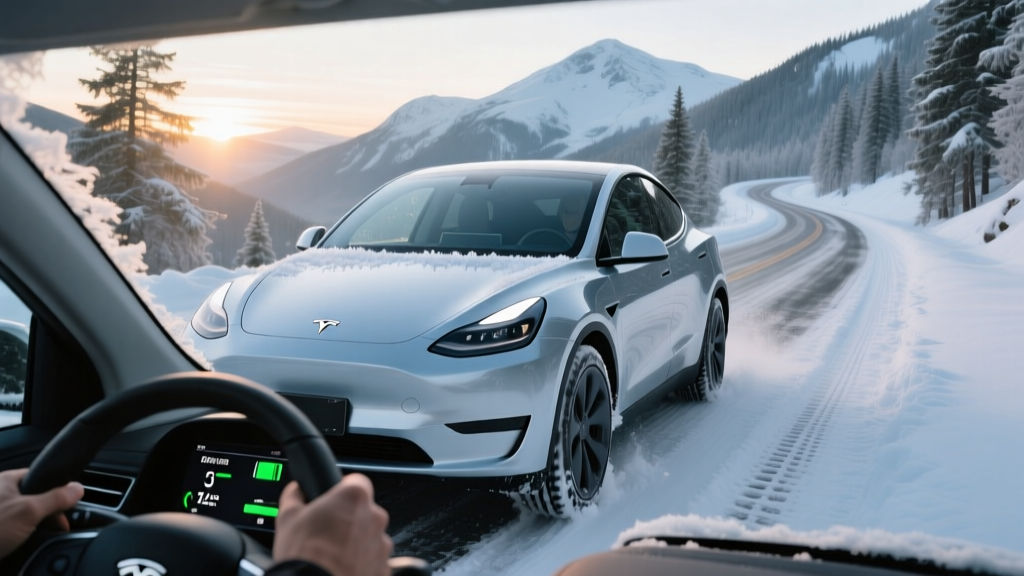
Search "Tesla snow" and you'll find polarized takes: some owners swear their dual-motor Tesla outperforms every SUV in a blizzard, while others report terrifying range drops on sub-zero road trips. The truth is nuanced. Tesla's low center of gravity, dual-motor all-wheel drive, and sophisticated traction control make them surprisingly capable in winter conditions — but cold weather exacts a measurable toll on battery range, charging speed, and efficiency that every buyer in snow country needs to understand before purchasing.
This guide breaks down exactly how the current 2026 Tesla lineup — Model 3, Model Y, Model S, and Model X — handles snow and freezing temperatures, with real numbers on range loss, charging behavior, and the features that matter when the mercury drops.
How Much Range Do Teslas Lose in Snow and Cold Weather?
Lithium-ion batteries are chemically less efficient at low temperatures. Internal resistance increases, regenerative braking is limited until the pack warms up, and cabin heating draws significant energy from the same battery that propels the car. Add winter tires, snow-packed wheel wells, and denser cold air increasing drag, and the cumulative effect is substantial.
Expect 20–35% range reduction in sustained freezing temperatures (below 32°F / 0°C) compared to EPA estimates. At highway speeds in sub-20°F weather, losses can reach 40%. City driving with frequent stops is less punishing because regenerative braking recovers energy — once the battery is warm enough to accept it.
| Model / Trim | EPA Range (mi) | Est. Cold Range (mi)* | Battery (kWh usable) | Chemistry |
|---|---|---|---|---|
| Model 3 Long Range AWD | 363 | ~235–290 | ~75 | NMC |
| Model 3 RWD | 272 | ~175–218 | ~57.5 | LFP |
| Model Y Long Range AWD | 320 | ~210–256 | ~75 | NMC |
| Model S Long Range | 402 | ~260–322 | ~95 | NMC |
| Model X Long Range | 335 | ~218–268 | ~95 | NMC |
*Cold range estimates assume sustained temps below 32°F with highway driving. Actual results vary with temperature severity, driving style, cabin heat usage, and preconditioning. Source: fueleconomy.gov EPA estimates.
Why LFP Batteries Handle Cold Differently
The base Model 3 RWD uses a lithium iron phosphate (LFP) battery, which is more tolerant of repeated 100% charging and has a longer cycle life — but LFP chemistry is notably more affected by cold temperatures than NMC. In sub-freezing conditions, LFP packs may show more aggressive range reduction and slower initial charging speeds. Tesla recommends keeping LFP packs charged to 100% at least weekly, which partially offsets the cold-weather deficit by giving you the full usable capacity as a starting point.
Dual-Motor AWD and Traction: How Teslas Grip Snow
Tesla's dual-motor all-wheel-drive system is one of the strongest arguments for the brand in snow country. Unlike mechanical AWD systems with a center differential, Tesla independently controls torque to the front and rear motors in real time — reacting to wheel slip in milliseconds. There's no lag from a mechanical coupling engaging.
The battery pack mounted along the floor creates a center of gravity significantly lower than any comparable ICE vehicle. This translates to less body roll, more planted handling, and more even weight distribution over all four tires — the single most important factor for traction in snow.
| Model | Drivetrain | 0–60 mph | Horsepower | Curb Weight (lbs) |
|---|---|---|---|---|
| Model 3 LR AWD | Dual Motor AWD | 4.2 sec | ~384 | ~4,034 |
| Model Y LR AWD | Dual Motor AWD | 4.8 sec | ~384 | ~4,398 |
| Model S LR | Dual Motor AWD | 3.1 sec | ~670 | ~4,561 |
| Model X LR | Dual Motor AWD | 3.8 sec | ~670 | ~5,185 |
Important caveat: AWD helps you accelerate and maintain control in snow, but it does not help you stop. Braking distance in snow is determined by your tires. Tesla's stock all-season tires are adequate for light snow but compromise significantly in sustained winter conditions. Dedicated winter tires (like the Michelin X-Ice or Bridgestone Blizzak) transform any Tesla's snow performance and are strongly recommended for owners in regions with regular snowfall.
Winter Charging: What Happens to Speeds Below Freezing
Cold batteries accept charge more slowly — this is electrochemistry, not a Tesla-specific flaw. When you pull up to a Supercharger with a cold-soaked battery, the car must first warm the pack before it can accept peak charge rates. Without preconditioning, you might see initial charging speeds of 30–50 kW on a 250 kW Supercharger, ramping up only after 10–15 minutes of warming.
| Charging Method | Max Rate | 10–80% (Optimal) | 10–80% (Cold, No Precon) | Miles per Hour (Level 2) |
|---|---|---|---|---|
| V3 Supercharger (DC) | 250 kW | ~25–30 min | ~40–55 min | N/A |
| V4 Supercharger (DC) | 250+ kW | ~22–28 min | ~38–50 min | N/A |
| Home Level 2 (Wall Connector, 48A) | 11.5 kW | ~6–8 hrs (full) | ~7–9 hrs (full) | ~37–44 mi/hr |
| Level 1 (120V outlet) | ~1.4 kW | Days | Days | ~3–5 mi/hr |
The Preconditioning Advantage
Tesla's navigation-based battery preconditioning is one of the brand's strongest winter features. When you enter a Supercharger as your navigation destination, the car begins heating the battery pack en route — often for 15–30 minutes before arrival. This means you pull up to the charger with a pack already near optimal temperature and can hit peak charge rates almost immediately. In our experience, preconditioning cuts cold-weather Supercharger sessions by 15–20 minutes versus arriving with a cold-soaked battery.
Pro tip: Always navigate to the Supercharger, even if you know the route by heart. Skipping navigation means skipping preconditioning. In winter, this single habit change saves significant time.
Tesla's Heat Pump: A Winter Efficiency Edge
All current Tesla models (2021 and newer for Model 3/Y; standard on S/X) use a heat pump for cabin heating rather than a resistive heater. A resistive heater converts electricity to heat at a 1:1 ratio — 1 kW of electricity produces 1 kW of heat. A heat pump moves thermal energy from outside air (yes, even cold air contains extractable heat) and can achieve a coefficient of performance (COP) of 2–4x, meaning 1 kW of electricity produces 2–4 kW of heat.
This matters enormously in winter. Cabin heating is the single largest parasitic drain on an EV battery in cold weather. The heat pump reduces that drain substantially, which is why newer Teslas lose less range in winter than older models with resistive heating. Tesla's "octovalve" thermal management system also scavenges waste heat from the motors and battery, further improving overall efficiency.
According to fueleconomy.gov, the 2026 Model 3 Long Range AWD achieves 132 MPGe combined (25 kWh/100mi), among the most efficient vehicles in its class — a rating that partially reflects heat-pump efficiency gains.
2026 Tesla Pricing and Federal Tax Credit Eligibility
| Model / Trim | Base MSRP | §30D Credit | Effective Price* |
|---|---|---|---|
| Model 3 RWD | ~$38,990 | Up to $7,500 | ~$31,490 |
| Model 3 Long Range AWD | ~$45,240 | Up to $7,500 | ~$37,740 |
| Model Y Long Range AWD | ~$46,630 | Up to $7,500 | ~$39,130 |
| Model S Long Range | ~$79,990 | $0 (MSRP cap) | ~$79,990 |
| Model X Long Range | ~$84,990 | $0 (MSRP cap) | ~$84,990 |
*Effective price assumes full §30D credit eligibility. Actual credit varies based on buyer income, battery sourcing, and point-of-sale transfer rules. See IRS §30D guidelines for current requirements.
- MSRP Cap: Sedans (Model 3, S) must be under $55,000; SUVs/trucks (Model Y, X) under $80,000. This disqualifies Model S and most Model X configurations.
- Income Cap: Modified AGI must not exceed $150,000 (single), $225,000 (head of household), or $300,000 (joint filers).
- Battery Sourcing: Credit splits into two halves ($3,750 each) — one for critical minerals, one for battery component manufacturing. Sourcing requirements tighten annually; check current-year IRS guidance.
- Point-of-Sale Transfer: Buyers can transfer the credit to the dealer at purchase for an immediate price reduction, rather than waiting to claim it on their tax return.
Always consult a tax professional before relying on credit eligibility. Rules change, and your specific situation may differ.
Tech Features That Matter in Winter
Tesla's software-centric approach delivers several features that are particularly valuable in snow and ice:
- Scheduled Departure & Preconditioning: Set a departure time while plugged in at home, and the car warms the battery and cabin using grid power — not battery energy. You leave with a warm car and a full, warm battery. This is the single most impactful winter habit for EV owners with home charging.
- Traction Control: Tesla's electric traction control responds to wheel slip far faster than any mechanical system, modulating torque to individual motors in real time.
- Chill Mode: Reduces acceleration torque for smoother starts on slippery surfaces, minimizing wheel spin.
- Heated Everything: All current Teslas include heated front and rear seats, heated steering wheel, and heated side mirrors. The heat pump cabin system warms quickly without the massive energy draw of resistive elements.
- Autopilot (Level 2): Tesla's driver-assistance system can help reduce fatigue on long winter highway drives, but requires constant driver supervision. Lane markings obscured by snow can degrade performance — keep hands on the wheel and eyes on the road.
Tesla Autopilot and Full Self-Driving (Supervised) are SAE Level 2 driver-assistance systems — not self-driving. You must remain fully engaged, hands on the wheel, ready to take over at any moment. Snow-covered lane markings, faded road lines, and heavy precipitation can degrade camera-based systems. Never rely on Autopilot as a substitute for attentive winter driving.
Cargo, Comfort, and Practicality by Model
| Model | Cargo (rear seats up) | Cargo (rear seats down) | Rear Legroom | Seating |
|---|---|---|---|---|
| Model 3 | 23 cu ft | ~60 cu ft | 35.2 in | 5 |
| Model Y | 30 cu ft | ~76 cu ft | 41.6 in | 5 (opt. 7) |
| Model S | 28 cu ft | ~80 cu ft | 35.4 in | 5 |
| Model X | ~37 cu ft (5-seat) | ~92 cu ft | 38.4 in | 5/6/7 |
The Model Y is the clear pick for families in snow country — its SUV ride height, generous cargo space, and available third row make it the most versatile Tesla for winter gear, ski equipment, and child seats. The Model 3 is more efficient but sits lower, meaning deeper snow can become a ground-clearance issue.
Battery Warranty and Long-Term Ownership in Cold Climates
Tesla's battery and drive unit warranty provides meaningful protection for cold-climate owners:
- Model 3 / Model Y: 8 years or 100,000 miles (Long Range/Performance); 8 years or 120,000 miles (some configurations). Minimum 70% capacity retention over the warranty period.
- Model S / Model X: 8 years or 150,000 miles. Minimum 70% capacity retention.
Cold weather itself does not cause permanent battery degradation — it causes temporary range loss that recovers when temperatures rise. The long-term degradation concern in cold climates is actually charging a cold battery without preconditioning, which can cause lithium plating. Tesla's thermal management system actively prevents this by limiting charge speed and regen until the battery warms, which is why winter preconditioning is so important.
Pros and Cons: Tesla Ownership in Snow Country
- Dual-motor AWD with instant torque vectoring — excellent snow traction
- Low center of gravity from floor-mounted battery pack
- Heat pump dramatically reduces cabin heating energy draw
- Preconditioning while plugged in preserves range
- Navigation-based battery preheating for faster DC charging
- Supercharger network — the most reliable public charging infra in winter
- Over-the-air updates continually improve thermal management
- Frunk + trunk storage for winter gear
- 20–40% range loss in sustained freezing temperatures
- LFP batteries (Model 3 RWD) more affected by cold than NMC
- Slower DC charging without preconditioning in cold weather
- Regenerative braking limited until battery warms — changes braking feel
- Camera-based Autopilot degraded by snow-covered lane markings
- Model 3 ground clearance (5.5 in) can be limiting in deep snow
- No physical buttons — glove adjustments require touchscreen while wearing gloves
- Model S and X exceed MSRP caps for federal tax credit
Who Should Buy a Tesla for Snow Driving?
- Choose Model Y LR AWD if: You need family space, cargo room for ski gear, and the best balance of range and practicality in snow. The top pick for most snow-country buyers.
- Choose Model 3 LR AWD if: You prioritize efficiency and range over cargo space, commute in winter conditions, and have reliable home charging to precondition daily.
- Choose Model 3 RWD if: You live in a mild-winter region with occasional snow, want the lowest entry price, and can charge to 100% regularly (LFP requirement).
- Choose Model S/X if: Budget allows (no federal credit), you want maximum range (Model S) or seating for 6–7 (Model X), and value premium features. Best for those with garaged home charging.
- Consider a non-Tesla alternative if: You live in a region with limited Supercharger coverage, need physical buttons, or want CCS/NACS charging flexibility without adapters.
Frequently Asked Questions
Do Teslas get stuck in snow?
Dual-motor AWD Teslas with proper winter tires rarely get stuck in typical snow conditions. The low center of gravity and instant torque control provide excellent traction. However, ground clearance matters — the Model 3's 5.5 inches can be a limitation in unplowed deep snow, while the Model Y and X offer more clearance. Single-motor RWD models (base Model 3) are significantly less capable in snow and are not recommended for regions with regular snowfall.
Should I get winter tires for my Tesla?
Yes, strongly recommended if you drive in sustained temperatures below 45°F or regular snow. All-season tires harden in cold temperatures, reducing grip. Winter tires use softer compounds that stay pliable and have tread patterns designed for snow and ice. The combination of AWD + winter tires makes a Tesla genuinely competitive with dedicated winter SUVs. Expect to spend $800–$1,400 for a set of four winter tires on a Model 3 or Y.
How do I maximize Tesla range in winter?
Precondition while plugged in (use Scheduled Departure). Use seat heaters instead of cranking cabin heat. Drive at moderate speeds (65 vs 75 mph saves ~15% range). Keep the battery above 20% — cold + low SoC is the worst combination. Navigate to Superchargers to trigger battery preconditioning. Garage your car if possible to reduce cold-soak.
Does the Supercharger network work reliably in winter?
Generally yes — Tesla's Supercharger network is the most reliable public charging infrastructure in North America, with uptime above 95% according to Tesla's own data. However, individual stalls can be affected by ice, and charging speeds are slower in cold weather. V4 Superchargers with longer cables are easier to use when snow is piled around the vehicle. Always have a backup charging plan for road trips in remote winter areas.
Is a Tesla worth buying in snow country vs. a gas AWD SUV?
For daily commuting with home charging, a Tesla AWD offers lower operating costs (electricity vs gas, no oil changes), instant torque for confident merging on icy on-ramps, and the ability to "refuel" in your warm garage every night. The trade-offs are reduced winter range, longer "refueling" on road trips, and higher upfront cost (though partially offset by the $7,500 credit on Model 3/Y). If you regularly drive 300+ miles in winter without reliable charging access, a PHEV or efficient AWD gas SUV may be more practical until charging infrastructure improves in your region.