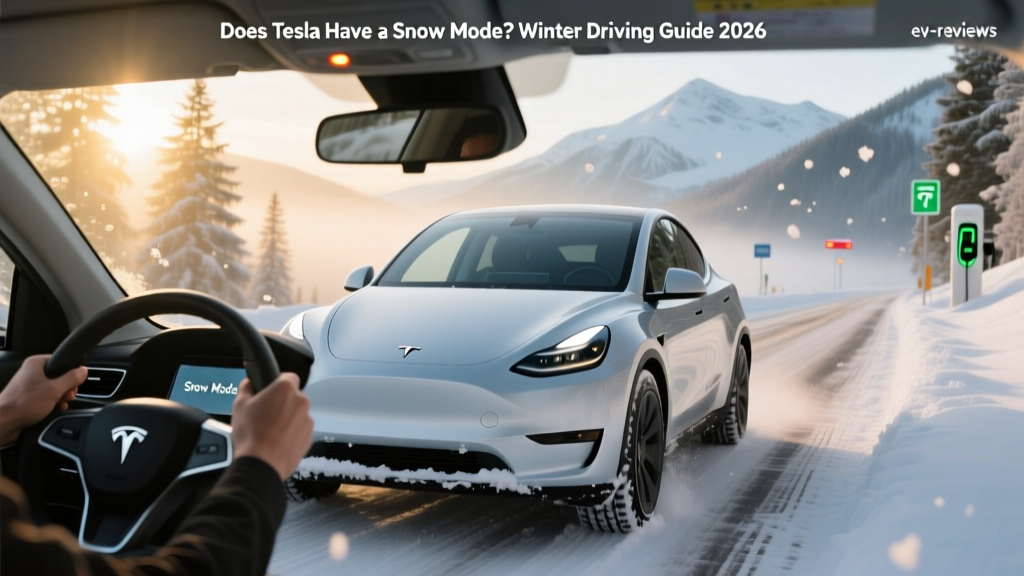
Does Tesla Have a Snow Mode? The Short Answer
No Tesla model includes a dedicated "Snow Mode" button or selectable drive setting like you will find on the Ford Mustang Mach-E, Hyundai Ioniq 5, or Rivian R1S. Instead, Tesla bakes winter capability into the vehicle's traction control, stability software, and dual-motor all-wheel-drive (AWD) system. The car continuously modulates torque to each axle hundreds of times per second, which in practice mimics what a dedicated snow mode does on other EVs — but without requiring the driver to select it.
For 2026, Tesla's lineup — Model 3, Model Y, Model S, Model X, and the Cybertruck — all rely on this software-defined traction approach. If you are shopping for a Tesla specifically for snowy climates, the real question is not whether a snow mode exists, but how well the AWD system, winter tire compatibility, battery preconditioning, and cold-weather range hold up. This guide covers all of that with exact numbers.
How Tesla Handles Snow and Ice Without a Snow Mode
Tesla's traction system uses independent front and rear motors (on AWD trims) with millisecond-response torque vectoring. When the system detects slip, it can instantly reduce or redirect torque. In testing by multiple outlets and in real-world owner reports from northern US states and Canada, this system performs comparably to a traditional snow mode.
Key winter-driving features Tesla includes across its 2026 lineup:
- Traction Control: Always active, cannot be fully disabled. Modulates power to prevent wheel spin on low-grip surfaces.
- Regenerative Braking Adjustment: In firmware updates since late 2023, Tesla added a "Low" regen option that reduces the aggressiveness of one-pedal deceleration on slippery roads, preventing rear-end slide from sudden regen torque.
- Chill Mode (Performance trims): Limits acceleration output. While designed for comfort, many owners use Chill Mode in snow for smoother, less aggressive throttle response — effectively serving as a makeshift snow mode.
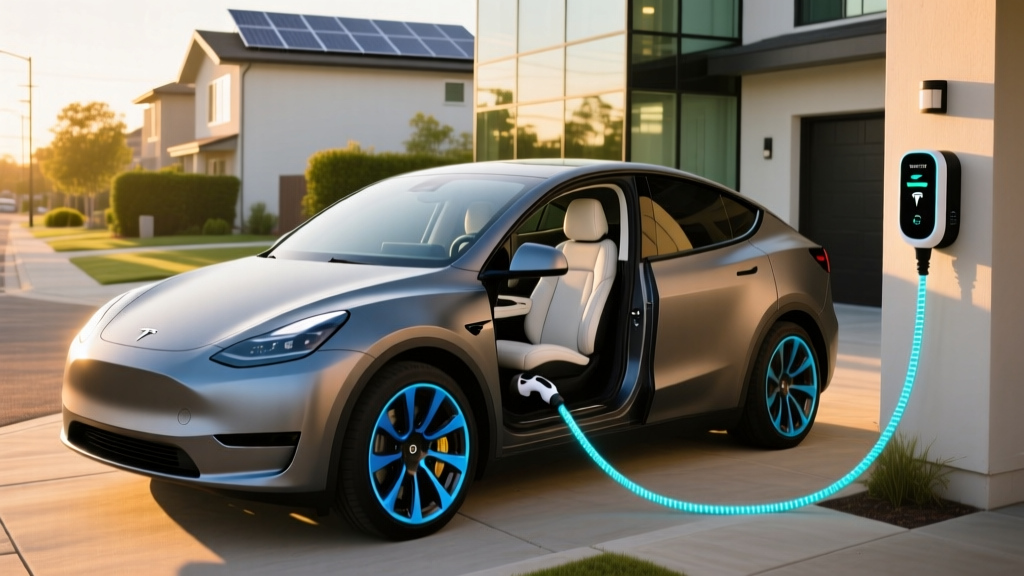
- Battery Preconditioning: When navigating to a Supercharger, the car warms the battery pack to optimize charge acceptance. This also helps maintain range in cold weather by keeping the pack in its efficient temperature window.
- Cabin Overheat/Preconditioning: Scheduled departure times let you warm the cabin and battery while plugged in, preserving range for your commute.
Tesla Model Y 2026: Winter-Capable Spec Breakdown
The Model Y remains Tesla's best-selling vehicle and the most common Tesla in snowy northern states. Here are the exact 2026 specifications for the Long Range AWD and Performance trims — the two variants most relevant for winter buyers.
| Spec | Long Range AWD | Performance |
|---|---|---|
| EPA Range | 310 miles | 285 miles |
| Battery (usable) | ~75 kWh, NMC | ~75 kWh, NMC |
| Drivetrain | Dual-motor AWD | Dual-motor AWD |
| Horsepower | 384 hp | ~456 hp |
| 0–60 mph | 4.8 sec | 3.5 sec |
| Max DC Fast Charge | 250 kW (CCS/NACS) | 250 kW |
| 10–80% DCFC Time | ~27 min | ~27 min |
| Level 2 Home Charge | 11.5 kW (~44 mi/hr) | 11.5 kW (~44 mi/hr) |
| MPGe (combined) | 122 MPGe | 111 MPGe |
| Efficiency | 28 kWh/100 mi | 30 kWh/100 mi |
| Cargo Volume | 76 cu ft (rear seats folded) | 76 cu ft |
| Rear Legroom | 41.6 in | 41.6 in |
| Base MSRP | $44,990 | $48,990 |
| Battery Warranty | 8 yr / 120,000 mi | 8 yr / 120,000 mi |
Source: fueleconomy.gov and Tesla Model Y specs page.
Charging in Winter: What Changes When It's Cold
Cold temperatures slow lithium-ion charge acceptance. If you pull up to a Supercharger with a cold-soaked battery (the car has been sitting outside for hours without preconditioning), peak charge rates can drop from 250 kW to 50–90 kW until the pack warms up.
| Condition | Peak kW | 10–80% Time | Notes |
|---|---|---|---|
| Warm pack, preconditioned | 250 kW | ~27 min | Ideal; navigate to Supercharger via nav |
| Cold pack (32°F), preconditioned | 170–220 kW | ~32–38 min | Preconditioning via nav helps |
| Cold-soaked, no preconditioning | 50–90 kW | 55–75 min | Avoid: always precondition in winter |
| Home Level 2 (11.5 kW / 48A) | 11.5 kW | ~7–8 hr (0–100%) | Overnight; adds ~44 mi/hr |
| Level 1 (120V / 12A) | ~1.4 kW | N/A | ~3–4 mi/hr; emergency/trickle only |
Pro tip: Always enter a Supercharger as your navigation destination, even if you know the route. This triggers battery preconditioning automatically, warming the pack to ~95°F before you arrive. In winter, this can shave 20+ minutes off your charge session.
2026 Federal Tax Credit: Does the Model Y Qualify?
Under IRS §30D rules for 2026, the Tesla Model Y Long Range AWD and Performance are currently eligible for up to $7,500 in federal tax credits — but eligibility depends on multiple factors that buyers must verify individually.
- MSRP Cap: SUVs/vans/pickups must be under $80,000 MSRP. Model Y qualifies (base $44,990; fully loaded ~$55,000). ✓
- Buyer Income Cap: Modified AGI must not exceed $150,000 (single), $225,000 (head of household), or $300,000 (married filing jointly). Check your prior-year or current-year AGI.
- Battery Sourcing: Critical minerals and battery components must meet phased-in percentage thresholds from US or FTA-partner countries. Tesla's US-built battery packs have largely met these requirements for 2025–2026, but specific build dates and supply chain changes can affect eligibility.
- Point-of-Sale Transfer: Since Jan 1, 2024, you can transfer the credit to the dealer at purchase, reducing your out-of-pocket cost immediately rather than waiting for a tax refund.
- One Credit Per Vehicle: The credit applies once per VIN. Used EVs have a separate §25E credit (up to $4,000).
Always verify current eligibility at irs.gov/credits-deductions/credits-for-new-clean-vehicles and consult a tax professional for your specific situation.
| Trim | Base MSRP | Est. §30D Credit | Effective Price* |
|---|---|---|---|
| Long Range AWD | $44,990 | Up to $7,500 | ~$37,490 |
| Performance | $48,990 | Up to $7,500 | ~$41,490 |
*Effective price assumes full $7,500 credit eligibility. Destination fee ($1,390), paint upgrades, FSD, and other options increase final price. State incentives (e.g., Colorado, California, New York) may stack on top — check your state's energy office for current programs.
Model Y vs. Competitors for Winter Driving
If snow performance is your top priority, here is how the Model Y stacks up against key AWD electric crossovers in the $40,000–$55,000 range:
| Feature | Tesla Model Y LR AWD | Ford Mach-E Ext. Range AWD | Hyundai Ioniq 5 AWD |
|---|---|---|---|
| Dedicated Snow Mode | No (software-based traction) | Yes (Whisper/Wet/Snow) | Yes (Snow drive mode) |
| EPA Range (AWD) | 310 mi | 290 mi | 260 mi |
| Heat Pump | Standard | Standard (2025+) | Standard |
| Max DCFC kW | 250 kW | 150 kW | 350 kW (800V) |
| 10–80% Time | ~27 min | ~45 min | ~18 min |
| Ground Clearance | 6.6 in | 5.7 in | 6.1 in |
| Battery Warranty | 8 yr / 120,000 mi | 8 yr / 100,000 mi | 10 yr / 100,000 mi |
| Base MSRP (AWD) | $44,990 | $48,995 | $49,850 |
Sources: fueleconomy.gov, manufacturer spec pages. Specs reflect 2025–2026 model year data.
Key takeaway: The Model Y offers the best EPA range and the highest ground clearance of the three, plus access to Tesla's Supercharger network (now open to other brands via NACS adapters, but still the most reliable and dense). The Ioniq 5 charges faster on 800V architecture (350 kW capable), which matters on long winter road trips. The Mach-E offers a true selectable snow mode but trails on range and charging speed.
Pros and Cons: Tesla for Snowy Climates
- Best-in-class EPA range (310 mi) provides winter buffer
- Heat pump standard — minimizes cold-weather range loss
- Dual-motor AWD with instant torque vectoring
- Supercharger network reliability in remote/cold areas
- Battery preconditioning optimizes winter DCFC speeds
- Scheduled departure preconditioning while plugged in
- OTA updates continuously improve traction algorithms
- Over-the-air "Chill Mode" softens throttle for low-grip starts
- No dedicated Snow Mode button or selectable drive profile
- All-season tires stock — winter tires are an added cost
- 6.6" ground clearance limits deep-snow capability
- No Apple CarPlay/Android Auto for preferred nav apps
- Touchscreen-only climate controls are distracting in winter gloves
- Regen can feel abrupt on ice if "Low" setting not selected
- Insurance premiums run 15–25% higher than comparable non-EV SUVs
- FSD/Autopilot is Level 2 — driver must stay fully engaged in all conditions
Who Should Buy a Tesla for Winter Driving?
The Model Y Long Range AWD is a strong winter vehicle for:
- Daily commuters in northern states who can charge at home overnight and need 200+ real-world winter miles for round trips.
- Families needing cargo space (76 cu ft with seats folded) and AWD traction for school runs and weekend trips.
- Road trippers who value Supercharger network density on interstate corridors through mountain passes and cold plains.
It is less ideal for:
- Deep backcountry or unplowed roads where 6.6 inches of ground clearance and low approach angles are limiting — consider a Rivian R1S or Ford F-150 Lightning instead.
- Drivers who want a physical snow mode switch — if the psychological comfort of a dedicated mode matters, the Mach-E or Ioniq 5 provide that interface.
- Apartment dwellers without home charging — winter range loss makes public-only charging significantly more inconvenient.
Frequently Asked Questions
Does Tesla have a snow mode?
No. Tesla does not offer a selectable "Snow Mode" on any model. Instead, the dual-motor AWD system uses real-time traction control, torque vectoring, and software-based stability management to handle low-grip conditions. Drivers can use Chill Mode to soften throttle response and select Low regenerative braking to reduce the risk of regenerative-induced sliding on ice.
How much range do I lose in winter?
Expect a 15–30% range reduction in sustained freezing temperatures. The Model Y Long Range AWD's 310-mile EPA rating drops to roughly 220–260 miles in real-world winter highway driving. City driving losses are less severe. Preconditioning the battery and cabin while plugged in recovers some of this penalty.
Do I need winter tires on a Tesla?
If you regularly drive in temperatures below 45°F, on packed snow, or on ice, winter tires are strongly recommended. Tesla's AWD system manages power delivery, but tires are the only contact point with the road. A dedicated winter tire set (e.g., Michelin X-Ice or Bridgestone Blizzak) on separate wheels typically costs $1,200–$1,800 for a Model Y and dramatically improves braking and cornering on snow and ice.
Can I use Autopilot or FSD in snow?
Tesla's Autopilot and FSD (Supervised) are SAE Level 2 driver-assistance systems. They are not self-driving. In heavy snow, lane markings may be obscured and camera visibility reduced, which can cause the system to disengage or behave unpredictably. Tesla's owner manual explicitly warns that Autopilot performance degrades in adverse weather. The driver must remain fully attentive with hands on the wheel at all times.
Does the Model Y qualify for the $7,500 federal tax credit in 2026?
The Model Y is eligible for up to $7,500 under IRS §30D, provided the buyer meets income caps ($150K single / $300K joint), the vehicle MSRP is under $80,000 (it is), and battery sourcing requirements are met. The credit can be transferred at point of sale to reduce your purchase price immediately. Always verify current eligibility at irs.gov before purchasing.
How does the Model Y's AWD compare to a traditional snow mode?
In practice, Tesla's dual-motor torque vectoring reacts faster than most traditional AWD systems with a selectable snow mode. The system can independently adjust front and rear torque within milliseconds. The main difference is interface: a dedicated snow mode on a Mach-E or Ioniq 5 also adjusts throttle mapping, transmission behavior (in single-speed EVs, this means torque delivery curves), and traction control sensitivity in a bundled package. Tesla separates these into Chill Mode (throttle) and Low Regen (deceleration), requiring the driver to configure them manually.