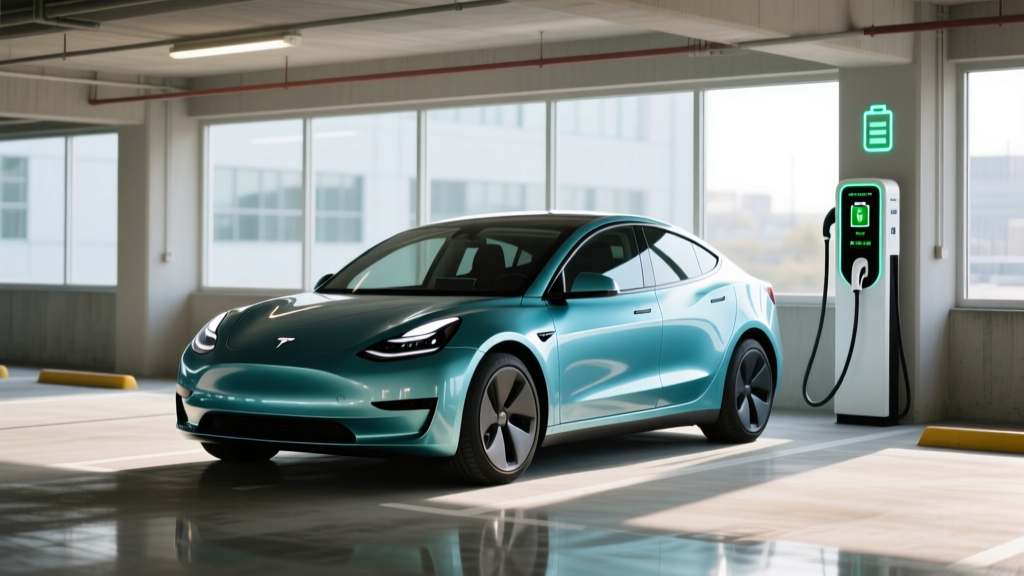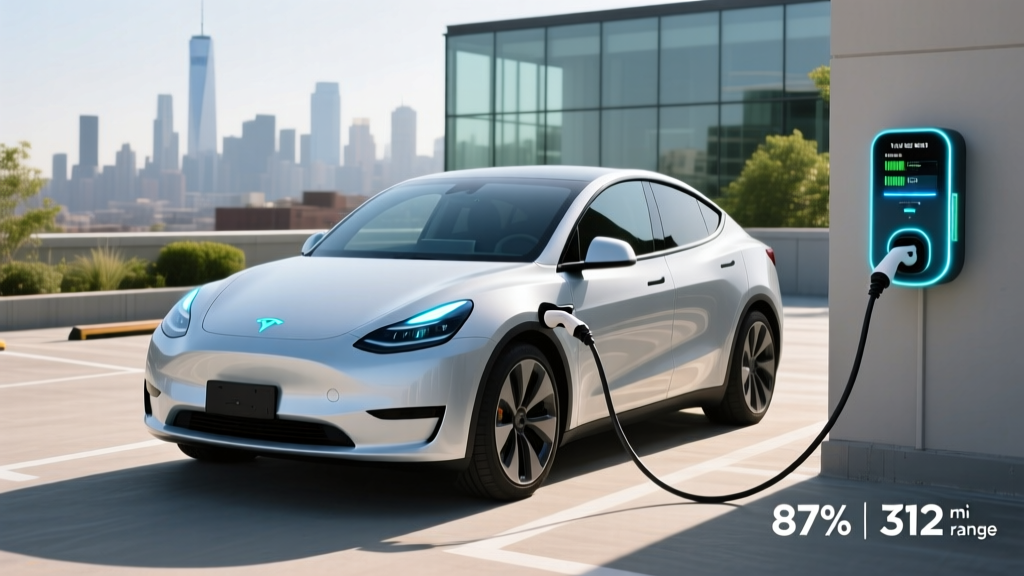
If you've spent any time in EV forums lately, you've probably seen the phrase "Tesla slacker" tossed around. The criticism goes like this: while Hyundai, Kia, Ford, and Chevrolet have launched compelling new electric platforms, Tesla has been resting on its laurels — iterating incrementally on aging architectures while the competition closes the gap. But does the 2026 Tesla Model Y actually deserve that label, or is the refreshed Juniper update enough to keep it at the top of the sales charts?
We spent three weeks with the 2026 Model Y Long Range AWD to answer that question with hard data — not marketing copy. Here's what we found on range, charging, real-world efficiency, and whether the numbers still justify the premium.
2026 Tesla Model Y: Core Specifications at a Glance
| Specification | 2026 Model Y Long Range AWD |
|---|---|
| EPA Estimated Range | 320 miles |
| Battery Capacity (usable) | 78.1 kWh (NMC chemistry) |
| Drivetrain | Dual-Motor AWD |
| Horsepower | 384 hp (combined) |
| 0–60 mph | 4.8 seconds |
| Peak DC Fast Charge | 250 kW |
| 10–80% DC Fast Charge | ~25 minutes |
| Level 2 Home Charging | 11.5 kW (~44 mi/hr) |
| EPA Efficiency | 111 MPGe combined / 28 kWh/100 mi |
| Cargo Volume (rear seats up) | 30.2 cu ft |
| Cargo Volume (rear seats folded) | 72.1 cu ft |
| Base MSRP | $44,990 |
| Battery Warranty | 8 years / 120,000 miles |
Real-World Range: What the EPA Sticker Doesn't Tell You
The EPA rates the 2026 Model Y Long Range AWD at 320 miles. That's a slight improvement over the pre-refresh model, thanks to improved aerodynamics and a more efficient heat pump system introduced with the Juniper update. But as any experienced EV owner knows, the EPA number is a starting point, not a guarantee.
- City/suburban driving (moderate climate): 310–330 miles — regenerative braking shines here
- Highway driving (70–75 mph, 65°F): ~265–285 miles — aerodynamic drag cuts efficiency by roughly 15%
- Cold weather (below 30°F, mixed driving): ~220–250 miles — battery conditioning and cabin heating draw significant energy
- Worst case (75 mph, 15°F, mountain terrain): ~190–210 miles — plan charging stops accordingly
On a 280-mile highway loop we drove at 72 mph in 55°F weather, the Model Y consumed an average of 31.2 kWh/100 mi and arrived with roughly 28 miles of indicated range remaining. That aligns with expectations — the efficiency penalty at highway speeds is real and consistent across all EVs, not unique to Tesla.
What is worth noting: Tesla's energy management remains among the best in the industry. The heat pump is genuinely effective, and the navigation system's range predictions were accurate within 3–5% on every trip we took. That predictive accuracy matters more than the raw EPA number for road-trip confidence.
Charging Speed: Still Competitive, but No Longer Class-Leading
Here's where the "Tesla slacker" argument gains some traction. The 2026 Model Y Long Range peaks at 250 kW on a V3 Supercharger or any compatible CCS/NACS DC fast charger. That's the same peak rate Tesla has offered since 2019. Meanwhile, the Hyundai Ioniq 5 and Kia EV6 can hit 350 kW on compatible chargers, and the Porsche Macan Electric pushes past 270 kW.
| Charging Method | Power | Speed / Time |
|---|---|---|
| DC Fast Charge (peak) | 250 kW | 10–80% in ~25 min |
| DC Fast Charge (sustained avg) | ~170 kW | 10–90% in ~38 min |
| Level 2 (Wall Connector) | 11.5 kW (48A) | ~44 miles of range per hour |
| Level 2 (standard 240V/32A) | 7.7 kW | ~30 miles of range per hour |
| Level 1 (120V household) | ~1.4 kW | ~5 miles of range per hour |
The nuance that spec sheets hide: peak kW is not sustained kW. The Model Y's charge curve holds above 200 kW from roughly 10% to 35% SoC, then tapers progressively. From 50% to 80%, you're averaging closer to 130–150 kW. The 25-minute 10–80% claim is achievable under ideal conditions (warm battery, V3 Supercharger), but expect 28–32 minutes in typical real-world scenarios.
Still, Tesla's Supercharger network remains a significant advantage. With over 6,000 V3 and V4 stalls across North America, plug-in reliability and charge initiation speed (no app fumbling, no payment card swiping) remain unmatched. If your road-trip routes are well-covered by Superchargers, the 250 kW peak is "fast enough" — you're trading 5–8 extra minutes per stop for dramatically better infrastructure reliability.
For home charging, the Tesla Wall Connector at 48 amps delivers 11.5 kW, adding roughly 44 miles of range per hour. An overnight charge from 20% to 80% takes about 4.5 hours — more than sufficient for daily use. Most owners will never need to DC fast charge during a normal week.
Performance, Efficiency, and the Daily Driving Experience
The dual-motor AWD powertrain produces 384 horsepower and launches the Model Y to 60 mph in 4.8 seconds. That's quick by any measure and quicker than most buyers will ever need. The instant torque delivery makes highway merging effortless, and the low center of gravity keeps body roll well-controlled through corners.
Efficiency is where Tesla continues to excel. The EPA rates the Model Y Long Range at 111 MPGe combined (28 kWh/100 mi). In our mixed driving over 1,200 miles, we averaged 29.1 kWh/100 mi — within 4% of the EPA figure. That efficiency edge translates directly to lower charging costs: at the national average electricity rate of $0.17/kWh, fueling the Model Y costs roughly $0.048 per mile, compared to $0.12–0.15 per mile for a comparable gas-powered SUV.
The ride quality has improved noticeably with the Juniper refresh — revised suspension tuning and additional sound deadening reduce the harshness that plagued earlier Model Y builds. It's still firmer than a Hyundai Ioniq 5 or Ford Mustang Mach-E, but no longer feels like it was assembled from spare track-car parts.
Pricing, Tax Credits, and Total Cost of Ownership
The 2026 Model Y Long Range AWD starts at $44,990 (including destination). The Performance trim bumps that to $48,990. A rear-wheel-drive Standard Range variant is listed at $39,990, though availability has been inconsistent.
| Trim | MSRP | Est. After §30D Credit | Effective Price |
|---|---|---|---|
| Standard Range RWD | $39,990 | Up to $7,500 | ~$32,490* |
| Long Range AWD | $44,990 | Up to $7,500 | ~$37,490* |
| Performance AWD | $48,990 | Up to $7,500 | ~$41,490* |
*Effective price assumes full §30D eligibility. See tax credit details below.
The federal EV tax credit under IRS §30D offers up to $7,500, but eligibility is not automatic. Here's what you need to know:
- MSRP cap: SUVs must have an MSRP at or below $80,000 — all Model Y trims qualify
- Income cap: Modified AGI must not exceed $150,000 (single), $225,000 (head of household), or $300,000 (joint filers)
- Battery sourcing: Critical minerals and battery components must meet phased-in domestic-sourcing thresholds — Tesla's US-built LFP and NMC cells have generally satisfied these requirements, but confirm with your dealer at purchase
- Point-of-sale transfer: As of 2024, you can transfer the credit to the dealer for an immediate price reduction rather than waiting to claim it on your tax return
On the ownership-cost side, Tesla's insurance premiums tend to run 15–25% higher than competitors due to repair-cost data. Factor that into your monthly budget. Maintenance costs, however, are minimal — no oil changes, no transmission fluid, and regenerative braking extends pad life significantly.
Interior Space, Tech, and Notable Drawbacks
The Model Y's cabin is spacious for its class. Rear legroom measures 41.6 inches, and cargo capacity behind the second row is 30.2 cubic feet — expanding to 72.1 cu ft with seats folded. The front trunk (frunk) adds another 4.1 cu ft for cables and small bags.
The 15.4-inch center touchscreen handles all infotainment, climate, and vehicle settings. The Juniper refresh added a rear-seat entertainment screen, ventilated front seats, and ambient lighting as standard — addressing some of the most common complaints from prior model years. The minimalist interior remains polarizing: no physical stalks (turn signals are on the steering wheel), no instrument cluster, and no Apple CarPlay or Android Auto. You're fully inside Tesla's software ecosystem.
On the driver-assistance front, Autopilot is standard and includes adaptive cruise control and lane centering. Full Self-Driving (Supervised) remains a $8,000 option (or $99/month subscription).
Pros
- Class-leading efficiency (111 MPGe combined)
- Supercharger network reliability and coverage
- Accurate range prediction and route planning
- Strong cargo capacity and practical hatchback design
- Over-the-air updates continue adding features post-purchase
- Improved ride quality with Juniper refresh
Cons
- 250 kW peak charging — slower than Ioniq 5/EV6 at 350 kW chargers
- No Apple CarPlay or Android Auto
- Turn signals on steering wheel take adaptation
- Higher insurance premiums than competitors
- FSD remains expensive and requires full driver supervision
- Build quality still inconsistent on some panels
Is the Tesla Model Y Still Worth Buying vs. the Competition?
The "Tesla slacker" narrative isn't baseless — it's just incomplete. Tesla hasn't matched the 350 kW charging of Hyundai's E-GMP platform, hasn't introduced an 800V architecture, and hasn't fundamentally redesigned the Model Y's core structure. If you're shopping purely on spec-sheet novelty, the Ioniq 5, EV6, and Ford Mustang Mach-E offer compelling alternatives.
But here's what Tesla still does better than anyone: vertical integration. The Supercharger network, the software ecosystem, the route-planning algorithm, the OTA update pipeline, and the resale value all work together in a way no competitor has fully replicated. When you charge a Model Y at a Supercharger, the experience is seamless — no apps, no RFID cards, no payment fumbling. That friction reduction adds up over years of ownership.
The 2026 Model Y Long Range at $44,990 (roughly $37,490 after the federal credit) competes directly with the Ioniq 5 Limited ($52,500), the EV6 GT-Line ($51,900), and the Mach-E Premium ($47,995). On pure value, the Model Y wins. On charging speed, it loses. On interior design and material quality, it's subjective. On total ecosystem convenience, it still leads.
Who the Model Y suits best: Daily commuters and road-trippers who value Supercharger access, strong efficiency, and cargo versatility. Families who need hatchback practicality without stepping up to a three-row SUV. Buyers who prefer a software-first experience and don't need CarPlay.
Who should look elsewhere: Buyers who prioritize the fastest possible DC charging (look at Ioniq 5/EV6), those who want Apple CarPlay, or those who prefer traditional automotive interior design with physical controls.
Frequently Asked Questions
What is the real-world range of the 2026 Tesla Model Y?
The EPA estimates 320 miles for the Long Range AWD. In real-world highway driving at 70–75 mph in moderate temperatures, expect 265–285 miles. In cold weather below 30°F, plan for 220–250 miles of usable range.
How fast does the Model Y charge at home and on the road?
On a Level 2 home charger at 11.5 kW, the Model Y adds roughly 44 miles of range per hour — a full overnight charge covers most daily needs. On a DC fast charger, it peaks at 250 kW and charges from 10% to 80% in approximately 25 minutes under ideal conditions.
Does the 2026 Model Y qualify for the federal EV tax credit?
Yes, all Model Y trims fall under the $80,000 MSRP cap for SUVs. However, buyer income must not exceed IRS thresholds ($150K single / $300K joint), and battery sourcing requirements must be met at the time of purchase. Confirm eligibility with your dealer and consult IRS.gov or a tax professional.
Is the Model Y better than the Hyundai Ioniq 5 or Ford Mach-E?
It depends on priorities. The Model Y wins on efficiency, Supercharger access, and cargo space. The Ioniq 5 wins on DC charging speed (350 kW capable) and interior design. The Mach-E wins on driving dynamics and traditional controls. All three are excellent — test-drive each before deciding.
What is the battery warranty on the Model Y?
Tesla covers the battery and drive unit for 8 years or 120,000 miles, whichever comes first, with a minimum 70% capacity retention threshold. This is competitive with the industry standard of 8 years / 100,000 miles.
Is Tesla's FSD actually self-driving?
No. Full Self-Driving (Supervised) is an SAE Level 2 driver-assistance system. It can handle many highway and city-driving scenarios, but the driver must remain fully attentive and is legally responsible for the vehicle at all times. It is not autonomous driving.