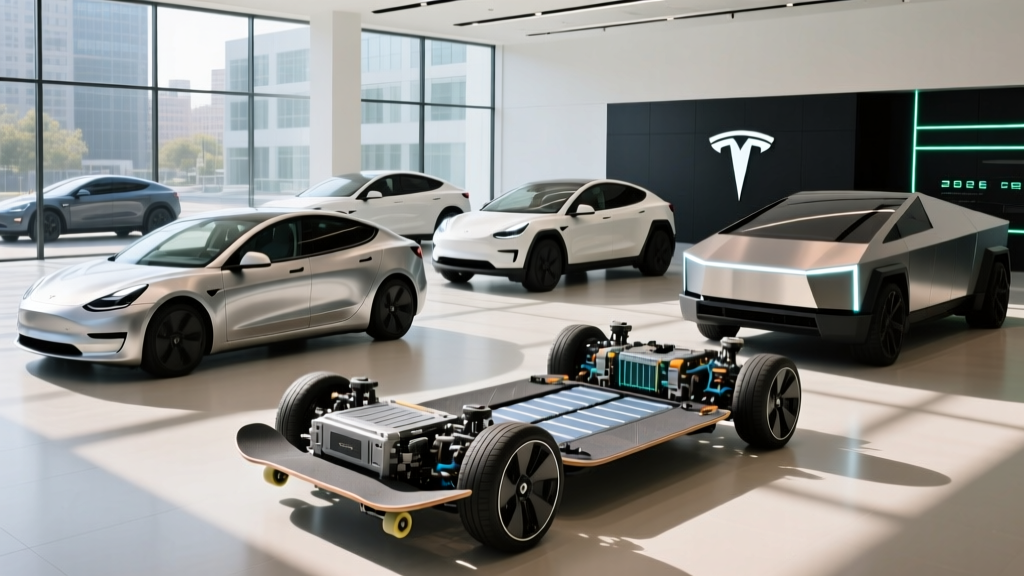
When EV engineers talk about a "skateboard platform," they're describing the foundational architecture that houses an electric vehicle's battery pack, electric motors, suspension, and thermal management system in a flat, low-slung chassis. Tesla pioneered this concept in mass production, and it remains the backbone of every vehicle the company sells. The so-called Tesla skateboard isn't a single product you can buy—it's the engineering philosophy that shapes how the Model 3, Model Y, Model S, and Model X drive, charge, and package their interiors.
In this deep-dive profile, we examine the 2026 Tesla lineup through the lens of this platform architecture, providing exact EPA range figures, charging benchmarks, pricing, and tax credit data you need to make a purchase decision.
What Is the Tesla Skateboard Platform?
The skateboard architecture places the battery pack—Tesla's largest and heaviest component—flat along the vehicle floor between the axles. Electric motors sit at the front and/or rear axle, and the power electronics, cooling loops, and structural subframes integrate directly into the chassis. The result is a low center of gravity, near-50/50 weight distribution, and a cabin freed from the transmission tunnel and engine bay constraints of internal-combustion vehicles.
Tesla evolved this concept significantly with the structural battery pack introduced in the refreshed Model Y and Cybertruck. Rather than treating cells as cargo inside a metal box, Tesla uses the cells themselves as a load-bearing element, bonding them between upper and lower casting pieces. This reduces parts count, drops weight, and increases torsional rigidity.
For 2026, Tesla's lineup spans four core consumer vehicles built on skateboard-derived architectures:
- Model 3 (Highland refresh) — compact sedan on the original unibody skateboard
- Model Y (Juniper refresh) — compact SUV on an evolved structural-battery skateboard
- Model S — flagship sedan on the large-platform skateboard (Plaid tri-motor variant)
- Model X — flagship SUV sharing the Model S architecture
2026 Tesla Lineup: Core Specifications at a Glance
| Spec | Model 3 Long Range AWD | Model Y Long Range AWD | Model S Plaid | Model X Long Range |
|---|---|---|---|---|
| EPA Range | 341 mi | 320 mi | 396 mi | 335 mi |
| Battery (usable) | ~75 kWh (NMC) | ~75 kWh (NMC) | ~95 kWh (NMC) | ~95 kWh (NMC) |
| Drivetrain | Dual-motor AWD | Dual-motor AWD | Tri-motor AWD | Dual-motor AWD |
| Horsepower | 346 hp | 384 hp | 1,020 hp | 670 hp |
| 0–60 mph | 4.2 sec | 4.8 sec | 1.99 sec | 3.8 sec |
| Peak DC Fast Charge | 250 kW | 250 kW | 250 kW | 250 kW |
| 10–80% DC Time | ~27 min | ~27 min | ~32 min | ~32 min |
| Level 2 Rate | 11.5 kW (~44 mi/hr) | 11.5 kW (~44 mi/hr) | 11.5 kW (~34 mi/hr) | 11.5 kW (~34 mi/hr) |
| MPGe (combined) | 132 MPGe | 122 MPGe | 116 MPGe | 102 MPGe |
| Base MSRP | $47,740 | $48,630 | $89,990 | $79,990 |
| Battery Warranty | 8 yr / 120,000 mi | 8 yr / 120,000 mi | 8 yr / 150,000 mi | 8 yr / 150,000 mi |
Sources: EPA fueleconomy.gov, Tesla official specs. Figures reflect 2025–2026 model year data as published. MSRP excludes destination fee.
Real-World Range: What the EPA Sticker Doesn't Tell You
EPA estimates are standardized lab values. In real-world driving, expect variation:
• Highway (70–80 mph): Subtract 10–15% from EPA due to aerodynamic drag scaling with the square of speed.
• Cold weather (below 32°F): Expect 20–30% range loss from cabin heating demands and reduced battery chemical efficiency, even with Tesla's heat pump.
• City / moderate temps: You may match or slightly exceed EPA thanks to regenerative braking recapturing energy.
Tesla's thermal management system is among the most sophisticated in the industry. The octovalve heat pump scavenges waste heat from the motors, battery, and even ambient air to warm the cabin efficiently. In our experience, a Model 3 Long Range that stickers at 341 miles EPA will deliver roughly 280–300 miles at highway speeds in 65°F weather and closer to 230–260 miles in 20°F conditions.
The Model S, with its larger 95 kWh pack, provides a greater absolute buffer. Even with a 25% cold-weather reduction, you're still looking at approximately 295 usable miles—enough for most road-trip segments between Supercharger stops.
Charging Speed and the Supercharger Network
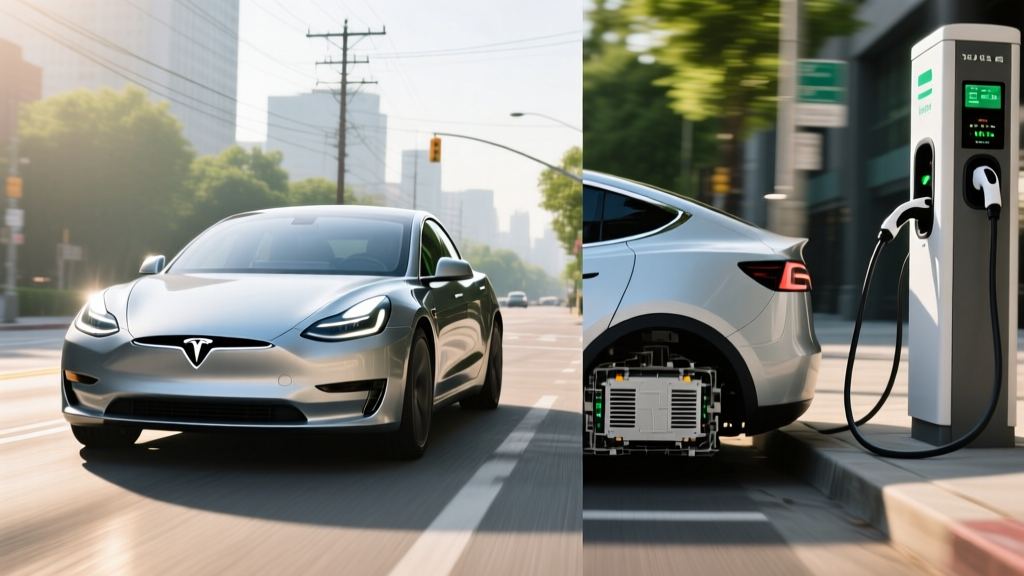
Charging speed is where the Tesla skateboard's thermal preconditioning pays dividends. When you navigate to a Supercharger, the car begins warming the battery to its optimal charging temperature—typically 35–50°C—before you arrive. This means you hit peak charge rates immediately rather than spending the first 10 minutes ramping up.
| Charging Level | Power / Rate | Miles Added per Hour | Typical Use Case |
|---|---|---|---|
| Level 1 (120V household) | ~1.4 kW | ~3–5 mi/hr | Emergency / overnight trickle |
| Level 2 (240V home Wall Connector) | 11.5 kW | ~34–44 mi/hr | Daily home charging (8–10 hr for full) |
| DC Fast (V3 Supercharger) | Up to 250 kW peak | ~1,000 mi/hr at peak | Road trips; 10–80% in ~27–32 min |
| DC Fast (V4 Supercharger) | Up to 250 kW (current vehicles) | Same as V3 for current models | Newer stations; future vehicles may exceed |
A critical nuance: peak kW is not sustained kW. The 250 kW rate applies roughly between 10–30% state of charge. Above 50%, the charge curve tapers significantly, dropping below 100 kW by 70% SoC. This is why Tesla quotes 10–80% times rather than 0–100%—the final 20% can take as long as the first 70%.
At home, the Tesla Wall Connector on a 60-amp circuit delivers 11.5 kW (48 amps continuous). For most owners driving 30–40 miles daily, a 2–3 hour overnight session fully replenishes daily use. A NEMA 14-50 outlet on a 50-amp circuit delivers about 9.6 kW, which is adequate for most use cases and less expensive to install.
Performance and the Skateboard Driving Experience
The low-slung battery pack gives every Tesla a planted, sports-sedan feel regardless of body style. The Model 3 Highland refresh improved ride quality substantially with revised damping and acoustic glass, addressing the most common complaint from the prior generation. The Model Y Juniper update followed suit in 2025, adding ventilated front seats, a rear touchscreen, and ambient lighting.
The Model S Plaid remains the performance benchmark. Its tri-motor setup—one front, two rear—delivers 1,020 horsepower and a 1.99-second 0–60 mph time that rivals hypercars costing five times as much. The torque-vectoring rear motors can independently modulate power to each wheel, providing cornering agility that belies the car's 4,766-pound curb weight.
All 2026 Teslas include Basic Autopilot as standard, which provides lane centering and adaptive cruise control. This is an SAE Level 2 driver-assistance system—you must keep your hands on the wheel and eyes on the road at all times. Full Self-Driving (Supervised), available as a $8,000 option or $99/month subscription, adds automatic lane changes, intersection handling, and parking assist, but remains Level 2 despite its name.
Autopilot and FSD (Supervised) are driver-assistance systems, not self-driving technology. The driver is responsible for all vehicle operation at all times. True driverless operation (SAE Level 4) is currently offered only by commercial robotaxi services like Waymo in select metro areas.
Pricing, Trims, and Federal Tax Credit Eligibility
Tesla's pricing has fluctuated frequently over the past two years. As of early 2026, here is where the lineup stands:
| Model / Trim | Base MSRP | Est. Destination | As-Tested Typical |
|---|---|---|---|
| Model 3 RWD | $38,990 | $1,390 | $40,380 |
| Model 3 Long Range AWD | $47,740 | $1,390 | $49,130 |
| Model 3 Performance | $52,990 | $1,390 | $54,380 |
| Model Y Long Range AWD | $48,630 | $1,390 | $50,020 |
| Model Y Performance | $52,490 | $1,390 | $53,880 |
| Model S Long Range | $74,990 | $1,390 | $76,380 |
| Model S Plaid | $89,990 | $1,390 | $91,380 |
| Model X Long Range | $79,990 | $1,390 | $81,380 |
| Model X Plaid | $94,990 | $1,390 | $96,380 |
Federal Tax Credit (IRS §30D) Eligibility
- Credit amount: Up to $7,500, split into $3,750 for critical minerals sourcing + $3,750 for battery component manufacturing (North America).
- MSRP cap: Sedans (Model 3, Model S) must be ≤ $55,000. SUVs/trucks/vans (Model Y, Model X) must be ≤ $80,000.
- Buyer income cap (AGI): $150,000 single / $225,000 head of household / $300,000 joint filers.
- Battery sourcing: Increasing percentages of critical minerals must be sourced from the US or FTA partners; components must be manufactured/assembled in North America. Foreign Entity of Concern (FEOC) restrictions apply.
- Point-of-sale transfer: Eligible buyers can transfer the credit to the dealer at purchase, reducing the purchase price directly.
Always verify current eligibility at IRS.gov and consult a tax professional. Rules and sourcing requirements are subject to change.
For 2026, the Model 3 RWD and Model 3 Long Range (both under $55,000 MSRP) are the strongest candidates for the full $7,500 credit, assuming the buyer meets income limits and the specific vehicle VIN satisfies battery-sourcing requirements. The Model Y Long Range qualifies under the $80,000 SUV cap. The Model S and Model X Plaid trims exceed their respective MSRP caps and are not eligible for the federal credit, though the Model X Long Range at $79,990 sits at the threshold.
Interior, Cargo, and Daily Practicality
The skateboard platform's flat floor creates interior packaging advantages that Tesla exploits fully:
- Model 3: 23 cu ft trunk + rear frunk; rear legroom of 35.2 inches. Minimalist cabin with a single 15.4-inch touchscreen controlling all functions. Highland refresh added ambient lighting, ventilated front seats, and rear-seat ventilation controls.
- Model Y: 30 cu ft behind the second row (76 cu ft with seats folded); optional third row (best suited for children under 5'4"). The Juniper refresh improved cabin quietness significantly with acoustic glass all around.
- Model S: 28 cu ft trunk + frunk; generous rear legroom at 41.7 inches. The yoke steering wheel remains optional; a conventional round wheel is standard. 17-inch center screen plus 12.3-inch instrument cluster and rear passenger screen.
- Model X: Up to 88 cu ft with all rear seats folded. Falcon-wing rear doors provide standing-height access to the second and third rows—a genuine advantage in tight parking spaces but a maintenance concern long-term.
Pros and Cons of the Tesla Skateboard Lineup
- Class-leading Supercharger network reliability (17,000+ US stalls)
- Excellent charge preconditioning = real-world fast-charge speeds match or beat rivals
- Over-the-air updates continuously add features post-purchase
- Low center of gravity yields confident handling across the lineup
- Strong energy efficiency (MPGe) relative to vehicle weight and power
- 8-year battery warranty with 70% minimum retention threshold
- 250 kW peak DC charging trails 800V rivals (Hyundai Ioniq 5 at 350 kW)
- Panel gaps and paint quality remain inconsistent across Fremont/Austin/Berlin builds
- No Apple CarPlay or Android Auto — Tesla's proprietary infotainment only
- FSD (Supervised) subscription cost adds up; capability still requires full driver attention
- Model S/X pricing well above the federal tax credit cap
- Service center wait times can extend weeks in some metro areas
Who Should Buy a Tesla in 2026?
Choose the Model 3 if you want the best efficiency-to-price ratio in Tesla's lineup, primarily commute solo or with one passenger, and qualify for the full $7,500 federal credit. The Long Range AWD at ~$49,000 before incentives is one of the most well-rounded electric sedans available.
Choose the Model Y if you need SUV cargo space, have a family, or want the best-selling EV in America with strong resale value. The Juniper refresh addressed the ride-quality and noise complaints that plagued the pre-2025 model.
Choose the Model S if you want flagship luxury, 396 miles of EPA range (the longest in Tesla's lineup), or tri-motor Plaid performance—and you don't need the federal tax credit to justify the purchase.
Choose the Model X if you need three-row seating with standing-height access via the falcon-wing doors and have the budget for an $80,000+ luxury EV SUV.
Across all trims, the Tesla skateboard architecture delivers a consistent formula: low, planted handling; efficient packaging; and access to the most reliable DC fast-charging network in North America. The platform's main limitation in 2026 is charge speed—Tesla's 400V electrical architecture caps at 250 kW while 800V competitors push 350 kW and beyond. For most owners charging at home overnight and using Superchargers for road trips, this gap matters less than the marketing suggests.
Frequently Asked Questions
What is the real-world range of the Tesla Model 3 and Model Y?
Expect roughly 85–90% of EPA range in mixed highway driving at moderate temperatures. The Model 3 Long Range (341 mi EPA) delivers about 290–305 miles in real-world highway use. In cold weather below freezing, plan for 230–260 miles. The Model Y Long Range (320 mi EPA) yields approximately 270–290 miles highway, dropping to 220–250 miles in winter.
How fast does a Tesla charge at home and on the road?
At home on a 240V Wall Connector (11.5 kW), you add roughly 44 miles of range per hour in a Model 3—enough for a full overnight charge from near-empty. On a V3 Supercharger, the 10–80% session takes approximately 27 minutes for Model 3/Y and 32 minutes for Model S/X, provided the battery is preconditioned.
Does the Tesla Model 3 or Model Y qualify for the $7,500 federal tax credit?
Both can qualify, but eligibility depends on three factors: your adjusted gross income (must be below IRS thresholds), the vehicle's battery-sourcing compliance for the specific production batch, and MSRP (both are under their respective caps). Verify your specific VIN's eligibility at fueleconomy.gov before purchase. The credit can be applied at the point of sale to reduce your purchase price directly.
Is the Tesla skateboard platform better than competitors?
Tesla's platform excels in energy efficiency, Supercharger network access, and OTA update capability. However, Hyundai/Kia's E-GMP platform offers faster 800V charging (350 kW peak), and GM's Ultium platform supports a wider range of vehicle sizes. "Better" depends on your priorities: charging network reliability favors Tesla; peak charge speed favors Hyundai/Kia; vehicle variety favors GM.
How long will a Tesla battery last?
Tesla warrants its NMC battery packs for 8 years and 120,000–150,000 miles (depending on model), guaranteeing at least 70% capacity retention. Real-world data from high-mileage Teslas shows degradation curves that flatten after the initial 10–15% loss in the first 20,000–30,000 miles, with many packs retaining 85–90% capacity at 100,000 miles. A full battery replacement out of warranty costs approximately $12,000–$16,000 depending on the model.