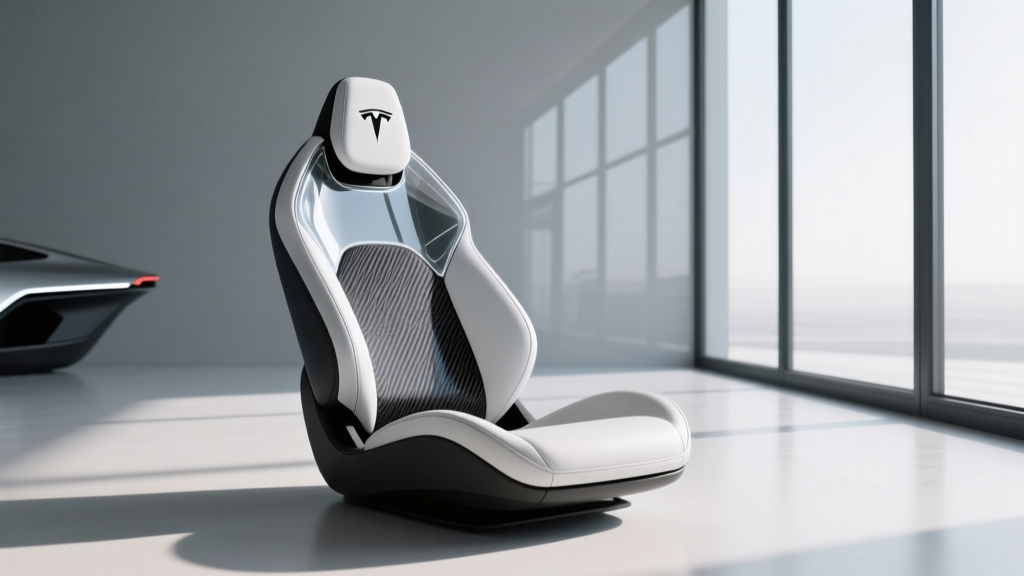
Tesla's relentless focus on manufacturing efficiency has led to a patented new single-piece composite car seat design that could reshape how EV interiors are built. The patent, filed with the USPTO, describes a seat structure molded from composite materials as a single monolithic piece — eliminating the dozens of metal brackets, foam layers, and mechanical adjusters found in conventional automotive seating.
While this technology has not yet appeared in a production Tesla vehicle as of early 2026, its implications for weight reduction, cabin space, and manufacturing cost are significant. Below, we unpack the engineering behind Tesla's composite seat patent, examine how it aligns with Tesla's broader unboxed manufacturing strategy, and explore which future models are most likely to adopt it.
Understanding Tesla's Single-Piece Composite Seat Patent
Traditional car seats are assemblies of 40 to 60 individual components: a steel or aluminum frame, foam cushioning, fabric or leather upholstery, mechanical or motorized adjusters, seat heaters, ventilation fans, and safety hardware including belt pretensioners and side-airbag housings. Each part adds weight, cost, and assembly time.
Tesla's patented approach replaces the conventional multi-part frame with a single composite structure — likely a fiber-reinforced polymer (FRP) or thermoplastic composite — molded into a net-shape seat shell. The patent describes integrated mounting points, structural ribs for crash-energy management, and channels for wiring harnesses molded directly into the composite body.
| Attribute | Conventional Seat Assembly | Tesla Composite Seat (Patent) |
|---|---|---|
| Component Count | 40–60 parts | 1 molded shell + trim/foam |
| Frame Material | Stamped steel / aluminum | Fiber-reinforced composite |
| Estimated Frame Weight | 15–22 kg (33–49 lbs) | ~7–10 kg (15–22 lbs) est. |
| Assembly Steps | Welding, bolting, foam bonding | Single mold + snap-in trim |
| Adjustment Mechanism | Motorized rails, recliners | Integrated composite flexure or simplified rail |
The weight savings alone — potentially 8 to 12 kg per seat — compound across a five-seat vehicle to save 40 to 60 kg (88 to 132 lbs). In an EV, every kilogram shed translates directly to efficiency gains: roughly 0.3 to 0.5 additional miles of range per 10 kg removed, depending on the vehicle platform and driving profile.
Why Weight Reduction Matters More in EVs
EVs carry heavy battery packs. The 2026 Tesla Model Y Long Range, for example, weighs approximately 4,398 lbs, with the battery accounting for roughly 1,000 lbs of that total. Reducing non-battery mass is one of the most cost-effective ways to improve range without increasing battery capacity.
Context: Current Tesla Model Y Long Range AWD (2026)
EPA Estimated Range: 320 miles
Battery: ~75 kWh usable, NMC chemistry
Efficiency: 28 kWh/100 mi (120 MPGe combined)
Real-world note: Expect approximately 270–290 miles on mixed highway driving at 70+ mph, and 230–250 miles in sustained sub-30°F cold weather without preconditioning.
If Tesla's composite seat design saves 50 kg across the cabin, that could yield roughly 8 to 15 additional miles of real-world range — a meaningful gain when combined with other unboxed-process efficiencies Tesla is pursuing at factories like Giga Texas and Giga Shanghai.
Manufacturing Implications: The Unboxed Process Connection
Tesla's "unboxed" manufacturing strategy, first detailed at its 2023 Investor Day, aims to build vehicles in modular sub-assemblies rather than on a traditional sequential assembly line. The single-piece composite seat fits squarely into this philosophy.
A molded composite seat shell can be produced off-line in a compression-molding or resin-transfer-molding (RTM) process, then snapped into the vehicle sub-assembly with minimal fasteners. This reduces:
- Assembly time: Fewer parts mean fewer robotic or manual operations on the line.
- Supply-chain complexity: One composite supplier replaces multiple steel-stamping, foam, and mechanism vendors.
- Factory floor space: Eliminating seat-frame welding and sub-assembly stations frees up square footage for other production steps.
Tesla has estimated that the unboxed process could reduce production costs by up to 50%. The composite seat patent is one of many design-for-manufacturing innovations — alongside gigacastings, a 48-volt electrical architecture, and a steer-by-wire system — that collectively drive toward that target.
Which Tesla Models Could Get Composite Seats First?
Tesla has not confirmed which production vehicles will incorporate the patented composite seat design. However, based on Tesla's typical technology rollout pattern — new manufacturing processes debut on new platforms before migrating to existing ones — here is a probability-based assessment:
| Model | Status (2026) | Adoption Likelihood | Rationale |
|---|---|---|---|
| Next-Gen Platform (Robotaxi / $25K vehicle) | Announced / Pre-production | Very High | New platform = clean-sheet design; cost reduction is primary goal |
| Model Y (Juniper refresh) | On sale | Low (current gen) | Existing tooling; mid-cycle refresh unlikely to re-engineer seats |
| Model 3 (Highland refresh) | On sale | Low (current gen) | Same rationale as Model Y |
| Cybercab (Robotaxi) | Announced / Limited pilot | Very High | Purpose-built for minimalism and low cost |
| Next-Gen Roadster | Announced / Delayed | Moderate | Performance focus; weight savings highly valued but low-volume |
The most likely debut vehicle is Tesla's widely anticipated next-generation, lower-cost platform — often referred to as the "$25,000 Tesla" or the Robotaxi platform. This vehicle is expected to prioritize radical cost reduction and manufacturing simplicity, making the composite seat an ideal fit.
Current Tesla Seat Specifications: What Buyers Get Today
While the composite seat remains a patent-stage innovation, here is a reference profile of Tesla's current best-selling vehicle, the 2026 Model Y Long Range AWD, to ground expectations for buyers shopping today:
| Specification | Value |
|---|---|
| EPA Range | 320 miles |
| Battery (usable) | ~75 kWh, NMC |
| Drivetrain | Dual-motor AWD |
| Horsepower | 384 hp |
| 0–60 mph | 4.8 seconds |
| Max DC Fast Charge | 250 kW (peak) |
| 10–80% DC Charge Time | ~27 minutes |
| Level 2 Home Charging | 11.5 kW (~44 mi/hr) |
| Efficiency | 28 kWh/100 mi (120 MPGe) |
| Cargo Volume | 30.2 cu ft (rear seats up) / 76.2 cu ft (folded) |
| Rear Legroom | 38.4 inches |
| Battery Warranty | 8 years / 120,000 miles |
| Base MSRP | $44,990 |
Source: fueleconomy.gov and Tesla Model Y specifications.
Charging, Efficiency, and Ownership Costs
For buyers evaluating Tesla vehicles today, charging infrastructure remains a key differentiator. Tesla's Supercharger network — now opening to non-Tesla EVs via the NACS standard — provides the most reliable DC fast-charging experience in the U.S.
| Charging Level | Power / Rate | Speed |
|---|---|---|
| Level 1 (120V household) | ~1.4 kW | ~3–5 mi/hr |
| Level 2 (240V home Wall Connector) | 11.5 kW | ~44 mi/hr |
| DC Fast Charge (V3 Supercharger) | 250 kW peak | 10–80% in ~27 min |
| DC Fast Charge (V4 Supercharger) | Up to 350 kW (vehicle-limited to ~250 kW for current Model Y) | Future potential with next-gen platform |
Charging curve reality: The Model Y's peak 250 kW rate is sustained only between approximately 10% and 35% State of Charge. Above 50% SoC, the rate tapers to ~150 kW, and above 80% it drops further to ~60 kW. This is normal lithium-ion battery behavior to protect cell longevity. Plan road-trip stops around the 10–80% window for fastest throughput.
Federal Tax Credit Eligibility (IRS §30D)
As of 2026, Tesla vehicles may qualify for the federal EV tax credit under IRS §30D, but eligibility is not automatic. Buyers must meet income caps, and the vehicle must satisfy MSRP limits and battery-component/critical-mineral sourcing requirements that tighten annually.
| Requirement | 2026 Threshold |
|---|---|
| Max MSRP (SUVs / trucks) | $80,000 |
| Max MSRP (sedans) | $55,000 |
| Buyer AGI Cap (Married Filing Jointly) | $300,000 |
| Buyer AGI Cap (Head of Household) | $225,000 |
| Buyer AGI Cap (Single) | $150,000 |
| Battery Component Sourcing | Increasing % from North America / FTA partners (annual escalation) |
| Critical Minerals Sourcing | Increasing % from U.S. / FTA partners (annual escalation) |
| Point-of-Sale Transfer | Available — credit can be applied at purchase, reducing out-of-pocket |
Source: IRS.gov — New Clean Vehicle Credit.
The Model Y Long Range at $44,990 MSRP falls under the $80,000 SUV cap. However, whether it qualifies for the full $7,500, a partial $3,750, or no credit depends on the specific battery-sourcing percentages for the production batch. Tesla's credit eligibility has fluctuated quarter to quarter. Always verify current eligibility on the IRS qualified vehicles list before purchasing.
What a Composite Seat Could Mean for Future Tesla Pricing
If the composite seat patent reaches production, the cost implications extend beyond weight savings:
- Lower Bill of Materials (BOM): A single molded part replaces dozens of sourced components, reducing procurement overhead and supplier margins.
- Reduced Warranty Claims: Fewer mechanical adjusters and joints mean fewer failure points — seat squeaks, broken recliner gears, and torn upholstery seams are among the most common interior warranty claims industry-wide.
- Design Flexibility: Composite molding allows complex geometries — integrated headrests, contoured side bolsters, and embedded sensor housings — that would require expensive multi-step assembly in metal.
- Recyclability Questions: Thermoset composites are difficult to recycle compared to stamped steel. Tesla would need to address end-of-life material recovery, potentially using thermoplastic composites (which can be remelted) to satisfy sustainability commitments.
These savings, combined with gigacastings and the 48V architecture, support Tesla's stated goal of producing a next-generation vehicle at roughly half the production cost of the Model Y.
Potential Pros of Composite Seats
- 30–50% weight reduction per seat vs. steel-frame assemblies
- Fewer components = fewer failure points and warranty claims
- Lower manufacturing cost and assembly time
- Design freedom for ergonomic and structural optimization
- Corrosion resistance (no steel frame to rust)
Potential Cons and Challenges
- Thermoset composite recycling is difficult; end-of-life concerns
- Adjustability may be limited vs. multi-axis motorized seats
- Repair after damage likely requires full replacement, not spot repair
- Comfort perception: composite shells may feel firmer than traditional foam-on-spring
- Regulatory crash-testing validation for composite seat structures is still maturing
Frequently Asked Questions
Is Tesla's single-piece composite seat available in any current vehicle?
No. As of early 2026, this design exists only as a patent filing. No production Tesla vehicle currently uses a single-piece composite seat structure. The technology is most likely to debut on Tesla's next-generation lower-cost platform or the Cybercab robotaxi, both of which are in pre-production or limited pilot phases.
How much weight could the composite seat save?
Based on the patent's description and industry benchmarks for composite automotive structures, a reasonable estimate is 8 to 12 kg (15 to 22 lbs) per seat compared to a conventional steel-frame assembly. Across a five-seat vehicle, that totals approximately 40 to 60 kg (88 to 132 lbs).
Will composite seats be comfortable for long drives?
Comfort depends on the foam and trim layers applied over the composite shell, not just the shell itself. Tesla's patent describes contoured composite geometries that could provide ergonomic support comparable to molded racing seats. However, the reduced adjustability of a monolithic structure may limit fine-tuning for drivers who rely on multi-axis power adjustments.
Does this patent affect the Tesla Model Y or Model 3 I can buy today?
No. Current Model Y and Model 3 vehicles use conventional seat assemblies with steel frames, foam cushioning, and motorized adjusters. The composite seat patent is a forward-looking technology that would require significant retooling and safety validation before reaching existing production lines.
What is the real-world range of the current Tesla Model Y?
The 2026 Model Y Long Range AWD carries an EPA estimate of 320 miles. In real-world mixed highway driving at 70+ mph, expect approximately 270 to 290 miles. In sustained cold weather (below 30°F) without battery preconditioning, range can drop to 230 to 250 miles.
Does the current Model Y qualify for the $7,500 federal tax credit?
Eligibility depends on battery-sourcing compliance for the specific production quarter, as well as buyer income limits. The Model Y's $44,990 MSRP is under the $80,000 SUV cap. Check the current IRS qualified vehicle list before purchasing, as eligibility can change.
The Bottom Line for Tesla Buyers and EV Watchers
Tesla's patented single-piece composite car seat design represents a serious engineering play to cut weight, cost, and complexity from one of the last heavily assembled components in a vehicle interior. While it won't affect any Tesla you can order today, it signals the direction Tesla is heading: fewer parts, faster assembly, and relentless cost reduction in pursuit of a sub-$30,000 EV.
For buyers shopping now, the current Model Y and Model 3 remain compelling options with proven range, best-in-class charging infrastructure, and competitive efficiency. For those tracking Tesla's next-generation platform, the composite seat is one of several manufacturing innovations — gigacastings, 48V architecture, steer-by-wire — that could make the next Tesla dramatically cheaper to build and, potentially, to buy.