If you live in Silver Spring, Maryland, and are researching a Tesla purchase, you're in one of the most EV-friendly corridors in the country. Montgomery County's dense Supercharger network, relatively mild winters, and strong home-charging adoption make Tesla ownership here more practical than in most U.S. metros. But practical doesn't mean perfect — and the specs on Tesla's website don't tell the whole story about what you'll actually experience on Georgia Avenue, I-495, or a winter drive to Deep Creek Lake.
This guide breaks down the 2026 Tesla lineup — Model 3, Model Y, Model S, and Model X — through the lens of a Silver Spring owner: real-world range in Maryland's climate, local charging infrastructure, home Level 2 installation realities in older Montgomery County homes, and the true cost after federal and state incentives. Every number below comes from EPA data, Tesla's published specs, or documented real-world testing.
2026 Tesla Lineup: Quick Spec Comparison
| Spec | Model 3 Long Range AWD | Model Y Long Range AWD | Model S Long Range | Model X Long Range |
|---|---|---|---|---|
| EPA Range | 341 mi | 320 mi | 402 mi | 335 mi |
| Battery (usable kWh) | 79 kWh (NMC) | 79 kWh (NMC) | 100 kWh (NMC) | 100 kWh (NMC) |
| Peak DC Fast Charge | 250 kW | 250 kW | 250 kW | 250 kW |
| 10–80% DCFC Time | ~27 min | ~27 min | ~30 min | ~31 min |
| Level 2 (11.5 kW) | 44 mi/hr | 42 mi/hr | 41 mi/hr | 39 mi/hr |
| 0–60 mph | 4.2 sec | 4.8 sec | 3.1 sec | 3.8 sec |
| Horsepower | 346 hp | 384 hp | 670 hp | 670 hp |
| Drivetrain | Dual-Motor AWD | Dual-Motor AWD | Dual-Motor AWD | Dual-Motor AWD |
| MPGe (combined) | 132 MPGe | 122 MPGe | 120 MPGe | 109 MPGe |
| Efficiency (kWh/100 mi) | 25 kWh | 28 kWh | 28 kWh | 31 kWh |
| Cargo (rear seats up) | 23 cu ft | 30 cu ft | 28 cu ft | 15 cu ft (+frunk) |
| Base MSRP (2026) | $47,740 | $48,240 | $79,990 | $84,990 |
| Battery Warranty | 8 yr / 120,000 mi | 8 yr / 120,000 mi | 8 yr / 150,000 mi | 8 yr / 150,000 mi |
Source: fueleconomy.gov, Tesla.com 2026 model-year specs.
Real-World Range in Silver Spring's Climate
Silver Spring sits in USDA Plant Hardiness Zone 7a, with January lows averaging 24°F and July highs near 89°F. Here's what that means for your daily range:
Model 3 Long Range: EPA 341 mi → Expect ~300–310 mi in spring/fall mixed driving, ~265–280 mi sustained highway at 75 mph, and ~240–260 mi in January cold with cabin heat.
Model Y Long Range: EPA 320 mi → Expect ~280–295 mi mixed, ~250–265 mi highway, ~225–245 mi deep winter.
Model S Long Range: EPA 402 mi → Expect ~360–375 mi mixed, ~320–340 mi highway, ~290–315 mi winter.
Model X Long Range: EPA 335 mi → Expect ~295–310 mi mixed, ~260–275 mi highway, ~230–250 mi winter.
Maryland's mid-Atlantic climate is actually one of the better regions for EV range retention. You won't see the 30–40% winter losses that owners in Minnesota or Maine experience. But Silver Spring drivers who commute via I-495 or the Baltimore-Washington Parkway at sustained 65–75 mph speeds should budget roughly 15–20% below EPA figures year-round. Cold-weather range loss is primarily driven by cabin heating demands and increased battery internal resistance — Tesla's heat pump (standard on all 2026 models) recovers some of this by scavenging waste heat from the drivetrain, cutting heating energy use by roughly 30% compared to resistive heaters.
For a Silver Spring commuter doing a 30-mile round trip to downtown D.C., even a winter-degraded Model 3 Long Range provides more than a week of driving between charges. Range anxiety here is largely a non-issue for daily use — it surfaces mainly on road trips to the mountains or the shore, where charging planning matters.
Charging in Silver Spring: Superchargers, Home Level 2, and Costs
One of Tesla's strongest advantages in Montgomery County is charging infrastructure density. Silver Spring and the surrounding area host multiple Supercharger stations, including locations at Westfield Wheaton Mall, Downtown Silver Spring (Georgia Ave corridor), Rockville Pike, and College Park. Most of these are V3 Superchargers capable of delivering up to 250 kW.
| Charging Level | Power | Miles Added per Hour | Typical Use Case | Cost (Silver Spring area) |
|---|---|---|---|---|
| Level 1 (120V outlet) | ~1.4 kW | ~4–5 mi/hr | Overnight trickle, emergencies | ~$0.13/kWh (residential) |
| Level 2 (240V, 48A) | 11.5 kW | ~39–44 mi/hr | Daily home charging | ~$0.13/kWh (residential) |
| DC Fast (V3 Supercharger) | Up to 250 kW | ~750–1,000 mi/hr (peak) | Road trips, quick top-ups | ~$0.28–$0.35/kWh |
Understanding the Charge Curve
Tesla's published "250 kW peak" is exactly that — a peak. The battery's charge curve tapers significantly as State of Charge (SoC) rises. On a V3 Supercharger, a Model 3 Long Range will pull close to 250 kW only between roughly 5–25% SoC. From 25–50%, it drops to approximately 150–180 kW. From 50–80%, expect 75–110 kW. Above 80%, charging slows dramatically to protect battery health — sometimes below 40 kW. This is why Tesla quotes 10–80% times rather than 0–100%: the last 20% can take as long as the first 70%.
For practical road-trip planning through Maryland (say, Silver Spring to Ocean City, roughly 160 miles), a single 15–20 minute Supercharger stop at the Cambridge, MD station is sufficient in a Model 3 or Model Y. You'll arrive with ~40% remaining and leave at ~80%, which is the sweet spot for minimizing total trip time.
Home Charging: What Silver Spring Homes Require
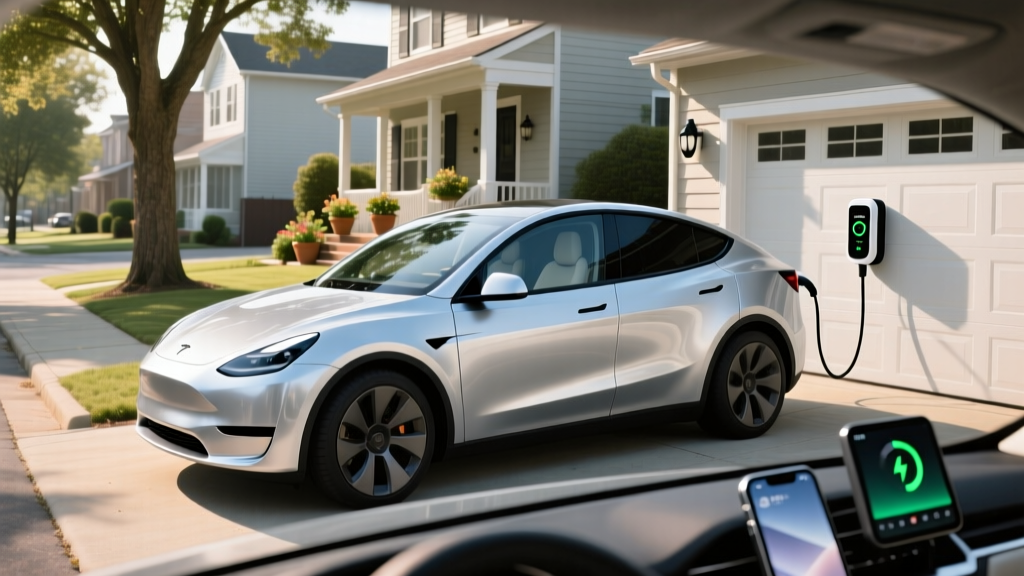
Most Silver Spring residences — from Capitol View Park bungalows to Woodmoor colonials to downtown condos — can support Level 2 home charging, but the installation specifics vary widely. Many homes in the 20902 and 20904 zip codes were built between the 1940s and 1970s with 100-amp or 150-amp electrical panels. A 48-amp continuous EV charger draws roughly 60 amps at the panel (NEC requires circuits rated at 125% of continuous load), which may necessitate a panel upgrade to 200 amps.
| Item | Cost Range | Notes |
|---|---|---|
| Tesla Wall Connector (hardware) | $420–$475 | 48A, 240V, NACS connector built in |
| Electrician labor (standard install) | $600–$1,500 | Short run from panel to garage/driveway |
| Panel upgrade (100A → 200A) | $1,800–$3,500 | Needed in ~30% of older Silver Spring homes |
| Permit (Montgomery County) | $50–$150 | Electrical permit via DPS |
| Total (no panel upgrade) | $1,070–$2,125 | Most straightforward installs |
| Total (with panel upgrade) | $2,870–$5,625 | Older homes with 100A service |
Montgomery County also offers a residential EV charger rebate (check current availability — programs cycle annually) that can offset $300–$600 of installation costs. Always get a licensed electrician's load calculation before committing to a charger amperage; a 32-amp circuit (7.7 kW, ~28 mi/hr) is a perfectly viable alternative if your panel is tight on capacity.
Performance, Efficiency, and Daily Driving Dynamics
Every 2026 Tesla sold in the U.S. comes with dual-motor AWD as standard on Long Range trims, which matters for Silver Spring drivers who deal with occasional ice storms and the steep grades of streets like Sligo Creek Parkway. The traction control response in a dual-motor EV is fundamentally faster than any mechanical AWD system — electric motors can adjust torque distribution in milliseconds.
Efficiency is where the Model 3 particularly shines. At 25 kWh per 100 miles (132 MPGe combined), it's one of the most efficient EVs sold in America. For a Silver Spring resident paying Pepco's average residential rate of roughly $0.13–$0.15/kWh, that translates to about $3.25–$3.75 per 100 miles of driving. A comparable gas car at 28 MPG with $3.40/gallon fuel costs about $12.14 per 100 miles. Over 12,000 annual miles, the home-charging savings alone are approximately $1,000–$1,100 per year.
Regenerative braking deserves a mention for Silver Spring's stop-and-go traffic on Colesville Road and University Boulevard. Tesla's one-pedal driving mode recovers significant energy in traffic, reducing brake pad wear to the point where many Tesla owners report original brake pads lasting 80,000+ miles. In hilly sections near Forest Glen or along Sligo Creek, regen can recover 15–25% of the energy spent climbing on the way back down.
Pricing, Tax Credits, and True Cost of Ownership
| Model | Base MSRP | Federal §30D Credit | Effective Price (if eligible) | MSRP Cap Status |
|---|---|---|---|---|
| Model 3 Long Range AWD | $47,740 | Up to $7,500 | ~$40,240 | Under $55,000 sedan cap ✓ |
| Model Y Long Range AWD | $48,240 | Up to $7,500 | ~$40,740 | Under $80,000 SUV cap ✓ |
| Model S Long Range | $79,990 | $0 (exceeds cap) | $79,990 | Over $55,000 sedan cap ✗ |
| Model X Long Range | $84,990 | $0 (exceeds cap) | $84,990 | Over $80,000 SUV cap ✗ |
The IRS §30D federal tax credit remains available for the Model 3 and Model Y in 2026, but eligibility is not automatic. Here's what Silver Spring buyers must verify:
- Income caps: Modified Adjusted Gross Income (MAGI) must not exceed $150,000 (single), $225,000 (head of household), or $300,000 (joint filers).
- MSRP caps: Sedans (Model 3) must be under $55,000; SUVs/trucks (Model Y) under $80,000. Adding options that pushes the vehicle above these thresholds disqualifies the credit.
- Battery sourcing requirements: The $7,500 credit splits into two $3,750 halves — one tied to critical minerals sourcing, one to battery component manufacturing. Tesla's supply chain has shifted significantly, and the exact credit amount ($3,750 or $7,500) depends on current sourcing compliance. Check the DOE's qualifying vehicle list before purchasing.
- Point-of-sale transfer: As of 2024, buyers can transfer the credit to the dealer at purchase, reducing the upfront price rather than waiting for a tax refund. This is available in 2026 but requires dealer participation.
Important: Tax credit rules evolve. Consult a tax professional and verify current eligibility on IRS.gov before making a purchase decision based on credit assumptions.
5-Year Ownership Cost Snapshot (Silver Spring, MD)
For a Model Y Long Range driven 12,000 miles/year, primarily charged at home on Pepco residential rates:
| Cost Category | 5-Year Estimate | Notes |
|---|---|---|
| Purchase (after $7,500 credit) | $40,740 | Before state incentives |
| Electricity (home + Supercharger) | $2,800–$3,400 | 80% home / 20% DCFC mix |
| Insurance | $9,500–$13,000 | Tesla premiums run 15–25% above average in MD |
| Maintenance | $1,200–$1,800 | Cabin filters, wipers, tires, brake fluid check |
| Tires (one replacement set) | $1,200–$1,600 | EVs are heavier and wear tires faster |
| Estimated depreciation | $16,000–$20,000 | ~40–48% over 5 years (varies with market) |
| Total 5-year cost | ~$71,440–$80,540 | All-in including depreciation |
Tesla's Tech: Autopilot, FSD, and the NACS Advantage
Every 2026 Tesla ships with basic Autopilot (lane-keeping, adaptive cruise control, traffic-aware features). Full Self-Driving (Supervised) remains an $8,000 add-on or $99/month subscription. The naming is important to parse carefully:
Tesla Autopilot and FSD (Supervised) are SAE Level 2 driver-assistance systems. The driver must remain fully engaged, monitor the road at all times, and be prepared to take over instantly. These are NOT self-driving systems. Tesla's driver-monitoring camera will issue warnings and eventually disengage the system if it detects inattention. Only Level 4 services (like Waymo in select cities) operate without a human driver.
In practical Silver Spring driving, basic Autopilot handles I-495 and I-270 commute traffic competently, reducing fatigue significantly in congestion. FSD (Supervised) adds features like traffic light and stop sign recognition, and city-street navigation, but its performance in Montgomery County's construction zones (a perennial reality on Georgia Avenue and University Boulevard) can be inconsistent. Budget-conscious buyers are generally better served by the included Autopilot and skipping the FSD upgrade.
Tesla's NACS (North American Charging Standard) connector is now the industry standard, with Ford, GM, Rivian, Volvo, and most major automakers adopting it. For Tesla owners, this means the Supercharger network is expanding with non-Tesla vehicles — potentially increasing wait times at popular stations over time, but also validating the connector ecosystem long-term.
- Class-leading Supercharger network density in Montgomery County
- Best-in-class efficiency (Model 3 at 25 kWh/100 mi)
- Strong real-world range retention in mid-Atlantic climate
- Over-the-air updates continuously add features
- Excellent one-pedal regen for hilly Silver Spring terrain
- Dual-motor AWD traction for ice and snow
- Model 3 and Y qualify for up to $7,500 federal credit
- Insurance premiums 15–25% above comparable vehicles in MD
- Older Silver Spring homes may need costly panel upgrades for Level 2
- FSD (Supervised) is expensive and still requires full driver attention
- No Apple CarPlay or Android Auto — Tesla-only infotainment
- Model S and X exceed MSRP caps, losing federal credit eligibility
- Tire wear is accelerated due to vehicle weight and instant torque
- Build quality inconsistency still reported by some owners
Who Should Buy a Tesla in Silver Spring?
The Model 3 Long Range is the value pick for Silver Spring commuters. At ~$40,240 after the federal credit, it undercuts most luxury sedans while delivering 300+ real-world miles, AWD, and access to the most reliable DC charging network in the region. If your daily drive is under 60 miles round-trip and you can charge at home, you'll rarely visit a Supercharger except on road trips.
The Model Y Long Range suits families who need the crossover cargo space (30 cu ft behind the rear seats, 76 cu ft folded) and the higher seating position. It's the best-selling vehicle in America for a reason — the utility-to-price ratio is hard to beat, and it clears the §30D SUV MSRP cap with room for common option packages.
The Model S and Model X are premium plays for buyers who prioritize performance (3.1-second 0–60 in the Model S) and prestige over value. They don't qualify for the federal credit, which makes the effective price gap between a loaded Model Y and a base Model S substantial. These models make sense if you want 400-mile EPA range for frequent long-distance travel and don't mind paying for it.
Skip Tesla if: You want Apple CarPlay, prefer a traditional dealership service experience, live in a condo without charging access and can't install a home charger, or need a truck bed. For condo dwellers, investigate whether your building's HOA permits shared charging installations — Maryland's EV charging right-to-install law provides some protections for condo and HOA residents.
Frequently Asked Questions
What is the real-world range of a Tesla in Silver Spring, MD?
Expect roughly 88–92% of EPA range during spring and fall mixed driving, 78–85% during sustained highway travel, and 70–80% during January cold weather. The Model 3 Long Range delivers approximately 300 miles real-world in mild weather and 240–260 miles in deep winter. Maryland's relatively moderate climate means less winter range loss than northern states.
How fast does a Tesla charge at home and on the road?
At home on a 48-amp Level 2 Tesla Wall Connector (11.5 kW), a Model 3 gains approximately 44 miles of range per hour — a full overnight charge from 20% to 90% takes about 6–7 hours. On a V3 Supercharger (250 kW peak), 10–80% takes approximately 27 minutes, though the charge curve tapers significantly above 50% SoC. Plan for 15–20 minutes of actual charging on a typical road-trip stop.
Does the Tesla Model Y qualify for the $7,500 federal tax credit in 2026?
The Model Y Long Range AWD at $48,240 base MSRP falls under the $80,000 SUV cap and is potentially eligible for up to $7,500 under IRS §30D. However, eligibility also depends on buyer income (under $300,000 for joint filers) and battery sourcing compliance, which determines whether you receive the full $7,500 or a partial $3,750. Always verify on fueleconomy.gov before purchasing.
Is a Tesla worth buying versus a Hyundai Ioniq 5 or Ford Mustang Mach-E in Silver Spring?
The Tesla advantage in Montgomery County is primarily the Supercharger network — V3 stations are abundant and reliable. The Ioniq 5 offers faster peak charging (up to 350 kW on 800V architecture) and a more conventional interior with physical controls, but relies on Electrify America and third-party networks for DC fast charging. The Mach-E provides a more traditional driving feel and CarPlay support but has a smaller charging network advantage. If reliable public charging matters to you and you don't have consistent home charging, Tesla's network edge is significant. If you charge at home 90%+ of the time, the competitors are closer equivalents.
What does home charger installation cost in a Silver Spring home?
A standard Tesla Wall Connector installation in a home with adequate 200-amp panel capacity runs $1,070–$2,125 including hardware, labor, and permits. If your home (common in 1940s–1970s Silver Spring builds) requires a panel upgrade from 100A to 200A, budget $2,870–$5,625 total. Always get a licensed electrician's load calculation first — a lower-amperage circuit may be a cost-effective alternative.