The Tesla Model X has long occupied a singular position in the luxury electric SUV segment: falcon-wing doors, three-row seating, and performance that embarrasses sports cars. For 2026, Tesla introduces the Signature Edition Model X, a top-tier trim that bundles the Plaid powertrain with exclusive interior materials, enhanced Autopilot hardware, and a curated package of premium features previously spread across the options list. This review breaks down the real-world range, charging behavior, ownership costs, and practical trade-offs of the 2026 Tesla Signature Edition Model X so you can decide whether it earns a spot in your garage.
Quick Verdict: Who the Signature Edition Model X Is For
The 2026 Signature Edition Model X targets buyers who want a three-row electric SUV without compromising on acceleration or technology. It is not the most efficient EV in its class, nor the most affordable. But if you need seating for six or seven, access to the Supercharger network, and sub-3-second 0-60 performance, the Model X Signature Edition has no direct equivalent. Families who road-trip frequently and can charge at home will get the most value. Buyers prioritizing maximum range per dollar or minimalist interior refinement may find better options in the BMW iX or Rivian R1S.
- You need three rows and falcon-wing rear doors for tight parking access
- You want Plaid-level performance (1,020 hp) in a family SUV
- Supercharger network reliability is a top priority for road trips
- You prioritize interior material quality over performance (consider BMW iX)
- You need maximum cargo space (Rivian R1S offers more behind the third row)
- Budget is under $100,000 before incentives
Range, Efficiency, and Real-World Expectations
The 2026 Tesla Signature Edition Model X carries an EPA-estimated range of 320 miles on a full charge, powered by a 100 kWh usable battery pack using NMC (nickel-manganese-cobalt) chemistry. Tesla's NMC cells prioritize energy density, which is essential for a vehicle with the Model X's mass and frontal area.
Real-World Highway (70 mph, moderate climate): ~265–285 miles
Real-World Cold Weather (below 30°F, highway): ~220–245 miles
City/Commuter Driving (with regen): ~300–315 miles
The Model X's large frontal area and 5,100+ lb curb weight penalize highway efficiency more than city driving, where regenerative braking recaptures energy. Expect roughly 15–20% range loss on sustained highway trips and up to 30% in deep cold without preconditioning.
Efficiency comes in at 100 MPGe combined (EPA), translating to approximately 34 kWh per 100 miles. That is competitive for a three-row performance SUV but trails the more aerodynamic BMW iX xDrive50 (rated at 86 MPGe combined but with a smaller footprint). On the EPA's fueleconomy.gov comparison tool, the Model X sits mid-pack among luxury electric SUVs when adjusted for size and output.
Charging Speed: DC Fast, Level 2, and the Charge Curve Reality
Tesla rates the 2026 Signature Edition Model X for a peak DC fast-charge rate of 250 kW on V3 Superchargers. In practice, the charge curve tells a more nuanced story:
| Charging Method | Power / Rate | Speed | Notes |
|---|---|---|---|
| DC Fast Charge (V3 Supercharger) | Peak 250 kW | 10–80% in ~30 minutes | Peak rate sustained only up to ~40% SoC; tapers significantly above 65% |
| DC Fast Charge (CCS adapter, non-Tesla) | Up to 170 kW typical | 10–80% in ~40 minutes | Most third-party stations cap lower than Superchargers for Tesla vehicles |
| Level 2 Home (Wall Connector, 48A) | 11.5 kW | ~34 miles per hour of charging | Full charge in ~9 hours; ideal for overnight |
| Level 2 Home (32A mobile connector) | 7.7 kW | ~23 miles per hour | Requires NEMA 14-50 outlet; full charge ~13 hours |
| Level 1 (120V standard outlet) | ~1.4 kW | ~3–4 miles per hour | Emergency/trickle only; not practical for daily use |
Charge curve insight: The 250 kW peak is real but brief. From 10% to roughly 40% state of charge, the Model X pulls close to its maximum rate. Between 40% and 65%, expect sustained rates around 150–175 kW. Above 80%, charging slows dramatically to protect battery health — a typical 80–100% top-off can add 20+ minutes. For road trips, plan stops around the 10–80% window to minimize time at the charger.
At home, Tesla's Wall Connector on a 60-amp circuit delivers 48 amps (11.5 kW), which replenishes roughly 34 miles of range per hour. A full overnight session easily covers daily driving needs. Installation typically requires a licensed electrician; budget $500–$2,000 depending on panel proximity and local permitting, or more if a panel upgrade to 200A service is needed.
Performance and Drivetrain
The Signature Edition Model X uses the Plaid tri-motor all-wheel-drive powertrain: one motor on the front axle and two on the rear, producing a combined 1,020 horsepower. The result is a 0–60 mph time of 2.5 seconds — making it one of the quickest production SUVs ever built. Top speed is electronically limited to 163 mph.
| Specification | 2026 Signature Edition Model X |
|---|---|
| EPA Range | 320 miles |
| Battery (usable) | 100 kWh, NMC chemistry |
| Drivetrain | Tri-motor AWD (Plaid) |
| Horsepower | 1,020 hp |
| 0–60 mph | 2.5 seconds |
| Top Speed | 163 mph |
| Max DC Charge Rate | 250 kW (peak) |
| 10–80% DC Charge Time | ~30 minutes |
| Level 2 Rate (48A) | 11.5 kW / ~34 mi/hr |
| EPA Efficiency | 100 MPGe / 34 kWh/100mi |
| Curb Weight | ~5,185 lbs |
| Towing Capacity | 5,000 lbs |
The tri-motor setup enables torque vectoring across the rear axle, which translates to confident cornering despite the vehicle's weight. Air suspension is standard and adjusts ride height automatically — lowering at highway speeds for aerodynamic efficiency and raising for rough roads or loading. The adaptive damping system in the Signature Edition receives a revised tune for 2026, slightly firmer in Sport mode while retaining compliance in Comfort.
Interior, Cargo, and Technology
The Signature Edition distinguishes itself with semi-aniline leather upholstery (a step above Tesla's standard vegan leatherette), open-pore wood or carbon fiber trim, and contrast stitching exclusive to this trim. The 17-inch center touchscreen remains the hub for all vehicle controls, navigation, and entertainment. A rear-seat 8-inch touchscreen provides climate and media controls for second-row passengers.
Passenger and cargo dimensions:
- Seating: 5, 6, or 7-passenger configurations (6-seat with center console is the Signature default)
- Front headroom: 40.5 in | Front legroom: 41.2 in
- Second-row legroom: 38.4 in
- Third-row legroom: 32.7 in (best for children or short trips)
- Cargo behind 3rd row: 26.6 cu ft
- Cargo behind 2nd row (3rd row folded): 53.9 cu ft
- Max cargo (all rear seats folded): 88.1 cu ft
- Frunk (front trunk): 6.6 cu ft
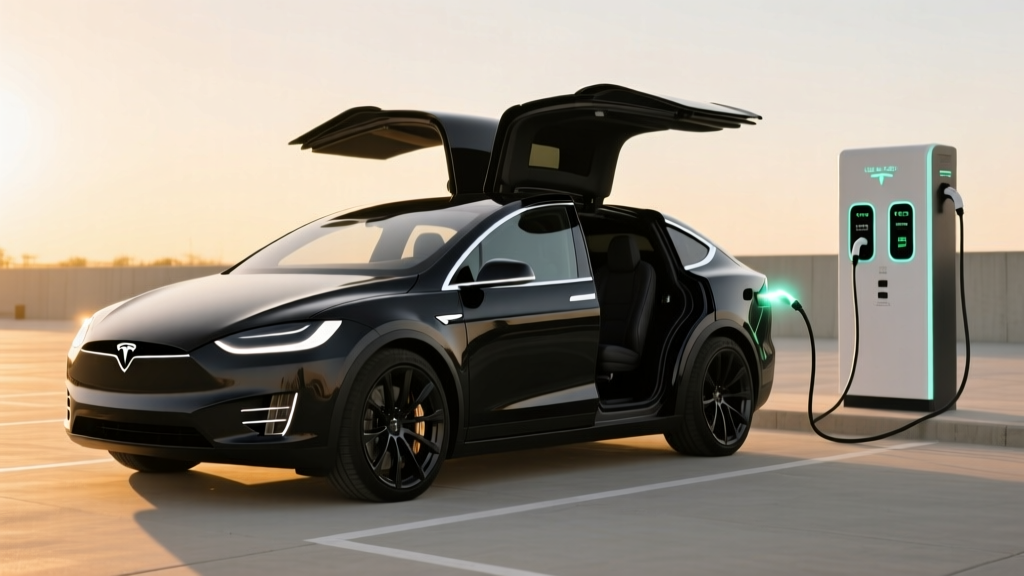
The falcon-wing rear doors remain the Model X's signature feature. They open upward with a double-hinge design, requiring only about 12 inches of lateral clearance — useful in tight parking spaces. However, they operate more slowly than conventional doors and can be problematic in low-clearance garages. Sensors detect overhead obstructions, but the system occasionally hesitates in our experience.
Driver Assistance: The Signature Edition includes Tesla's latest HW4 Autopilot hardware suite. Basic Autopilot (lane centering, adaptive cruise) is standard. Full Self-Driving (Supervised) capability is included on the Signature Edition — a $8,000 value on lower trims. Note that FSD remains an SAE Level 2 driver-assist system: the driver must remain fully engaged, hands on or near the wheel, and eyes on the road at all times. It is not autonomous driving.
Pricing, Trims, and Federal Tax Credit Eligibility
The 2026 Tesla Signature Edition Model X starts at a base MSRP of $119,990 (including destination). With no standalone options — the Signature Edition bundles FSD, premium interior, and 22-inch turbine wheels as standard — the as-tested price typically lands between $121,000 and $124,000 depending on paint color (Ultra Red and Solid Black carry a $2,000 premium; Pearl White is included).
| Item | Amount |
|---|---|
| Base MSRP (Signature Edition) | $119,990 |
| Premium Paint (optional) | $0–$2,000 |
| Destination Fee | Included |
| Federal §30D Tax Credit | $0 — exceeds MSRP cap |
| Estimated Total (before state incentives) | $119,990–$123,990 |
Federal tax credit reality: The Signature Edition Model X does not qualify for the IRS §30D federal EV tax credit. The credit caps eligible SUVs at an MSRP of $80,000, and this trim exceeds that threshold by nearly $40,000. Additionally, buyer income caps apply ($300,000 joint / $225,000 head of household / $150,000 individual modified AGI), and battery critical-mineral and component sourcing requirements must be met. Even lower-priced Model X trims exceed the MSRP cap. Always verify current rules at IRS.gov before making a purchase decision.
Some states offer their own rebates or tax credits that apply regardless of MSRP — check your state's energy office or the AFDC incentive database for local programs. These vary widely and may have their own income or price restrictions.
Warranty, Battery Longevity, and Ownership Costs
Tesla covers the 2026 Model X with the following warranty structure:
- Basic Vehicle Limited Warranty: 4 years / 50,000 miles
- Battery & Drive Unit Warranty: 8 years / 150,000 miles, with a minimum 70% capacity retention guarantee
The 150,000-mile battery warranty on the Model X is more generous than the 120,000-mile coverage on the Model 3 and Model Y, reflecting the higher expected mileage of a premium SUV. NMC chemistry in Tesla's packs has demonstrated strong long-term durability in fleet data: typical degradation is approximately 10–12% over the first 100,000 miles, after which the curve flattens. The 100 kWh pack should comfortably retain 85%+ state of health at the 8-year mark under normal use.
Ownership cost considerations:
- Insurance: Expect premiums 15–30% above comparable luxury SUVs due to repair costs and performance. Average annual premium: $2,800–$3,600 depending on profile.
- Charging cost (home, national avg $0.16/kWh): ~$5.44 per 100 miles vs. ~$12.50 per 100 miles for a gas SUV at 20 MPG and $3.50/gallon.
- Maintenance: Minimal — no oil changes, fewer brake replacements (regen extends pad life), cabin air filter every 2 years, tire rotation every 6,250 miles.
- Depreciation: The Model X has historically seen steeper depreciation than the Model 3/Y. Expect ~45–55% value retention at 5 years / 60,000 miles.
Signature Edition Model X vs. Key Competitors
The Signature Edition occupies a niche with few direct rivals. Here's how it compares:
| Feature | 2026 Tesla Model X Signature | 2026 BMW iX M60 | 2026 Rivian R1S Tri-Motor |
|---|---|---|---|
| EPA Range | 320 mi | 305 mi | 352 mi |
| 0–60 mph | 2.5 sec | 3.6 sec | 2.9 sec |
| Seating | 5/6/7 | 5 only | 5/7 |
| Starting MSRP | $119,990 | $111,500 | $109,900 |
| DC Fast Charge Peak | 250 kW | 200 kW | 220 kW |
| Towing | 5,000 lbs | 3,500 lbs | 7,700 lbs |
| Charging Network | Supercharger (native) | CCS (EA/others) | CCS + Rivian Adventure Network |
The BMW iX M60 offers a more refined interior and slightly lower price but lacks a third row. The Rivian R1S is the strongest competitor for buyers who prioritize range, off-road capability, and towing — but it lacks the Model X's Supercharger convenience and has a longer delivery wait. If three-row seating and Supercharger access are non-negotiable, the Model X remains the default choice.
Pros and Cons
- Tri-motor Plaid performance: 1,020 hp, 2.5-second 0–60 in a family SUV
- Supercharger network: most reliable DC fast-charging ecosystem in the US
- Falcon-wing doors ease child-seat loading in tight spaces
- Over-the-air updates continuously add features
- FSD (Supervised) included at no extra charge on this trim
- 150,000-mile battery/drive unit warranty
- No federal §30D tax credit — MSRP far exceeds the $80,000 SUV cap
- Real-world highway range drops to ~265 miles; cold weather compounds this
- Interior quality still lags BMW/Mercedes at this price point
- Falcon-wing doors are slow and can struggle in freezing rain
- Third row is cramped for adults on longer trips
- Insurance costs significantly above segment average
Frequently Asked Questions
What is the real-world range of the 2026 Tesla Signature Edition Model X?
The EPA rates it at 320 miles. In real-world highway driving at 70 mph in moderate temperatures, expect approximately 265–285 miles. In cold weather (below 30°F), range can drop to 220–245 miles on the highway. City driving with regenerative braking gets closest to the EPA sticker, around 300–315 miles.
How fast does the Signature Edition Model X charge?
On a Tesla V3 Supercharger, it peaks at 250 kW and charges from 10% to 80% in roughly 30 minutes. The peak rate is sustained only to about 40% SoC, then tapers. At home on a 48-amp Wall Connector (11.5 kW), you add about 34 miles of range per hour — a full overnight charge is sufficient for most daily needs.
Does the 2026 Signature Edition Model X qualify for the federal EV tax credit?
No. The IRS §30D credit caps eligible SUVs at $80,000 MSRP, and the Signature Edition starts at $119,990. It does not qualify regardless of buyer income or battery sourcing. Check your state's incentive programs for possible local credits at the AFDC website.
Is the Signature Edition Model X worth buying over the Rivian R1S or BMW iX?
It depends on priorities. If you need three rows, Supercharger access, and maximum acceleration, the Model X is unmatched. If towing (7,700 lbs) and off-road capability matter more, the Rivian R1S is stronger. If interior refinement and a quieter cabin are your top criteria, the BMW iX excels — but it seats only five.
What does FSD (Supervised) actually do?
Full Self-Driving (Supervised) handles highway lane changes, on-ramp to off-ramp navigation, and some city-street driving. It is an SAE Level 2 system — you must supervise it at all times, keep your eyes on the road, and be ready to take over instantly. It does not make the vehicle autonomous.
How long will the battery last?
Tesla warranties the battery for 8 years or 150,000 miles with a 70% minimum capacity retention. Real-world fleet data suggests NMC packs in Tesla vehicles lose roughly 10–12% capacity over 100,000 miles, then degrade more slowly. With proper care (avoiding frequent 100% charges, using preconditioning for fast charging), the pack should last well beyond the warranty period.