Is Tesla Shutting Down? Separating Fact From Headline Hype
Searches for "Tesla shut down" spike every few months, usually triggered by a misleading headline about a single factory pausing production, a quarterly delivery miss, or Elon Musk's attention being pulled toward SpaceX and xAI. As of early 2026, Tesla is not shutting down. The company operates five vehicle assembly plants globally (Fremont, Shanghai, Berlin, Austin, and a newly expanded Mexico facility in ramp-up), delivered over 1.8 million vehicles in 2025, and remains the best-selling EV brand in the United States.
What is true: Tesla has temporarily paused or retooled specific production lines — most notably the Fremont factory briefly halting Model S/X output in late 2025 to prepare for refreshed tooling, and the Robotaxi (Cybercab) program consuming significant R&D budget at the expense of a next-generation mass-market model. These operational pivots get flattened into "Tesla shutting down" clickbait. For buyers, the real question isn't whether Tesla will exist next year — it's whether a 2026 Tesla is the right EV for your garage.
Below, we profile every vehicle Tesla currently sells in the U.S. for the 2026 model year, with exact EPA range, charging speeds, pricing, and federal tax credit eligibility.
2026 Tesla Lineup at a Glance: Specs You Actually Need
| Spec | Model 3 (Long Range AWD) | Model Y (Long Range AWD) | Cybertruck (AWD) | Model S (Long Range) | Model X (Long Range) |
|---|---|---|---|---|---|
| EPA Range | 363 mi | 320 mi | 340 mi | 402 mi | 348 mi |
| Battery (usable) | ~79 kWh (NMC) | ~78 kWh (NMC) | ~123 kWh (NMC) | ~95 kWh (NMC) | ~95 kWh (NMC) |
| Peak DC Charge | 250 kW | 250 kW | 350 kW (800V) | 250 kW | 250 kW |
| 10–80% DC Time | ~28 min | ~27 min | ~20 min | ~33 min | ~34 min |
| Level 2 Rate | 11.5 kW (~44 mi/hr) | 11.5 kW (~44 mi/hr) | 17 kW (~58 mi/hr) | 11.5 kW (~34 mi/hr) | 11.5 kW (~30 mi/hr) |
| 0–60 mph | 4.2 sec | 4.8 sec | 3.9 sec | 3.1 sec | 3.8 sec |
| Horsepower | 346 hp | 384 hp | 600 hp | 670 hp | 670 hp |
| Drivetrain | Dual-Motor AWD | Dual-Motor AWD | Dual-Motor AWD | Dual-Motor AWD | Dual-Motor AWD |
| MPGe (combined) | 132 MPGe | 122 MPGe | 77 MPGe | 120 MPGe | 109 MPGe |
| Cargo (rear seats up) | 23 cu ft | 30 cu ft | 34 cu ft (bed) | 28 cu ft | 37 cu ft (+frunk) |
| Base MSRP | $42,630 | $44,630 | $79,990 | $79,990 | $84,990 |
Sources: fueleconomy.gov, Tesla.com 2026 model-year specs. Pricing excludes destination fees.
Real-World Range: What the EPA Sticker Doesn't Tell You
The Model 3 Long Range posts a 363-mile EPA estimate — among the highest of any mainstream sedan. But EPA testing uses a mixed city/highway cycle at moderate temperatures. Expect ~290–310 miles on sustained highway driving at 75 mph, and ~230–260 miles in sub-freezing winter conditions where cabin heating and battery chemistry losses compound. The Model Y Long Range (320 EPA) realistically delivers 260–280 highway, 210–240 cold-weather. The Cybertruck's brick-like aerodynamics hit hardest at speed: its 340-mile EPA figure drops to roughly 260–280 at 70+ mph.
Tesla's heat pump (standard on all 2026 models) significantly reduces cold-weather range loss compared to resistive heating, but physics still applies. LFP-equipped base Model 3 RWD variants (not profiled above) tolerate 100% daily charging and show less long-term degradation but carry ~50 fewer miles of EPA range.
Charging Speed and the Supercharger Advantage
| Model | Peak DC kW | Sustained 10–80% Avg kW | 10–80% Time | Level 2 (240V) Rate |
|---|---|---|---|---|
| Model 3 LR | 250 kW | ~165 kW | ~28 min | 11.5 kW / ~44 mi/hr |
| Model Y LR | 250 kW | ~170 kW | ~27 min | 11.5 kW / ~44 mi/hr |
| Cybertruck | 350 kW (800V) | ~250 kW | ~20 min | 17 kW / ~58 mi/hr |
| Model S LR | 250 kW | ~140 kW | ~33 min | 11.5 kW / ~34 mi/hr |
| Model X LR | 250 kW | ~135 kW | ~34 min | 11.5 kW / ~30 mi/hr |
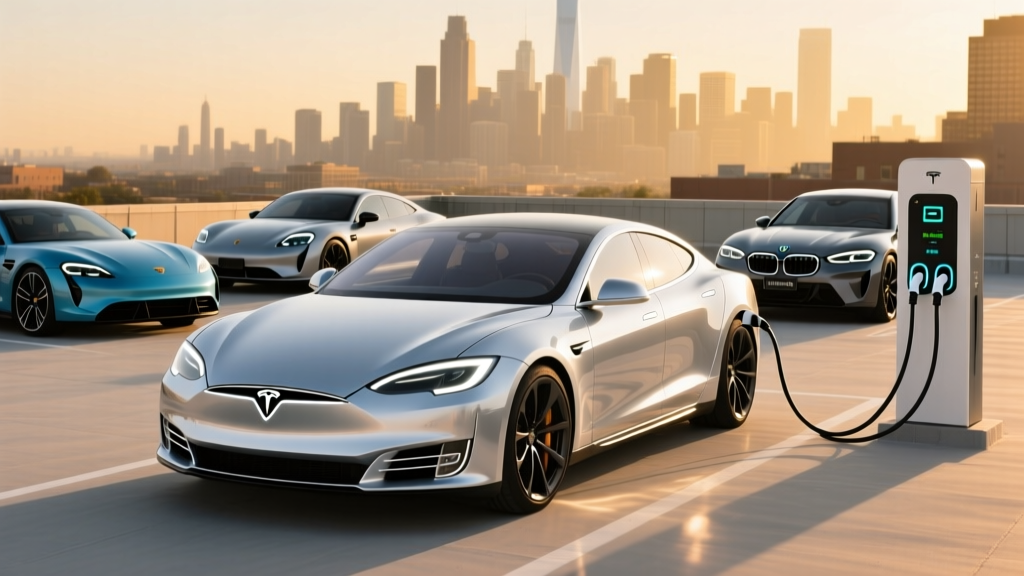
Peak kW is a marketing headline; the charge curve is what you live with. Tesla's 250 kW V3 Superchargers taper noticeably above 55% state of charge. The Cybertruck's 800-volt architecture is the outlier — it sustains higher power deeper into the curve, making it genuinely faster on road trips. All 2026 Teslas now ship with the NACS (J3400) charge port natively, meaning access to the full Supercharger network without adapters, plus the growing number of non-Tesla networks adopting NACS ( Electrify America, EVgo, and others by late 2026).
For home charging, a 48-amp Level 2 wall connector on a 60-amp circuit delivers the full 11.5 kW on most models — roughly 44 miles of range per hour, enough to refill a Model 3 overnight from 20% to full.
Pricing, Trims, and Federal Tax Credit Eligibility (2026)
| Model / Trim | Base MSRP | As-Tested (typical) | §30D Credit Eligible? | After-Credit Price |
|---|---|---|---|---|
| Model 3 RWD (LFP) | $38,630 | $39,630 | Partial ($3,750)* | ~$34,880 |
| Model 3 Long Range AWD | $42,630 | $44,130 | Partial ($3,750)* | ~$38,880 |
| Model Y Long Range AWD | $44,630 | $46,630 | Partial ($3,750)* | ~$40,880 |
| Cybertruck AWD | $79,990 | $99,990 | No (MSRP cap) | $79,990+ |
| Model S Long Range | $79,990 | $89,990 | No (MSRP cap) | $79,990+ |
| Model X Long Range | $84,990 | $94,990 | No (MSRP cap) | $84,990+ |
*Under current IRS §30D rules, the full $7,500 credit requires both a critical-minerals threshold AND battery-component sourcing from U.S./FTA partners. Tesla's U.S.-built vehicles typically meet the component requirement but have struggled with the critical-minerals prong due to graphite and lithium supply chain shifts. Always verify eligibility at the IRS point-of-sale portal before purchase. Buyer income caps apply ($150K single / $300K joint AGI). SUV MSRP cap: $80,000; sedan cap: $55,000.
The Model 3 and Model Y remain the value plays. The Cybertruck, Model S, and Model X exceed the §30D MSRP caps for their vehicle classes — no amount of lobbying changes that under current law.
Warranty, Battery Longevity, and Ownership Costs
Tesla's warranty structure is straightforward:
- Basic vehicle: 4 years / 50,000 miles
- Battery & drive unit (Model 3/Y): 8 years / 120,000 miles (Long Range AWD)
- Battery & drive unit (Model S/X): 8 years / 150,000 miles
- Battery & drive unit (Cybertruck): 8 years / 120,000 miles
- Capacity retention threshold: 70% of original capacity during the warranty period
Real-world data from Tesla's 2025 Impact Report shows NMC packs retaining ~88% capacity at 150,000 miles — well above the warranty floor. LFP packs in the base Model 3 show even slower degradation curves and can be charged to 100% daily without harm, making them ideal for high-mileage commuters.
Insurance remains a Tesla pain point. Average annual premiums run 25–40% higher than equivalent ICE sedans, driven by repair costs and aluminum-intensive body structures. Get quotes before ordering.
Driver Assistance: Autopilot and FSD Supervised (Not Self-Driving)
Tesla Autopilot (standard) and Full Self-Driving Supervised ($8,000 option or $99/mo subscription) are SAE Level 2 driver-assistance systems. They do not make the car self-driving. You must keep your hands on the wheel and eyes on the road at all times. True Level 4 driverless operation currently exists only in geofenced robotaxi services like Waymo. Tesla's FSD Supervised has improved significantly in city driving fluidity, but it remains a hands-on-the-wheel assist — not a nap-capable autonomy system.
Standard Autopilot includes adaptive cruise and lane centering on highways. FSD Supervised adds traffic-light recognition, city-street navigation, and automatic turns. Competitor systems like GM's Super Cruise and Ford's BlueCruise offer hands-off (but eyes-on) driving on pre-mapped divided highways — a narrower but more relaxed experience for long commutes.
Pros, Cons, and Who Should Buy a Tesla in 2026
- Best-in-class DC charging network (Supercharger: 6,500+ U.S. stations)
- Top-tier energy efficiency (kWh/mi) across the lineup
- OTA updates that add features post-purchase
- Strong resale value relative to non-Tesla EVs
- Over-the-air diagnostics reduce dealer visits
- NACS port = future-proof for non-Tesla charging
- Higher insurance premiums than competitors
- No Apple CarPlay or Android Auto
- Minimalist interior polarizes buyers (no stalks on Model 3/Y refresh)
- FSD Supervised is expensive and still requires full driver attention
- Service center wait times in some metros remain long
- Model S/X aging platforms vs. newer Lucid Air, Rivian R1S
- Choose Model 3 if you commute 30–80 miles daily, want the lowest cost-per-mile EV sedan, and can charge at home.
- Choose Model Y if you need crossover cargo space for a young family but want sedan-like efficiency.
- Choose Cybertruck if you need a truck bed and want electric, but understand it's a premium-priced statement vehicle, not a fleet work truck.
- Choose Model S/X only if you need 400-mile range or 3-row seating and accept the premium over newer competitors.
- Look elsewhere if you need Apple CarPlay, hands-off highway driving (GM Super Cruise), or the lowest insurance costs.
Frequently Asked Questions
Is Tesla actually shutting down in 2026?
No. Tesla operates five active vehicle factories and remains the highest-volume EV manufacturer in the U.S. Periodic production pauses for retooling (like the late-2025 Model S/X line update at Fremont) are normal automotive operations, not closures.
What is the real-world range of the 2026 Tesla Model 3?
The EPA rates the Model 3 Long Range AWD at 363 miles. Real-world highway driving at 75 mph yields approximately 290–310 miles. In freezing temperatures with cabin heat, expect 230–260 miles.
How fast does a Tesla charge at home and on the road?
At home on a 48-amp Level 2 charger, a Model 3 or Model Y adds ~44 miles of range per hour (11.5 kW). On a V3 Supercharger (250 kW DC), 10–80% takes about 27–28 minutes. The Cybertruck's 800V system hits 10–80% in ~20 minutes at a 350 kW-capable stall.
Does the Tesla Model Y qualify for the $7,500 federal tax credit?
As of early 2026, the Model Y qualifies for a partial $3,750 credit under IRS §30D, meeting battery-component sourcing requirements but not the full critical-minerals threshold. Buyer income caps ($300K joint / $150K single) and the $80,000 SUV MSRP cap also apply. Always verify at the IRS point-of-sale portal before purchase.
Is Tesla FSD actually self-driving?
No. FSD Supervised is an SAE Level 2 driver-assist system. It requires continuous driver supervision — hands on the wheel, eyes on the road. It is not a Level 4 autonomous system like Waymo.
How does Tesla compare to Hyundai Ioniq 6 or Ford Mustang Mach-E?
The Model 3 beats the Ioniq 6 on Supercharger network access and OTA software but trails on interior material quality and lacks CarPlay. The Mach-E offers a more traditional cockpit layout and hands-free BlueCruise but charges slower (peak 150 kW) and has a smaller public charging ecosystem. Cross-shop all three with real insurance quotes in hand.