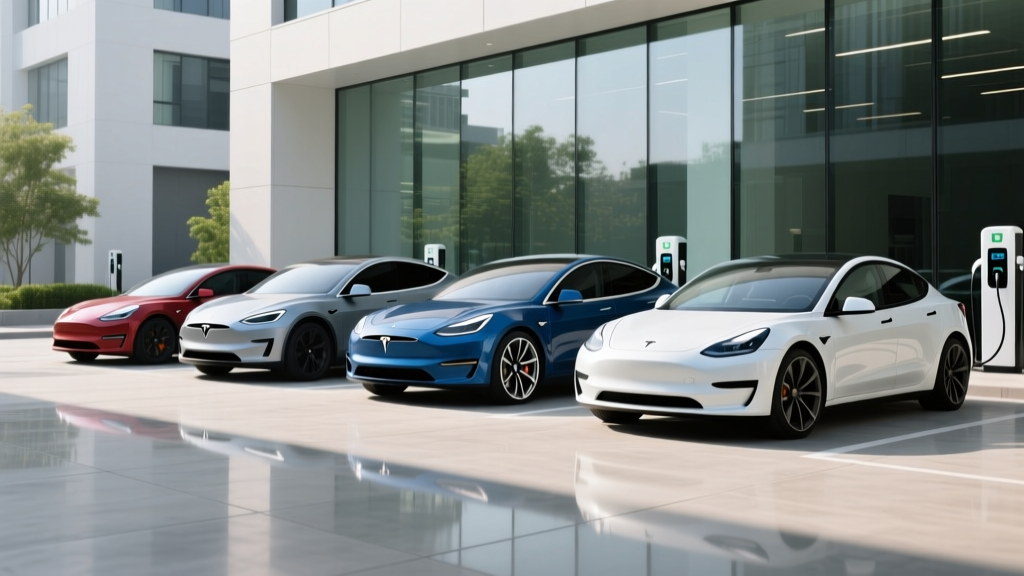
If you have been browsing financial headlines or EV forums in early 2026, you have likely encountered the term Tesla short ratio — the proportion of Tesla shares being sold short relative to overall trading volume. While short interest is fundamentally a stock-market metric, it has become an informal sentiment gauge for the EV market itself. When short sellers pile in, it often signals skepticism about demand, pricing power, or competitive positioning. When the ratio compresses, it can reflect renewed confidence in Tesla's product lineup and delivery trajectory.
But for the actual EV buyer — someone researching a Model Y, Model 3, or Cybertruck purchase — the real question is whether the vehicles themselves hold up against an increasingly crowded field. This article dissects the short-ratio context briefly, then pivots to what actually matters at the dealership: range, charging speed, pricing after federal tax credits, and how Tesla's 2026 lineup stacks up against rivals from Hyundai, Ford, and BMW.
What the Tesla Short Ratio Actually Measures
The short ratio (also called "days to cover") is calculated by dividing the number of shares currently sold short by the stock's average daily trading volume. A short ratio of 1.5, for example, means it would take roughly 1.5 trading days for all short sellers to buy back their positions. A rising short ratio can indicate growing bearish conviction — or a setup for a short squeeze if positive news forces covering.
As of Q1 2026, Tesla's short interest has fluctuated between roughly 3% and 5% of the float, with the days-to-cover ratio hovering in the 1.0–2.0 range depending on the week. This is moderate by historical standards. For context, Tesla's short ratio spiked above 5.0 during the 2020 short-seller campaigns and compressed near 1.0 during the 2023 delivery surge.
Why this matters to car buyers: Elevated short interest sometimes correlates with upcoming price cuts or aggressive incentive offers as Tesla moves to defend market share. If you are timing a purchase, watching the short ratio alongside Tesla's quarterly delivery reports can offer clues about pricing direction in the next 60–90 days.
2026 Tesla Lineup: Core Specs at a Glance
Rather than rehash stock charts, let's focus on the metal. Below is a consolidated spec table for Tesla's three highest-volume consumer vehicles for the 2026 model year.
| Spec | Model 3 Long Range AWD | Model Y Long Range AWD | Cybertruck AWD |
|---|---|---|---|
| EPA Range | 341 mi | 320 mi | 340 mi |
| Battery (usable) | ~75 kWh (NMC) | ~75 kWh (NMC) | ~123 kWh (NMC) |
| Peak DC Fast Charge | 250 kW | 250 kW | 250 kW |
| 10–80% DC Time | ~25 min | ~27 min | ~38 min |
| Level 2 Home Rate | 11.5 kW (~44 mi/hr) | 11.5 kW (~44 mi/hr) | 11.5 kW (~37 mi/hr) |
| 0–60 mph | 4.2 sec | 4.8 sec | 3.9 sec |
| Horsepower | ~346 hp | ~384 hp | ~600 hp |
| Drivetrain | Dual-Motor AWD | Dual-Motor AWD | Dual-Motor AWD |
| MPGe (combined) | 134 MPGe | 122 MPGe | 67 MPGe |
| Cargo Volume | 23 cu ft (trunk+frunk) | 76 cu ft (max) | ~120 cu ft (vault+frunk) |
| Base MSRP | $47,740 | $48,990 | $79,990 |
Sources: fueleconomy.gov, Tesla official specs. Figures reflect 2026 model-year data where published.
Real-World Range: What the EPA Sticker Does Not Tell You
EPA Estimate: 320 miles
Real-World Highway (70 mph, moderate climate): ~265–285 miles
Cold-Weather Highway (30°F or below): ~220–250 miles
City / Suburban Mixed: ~290–310 miles (regen braking recovers more energy)
Tesla's EPA range estimates are among the more conservative in the industry — meaning real-world results tend to land closer to the sticker than some competitors — but physics still applies. Sustained highway speeds above 70 mph increase aerodynamic drag substantially, and cold temperatures reduce battery chemical efficiency while demanding cabin heating energy.
The Model 3 Long Range, with its lower curb weight and sleeker drag coefficient (Cd ~0.219), tends to hold range better at highway speeds than the taller Model Y. In Edmunds real-world highway testing, the refreshed Model 3 achieved roughly 88–91% of its EPA rating at 70 mph in 65°F conditions — a strong result. Expect the Model Y to land in the 83–88% bracket under the same conditions.
Practical takeaway: If your typical road trip involves 250+ miles between charging stops, the Model 3 Long Range handles this comfortably in fair weather. The Model Y can do it too, but you will want to plan stops with a buffer, especially in winter or mountain terrain.
Charging Speed: Supercharger Network Advantage
Tesla's 250 kW V3 Supercharger architecture remains competitive in 2026, though rivals like the Hyundai Ioniq 5 (peak 350 kW on compatible chargers) and the Lucid Air (peak 300+ kW) have surpassed it on paper. The real advantage Tesla retains is network density and reliability.
| Charging Level | Power | Speed (Model Y LR) | Typical Use Case |
|---|---|---|---|
| Level 1 (120V) | ~1.4 kW | ~3–4 mi/hr | Emergency / overnight trickle |
| Level 2 (240V, 48A) | 11.5 kW | ~44 mi/hr | Home daily charging (Wall Connector) |
| DC Fast (V3 Supercharger) | 250 kW peak | ~1,000 mi/hr peak; 10–80% in ~27 min | Road trips |
| DC Fast (V4 Supercharger) | Up to 325 kW (limited vehicles) | Similar curve for current fleet | Newer installations |
Charging curve reality: Tesla vehicles peak at 250 kW only at low state-of-charge (roughly 10–30% SoC). By 50% SoC, the rate tapers to approximately 150 kW, and above 80% it drops below 50 kW. This is standard lithium-ion behavior, but it means the advertised 10–80% time is the meaningful metric — not the peak kW number. Plan your road-trip stops around the 10–80% window for optimal efficiency.
Preconditioning matters: Navigate to a Supercharger using the built-in navigation, and the car will automatically precondition the battery to optimal temperature before arrival. This can shave 5–10 minutes off your charge session, particularly in cold weather. Skipping preconditioning (e.g., driving to a charger without routing through nav) can result in significantly slower initial charge rates.
Pricing, Trims, and Federal Tax Credit Eligibility
Tesla's pricing has been volatile over the past several years, responding to competitive pressure, supply-chain costs, and demand fluctuations. As of early 2026, the core lineup MSRPs are as follows:
| Model / Trim | Base MSRP | Est. §30D Credit | Effective Price |
|---|---|---|---|
| Model 3 RWD | $38,990 | Up to $7,500* | ~$31,490* |
| Model 3 Long Range AWD | $47,740 | Up to $7,500* | ~$40,240* |
| Model Y Long Range AWD | $48,990 | Up to $7,500* | ~$41,490* |
| Model Y Performance | $52,490 | Up to $7,500* | ~$44,990* |
| Cybertruck AWD | $79,990 | $0 (above MSRP cap) | $79,990 |
*Credit eligibility depends on buyer income, battery sourcing, and MSRP caps under IRS §30D rules. Consult a tax professional before relying on credit estimates.
- MSRP Cap: SUVs/pickups/vans must be ≤$80,000; sedans ≤$55,000
- Buyer Income Cap (MAGI): $150,000 single / $225,000 head of household / $300,000 joint
- Battery Sourcing: Critical minerals and battery components must meet phased-in domestic/free-trade-partner thresholds (requirements tighten annually through 2029)
- Point-of-Sale Transfer: Eligible buyers can apply the credit as an immediate dealer discount rather than waiting for tax filing
- FEOC Restriction: Vehicles with battery components from a "foreign entity of concern" are disqualified
The Model 3 RWD, with its LFP battery chemistry (sourced primarily from CATL in China), has faced periodic eligibility challenges as the critical-minerals and FEOC sourcing rules tighten. Tesla has worked to diversify its supply chain, and the Model 3 Long Range (NMC chemistry with more diversified sourcing) has maintained more consistent eligibility. Always verify current eligibility on the fueleconomy.gov credit lookup tool before purchasing.
The Cybertruck, at $79,990, falls just under the $80,000 SUV/truck MSRP cap — but its pricing has been volatile, and some configurations exceed the threshold. As of this writing, the base AWD Cybertruck qualifies on MSRP grounds, but buyer income limits and sourcing requirements still apply.
Tech, Driver Assistance, and Interior Assessment
Tesla's technology stack remains a core selling point, though the gap with competitors has narrowed significantly by 2026.
Infotainment: The 15.4-inch center touchscreen (Model 3/Y) handles virtually all vehicle controls — there are no physical buttons for climate, mirrors, or even the glovebox. This minimalism is polarizing: some owners love the clean aesthetic, while others find basic adjustments distractingly tap-intensive while driving. The system is responsive, receives regular OTA updates, and includes Netflix/YouTube streaming (parked only), a strong navigation system with real-time Supercharger routing, and a capable phone-as-key implementation.
Driver Assistance — Autopilot & FSD (Supervised):
Tesla Autopilot and Full Self-Driving (Supervised) are Level 2 driver-assistance systems. They require continuous driver supervision, hands-on-wheel (or torque-based) monitoring, and do NOT make the vehicle self-driving. You are legally and operationally the driver at all times. True Level 4 driverless service (no human backup required) is currently offered only by robotaxi operators like Waymo in geofenced urban zones.
Autopilot (standard) provides competent adaptive cruise control and lane-centering on highways. FSD (Supervised), which costs an additional $8,000 or $99/month as of 2026, adds city-street navigation, traffic-light recognition, and more assertive lane changes. FSD has improved substantially through its neural-net-based "end-to-end" architecture, but it still makes errors at complex intersections, construction zones, and unmapped areas. It is best understood as a convenience feature that reduces fatigue, not a replacement for attention.
- Drive without your supervision — you must remain alert and ready to intervene
- Handle all construction zones, detours, or unmapped roads reliably
- Replace the legal responsibility of the driver in any jurisdiction
- Guarantee collision-free operation — NHTSA has investigated multiple Autopilot/FSD incidents
Interior Quality: The refreshed Model 3 ("Highland") brought meaningful improvements — ventilated front seats, ambient lighting, acoustic glass, rear-seat touchscreen, and better material quality. The Model Y received similar updates ("Juniper" refresh). However, compared to a BMW i4 or Genesis Electrified G80, Tesla interiors still feel spartan. Panel-gap consistency has improved but remains a talking point among critical buyers.
Pros, Cons, and Competitive Position
- Supercharger network remains the most reliable and extensive DC fast-charging network in North America (17,000+ V3/V4 stalls in the US)
- Industry-leading energy efficiency — Model 3 achieves 134 MPGe combined, translating to roughly $0.04–$0.06 per mile on average US electricity rates
- OTA updates continuously add features; the car you buy today may gain capabilities tomorrow
- Strong resale value relative to most EV competitors (though depreciation has accelerated since 2023 price cuts)
- Point-of-sale tax credit transfer available at Tesla, simplifying the purchase
- 250 kW peak DC charging is now outpaced by Hyundai/Kia (350 kW), Porsche (350 kW), and Lucid (300+ kW)
- Minimalist interior and screen-only controls are not for everyone
- FSD (Supervised) remains expensive ($8,000) and is still Level 2 — not autonomous
- Service center capacity has not kept pace with fleet growth; wait times for body repair can stretch weeks
- Brand perception has become politically polarized, which may affect resale in some markets
Model Y vs. Key Competitors
The Model Y competes directly with the Hyundai Ioniq 5, Ford Mustang Mach-E, BMW iX3, and the refreshed Rivian R2 (launching late 2026). The Ioniq 5 charges faster (350 kW peak, 10–80% in ~18 min) and offers a more conventional interior with physical controls. The Mach-E delivers a sportier driving feel and Ford's BlueCruise hands-free highway system. But the Model Y still leads in cargo space (76 cu ft max), Supercharger access, and overall energy efficiency.
If you value charging speed above all else and have reliable CCS or NACS adapter access, the Ioniq 5 is a compelling alternative. If network reliability on road trips is your priority, the Tesla ecosystem still wins in 2026.
Who Should Buy a Tesla in 2026?
- You road-trip frequently and value the Supercharger network's reliability and coverage
- You want the lowest cost-per-mile efficiency in the EV segment
- You prefer OTA-updated software and a tech-forward ownership experience
- You can install a Level 2 home charger (11.5 kW Wall Connector) for daily convenience
- You want the fastest possible DC charging (Ioniq 5, Porsche Taycan)
- You prefer physical buttons, a traditional instrument cluster, or a luxury interior (BMW i4, Genesis GV60)
- You need a third row (Kia EV9, Rivian R1S)
- You want hands-off Level 3+ highway driving (Mercedes Drive Pilot in limited markets)
Frequently Asked Questions
What is the real-world range of a Tesla Model Y?
The EPA rates the 2026 Model Y Long Range AWD at 320 miles. In real-world highway driving at 70 mph in moderate temperatures, expect roughly 265–285 miles. In cold weather (below 30°F), plan for 220–250 miles. City driving with regenerative braking recovers more energy, pushing closer to the EPA number.
How fast does a Tesla charge at home and on the road?
At home on a Level 2 Tesla Wall Connector (240V, 48A), a Model Y gains roughly 44 miles of range per hour — a full overnight session easily replenishes a daily commute. On a V3 Supercharger, the Model Y peaks at 250 kW and charges from 10–80% in approximately 27 minutes, though the rate tapers significantly above 80%.
How much does a Tesla cost after federal tax credits?
If you qualify for the full $7,500 §30D credit (income within limits, vehicle meets sourcing requirements), a Model 3 RWD drops from $38,990 to roughly $31,490, and a Model Y Long Range drops from $48,990 to about $41,490. The credit can be applied as a point-of-sale discount. Always verify current eligibility on fueleconomy.gov and consult a tax professional.
Is Tesla worth buying vs. Hyundai, Ford, or BMW?
It depends on priorities. Tesla wins on Supercharger network access, energy efficiency, and cargo space (Model Y). Hyundai/Kia wins on DC charging speed. Ford's Mach-E offers a sportier drive. BMW delivers a more premium interior. Cross-shop based on your top three priorities and test-drive at least two options.
Does Tesla qualify for the federal EV tax credit?
Most Tesla models currently qualify, but eligibility depends on the specific trim's MSRP (sedans ≤$55,000, SUVs/trucks ≤$80,000), buyer income (MAGI caps apply), and battery-component/critical-mineral sourcing rules that tighten annually. The Model 3 RWD's LFP battery has faced periodic sourcing challenges. Verify on the IRS-approved vehicle list at fueleconomy.gov before purchasing.
What are the biggest pros and cons of owning a Tesla?
Pros: Supercharger network, best-in-class efficiency, OTA updates, strong software ecosystem, point-of-sale tax credit. Cons: Charging speed is now mid-pack, minimalist interior polarizes, FSD is expensive and still Level 2, service capacity lags fleet growth, and brand perception is increasingly politicized.
Does the Tesla short ratio affect my car purchase?
Not directly, but a rising short ratio can signal that Tesla may respond with price cuts, referral incentives, or promotional financing within the next quarter. If the short ratio is climbing, it may pay to wait a few weeks before locking in a purchase agreement. Monitor quarterly delivery reports and earnings calls for pricing signals.
Final Assessment: The Product Behind the Ticker
The Tesla short ratio is a financial sentiment indicator, not a product-quality score. Short sellers may have valid concerns about Tesla's long-term market share, margin compression, or competitive moat — but the vehicles themselves remain among the most efficient, well-integrated EVs on the market. The Model 3 and Model Y continue to deliver compelling range, low operating costs, and access to the strongest charging network in North America.
For the data-driven buyer, the decision comes down to specs and use case, not stock-market positioning. If a Model Y at ~$41,500 after tax credits, with 320 miles of EPA range, 250 kW DC charging, and 76 cu ft of cargo space fits your life — and you have access to home Level 2 charging — it remains a rational, well-supported purchase in 2026. Just cross-shop the Ioniq 5 and Mach-E before signing, and always verify your personal tax-credit eligibility with a qualified professional.