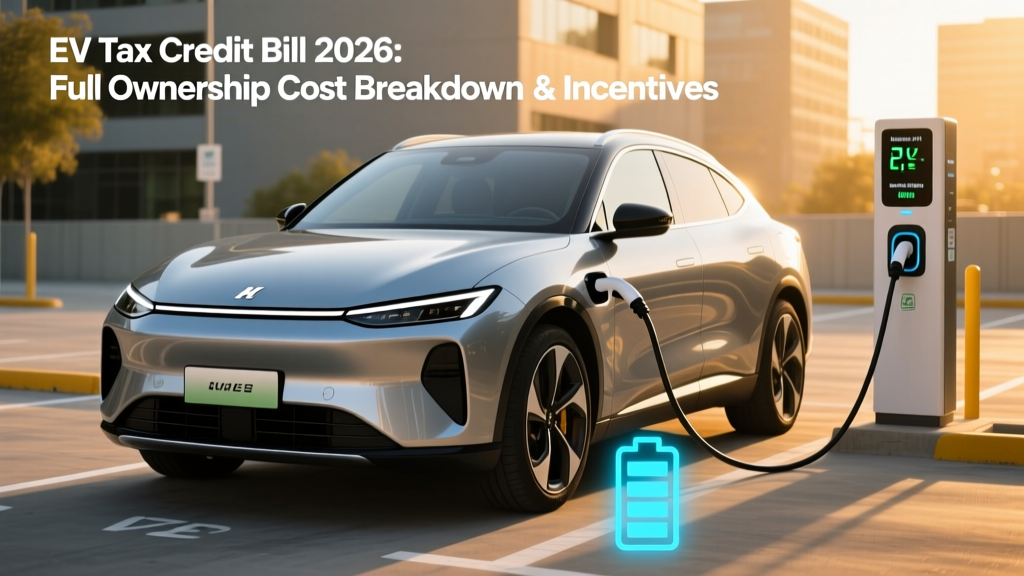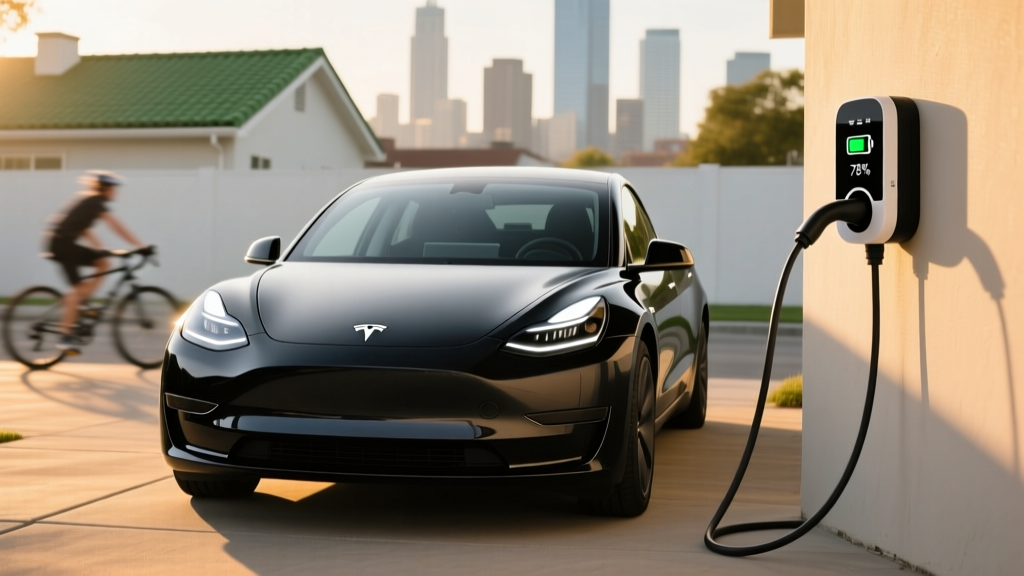
If you follow EV market news, you've likely seen Tesla short interest trending in financial circles. Short sellers have been betting against Tesla stock for years, and periodic spikes in short interest often generate alarming headlines. But if you're an EV shopper evaluating the 2026 Tesla Model 3 as a potential purchase, what does Wall Street sentiment actually mean for you — and more importantly, does the car itself hold up?
This review cuts through the financial noise to evaluate the 2026 Tesla Model 3 on the metrics that matter to owners: real-world range, charging speed, ownership costs, and whether it still competes against a growing field of rivals. The stock market and the product are two different conversations. Let's focus on the one that affects your driveway.
2026 Tesla Model 3 at a Glance: Core Specs
| Spec | Model 3 RWD (Base) | Model 3 Long Range AWD | Model 3 Performance |
|---|---|---|---|
| EPA Range | 272 mi | 363 mi | 315 mi |
| Battery Capacity (usable) | ~60 kWh (LFP) | ~75 kWh (NMC) | ~75 kWh (NMC) |
| Max DC Fast Charge | 170 kW | 250 kW | 250 kW |
| 10-80% DC Time | ~25 min | ~25 min | ~25 min |
| Level 2 Home Charging | 11.5 kW (~44 mi/hr) | 11.5 kW (~44 mi/hr) | 11.5 kW (~44 mi/hr) |
| 0-60 mph | 5.8 sec | 4.2 sec | 2.9 sec |
| Horsepower | 271 hp | 346 hp | 510 hp |
| Drivetrain | RWD (single motor) | AWD (dual motor) | AWD (dual motor) |
| Base MSRP | $38,990 | $45,990 | $52,990 |
Real-World Range: What the EPA Sticker Doesn't Tell You
The EPA numbers above are useful baselines, but no one drives in EPA test conditions. Here's what to expect in practice.
EPA estimate: 363 miles. Real-world highway driving at 70-75 mph: expect roughly 290-310 miles. In freezing temperatures (below 32°F), that drops further to approximately 240-270 miles depending on cabin heating demand and whether you precondition. City driving with regenerative braking can meet or slightly exceed the EPA figure.
The base RWD model's LFP (lithium iron phosphate) battery behaves differently than the NMC chemistry in the Long Range and Performance trims. LFP batteries tolerate — and actually prefer — being charged to 100% regularly, which effectively gives the RWD model more usable daily range than its EPA number alone might suggest. NMC batteries, by contrast, benefit from an 80% daily charge ceiling to maximize longevity, meaning your everyday usable range on the Long Range is closer to ~290 miles before you start dipping into the buffer Tesla reserves.
For context, the Model 3 Long Range's real-world highway efficiency runs approximately 26-28 kWh/100mi (roughly 120-129 MPGe combined), per fueleconomy.gov. That remains among the most efficient vehicles in its class.
Charging Speed: Supercharger Network Advantage
Charging infrastructure is where Tesla's moat becomes tangible for owners, even as the broader EV market adopts the NACS connector standard. Tesla Superchargers remain the most reliable DC fast-charging network in North America, and the Model 3 benefits from tight vehicle-to-charger integration, including battery preconditioning when you navigate to a Supercharger.
| Charging Level | Power (kW) | Speed (miles of range added) | Typical Use Case |
|---|---|---|---|
| Level 1 (120V household) | ~1.4 kW | ~3-5 mi/hr | Emergency/trickle top-off |
| Level 2 (240V home, 48A) | 11.5 kW | ~44 mi/hr | Overnight home charging |
| DC Fast (V2 Supercharger) | 150 kW | ~170 mi in 15 min | Road trips (older stations) |
| DC Fast (V3/V4 Supercharger) | Up to 250 kW | ~200 mi in 15 min | Road trips (current network) |
A critical nuance: the 250 kW peak rate applies only to the Long Range and Performance trims with NMC batteries, and only at the low end of the state of charge (SoC). The charge curve tapers significantly above 60% SoC, and drops sharply above 80%. The 10-80% time of roughly 25 minutes assumes you arrive at a low SoC and the battery is properly preconditioned. Show up cold without preconditioning, and that 10-80% session can stretch to 40+ minutes.
The base RWD model's LFP battery peaks at approximately 170 kW on DC fast charging. LFP charge curves are flatter but lower-peaked, meaning the RWD won't match the Long Range's burst speed but maintains more consistent charging across the session.
Pricing, Trims, and Federal Tax Credit Eligibility
Understanding the real cost of a 2026 Model 3 requires navigating the current IRS §30D federal tax credit rules, which have specific requirements around MSRP caps, buyer income, and battery component sourcing.
| Trim | Base MSRP | Federal Credit Potential | Effective Price (if eligible) |
|---|---|---|---|
| RWD | $38,990 | Up to $7,500 | ~$31,490 |
| Long Range AWD | $45,990 | Up to $7,500 | ~$38,490 |
| Performance | $52,990 | Up to $7,500 | ~$45,490 |
- MSRP cap: Sedans must be under $55,000 — the RWD and Long Range qualify; the Performance trim may exceed the cap depending on options
- Income cap: Modified AGI ≤ $150,000 (single), $225,000 (head of household), $300,000 (joint)
- Battery sourcing: Critical minerals and battery components must meet escalating domestic-content thresholds — Tesla's supply chain has been adapting, but eligibility can shift by production batch
- Point-of-sale transfer: You can apply the credit as a down-payment reduction at the dealer, rather than waiting to claim it on your tax return
How Tesla Short Interest Relates to Your Purchase Decision
So what does Tesla short interest actually signal for a Model 3 buyer? Here's the practical translation:
What short sellers are betting on: Increased competition (Hyundai Ioniq 6, BMW i4, Chevrolet Bolt successor), potential margin compression from price cuts, Elon Musk's divided attention across multiple companies, and the maturation of the broader EV market reducing Tesla's first-mover advantage.
What it means for your ownership experience: Stock performance and product quality are loosely correlated in the short term. Tesla's service network, Supercharger infrastructure, and over-the-air update pipeline continue to function regardless of share price. However, sustained financial pressure could theoretically affect future R&D investment, service center expansion, or resale values over a multi-year ownership horizon.
Resale value consideration: Tesla's aggressive price cuts in 2023-2025 already compressed used Model 3 values. If you plan to sell within 3-4 years, factor in potentially steeper-than-average depreciation compared to legacy brands with more stable pricing strategies. According to industry depreciation data, a Model 3 may retain roughly 45-55% of its value after 5 years, depending on trim and mileage.
Interior, Tech, and Daily Livability
The refreshed Model 3 (introduced for the 2024 model year and carried into 2026) addressed many of the prior generation's comfort complaints. Cabin noise is significantly reduced thanks to acoustic glass and improved sealing. The ventilated front seats, ambient lighting, and rear-seat touchscreen elevate the experience closer to what the price suggests.
Dimensions and space:
- Front legroom: 42.3 inches
- Rear legroom: 35.3 inches
- Cargo volume (trunk + frunk): 23 cu ft combined
- Frunk: ~3.1 cu ft (enough for a charging cable kit and small bag)
The minimalist interior remains polarizing. There are no physical buttons — climate, mirrors, and glovebox are all controlled through the 15.4-inch center touchscreen. The turn-signal stalks were eliminated in the refresh, replaced by steering-wheel-mounted buttons, which requires an adjustment period.
Driver assistance: Basic Autopilot (traffic-aware cruise control and lane centering) is standard. Full Self-Driving (Supervised) remains a $8,000 add-on or $99/month subscription. This is a SAE Level 2 system — it requires continuous driver supervision and does not make the vehicle autonomous. The name is aspirational, not descriptive.
Model 3 vs. Key Competitors: Is It Still the Default Choice?
- You value access to the Supercharger network (though NACS adoption is opening this to competitors by 2026)
- Efficiency and range-per-dollar are top priorities
- You want OTA updates that meaningfully add features over time
- You prefer a sedan form factor with strong performance
- You need a hatchback or liftback for cargo flexibility (Hyundai Ioniq 6, Polestar 2)
- Physical buttons and a more traditional interior matter to you (BMW i4)
- Brand perception and build consistency are high priorities
- You want to avoid association with Tesla's polarizing CEO
The Hyundai Ioniq 6 SE Long Range offers 361 miles EPA at a similar price point with 800V architecture enabling faster peak charging. The BMW i4 eDrive40 provides a more premium interior and conventional controls at a higher starting price (~$57,000). Neither matches Tesla's charging network integration, though both benefit from improving NACS adapter access to Superchargers.
Warranty and Long-Term Ownership
Tesla's warranty coverage is competitive but not class-leading:
- Basic vehicle: 4 years / 50,000 miles
- Battery and drive unit: 8 years / 100,000 miles (RWD), 8 years / 120,000 miles (Long Range & Performance)
- Capacity retention threshold: Tesla warrants the battery will retain at least 70% of its original capacity during the warranty period
The 70% threshold is standard for the industry. Real-world degradation data from high-mileage Model 3 owners suggests LFP batteries in the RWD trim show minimal degradation in the first 50,000 miles, while NMC batteries typically lose 5-8% capacity over the same period before stabilizing. Battery replacement outside warranty currently runs $12,000-$16,000 depending on the pack — a figure worth factoring into long-term ownership projections if you plan to keep the vehicle past 100,000 miles.
Pros, Cons, and the Bottom Line
- Class-leading efficiency and real-world range
- Supercharger network reliability
- Strong performance across all trims
- Over-the-air updates add features post-purchase
- Competitive pricing within the segment
- No physical controls — all touchscreen-dependent
- Rear seat space is tighter than some competitors
- Build quality inconsistency still reported
- Depreciation risk tied to price-cut history
- Steering-wheel turn signals require adaptation
Frequently Asked Questions
What is the real-world range of the 2026 Tesla Model 3?
The Long Range AWD achieves an EPA-estimated 363 miles, but expect 290-310 miles in real-world highway driving and 240-270 miles in freezing cold weather. The base RWD model's 272-mile EPA rating is more achievable in city driving thanks to LFP chemistry allowing regular 100% charges.
How fast does the Model 3 charge at home and on the road?
At home on a Level 2 (240V/48A) charger, the Model 3 adds approximately 44 miles of range per hour at 11.5 kW — enough for a full overnight charge. On DC fast charging, the Long Range and Performance peak at 250 kW, achieving a 10-80% charge in roughly 25 minutes under optimal (preconditioned) conditions.
Does the 2026 Model 3 qualify for the $7,500 federal EV tax credit?
The RWD ($38,990) and Long Range ($45,990) trims fall under the $55,000 MSRP cap for sedans. The Performance ($52,990) qualifies at base MSRP but may exceed the cap with options. Buyer income must be under $150,000 (single) / $300,000 (joint), and battery sourcing requirements must be met at time of delivery. Verify on IRS.gov before purchasing.
Should Tesla short interest affect my decision to buy a Model 3?
Short interest reflects investor sentiment about Tesla's stock, not the quality of the Model 3 as a product. The main risk to monitor is potential long-term depreciation if financial pressure leads to reduced innovation or service investment. However, the Supercharger network, OTA updates, and parts availability are not directly tied to stock performance.
Is the Model 3 worth buying over the Hyundai Ioniq 6 or BMW i4?
If charging infrastructure reliability and efficiency-per-dollar are your top priorities, the Model 3 Long Range remains a strong default choice. The Ioniq 6 offers comparable range with faster 800V charging architecture, and the BMW i4 delivers a more premium cabin with physical controls. Test-drive all three — the right choice depends on which trade-offs matter most to your daily routine.