What Is the Tesla Shared Vehicle Feature and Why It Matters
The Tesla shared vehicle feature is a software-driven permission layer built into Tesla's infotainment system that lets the primary owner grant secondary drivers access to the car with granular controls. Unlike a traditional key handoff, this feature uses the Tesla mobile app to assign driver profiles, set speed and acceleration limits, restrict access to certain vehicle functions, and track trip data — all without sharing the owner's Tesla account credentials.
For households with multiple drivers, fleet managers, or owners who occasionally lend their car, the shared vehicle feature transforms a Tesla from a single-user device into a multi-driver platform. It's one of the more under-discussed ownership advantages that Tesla holds over legacy EV competitors, most of which still rely on physical key fobs and offer no remote driver management.
This guide covers how the feature works in the 2026 model year, what it means for your daily driving and range, and whether the underlying vehicles — the 2026 Model 3 and 2026 Model Y — still hold up as smart purchases in their own right.
How the Shared Vehicle Feature Works in Practice
Setting up a shared driver takes roughly two minutes in the Tesla app (v4.40+). The owner navigates to Security & Drivers → Add Driver, enters the secondary driver's email, and assigns permissions. The invited driver receives a link, creates or logs into their own Tesla account, and their phone becomes a digital key for that specific vehicle.
Available controls per shared driver include:
- Speed Limit Mode: Cap top speed between 50–90 mph (useful for teen drivers or fleet vehicles)
- Acceleration Mode: Restrict to Chill mode only, limiting torque delivery
- Charging Access: Allow or block changes to charge limits and scheduled charging
- Sentry Mode & Dashcam: Enable or disable security recording
- Glovebox & Frunk Lock: Restrict access to locked compartments
- Valet Mode PIN: Additional layer for parking attendants or short-term borrowers
- Trip History: Owner can view mileage and routes per driver profile
Each shared driver gets their own seat position memory, mirror settings, steering wheel height, climate preferences, and media accounts (Spotify, Tidal). This profile isolation is a meaningful daily convenience — the car literally adjusts itself when it detects which phone is approaching.
This is not a ride-sharing or peer-to-peer rental platform. You cannot use it to list your Tesla on Turo or a similar service and remotely manage renters — Tesla's terms of service prohibit commercial use of the feature. It is designed for personal household sharing, trusted friends, or company fleet use only. Additionally, shared drivers cannot remotely summon the vehicle, initiate software updates, or change ownership settings.
2026 Model 3: Range, Battery, and Charging Specs
The shared vehicle feature is most commonly used with the 2026 Tesla Model 3, Tesla's entry-level sedan and one of the most efficient EVs on the market. Here are the exact numbers:
| Spec | Model 3 RWD | Model 3 Long Range AWD | Model 3 Performance |
|---|---|---|---|
| EPA Range | 272 mi | 341 mi | 315 mi |
| Battery (usable) | 57.5 kWh (LFP) | 75 kWh (NMC) | 75 kWh (NMC) |
| MPGe (combined) | 132 MPGe | 132 MPGe | 119 MPGe |
| kWh/100 mi | 25 | 25 | 28 |
| 0–60 mph | 5.8 sec | 4.2 sec | 2.9 sec |
| Horsepower | 271 hp | 346 hp | 510 hp |
| Drivetrain | RWD | Dual-Motor AWD | Dual-Motor AWD |
| Max DC Fast Charge | 170 kW | 250 kW | 250 kW |
| 10–80% DC Time | ~28 min | ~25 min | ~25 min |
| Level 2 Home Rate | 11.5 kW (~44 mi/hr) | 11.5 kW (~44 mi/hr) | 11.5 kW (~44 mi/hr) |
| Base MSRP | $38,990 | $45,990 | $52,990 |
Source: fueleconomy.gov, Tesla.com 2026 specs.
EPA: 341 mi (Long Range AWD) — In real-world highway driving at 70–75 mph, expect ~280–300 mi in mild weather. In cold conditions (below 32°F), range drops to approximately ~240–260 mi due to cabin heating demand and reduced battery efficiency, even with Tesla's heat pump. City driving with heavy regenerative braking often matches or slightly exceeds the EPA figure. LFP-equipped RWD models can be charged to 100% daily without degradation concerns — a significant advantage for shared-vehicle households where drivers may forget to manage charge limits.
2026 Model Y: The Family-Oriented Shared Vehicle
The 2026 Tesla Model Y is the more popular candidate for the shared vehicle feature simply because it's the vehicle most likely to serve multiple family members. Its crossover form factor, higher seating position, and larger cargo area make it a natural multi-driver household car.
| Spec | Model Y Long Range AWD | Model Y Performance |
|---|---|---|
| EPA Range | 320 mi | 295 mi |
| Battery (usable) | 75 kWh (NMC) | 75 kWh (NMC) |
| MPGe (combined) | 122 MPGe | 111 MPGe |
| 0–60 mph | 4.8 sec | 3.5 sec |
| Horsepower | 384 hp | 456 hp |
| Max DC Fast Charge | 250 kW | 250 kW |
| 10–80% DC Time | ~27 min | ~27 min |
| Cargo Volume | 76 cu ft (rear seats folded) | 76 cu ft |
| Rear Legroom | 41.6 in | 41.6 in |
| Base MSRP | $46,990 | $53,990 |
For Model 3, cargo space is 23 cu ft (trunk + frunk combined), with rear legroom of 35.2 in. The Model Y's 76 cu ft total cargo volume (with optional third-row deleted) is a substantial advantage for families sharing the vehicle across school runs, grocery trips, and weekend travel.
Charging Setup for Multi-Driver Households
When multiple drivers share a Tesla, home charging logistics become critical. A single Level 2 charger must accommodate different schedules, and the shared vehicle feature's per-driver charge limit settings help prevent one driver from accidentally leaving the car at 50% when another needs a full charge for a road trip.
| Charging Level | Power | Miles Added/Hour | Best For |
|---|---|---|---|
| Level 1 (120V) | 1.4 kW | ~4–5 mi/hr | Overnight top-up, low-mileage drivers |
| Level 2 (240V, 48A) | 11.5 kW | ~44 mi/hr | Primary home charging, multi-driver homes |
| DC Fast (Supercharger) | Up to 250 kW | ~1,000+ mi/hr (peak) | Road trips, quick top-ups |
For shared-vehicle households, the Tesla Wall Connector ($475) is the practical choice. It supports up to 48 amps on a 60-amp circuit, integrates with the Tesla app for per-driver charging schedules, and can load-share across two Wall Connectors on a single circuit — useful if the household also owns a second EV. Professional installation typically runs $500–$2,000 depending on panel proximity and whether a 200-amp panel upgrade is needed.
A key shared-feature advantage: each driver profile can set its own scheduled departure time and charge limit. The car will precondition the battery and cabin for Driver A's 7 AM commute while respecting Driver B's preference to stop charging at 80% for battery longevity.
Pricing, Tax Credits, and Total Cost
Federal tax credit eligibility under IRS §30D remains a moving target for Tesla vehicles in 2026 due to battery sourcing and critical mineral requirements. Here's where the lineup stands:
| Model / Trim | Base MSRP | Est. §30D Credit | Effective Price | MSRP Cap Status |
|---|---|---|---|---|
| Model 3 RWD | $38,990 | $3,750–$7,500* | $31,490–$35,240 | Under $55K cap ✓ |
| Model 3 Long Range | $45,990 | $3,750–$7,500* | $38,490–$42,240 | Under $55K cap ✓ |
| Model Y Long Range | $46,990 | $3,750–$7,500* | $39,490–$43,240 | Under $80K cap ✓ |
| Model Y Performance | $53,990 | $3,750–$7,500* | $46,490–$50,240 | Under $80K cap ✓ |
*Credit amount depends on battery component and critical mineral sourcing compliance. Verify current eligibility at IRS.gov §30D. Buyer income caps apply: $150K single / $225K head of household / $300K joint filers. The credit can be transferred to the dealer at point of sale as an instant discount.
- ✓ Vehicle MSRP under cap ($55K sedans / $80K SUVs and trucks)
- ⚠️ Battery sourcing: partial credit ($3,750) if only one of two sourcing requirements met; full credit ($7,500) if both battery components AND critical minerals comply
- ✓ Buyer adjusted gross income within limits
- ✓ Vehicle assembled in North America (all US-market Teslas qualify)
- ✓ Purchased new (used Tesla? Check §25E used clean vehicle credit — up to $4,000)
Standout Tech and Driver Assistance
The shared vehicle feature sits within Tesla's broader software ecosystem, which remains the most integrated in the EV market. Key technology highlights:
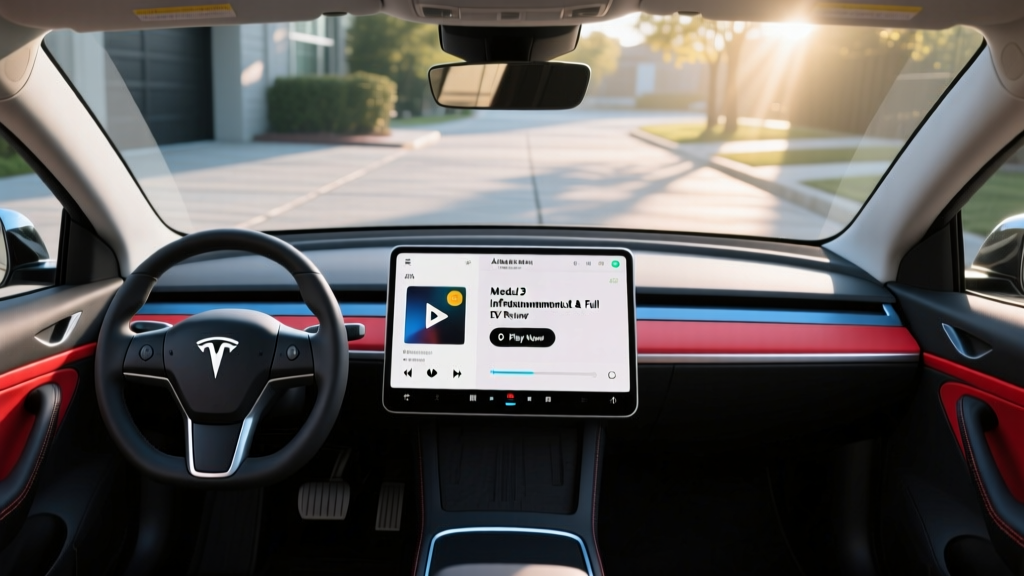
- 15.4" touchscreen (Model 3) / 15.4" + rear 8" screen (Model Y): All vehicle controls, navigation, and media run through the central display. No physical instrument cluster.
- Autopilot (standard): SAE Level 2 driver assistance with adaptive cruise control and lane centering. The driver must remain engaged at all times — this is not self-driving.
- Full Self-Driving Supervised ($8,000 add-on): Enhanced Level 2 with automatic lane changes, traffic light/stop sign recognition, and Navigate on Autopilot. Still requires active driver supervision. Despite the name, it does not achieve SAE Level 3 or higher.
- Over-the-air updates: Tesla regularly pushes feature improvements, including UI refinements to the driver profile system and shared-vehicle permissions.
- Sentry Mode: Records surroundings when parked, with per-driver access control via the shared vehicle feature.
Both Autopilot and FSD (Supervised) are SAE Level 2 systems. The driver is always responsible for vehicle operation and must keep hands on or near the wheel and eyes on the road. Tesla's cabin camera monitors attention. Only Level 4 systems (e.g., Waymo robotaxis in designated zones) operate without a human driver. Shared drivers using Autopilot should understand this distinction — the car will not drive itself.
Warranty, Battery Longevity, and Ownership
Tesla's warranty structure applies uniformly regardless of how many shared drivers are assigned to the vehicle:
- Basic Vehicle Warranty: 4 years / 50,000 miles
- Battery & Drive Unit: 8 years / 100,000 miles (RWD) or 8 years / 120,000 miles (Long Range / Performance)
- Battery Capacity Retention Threshold: Tesla warrants a minimum of 70% capacity retention during the warranty period
For shared-vehicle households, battery longevity is directly influenced by charging habits. The LFP battery in the Model 3 RWD is notably robust — it tolerates regular 100% charges better than NMC chemistry, making it ideal for a household where one driver may consistently deplete the battery and another needs a full charge the next morning. NMC-equipped Long Range and Performance trims benefit from keeping daily charges at 80%, which the shared vehicle feature's per-driver charge limit settings can enforce automatically.
Real-world degradation data from fleet studies and owner reports suggests Tesla's NMC batteries retain approximately 90% capacity after 100,000 miles and ~85% after 150,000 miles under normal use. LFP cells show even slower degradation curves. A full battery replacement out of warranty runs $12,000–$16,000 depending on the pack, though this is rarely needed within the vehicle's practical lifespan.
Pros and Cons: The Shared Vehicle Experience
- Per-driver profiles with seat, mirror, climate, and media memory
- Granular speed and acceleration limits for teen or fleet drivers
- Individual charge limit and schedule management per driver
- Trip tracking without sharing Tesla account credentials
- LFP option (Model 3 RWD) allows worry-free 100% daily charging
- Class-leading Supercharger network access (17,000+ stalls in North America)
- OTA updates continuously improve the feature set
- No support for commercial peer-to-peer rental use
- Shared drivers cannot use Summon or manage software updates
- Model 3 rear seat is tight for adults (35.2" legroom)
- Stalkless turn signals and screen-only controls frustrate some secondary drivers
- Insurance premiums often 15–25% higher than comparable non-Tesla EVs
- FSD ($8,000) remains Level 2 despite the marketing name
- Tax credit amount varies with battery sourcing rules — not guaranteed at $7,500
Who Should Use the Shared Vehicle Feature (and Which Tesla to Pick)
The Tesla shared vehicle feature is most valuable for three buyer profiles:
1. Two-driver households with different commutes. The Model Y Long Range is the default pick. Driver A leaves at 7 AM with the car preconditioned and charged to 90%; Driver B departs at 9 AM with their own profile, seat position, and podcast queue. The 320-mile EPA range covers most two-commuter days without mid-day charging.
2. Families with a teen driver. The Model 3 RWD's Speed Limit Mode (capped at 50–90 mph) and Chill-only acceleration give parents meaningful control. The LFP battery means the teen doesn't need to manage charge-limit percentages — charge to 100% daily without degradation guilt. At an effective price as low as ~$31,490 after the tax credit, it's also the most affordable new Tesla.
3. Small business fleet vehicles. A company Model Y with the shared vehicle feature lets a fleet manager assign vehicles to employees with trip tracking, speed limits, and controlled charging — without needing a third-party fleet management platform.
Frequently Asked Questions
What is the real-world range of the Tesla Model 3 and Model Y?
The Model 3 Long Range AWD achieves an EPA-estimated 341 miles, but expect ~280–300 miles in real-world highway driving at 70+ mph, and ~240–260 miles in freezing temperatures. The Model Y Long Range's 320-mile EPA figure translates to ~265–285 miles highway, ~230–250 miles in cold weather. City driving with regenerative braking often exceeds EPA estimates.
How fast does a Tesla charge at home and on the road?
On a Level 2 Tesla Wall Connector (11.5 kW), both Model 3 and Model Y add approximately 44 miles of range per hour — a full overnight charge from 20% to 80% takes about 4 hours. At a V3 Supercharger, both peak at 250 kW (Model 3 RWD peaks at 170 kW), achieving a 10–80% charge in approximately 25–28 minutes. Charging slows significantly above 80% due to the battery management system tapering current to protect cell health.
How much does a Tesla cost after federal tax credits?
Depending on battery sourcing compliance and buyer income eligibility under IRS §30D, the Model 3 RWD can drop from $38,990 to as low as ~$31,490 with the full $7,500 credit. The Model Y Long Range ranges from ~$39,490 to $46,990. Verify your exact eligibility on IRS.gov and confirm the current credit tier with your Tesla advisor at purchase — sourcing rules update periodically.
Is a Tesla with the shared vehicle feature worth buying vs. competitors?
For multi-driver households, the shared vehicle feature gives Tesla a meaningful software edge. Competitors like the Hyundai Ioniq 5, Ford Mustang Mach-E, and Chevrolet Equinox EV offer strong range and charging, but none match Tesla's per-driver permission system, trip tracking, and profile isolation. If your priority is purely driving dynamics or interior material quality, the Ioniq 5 N or BMW i4 may appeal more. If you need a true multi-driver EV with minimal friction, Tesla's software ecosystem is the most mature option in 2026.
Can shared drivers access Autopilot and FSD?
Yes. Autopilot (standard) and FSD Supervised (if purchased) are available to all driver profiles assigned to the vehicle. The owner can, however, restrict a shared driver to Chill acceleration mode, which limits torque and makes the car less aggressive. Remember: both systems are SAE Level 2 — the driver must remain fully attentive.
Does the shared vehicle feature affect my insurance?
Adding shared drivers through the Tesla app does not directly change your insurance premium, but insurers may require all regular drivers to be listed on the policy. Tesla's own insurance product (available in most states) uses real-time driving data, which is tracked per driver profile — a safe teen driver won't be penalized by a parent's harder braking habits, and vice versa.
Always verify current pricing, tax credit eligibility, and feature availability at Tesla.com and fueleconomy.gov. Specifications and IRS rules are subject to change.