When most buyers research the Tesla Model Y, they focus on range, charging speed, and cargo space. But one feature consistently drives owner satisfaction — and influences the purchase decision — more than spec sheets suggest: the Tesla Sentry cameras and the Sentry Mode security system they power. For 2026, the refreshed Model Y (internally dubbed "Juniper") carries over the same multi-camera architecture that enables Sentry Mode, Dashcam, and Autopilot vision, while updating the vehicle's efficiency, interior, and ride quality.
This review breaks down everything you need to know about Tesla's Sentry camera system in the context of the 2026 Model Y's full ownership picture — from real-world range and DC fast-charging curves to federal tax credit eligibility under current IRS §30D rules.
What Tesla Sentry Cameras Actually Do on the 2026 Model Y
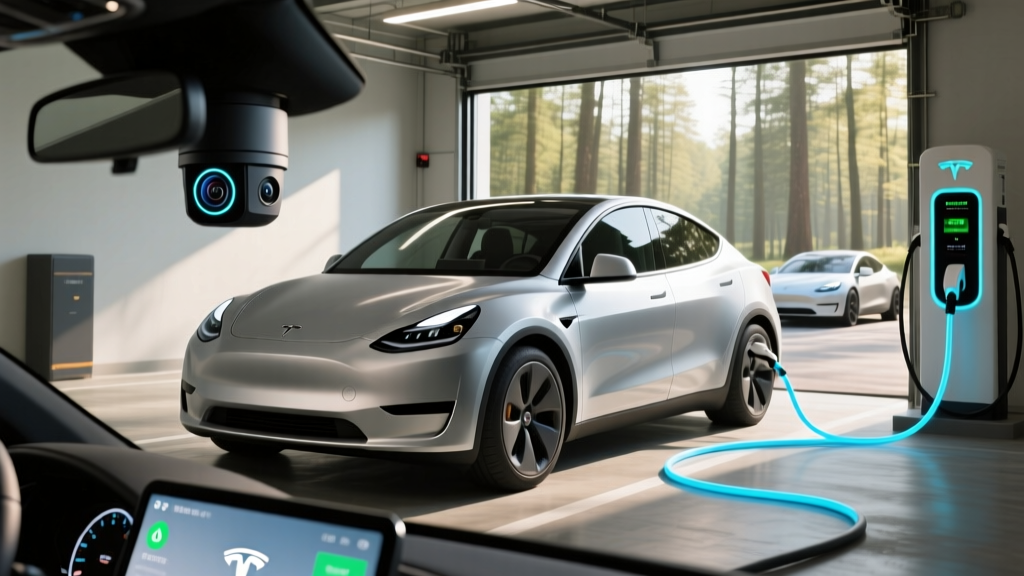
Tesla's Sentry Mode relies on the same suite of external cameras used for Autopilot and FSD (Supervised). The 2026 Model Y uses Tesla's Hardware 4 (HW4) camera suite — no ultrasonic sensors, no radar — with the following external cameras contributing to Sentry Mode:
- Front-facing camera (mounted behind the windshield, above the rearview mirror) — primary forward view
- Left and right front repeater cameras (mounted on the front fenders) — side-angle coverage
- Left and right rear repeater cameras (mounted on the B-pillars or rear quarter panels) — rear-side coverage
- Rear-view camera (mounted above the license plate) — rear coverage
When Sentry Mode is armed and the vehicle is parked, these cameras monitor the surroundings using a low-power standby state. If a threat is detected — someone leaning on the car, a break-in attempt, or an impact — the system escalates through three states: Standby (monitoring), Aware (screens flash to alert the person they're being recorded), and Alarm (horn sounds, phone notification sent, video saved to the USB drive).
Sentry Mode's Real-World Battery Drain
The most common concern owners raise about Tesla Sentry cameras is phantom drain. Sentry Mode keeps the vehicle's computers partially awake to process camera feeds. Expect a draw of approximately 1–2 miles of range per hour of active Sentry Mode, or roughly 24–48 miles of range over a 24-hour period. In cold weather, this loss compounds with natural battery thermal losses. If you park at an airport for a week with Sentry Mode on, plan for 150+ miles of range loss. Tesla allows you to exclude specific locations (like your home garage) from triggering Sentry Mode automatically.
2026 Model Y Spec Table: Range, Battery, Charging & Performance
| Spec | Long Range AWD | Performance |
|---|---|---|
| EPA Range | 320 miles | 294 miles |
| Battery (usable) | ~75 kWh, NMC | ~75 kWh, NMC |
| Drivetrain | Dual-motor AWD | Dual-motor AWD |
| Horsepower | 384 hp | ~510 hp |
| 0–60 mph | 4.8 sec | 3.5 sec |
| Max DC Fast Charge | 250 kW (peak) | 250 kW (peak) |
| 10–80% DCFC Time | ~25 min | ~25 min |
| Level 2 Home Charge | 11.5 kW (~44 mi/hr) | 11.5 kW (~44 mi/hr) |
| EPA Efficiency | 111 MPGe / 30 kWh/100mi | 104 MPGe / 32 kWh/100mi |
| Base MSRP | $46,630 | $52,130 |
Source: fueleconomy.gov and Tesla.com specifications. Specs reflect 2026 model year Long Range and Performance trims.
Charging Speed Deep Dive: DC Fast, Level 2, and the Charge Curve
The 2026 Model Y retains the NACS (North American Charging Standard) connector natively — no adapter needed at Tesla Superchargers. For non-Tesla DC fast-charging networks that have adopted NACS (a growing list through 2025–2026), the Model Y plugs in directly.
| Charging Level | Power (kW) | Miles of Range Added per Hour | Best Use Case |
|---|---|---|---|
| Level 1 (120V household) | ~1.4 kW | ~3–5 mi/hr | Emergency / overnight trickle |
| Level 2 (240V, 48A Wall Connector) | 11.5 kW | ~44 mi/hr | Daily home charging |
| DC Fast Charge (V3 Supercharger) | Up to 250 kW peak | ~1,000+ mi/hr (at peak) | Road trips, 10–80% in ~25 min |
Understanding the Charge Curve Taper
The 250 kW peak rate applies only at low state-of-charge (roughly 10–30% SoC) with a preconditioned battery. As the battery fills, the charge rate tapers significantly. From 50–80%, expect sustained rates closer to 80–120 kW. Above 80%, charging slows dramatically to protect battery health — a 80–100% top-off can take as long as the 10–80% session. For road trips, Tesla's trip planner accounts for this taper and will typically route you to charge from ~10% to ~60–70% at multiple stops rather than one long 0–100% session.
For home Level 2 charging, the Tesla Wall Connector on a 60-amp circuit delivers the full 48A / 11.5 kW. A full 10–80% home charge takes approximately 5.5 hours — easily accomplished overnight. If your home has a 200-amp electrical panel with available capacity, installation typically runs $500–$1,500 for a straightforward run. Homes needing a panel upgrade to 200A should budget an additional $1,500–$3,000. Always consult a licensed electrician for a site-specific quote.
Interior, Cargo Space, and Standout Technology
The 2026 Model Y "Juniper" refresh brought a notably quieter cabin, revised suspension tuning, ventilated front seats, a rear-seat touchscreen, and ambient lighting — addressing the most common complaints about the pre-refresh model.
Dimensions and Space
- Cargo volume (rear seats up): 30.2 cu ft
- Cargo volume (rear seats folded): 72.1 cu ft
- Front cargo (frunk): 4.1 cu ft
- Front legroom: 41.8 inches
- Rear legroom: 41.6 inches (improved with Juniper refresh)
- Seating: 5 passengers (optional 7-seat config available on Long Range, third row best for children only)
Tech and Driver Assistance
Beyond the Sentry camera system, the 2026 Model Y includes:
- 15.4-inch front touchscreen with all vehicle controls integrated (no physical instrument cluster)
- 8-inch rear touchscreen for climate and entertainment
- Autopilot (SAE Level 2): adaptive cruise, lane centering, automatic emergency braking, blind-spot cameras
- FSD (Supervised) available as a $8,000 add-on or $99/month subscription — still Level 2, requires full driver attention
- Dashcam: continuously records from all external cameras while driving, saves clips on USB drive
- Phone-as-key via Bluetooth, with NFC card backup
Pricing, Trim Levels, and Federal Tax Credit Eligibility
The 2026 Tesla Model Y is offered in two primary trims for the U.S. market:
| Trim | Base MSRP | As-Tested (typical) | §30D Credit Eligibility |
|---|---|---|---|
| Long Range AWD | $46,630 | $48,000–$52,000 | Eligible for up to $7,500 (see caveats) |
| Performance | $52,130 | $54,000–$58,000 | Eligible for up to $7,500 (see caveats) |
IRS §30D Federal Tax Credit: What You Must Know
Under current IRS §30D rules, the Model Y qualifies for up to $7,500 in federal tax credits, which as of 2024+ can be transferred to the dealer at the point of sale as an instant price reduction. However, eligibility depends on multiple requirements:
- MSRP cap: SUVs/vans/pickups must have an MSRP ≤ $80,000. The Model Y (classified as an SUV) clears this easily.
- Buyer income cap: Modified adjusted gross income must not exceed $150,000 (single), $225,000 (head of household), or $300,000 (joint filers).
- Battery sourcing: A percentage of critical minerals and battery components must be sourced from the U.S. or free-trade-agreement countries. These thresholds increase annually. Tesla has worked to localize its supply chain, but the exact credit amount ($3,750 for minerals, $3,750 for components) depends on current-year compliance. Check fueleconomy.gov for the latest per-model breakdown.
- Final assembly: Must occur in North America. The Model Y is assembled in Fremont, CA, and Austin, TX — both qualify.
Effective price after credit: A Long Range Model Y at $46,630 MSRP, with the full $7,500 point-of-sale transfer, comes to approximately $39,130 before destination fees, taxes, or optional add-ons. Confirm your personal eligibility with a tax professional.
Battery Warranty, Degradation, and Longevity
The 2026 Model Y uses an NMC (nickel manganese cobalt) lithium-ion battery pack. Tesla's battery and drive unit warranty covers:
- Long Range AWD: 8 years or 120,000 miles, whichever comes first, with minimum 70% capacity retention
- Performance: 8 years or 120,000 miles, whichever comes first, with minimum 70% capacity retention
Real-world degradation data from Tesla's fleet reports and third-party analyses (including owner forums and Tesla Impact Reports) suggest that NMC packs in the Model Y typically lose 8–12% capacity over the first 100,000 miles, with the degradation curve flattening significantly after the initial 20,000–30,000 miles. To maximize longevity:
- Set daily charge limit to 80% for NMC chemistry (Tesla's software defaults to this recommendation)
- Avoid frequent DC fast charging when Level 2 is available
- Minimize time spent at 100% SoC — charge to 100% only before long trips
- Precondition the battery in cold weather before charging or driving hard
Who the 2026 Model Y (with Sentry Cameras) Suits Best
Choose the 2026 Model Y if:
- You need a practical family EV with strong cargo capacity (72 cu ft seats-folded) and available 7-seat config
- You park in urban or street-parking environments where Sentry Mode's camera-based surveillance adds genuine peace of mind
- You want access to the Tesla Supercharger network — still the most reliable DC fast-charging ecosystem in the U.S. as of 2026
- You value OTA (over-the-air) updates that add features post-purchase
- Your daily commute is under 200 miles round-trip, well within the real-world range envelope
Look elsewhere if:
- You need a vehicle for frequent towing (the Model Y is rated for 3,500 lbs — competitors like the Rivian R1S or Ford F-150 Lightning offer far more)
- You require physical buttons and a traditional instrument cluster — Tesla's all-touchscreen interface is polarizing
- You want a full-size spare tire (the Model Y uses a tire repair kit)
- Off-road capability is a priority (ground clearance is 6.6 inches — adequate for snow, not for trails)
Pros and Cons of the 2026 Tesla Model Y
Pros
- Best-in-class Supercharger network access (17,000+ V3/V4 stalls in the U.S.)
- Sentry Mode and Dashcam provide real security and incident documentation at no extra cost
- Strong real-world efficiency (30 kWh/100mi Long Range) keeps charging costs low
- Excellent cargo space and practical hatchback form factor
- OTA updates continuously improve the vehicle
- Qualifies for up to $7,500 federal tax credit (subject to eligibility)
Cons
- Sentry Mode drains 1–2 mi/hr — significant for multi-day airport parking
- No physical buttons — everything routed through the touchscreen, including glovebox and mirror adjustments
- FSD (Supervised) costs $8,000 or $99/mo and remains SAE Level 2, not autonomous
- Rear visibility is compromised by the sloping roofline; relies heavily on the camera
- Insurance premiums tend to run 15–30% higher than comparable ICE SUVs
- 250 kW peak DCFC is competitive but trails Hyundai/Kia's 800V architecture (350 kW capable)
Is the 2026 Model Y Worth It vs. Key Competitors?
The Model Y's closest competitors in 2026 include the Hyundai Ioniq 5, Kia EV6, Ford Mustang Mach-E, and Volkswagen ID.4. Here's how they compare on the metrics that matter most:
| Metric | Tesla Model Y LR | Hyundai Ioniq 5 | Ford Mach-E ER AWD |
|---|---|---|---|
| EPA Range | 320 mi | 310 mi | 290 mi |
| Peak DCFC | 250 kW | 350 kW | 150 kW |
| 10–80% Time | ~25 min | ~18 min | ~38 min |
| Sentry-Style Security | Yes (Sentry Mode) | No equivalent | No equivalent |
| Cargo (seats up) | 30.2 cu ft | 27.2 cu ft | 29.7 cu ft |
| Base MSRP | $46,630 | $44,900 | $45,995 |
The Ioniq 5 charges faster thanks to its 800V architecture, and the Mach-E offers a more traditional interior layout. But neither competitor matches the Model Y's combination of Sentry camera security, Supercharger network reliability, cargo volume, and over-the-air update capability. If parked-vehicle security is a priority in your daily environment, the Tesla Sentry camera system is a genuine differentiator with no direct rival in this price segment.
Frequently Asked Questions
Does Sentry Mode record all the time while parked?
No. Sentry Mode monitors in a low-power standby state and only begins saving video clips when it detects a threat (motion near the vehicle, an impact, or someone touching the car). It does not continuously record hours of footage — only events. Recent clips are stored on the vehicle's USB drive and can be reviewed on the touchscreen or via the Tesla app (if you have Premium Connectivity).
How much range do Tesla Sentry cameras drain per day?
Expect roughly 24–48 miles of range loss over a 24-hour period with Sentry Mode active. This equates to approximately 1–2 miles per hour. Over a full work week (5 days, 10 hours/day), you'd lose roughly 50–100 miles of range. Exclude your home and work addresses in Sentry Mode settings to avoid unnecessary drain.
Can I view Sentry Mode footage remotely on my phone?
Yes — with Tesla's Premium Connectivity subscription ($9.99/month), you can use the "Live Camera Access" feature in the Tesla app to view the car's external cameras in real time. You can also receive push notifications when Sentry Mode triggers an alarm event. However, reviewing saved clips remotely requires removing the USB drive and viewing them on a computer, unless Tesla has enabled cloud clip access for your region.
Does the 2026 Model Y qualify for the $7,500 federal EV tax credit?
The Model Y is eligible for up to $7,500 under IRS §30D, provided you meet the income caps ($150K single / $300K joint), the MSRP is under $80,000 (it is), and the battery meets the current-year critical minerals and component sourcing thresholds. The credit can be applied at the point of sale as an instant discount. Verify current sourcing compliance at fueleconomy.gov and consult a tax professional for your specific situation.
Is Tesla's FSD actually self-driving?
No. Tesla's Full Self-Driving (Supervised) is an SAE Level 2 driver-assist system. It can handle steering, acceleration, and braking on highways and some city streets, but the driver must remain fully attentive and ready to take over at any moment. It is not autonomous. Only Level 4 services like Waymo operate without a human driver — and those are limited to specific geofenced areas.
What happens to Sentry Mode in extreme cold?
Sentry Mode operates in cold weather, but the combined effect of Sentry drain and natural battery cold-soak can be significant. In sub-freezing temperatures, total overnight range loss (Sentry + thermal) can reach 3–5 miles per hour. If you're parking outdoors in winter for extended periods, consider disabling Sentry Mode or plugging in to shore power to maintain battery temperature and SoC.