Tesla Semi: The Heavy-Duty Electric Truck Reshaping Freight
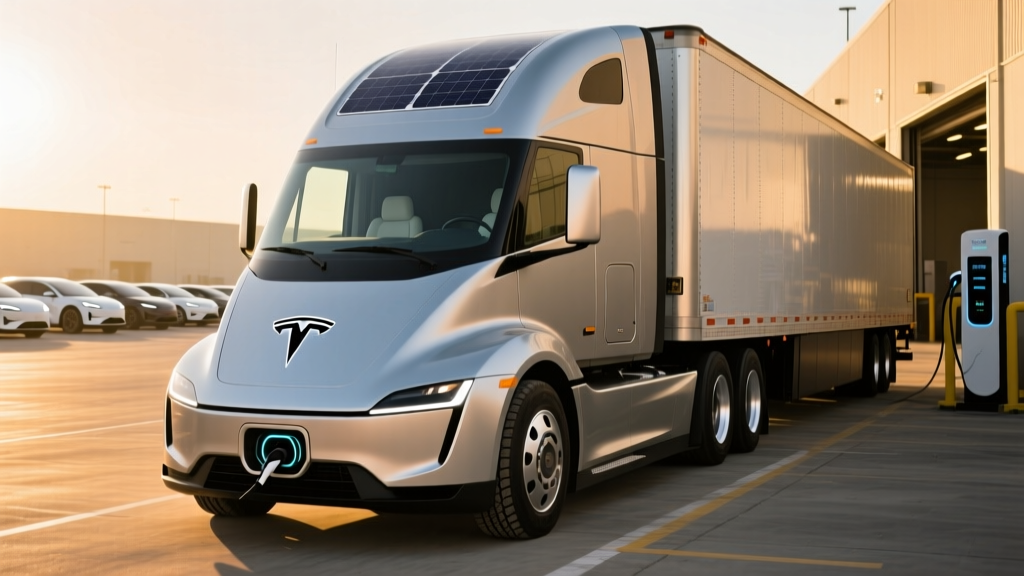
The Tesla Semi isn't a consumer vehicle — it's a Class 8 electric semi-truck built for regional and long-haul freight. Since PepsiCo took delivery of the first production units in late 2022 and Tesla ramped its Nevada Semi factory through 2024-2025, fleet operators have scrutinized one question above all: how does Tesla Semi weight affect real-world payload and range?
This review breaks down the Semi's curb weight, battery chemistry, charging infrastructure demands, and total cost of ownership using data from Tesla's spec sheets, EPA filings, and early fleet operator reports. Whether you're a fleet manager evaluating electrification or an industry analyst tracking commercial EV adoption, here's what the numbers actually show.
| Spec | 300-Mile Variant | 500-Mile Variant |
|---|---|---|
| EPA-Est. Range (loaded) | 300 mi | 500 mi |
| Battery Capacity (est.) | ~560 kWh usable (NMC) | ~900 kWh usable (NMC) |
| Curb Weight (tractor only) | ~21,000 lbs | ~26,000 lbs |
| GVWR (Gross Vehicle Weight Rating) | 82,000 lbs (with trailer) | 82,000 lbs (with trailer) |
| Max DC Fast Charge | ~1 MW (Megacharger) | ~1 MW (Megacharger) |
| 10–80% DC Charge Time | ~35 min (est.) | ~45 min (est.) |
| 0–60 mph (loaded, 82k lbs) | ~20 sec | ~20 sec |
| 0–60 mph (unloaded) | ~5 sec | ~5 sec |
| Drivetrain | Tri-Motor AWD | Tri-Motor AWD |
| Horsepower (peak combined) | ~900+ hp (est.) | ~900+ hp (est.) |
| Efficiency (loaded) | ~1.7 kWh/mi | ~1.7 kWh/mi |
| Base MSRP | $150,000 | $180,000 |
| Reservation Fee (Founder's Series) | $250,000 (all-in) | $250,000 (all-in) |
| Battery/Powertrain Warranty | Undisclosed (est. 1M mi) | Undisclosed (est. 1M mi) |
Breaking Down Tesla Semi Weight: Curb, Payload, and the EV Penalty
The Tesla Semi weight question sits at the center of every fleet electrification conversation. Here's the physics:
- Curb weight (tractor only, 500-mi variant): ~26,000 lbs
- Curb weight (tractor only, 300-mi variant): ~21,000 lbs
- Federal bridge-law GVWR limit: 80,000 lbs (82,000 lbs with the 2,000-lb EV weight exemption under FMCSA rules)
- Available payload (500-mi): ~56,000 lbs (82,000 − 26,000)
- Available payload (300-mi): ~61,000 lbs (82,000 − 21,000)
- Diesel Class 8 tractor curb weight: ~16,000–18,000 lbs
That ~8,000–10,000 lb weight penalty compared to a diesel tractor directly reduces revenue-generating payload. For fleets hauling weight-limited freight (gravel, liquids, bulk commodities), this is a dealbreaker. For fleets hauling volume-limited freight (snack foods, consumer packaged goods — think PepsiCo, the launch customer), the Semi's payload remains sufficient because trailers cube out before they weigh out.
Tesla partially offsets the battery weight with a lighter chassis architecture, carbon-fiber cab components, and the elimination of a heavy diesel engine, transmission, and exhaust aftertreatment system. The tri-motor setup is also lighter than a conventional diesel drivetrain of equivalent output.
Real-World Range vs. EPA: What Loaded Tesla Semi Drivers Actually See
EPA-Estimated Range: 500 miles (500-mi variant) / 300 miles (300-mi variant), measured at full 82,000-lb GCW.
Real-World Expectation: Early fleet data from PepsiCo and other operators suggests 420–470 miles on highway-dominant routes at full load in mild weather. In cold weather (below 32°F), expect a 15–25% reduction — roughly 375–400 miles from the 500-mi variant. Mountain grades and stop-and-go urban delivery routes further compress range through higher rolling resistance and aero drag at speed.
Tesla's stated 1.7 kWh/mile efficiency at full load is remarkably competitive. A diesel Class 8 achieves roughly 6.5 mpg, equating to ~1.9–2.1 kWh/mile in energy-equivalent terms. The Semi's tri-motor regenerative braking recovers significant energy on downhill grades and deceleration — routes with elevation changes can see efficiency improvements over flat highway runs.
Tesla's 2017 claim of "500 miles at 80,000 lbs" was validated by a November 2022 test run where a Semi drove from Fremont to San Diego (~500 miles) at gross weight without charging, though conditions were favorable (mild weather, moderate speeds).
Charging Speed: Megacharger Infrastructure and the 1 MW Reality
| Charging Level | Power | Miles Added/Hour | Notes |
|---|---|---|---|
| Level 2 (J1772/CCS adapter) | ~40–80 kW | ~25–50 mi/hr | Overnight depot top-up only |
| Tesla Megacharger (DC) | Up to ~1 MW (1,000 kW) | ~500+ mi/hr peak | Proprietary connector; depot install required |
| CCS2/MCS (future) | Up to ~750 kW | ~400 mi/hr peak | Industry Megawatt Charging Standard adoption pending |
The Semi's 1 MW peak charge rate is its most infrastructure-dependent specification. For context, a Tesla V4 Supercharger delivers up to 350 kW to passenger vehicles — the Semi needs roughly 3x that power. Tesla's Megacharger units are depot-installed, requiring significant electrical infrastructure: 480V three-phase service, dedicated transformers, and potentially utility upgrades costing $100,000–$500,000+ per site depending on existing grid capacity.
Charge curve reality: The Semi likely sustains peak ~1 MW from 10–40% State of Charge before tapering. A 10–80% charge in ~45 minutes for the 900 kWh pack requires sustained average power of ~700+ kW — achievable but dependent on thermal management and grid conditions. Fleet operators should plan for 60-minute charge windows to account for taper and preconditioning variability.
Level 2 charging is a supplementary option for overnight depot top-ups (~100–200 miles of range over 8–10 hours), but no fleet will rely on it as primary fueling. Public CCS infrastructure for Class 8 vehicles remains sparse as of 2025, though the National Renewable Energy Laboratory (NREL) tracks growing MCS (Megawatt Charging System) deployments along freight corridors.
Performance and Drivetrain: Tri-Motor Torque Meets 82,000 lbs
The Semi uses a tri-motor all-wheel-drive configuration — one motor on the steer axle and two on the drive axles. Tesla claims a 0–60 mph time of ~20 seconds at full 82,000-lb gross weight, compared to ~45–60 seconds for a loaded diesel Class 8. Unloaded, the Semi hits 60 mph in approximately 5 seconds — supercar territory in a tractor.
Peak combined output is estimated at 900+ horsepower across all three motors. More importantly for freight, the instant torque delivery (no turbo spool-up, no gear shifts) means the Semi maintains speed on 6–8% highway grades where diesel trucks drop to 35–40 mph. This is a measurable revenue advantage: faster average speeds on hilly routes translate to more deliveries per shift.
Regenerative braking is aggressive enough to enable near-one-pedal driving in many scenarios, reducing brake wear — a significant maintenance savings over diesel. Tesla's semi-truck also eliminates engine oil changes, diesel particulate filter (DPF) regenerations, DEF fluid, and transmission servicing. Fleet maintenance cost reductions of 30–50% versus diesel are widely reported by early adopters.
Pricing, Tax Credits, and Fleet TCO: Does the Math Work?
| Item | 300-Mile Variant | 500-Mile Variant |
|---|---|---|
| Base MSRP | $150,000 | $180,000 |
| Founder's Series (early production) | $250,000 | $250,000 |
| Federal Commercial Clean Vehicle Credit (§45W) | Up to $40,000 | Up to $40,000 |
| Estimated Post-Credit Price | ~$110,000–$210,000 | ~$140,000–$210,000 |
| Estimated Diesel Class 8 Tractor Price | $120,000–$180,000 | |
Tax credit clarification: The Tesla Semi does not qualify for the consumer §30D Clean Vehicle Credit (which has MSRP caps of $80,000 for trucks and buyer income limits). Instead, it qualifies for the §45W Commercial Clean Vehicle Credit, which provides up to $40,000 for qualifying commercial vehicles over 14,000 lbs GVWR. Per IRS guidelines, the credit equals 30% of the vehicle's incremental cost over a comparable diesel, capped at $40,000. Eligibility depends on battery sourcing and domestic content requirements that continue to tighten through 2026.
Total cost of ownership (TCO) — 5-year/500,000-mile projection:
- Energy cost: At $0.12/kWh (commercial depot rate) and 1.7 kWh/mi, the Semi costs ~$0.20/mile in electricity. Diesel at $4.20/gal and 6.5 mpg costs ~$0.65/mile. Savings: ~$0.45/mile × 500,000 mi = $225,000 in fuel savings.
- Maintenance savings: Estimated $0.08–$0.12/mi less than diesel = $40,000–$60,000 saved.
- Infrastructure cost: Megacharger installation ($150,000–$400,000 per depot) partially offsets savings.
- Net 5-year TCO advantage: The Semi can break even or save $100,000–$200,000+ per truck versus diesel, depending on route profile, electricity rates, and utilization.
Tech, Cab Design, and Driver Experience
The Semi's cab is unlike any conventional Class 8. The driver sits centerline (like a McLaren F1), flanked by two large touchscreen displays running Tesla's commercial fleet software. Key features include:
- Enhanced Autopilot (Level 2): Adaptive cruise, lane-keeping, automatic emergency braking. The driver must remain fully engaged — this is not autonomous driving.
- Jackknife prevention: Individual motor torque vectoring detects and corrects trailer swing before it becomes unrecoverable — a significant safety advantage over diesel.
- Fleet management integration: Real-time telemetry, route optimization, energy consumption tracking, and remote diagnostics via Tesla's fleet portal.
- Regenerative braking profiles: Configurable regen levels for different freight types (liquid tankers need gentler regen to avoid slosh).
- Standing headroom and sleeper option: The cab is taller than most Class 8 day cabs, with a sleeper berth variant expected for longer-haul routes.
Notable drawbacks: No conventional side mirrors (camera-based system requires NHTSA exemption, still pending as of early 2025). Limited service center network for Class 8 vehicles compared to Freightliner, Volvo, or Peterbilt dealer footprints. Body shop repair expertise for Tesla's unibody-ish cab structure is scarce.
Who Should Buy the Tesla Semi (and Who Shouldn't)
Pros
- Lowest per-mile energy cost in Class 8 (~$0.20/mi vs $0.65/mi diesel)
- Dramatically reduced maintenance (no engine, transmission, DPF, DEF)
- Superior grade-climbing performance vs. diesel at gross weight
- Jackknife prevention and advanced Level 2 driver assist
- Zero tailpipe emissions — meets CARB and EPA clean-air mandates
- Up to $40,000 §45W federal tax credit + state incentives (e.g., CARB HVIP in California)
Cons
- ~8,000–10,000 lb payload penalty vs. diesel (hurts weight-limited freight)
- $150K–$250K upfront cost; depot charging infrastructure is $150K–$400K+
- 500-mi range limits long-haul; best for regional routes under 400 mi/day
- Cold-weather range loss of 15–25% compresses usable range further
- Limited service network vs. legacy OEM dealerships
- Megacharger infrastructure requires utility coordination and long lead times
The Tesla Semi is best for: Fleet operators running regional, predictable routes under 400 miles per day with volume-limited (not weight-limited) freight. Companies with depot-based operations where overnight charging and daytime top-ups are feasible. Businesses under regulatory pressure to electrify (California's Advanced Clean Fleets rule, corporate ESG mandates).
The Tesla Semi is not for: Long-haul irregular-route operators (500+ mi/day), weight-limited bulk freight haulers, or fleets without access to depot charging infrastructure or the capital to build it.
Tesla Semi vs. Competitors: Freightliner eCascadia, Volvo VNR Electric
| Spec | Tesla Semi (500 mi) | Freightliner eCascadia | Volvo VNR Electric |
|---|---|---|---|
| EPA Range | 500 mi | ~230 mi | ~275 mi |
| Battery (usable) | ~900 kWh (NMC) | ~291 kWh (NMC) | ~375 kWh (NMC) |
| Peak DC Charge | ~1 MW | ~250 kW | ~250 kW |
| 10–80% Time | ~45 min | ~90 min | ~90 min |
| Curb Weight (tractor) | ~26,000 lbs | ~22,000 lbs | ~23,000 lbs |
| Base Price (est.) | $180,000 | $250,000+ | $250,000+ |
| Dealer/Service Network | Limited | Extensive | Extensive |
The Semi's range and charging speed advantages are massive on paper. But Freightliner and Volvo have decades of dealer relationships, parts availability, and fleet trust that Tesla is building from scratch. For a 500-truck fleet, uptime and service accessibility may matter more than spec-sheet superiority.
Frequently Asked Questions
What is the real-world range of the Tesla Semi?
The 500-mile variant delivers approximately 420–470 miles at full 82,000-lb gross weight on highway routes in mild weather. Cold weather (below 32°F) reduces this to roughly 375–400 miles. The 300-mile variant sees roughly 250–275 miles real-world in similar conditions.
How fast does the Tesla Semi charge?
At a Tesla Megacharger (~1 MW peak), the 500-mile variant charges from 10–80% in approximately 45 minutes. Level 2 depot charging at 40–80 kW adds 25–50 miles per hour — suitable for overnight top-ups only. Public DC fast-charging for Class 8 vehicles remains extremely limited.
Does the Tesla Semi qualify for the federal EV tax credit?
Not the consumer §30D credit. The Semi qualifies for the §45W Commercial Clean Vehicle Credit, which provides up to $40,000 for qualifying heavy-duty commercial EVs. Eligibility depends on battery component sourcing and critical mineral requirements per current IRS rules. Consult a tax professional for your fleet's specific eligibility.
How does Tesla Semi weight compare to a diesel truck?
The 500-mile Semi weighs approximately 26,000 lbs (tractor only) versus 16,000–18,000 lbs for a diesel Class 8 tractor. The ~8,000–10,000 lb difference reduces available payload under the 82,000-lb federal GVWR limit, which impacts weight-limited freight operations but not volume-limited routes.
Is the Tesla Semi worth buying vs. diesel or competitors?
For regional fleets running under 400 miles/day with depot charging, the Semi's $0.20/mi energy cost vs. $0.65/mi diesel and dramatically lower maintenance can deliver $100K–$200K+ in 5-year savings per truck. For long-haul or weight-limited freight, diesel or shorter-range competitors with better dealer networks may still be more practical. The decision hinges on route profile, freight type, and charging infrastructure feasibility.
What is the Tesla Semi's battery warranty?
Tesla has not published final warranty terms as of early 2025. Elon Musk has publicly stated the battery and drivetrain are designed for a 1-million-mile service life. Industry expectations are a warranty of 8 years or 500,000–1,000,000 miles with a capacity retention threshold of ~70%. Confirm final terms with Tesla before purchase.