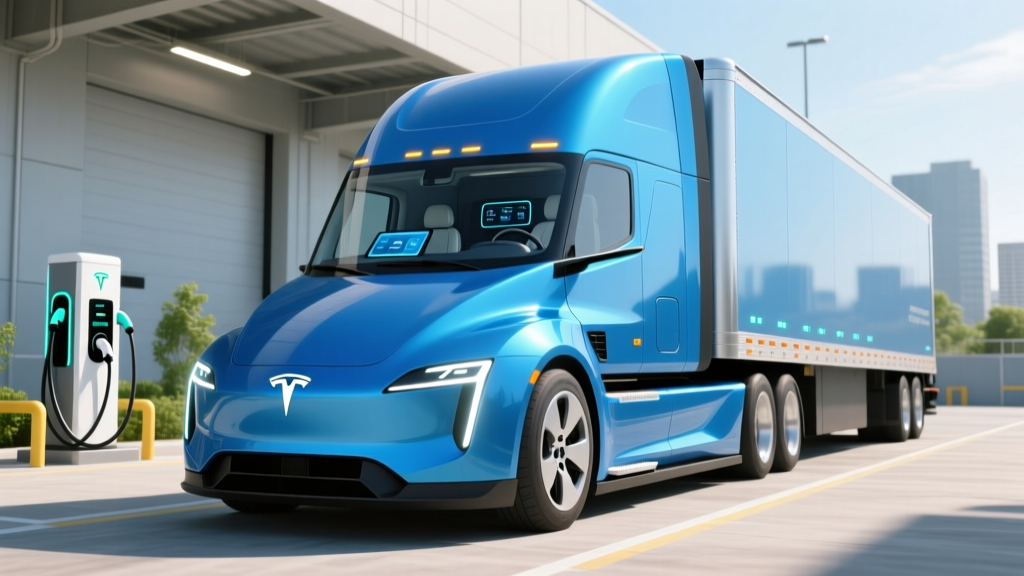
The Tesla Semi has been the most anticipated — and most delayed — electric commercial vehicle of the decade. First unveiled in 2017 with a 2019 production target, it finally entered limited customer deliveries in late 2022 before a prolonged ramp-up period. As of 2026, Tesla Semi volume production is scaling at the company's dedicated Semi factory adjacent to Giga Nevada in Sparks, with deliveries broadening beyond early adopters like PepsiCo and DHL to mid-size and regional fleets.
This review covers everything fleet managers and commercial buyers need to know: real-world range under load, Megacharger infrastructure realities, total cost of ownership, and how the Semi stacks up against the Freightliner eCascadia and Volvo VNR Electric.
Tesla Semi: Full Spec Overview
| Specification | 300-Mile Variant | 500-Mile Variant |
|---|---|---|
| EPA Estimated Range (loaded, 80,000 lb GCW) | 300 mi | 500 mi |
| Battery Capacity (usable, est.) | ~560 kWh (NMC) | ~900 kWh (NMC) |
| Drivetrain | Tri-motor AWD (1 steer, 2 drive axles) | |
| Peak Horsepower (combined) | ~1,000+ hp (est.) | |
| 0-60 mph (loaded, 80,000 lb) | ~20 seconds | |
| 0-60 mph (unloaded) | ~5 seconds (claimed) | |
| Max Grade (loaded, 65 mph) | 6% | |
| Max DC Fast Charge Rate | ~1.0 MW (Megacharger) | |
| 10-80% Charge Time (est.) | ~30 minutes (1 MW peak) | |
| Energy Efficiency (loaded) | ~1.7 kWh/mi (EPA est.) | |
| Base MSRP | $250,000 | $290,000 |
| Battery/Powertrain Warranty | TBD (est. 8 yr / 1,000,000 mi based on early fleet agreements) | |
Note: Tesla has not published a full EPA certification label for the Semi as of early 2026. Range and efficiency figures are based on manufacturer claims and third-party fleet testing data. Battery chemistry is confirmed NMC (nickel manganese cobalt) based on energy-density requirements for the 500-mile pack.
Real-World Range: What Fleets Actually See
EPA vs. Reality
EPA Estimated Range (500-mi variant): 500 miles at 80,000 lb GCW
Real-World Expectation: 380–440 mi on mixed highway routes; 300–360 mi in cold weather (<32°F) or sustained mountain grades. PepsiCo's early fleet data from Northern California routes showed ~400 mi average on 450-mi rated trucks under typical regional-haul conditions.
Key Variables: Payload weight (range drops ~8-12% at max 80,000 lb vs. partial loads), ambient temperature (LFP/NMC packs lose 15-25% range below freezing without preconditioning), terrain (regenerative braking recovers significant energy on downhill segments but sustained climbs are costly).
For regional-haul fleets running 250-350 mile daily loops with depot charging, both the 300- and 500-mile variants provide a comfortable buffer. Long-haul operators running 500+ mile routes will need to plan en-route Megacharger stops — and that's where infrastructure becomes the bottleneck.
Charging: Megacharger Speed and Depot Reality
The Tesla Semi uses the company's proprietary Megacharger standard, delivering up to approximately 1.0 MW (1,000 kW) of DC fast-charging power — roughly three to four times the peak rate of a Tesla Supercharger V4. This is necessary because a ~900 kWh battery at conventional 250 kW rates would take over 3 hours to fill.
| Charging Level | Power (kW) | Miles Added per Hour | Notes |
|---|---|---|---|
| Megacharger (DC) | ~1,000 kW peak | ~550-600 mi/hr (peak) | 10-80% in ~30 min; tapers above 80% |
| CCS2/MCS Adapter (DC) | ~350-500 kW (est.) | ~200-280 mi/hr | Requires adapter; limited public availability |
| Depot Level 2 (AC) | ~40-80 kW (est.) | ~25-45 mi/hr | Overnight top-up; 10+ hr for full charge |
Charging-curve reality: Like all large lithium-ion packs, the Semi won't sustain 1 MW from 10% to 80%. Peak rates hold roughly between 10-50% State of Charge (SoC), then taper progressively. Tesla's "30-minute 10-80%" claim assumes optimal battery preconditioning — the truck's thermal management system warms the pack en-route when a Megacharger is set as the navigation destination. Without preconditioning, cold-soak charging can add 10-15 minutes.
Depot charging is the primary use case. Most Semi operators will install depot-level AC or lower-power DC infrastructure (50-150 kW per stall) for overnight charging. A full 900 kWh overnight charge at 80 kW takes roughly 11 hours — workable for day-cab trucks parked from 7 PM to 5 AM. Megachargers are positioned along freight corridors for mid-shift top-ups.
Performance and Drivetrain
The Semi's tri-motor architecture — one motor on the steer axle and two on the drive axles — provides all-wheel-drive traction that outperforms conventional diesel Class 8 trucks in low-grip conditions. Tesla claims a loaded 0-60 mph time of approximately 20 seconds at 80,000 lb GCW, which is roughly half the time of a comparable diesel (typically 40-50 seconds). Unloaded, the truck hits 60 mph in an estimated 5 seconds.
The more operationally significant figure is grade-holding capability: Tesla rates the Semi at maintaining 65 mph up a 6% grade at full load, where diesel Class 8 trucks often drop to 35-45 mph on the same incline. This matters for routes through the Grapevine (I-5 in California), Donner Pass, or the Pennsylvania Turnpike — it reduces the speed-differential risk that causes highway accidents.
Regenerative braking is aggressive enough that Tesla claims the Semi can descend long grades without using friction brakes, reducing brake wear — a meaningful maintenance cost saving for mountainous routes.
Pricing, Tax Credits, and Total Cost of Ownership
| Item | 300-Mile Variant | 500-Mile Variant |
|---|---|---|
| Base MSRP | $250,000 | $290,000 |
| As-Tested / Fleet Config (est.) | $265,000–$280,000 | $305,000–$325,000 |
| Federal Commercial Clean Vehicle Credit (§45W) | Up to $40,000 | Up to $40,000 |
| Estimated Net Cost After Federal Credit | ~$210,000–$240,000 | ~$250,000–$285,000 |
Tax credit clarification: The Tesla Semi, as a Class 8 commercial vehicle with a GVWR above 14,000 lb, does not qualify for the consumer §30D Clean Vehicle Credit (which is capped at vehicles under 14,000 lb GVWR). Instead, fleet buyers should evaluate the §45W Commercial Clean Vehicle Credit, which provides up to $40,000 for qualifying heavy-duty electric trucks. Eligibility depends on battery sourcing, domestic content requirements, and the fleet's tax liability. Consult a tax professional and review current IRS §45W guidance before purchasing.
State and utility incentives can stack significantly: California's Hybrid and Zero-Emission Truck and Bus Voucher Incentive Project (HVIP) has offered up to $120,000 per Class 8 BEV in past funding rounds, and utilities like PG&E and SCE offer depot-charging infrastructure rebates. These vary by jurisdiction and funding cycle — check HVIP and your local utility for current availability.
5-Year Total Cost of Ownership vs. Diesel
Tesla's long-standing claim is that the Semi achieves diesel-parity TCO within two years. Independent fleet analyses suggest the breakeven point depends heavily on route profile and electricity cost:
- Fuel/Energy: At $0.12/kWh (depot rate) and 1.7 kWh/mi, the Semi costs ~$0.20/mi in energy. A diesel at 6.5 mpg and $4.20/gal costs ~$0.65/mi. On a 300 mi/day route (250 days/yr), that's a $33,750 annual energy savings.
- Maintenance: No oil changes, no DPF/Emissions systems, reduced brake wear from regen. Estimated savings: $8,000–$12,000/year vs. diesel.
- Insurance: Currently higher for BEV Class 8 trucks due to limited claims data and higher repair costs — budget a 10-20% premium increase.
- Depreciation: Uncertain. No established resale market for used electric Semis yet. Early adopters should plan for aggressive depreciation assumptions.
Key Competitors: Semi vs. eCascadia vs. VNR Electric
| Spec | Tesla Semi (500 mi) | Freightliner eCascadia | Volvo VNR Electric |
|---|---|---|---|
| EPA Range (loaded) | 500 mi | 230 mi | 275 mi |
| Battery (usable, est.) | ~900 kWh (NMC) | ~438 kWh (NMC) | ~565 kWh (NMC) |
| Max DC Charge Rate | ~1,000 kW | ~250 kW | ~250 kW |
| 10-80% Charge Time | ~30 min | ~90 min | ~90 min |
| 0-60 mph (loaded) | ~20 sec | ~30 sec | ~28 sec |
| Base MSRP (est.) | $290,000 | $275,000 | $280,000 |
| Dealer/Service Network | Limited (direct) | Extensive (Daimler) | Extensive (Volvo) |
The Semi's range and charging speed advantages are substantial on paper. The eCascadia and VNR Electric counter with established dealer networks, decades of fleet-service infrastructure, and proven uptime records. For fleets that can't afford a single missed delivery, the legacy OEM service footprint matters.
Tech, Driver Assistance, and Cabin
The Semi's cabin is centered around two large touchscreen displays flanking a yoke-style steering wheel — one for vehicle telemetry and navigation, one for media and fleet-management integration. The center-mounted driver seat (a signature design choice) provides excellent forward visibility but takes adjustment for drivers accustomed to left-hand seating.
Driver assistance: The Semi ships with Tesla's Enhanced Autopilot adapted for commercial use — adaptive cruise, lane-keeping, and automatic emergency braking calibrated for 80,000 lb GCW dynamics. This is an SAE Level 2 system: the driver must remain fully engaged and responsible at all times. It is not self-driving.
⚠ Autopilot Limitations (Commercial)
Tesla's Autopilot on the Semi is a Level 2 driver-assist system. It does NOT autonomously navigate freight routes, handle dock approaches, or manage in-yard maneuvers. The driver must maintain hands on the yoke and eyes on the road. Tesla has not announced a Full Self-Driving timeline for the Semi platform. Fleet safety policies should treat Autopilot as a fatigue-reduction aid, not a driver replacement.
Notable features: Jackknife prevention (independent torque vectoring on drive axles detects and corrects trailer swing), over-the-air software updates, integrated fleet telematics API, and a low center of gravity from the under-floor battery pack that Tesla claims reduces rollover risk vs. diesel counterparts.
Drawbacks: The center-seat layout is polarizing and may not suit all drivers. The lack of a sleeper cab limits the Semi to day-cab/regional-haul duty. Public Megacharger infrastructure remains sparse — Tesla had approximately 15 Megacharger stations operational in the western U.S. as of early 2026, concentrated along I-5 and I-10 corridors.
Who Should Buy the Tesla Semi?
Buy the Tesla Semi If:
- Your fleet runs predictable regional-haul routes of 250-400 miles with depot return
- You operate in states with strong BEV truck incentives (CA, NY, NJ, WA)
- You can invest in depot charging infrastructure (plan $50,000-$150,000+ per stall for high-power DC)
- Performance and grade-holding on mountainous routes are operational priorities
- You're an early-adopter fleet willing to work with Tesla on data-sharing and route optimization
Consider the eCascadia or VNR Electric If:
- You need established dealer service and 24/7 roadside support across all 48 states
- Your routes are shorter (150-250 mi) where the Semi's range premium isn't necessary
- You want to spec a sleeper cab for team driving or multi-day routes
- Your fleet is risk-averse on depreciation and resale value
Pros and Cons
✅ Pros
- Class-leading 500-mile EPA range (loaded)
- ~1 MW Megacharger speed — 10-80% in ~30 min
- Superior grade-holding (65 mph at 6% grade, loaded)
- Tri-motor AWD with jackknife prevention
- Significantly lower per-mile energy cost vs. diesel (~$0.20 vs ~$0.65)
- Reduced brake and drivetrain maintenance
- OTA updates and integrated fleet telematics
❌ Cons
- Volume production still ramping — long lead times for new orders
- Megacharger public network is sparse (mostly western U.S.)
- No sleeper cab option — day-cab only
- Center-seat layout requires driver adaptation
- Service network limited vs. Freightliner/Volvo
- Depot high-power charging requires major electrical infrastructure investment
- Resale value and long-term battery degradation data still limited
Frequently Asked Questions
What is the real-world range of the Tesla Semi?
The 500-mile variant delivers approximately 380-440 miles under typical regional-haul conditions at or near 80,000 lb GCW, based on early fleet data from PepsiCo and other operators. Cold weather (below 32°F) can reduce range by 15-25%, bringing realistic winter range to 300-360 miles. The 300-mile variant yields approximately 230-270 real-world miles loaded.
How fast does the Tesla Semi charge?
At a Tesla Megacharger (up to ~1 MW / 1,000 kW), the Semi charges from 10-80% in approximately 30 minutes with proper battery preconditioning. Depot-level AC charging at 80 kW takes roughly 11 hours for a full 900 kWh charge — suitable for overnight turnaround. Note that kW (kilowatts) measures charge power, while kWh (kilowatt-hours) measures battery capacity — they are not interchangeable.
How much does the Tesla Semi cost after incentives?
The 500-mile variant lists at $290,000 MSRP. With the federal §45W Commercial Clean Vehicle Credit (up to $40,000) and potential state incentives like California HVIP (up to $120,000), effective cost can drop to $130,000-$250,000 depending on jurisdiction and fleet tax situation. The §30D consumer credit does NOT apply to the Semi — it exceeds the 14,000 lb GVWR cap. Always verify current incentive availability with the IRS and state agencies.
Does the Tesla Semi qualify for the federal EV tax credit?
Not the consumer §30D credit, which is limited to vehicles under 14,000 lb GVWR. The Semi qualifies for the §45W Commercial Clean Vehicle Credit, which offers up to $40,000 for qualifying heavy-duty electric trucks. Eligibility depends on battery component sourcing, domestic content, the purchasing entity's tax liability, and current IRS rules — consult a tax professional.
Is the Tesla Semi worth buying vs. diesel and competitors?
For regional-haul fleets with depot charging access and favorable incentive environments, the Semi's energy and maintenance savings can deliver TCO parity with diesel within 2-4 years. Its range and charging speed significantly exceed the Freightliner eCascadia and Volvo VNR Electric. However, the legacy OEMs offer broader service networks, sleeper-cab options, and proven uptime. The Semi is compelling for tech-forward fleets; conservative operators may prefer the established infrastructure of Daimler or Volvo.
What is the Tesla Semi's warranty?
Tesla has not published a standard retail warranty for the Semi as of early 2026. Early fleet purchase agreements reportedly include battery and powertrain coverage of approximately 8 years / 1,000,000 miles, which would align with industry expectations for Class 8 BEVs. Confirm warranty terms directly with Tesla's commercial sales team before ordering, as terms may vary by fleet agreement.
How does Tesla Semi volume production compare to demand?
Tesla's Semi factory near Giga Nevada is targeting an initial capacity of approximately 50,000 units per year at full ramp, though actual 2026 production volumes are expected to be significantly lower as the facility scales. Order backlogs reportedly extend 12-18 months for new fleet orders. Tesla has indicated that Megacharger corridor expansion is proceeding in parallel, with planned stations along I-80, I-40, and I-10 freight corridors through 2027.
Sources: Tesla commercial specifications (tesla.com/semi), IRS Commercial Clean Vehicle Credit, NHTSA vehicle safety data, fleet operator disclosures (PepsiCo Frito-Lay earnings reports). Range and efficiency figures should be verified against the latest EPA certification data at fueleconomy.gov as formal Class 8 BEV listings become available.