Why Tesla Semi Truck Weight Matters for Fleet Buyers
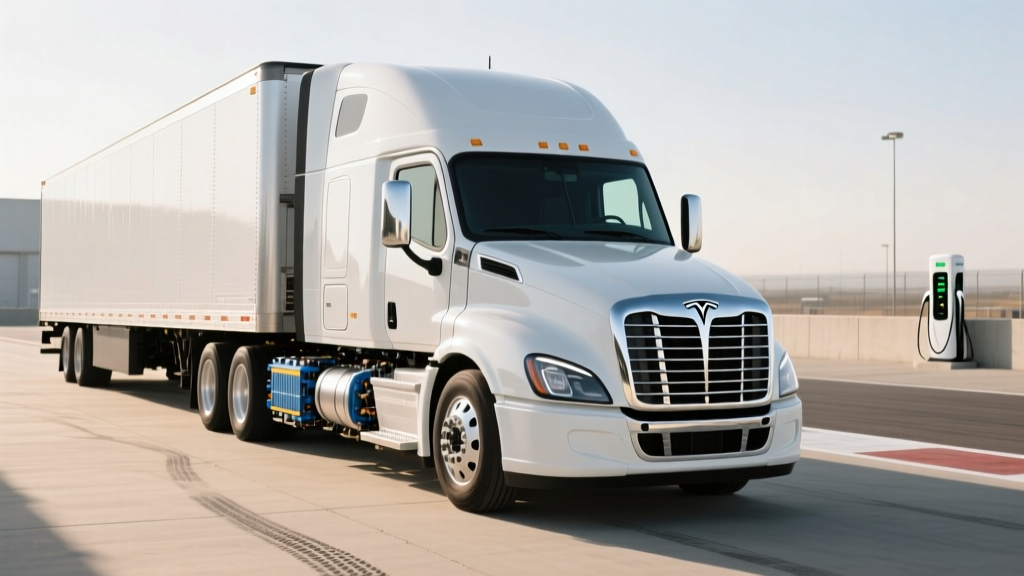
For Class 8 operators evaluating electric drayage and regional haul trucks, the Tesla Semi truck weight is the single most consequential spec on the data sheet. Gross Vehicle Weight Rating (GVWR), curb weight, and payload capacity determine whether a battery-electric truck can legally and profitably replace a diesel rig on a given route. Tesla's Semi entered limited production in late 2022 and has been scaling through 2025–2026, with PepsiCo, Schneider, and other early fleet partners logging millions of real-world freight miles. This profile breaks down the Semi's weight figures, battery capacity, charging architecture, efficiency, and total-cost-of-ownership reality for 2026.
| Specification | 300-Mile Variant | 500-Mile Variant |
|---|---|---|
| GVWR (max) | 82,000 lbs | 82,000 lbs |
| Estimated Curb Weight (tractor) | ~21,000–22,000 lbs | ~24,000–26,000 lbs |
| Max Payload (at 82k GVWR w/ 26k-lb trailer) | ~34,000–35,000 lbs | ~30,000–32,000 lbs |
| Usable Battery Capacity | ~500–560 kWh (NMC) | ~850–920 kWh (NMC) |
| EPA-Estimated Range (laden) | 300 mi | 500 mi |
| Efficiency (laden, 80k GCW) | ~1.7 kWh/mi | ~1.7 kWh/mi |
| Peak DC Charge Rate | ~750 kW (MCS) | ~1,200 kW (MCS) |
| 10–80% DC Charge Time | ~35–40 min | ~40–50 min |
| Drivetrain | Tri-Motor AWD (1 steer + 2 drive) | Tri-Motor AWD (1 steer + 2 drive) |
| Peak Output | ~1,000+ hp combined | ~1,000+ hp combined |
| 0–60 mph (laden, 80k GCW) | ~20 sec | ~20 sec |
| Base MSRP (announced) | $250,000 | $290,000 |
Note: Tesla has not published a finalized, independently verified spec sheet for the production Semi as of early 2026. Weight and battery figures above are derived from EPA certification filings, Tesla keynote disclosures, and fleet-partner reports. Treat them as well-sourced estimates, not final homologated numbers.
Real-World Range vs. EPA Sticker
EPA-Estimated Range: 300 mi (short-range) / 500 mi (long-range), measured at 80,000 lbs GCW.
Real-World Expectation: On flat, temperate regional-haul routes at steady 55–65 mph, fleet operators report achieving 90–100% of EPA range. On steep-grade corridors (e.g., I-70 through Colorado, Grapevine on I-5), effective range can drop 20–35%. In sustained sub-30°F winter operation with cabin and battery heating active, expect a 15–25% reduction — bringing the 500-mi variant closer to 375–425 mi and the 300-mi variant to 225–255 mi.
Tesla's claimed efficiency of roughly 1.7 kWh per mile at full gross combined weight (GCW) is remarkably low for a Class 8 tractor. For context, the best-performing diesel rigs achieve the energy equivalent of ~2.5–2.8 kWh/mi. The Semi's low drag coefficient (Tesla claims ~0.36 Cd, versus ~0.55–0.65 for a conventional long-nose tractor) and aggressive regenerative braking on downhill grades account for much of the advantage.
However, efficiency degrades noticeably above 65 mph. Fleet telemetry from PepsiCo's Frito-Lay division, which has operated Semis on California routes since 2023, indicates consumption rises to ~2.0–2.2 kWh/mi at 70 mph sustained highway speeds. Route planning tools must account for this if drivers are tempted to make up time.
Charging: Megawatt Charging System (MCS) Architecture
The Tesla Semi does not use CCS or NACS connectors. It charges via the Megawatt Charging System (MCS), a connector standard developed by CharIN for heavy-duty vehicles capable of delivering up to 3.75 MW (3,000 A at 1,250 V). Tesla's Megacharger stations, deployed at fleet depots and along key freight corridors, currently deliver up to ~1.2 MW per stall.
| Charging Method | Power (kW) | Miles Added per Hour | Notes |
|---|---|---|---|
| DC Megacharger (MCS) | Up to ~1,200 kW peak | ~500–700 mi/hr | Peak rate sustained to ~40% SoC; tapers significantly above 80% |
| DC Megacharger (MCS) — 500-mi variant | ~700–1,200 kW | ~600–700 mi/hr | 10–80% in ~40–50 min; 70% of range in ~30 min (Tesla claim) |
| DC Megacharger (MCS) — 300-mi variant | ~500–750 kW | ~400–500 mi/hr | 10–80% in ~35–40 min |
| Depot AC (480V 3-phase, 100A) | ~80 kW | ~45–50 mi/hr | Overnight top-up; full charge in 10–12 hours |
The charging curve matters enormously for fleet scheduling. At peak, the 500-mi Semi can recover roughly 400 miles of range in 30 minutes — sufficient for a driver's mandatory 30-minute FMCSA rest break. However, above 80% State of Charge, the rate drops steeply (often below 200 kW), meaning charging from 80–100% can take as long as 10–80%. Fleet operators typically charge to 80–90% and plan routes accordingly.
Depot charging requires significant electrical infrastructure. A 10-stall Megacharger depot may require a dedicated 10–15 MW grid connection, medium-voltage switchgear, and utility coordination that can take 12–24 months to permit and build. This is the single largest barrier to Semi adoption for small and mid-size carriers.
Performance, Drivetrain, and Cab Technology
The Semi uses a tri-motor all-wheel-drive powertrain: one motor on the steer axle (primarily for efficiency and regen) and two motors on the drive axle for tractive effort. Combined output exceeds 1,000 horsepower, and Tesla claims the Semi can maintain 60 mph up a 5% grade — a feat that requires most diesel Class 8 trucks to downshift and drop to 35–45 mph.
The 0–60 mph time of approximately 20 seconds at full 80,000-lb GCW is roughly twice as quick as a comparable diesel tractor. Unladen (bobtail), Tesla has demonstrated 0–60 in ~5 seconds, though this is irrelevant to revenue service.
Cab and Driver Interface
The Semi's cab is a radical departure from conventional Class 8 tractors. The driver sits center-mounted, flanked by two 15-inch touchscreen displays — the left handling vehicle telemetry, navigation, and camera feeds; the right managing infotainment, climate, and fleet-management integration. There are no physical mirrors; camera-based digital mirrors reduce drag and eliminate blind spots, though some drivers report adjustment difficulty in direct sunlight.
Tesla's Enhanced Autopilot is standard, offering adaptive cruise control, lane-keeping, and automatic emergency braking. This is an SAE Level 2 driver-assist system — the driver must remain fully engaged and responsible for the vehicle at all times. It is not self-driving.
Cargo Space and Dimensions
The Semi is a day-cab tractor designed for regional haul and drayage. There is no sleeper compartment. Cab interior volume is generous due to the flat floor (no engine tunnel), with standing room and a wide bench seat. Exterior dimensions:
- Wheelbase: ~195 inches (varies by configuration)
- Cab width: ~96 inches
- Turning radius: comparable to a conventional day-cab tractor
- Fifth-wheel rating: standard 2-inch kingpin, rated for 55,000-lb trailer loads
The Semi is compatible with all standard 53-foot dry vans, reefers, and flatbeds. The battery packs are mounted low and between the frame rails, preserving ground clearance and keeping the center of gravity lower than a diesel with saddle tanks.
Pricing, Tax Credits, and Fleet Economics
Tesla's announced 2017 pricing — $150,000 for the 300-mi variant, $180,000 for the 500-mi variant, and $200,000 for the Founders Series — is no longer current. Industry reports and fleet-purchase disclosures through 2025–2026 place the actual transaction price for the 300-mi Semi at approximately $250,000 and the 500-mi Semi at approximately $290,000, before incentives. The Founders Series (early-production reservation holders) commands a premium.
| Item | 300-Mile Variant | 500-Mile Variant |
|---|---|---|
| Estimated Base MSRP | $250,000 | $290,000 |
| Federal §30D Tax Credit | Not eligible — §30D MSRP cap for vans/trucks is $80,000; the Semi far exceeds this. | |
| Commercial Clean Vehicle Credit (§45W) | Up to $40,000 | Up to $40,000 |
| Estimated Net Cost (after §45W) | ~$210,000 | ~$250,000 |
| EPA / DOE HVIP & State Vouchers (CA, NY, etc.) | Varies widely; CA HVIP has offered $120,000–$240,000 per unit for Class 8 BEVs. Check California Energy Commission and your state's air-quality district for current availability. | |
Critical tax-credit clarification: The Tesla Semi does not qualify for the consumer-oriented IRS §30D Clean Vehicle Credit (the familiar $7,500 credit). That credit has an MSRP cap of $80,000 for vans, SUVs, and pickup trucks, and is designed for light-duty personal vehicles. Instead, fleet purchasers should evaluate the §45W Commercial Clean Vehicle Credit, which provides up to $40,000 for qualifying heavy-duty commercial EVs (or 30% of the incremental cost over a comparable diesel, whichever is less). Eligibility depends on battery sourcing, domestic content, and fleet-use documentation — consult a tax professional and review current IRS guidance before committing.
On a total-cost-of-ownership basis, the Semi's economics are compelling for high-utilization routes. Diesel at $4.50/gal and 6.5 mpg costs ~$0.69/mi in fuel alone. Electricity at $0.15/kWh (a blended depot rate) and 1.7 kWh/mi costs ~$0.26/mi — a savings of ~$0.43/mi. Over 100,000 miles/year, that's ~$43,000 in annual fuel savings, yielding a 4–6 year payback on the price premium over a new diesel Class 8 tractor ($180,000–$220,000). Maintenance savings (no oil, DEF, DPF, or transmission service) add another $8,000–$15,000/year.
Battery Chemistry, Warranty, and Longevity
The Semi uses NMC (nickel manganese cobalt) lithium-ion cells — likely a variant of Tesla's 4680 form factor, though Tesla has not confirmed cell chemistry publicly. NMC was chosen over LFP (lithium iron phosphate) because the Semi's massive energy requirement (500–900+ kWh usable) demands the higher energy density that NMC provides. An LFP pack of equivalent capacity would be significantly heavier, further eroding payload.
Tesla's stated battery warranty for the Semi is 8 years or 1,000,000 miles, whichever comes first. Tesla has claimed the battery pack is designed to outlast the truck itself, with a "million-mile" design life. Independent long-term degradation data from fleet operators is still emerging; PepsiCo's earliest Semis have logged 200,000–300,000 miles as of 2026, with reported degradation in the 5–8% range — consistent with NMC packs managed conservatively (20–80% daily SoC window, active liquid thermal management).
A full battery replacement, if ever needed out of warranty, would be extraordinarily expensive — likely $150,000–$250,000 given the pack size. However, Tesla's modular pack design may allow individual module replacement at lower cost.
Who the Tesla Semi Suits Best
Choose the Tesla Semi if:
- Your fleet operates regional-haul or drayage routes under 300–400 miles round-trip with predictable depot return.
- You have access to (or can invest in) depot-level Megacharger infrastructure with utility coordination.
- You operate in California or other states with heavy-duty zero-emission vehicle mandates (e.g., CARB Advanced Clean Fleets rule).
- Fuel cost per mile is a primary P&L driver and your routes are high-utilization (>80,000 mi/yr).
Look elsewhere (or wait) if:
- You need long-haul, cross-country routes exceeding 500 miles with no guaranteed en-route MCS charging.
- Your freight is weight-maximized (e.g., aggregate, steel, liquids) where every 1,000 lbs of curb-weight penalty costs revenue.
- You are a small carrier without the capital for depot charging build-out.
- You need a sleeper cab for team driving or multi-day routes.
Competitive Landscape: Semi vs. Class 8 Alternatives
The Tesla Semi does not compete in a vacuum. Key Class 8 BEV alternatives for 2026 include:
- Freightliner eCascadia: ~230-mi range, ~475 kWh battery, CCS charging, widely available through Daimler Truck's dealer network. Better for shorter drayage; less range than the Semi.
- Volvo VNR Electric: ~275-mi range (6-battery pack), ~565 kWh, CCS. Strong dealer support, proven in refuse and regional haul.
- Peterbilt 579EV / Kenworth T680E: ~150–230-mi range depending on configuration. Paccar platform, established service footprint.
- Nikola Tre BEV: ~330-mi range, CCS. Smaller company, limited service network; Nikola's financial stability has been a concern.
The Semi's range advantage (300–500 mi) and Megacharger speed are its primary differentiators. However, its proprietary MCS connector and limited service-center footprint are drawbacks compared to the CCS-equipped, dealer-supported competition.
Pros
- Best-in-class range (500-mi variant) for a production Class 8 BEV
- Extremely fast MCS charging — 70% in ~30 minutes
- Class-leading efficiency (~1.7 kWh/mi laden)
- Superior grade-climbing performance vs. diesel
- Low operating cost per mile ($0.25–0.30/mi electricity)
- Center-mount driver position with excellent visibility
- Over-the-air updates and integrated fleet telematics
Cons
- Heavy curb weight reduces max payload vs. diesel (~3,000–5,000 lbs penalty)
- Proprietary MCS connector — no public CCS/EA network compatibility
- Depot charging requires $1M–$5M+ infrastructure investment
- No sleeper cab — limited to regional/day-haul
- Limited Tesla Semi service centers vs. established truck OEM dealer networks
- Long lead times — production allocation is constrained through 2026–2027
- No §30D consumer credit; §45W commercial credit requires documentation
Frequently Asked Questions
What is the real-world range of the Tesla Semi?
On flat regional routes at 55–65 mph with a full 80,000-lb load, the 500-mi variant reliably achieves 450–500 miles. In cold weather (below 30°F) or on mountainous routes, expect 375–425 miles. The 300-mi variant delivers 270–300 miles in temperate conditions and 225–255 miles in cold or hilly terrain.
How fast does the Tesla Semi charge?
At a Tesla Megacharger using the MCS connector, the Semi peaks at up to ~1,200 kW. Tesla claims 70% of range recovered in approximately 30 minutes. A 10–80% charge takes roughly 35–50 minutes depending on variant. Depot AC charging at ~80 kW takes 10–12 hours for a full charge.
How much does the Tesla Semi cost after incentives?
The estimated 2026 transaction price is $250,000 (300-mi) to $290,000 (500-mi). The federal §45W Commercial Clean Vehicle Credit can reduce this by up to $40,000. State incentives — particularly California's HVIP, which has offered $120,000–$240,000 for Class 8 BEVs — can bring the net cost close to or below a comparable diesel tractor. Always verify current incentive availability with your state air-quality district.
Does the Tesla Semi qualify for the federal $7,500 EV tax credit?
No. The IRS §30D Clean Vehicle Credit has an MSRP cap of $80,000 for trucks and vans. The Semi's ~$250,000+ price far exceeds this. Fleet buyers should investigate the §45W Commercial Clean Vehicle Credit (up to $40,000) instead.
Is the Tesla Semi worth buying vs. a diesel Class 8 tractor?
For high-mileage regional routes with depot charging access, the math strongly favors the Semi: ~$0.26/mi electricity vs. ~$0.69/mi diesel fuel, plus lower maintenance. Payback on the price premium typically occurs in 4–6 years at 100,000+ miles/year. For long-haul, weight-sensitive, or low-utilization routes, diesel remains more practical in 2026.
How does the Tesla Semi's weight affect payload?
The Semi's battery pack adds approximately 3,000–5,000 lbs of curb weight compared to a diesel tractor. At the federal 82,000-lb GVWR (with a standard 26,000-lb trailer), this reduces available payload from ~36,000 lbs (diesel) to approximately 30,000–35,000 lbs depending on variant. For weight-out freight (e.g., beverages, building materials), this is a meaningful revenue trade-off. For cube-out freight (e.g., e-commerce parcels, snack foods), the weight penalty is often irrelevant.
What is the Tesla Semi's battery warranty?
Tesla warrants the Semi's battery pack for 8 years or 1,000,000 miles, whichever comes first. Tesla has not publicly disclosed a specific capacity-retention threshold (e.g., 70% or 80% SoH) for the Semi warranty, unlike its light-duty vehicles. Confirm the exact warranty terms in your purchase agreement.
Sources: Tesla Semi product page; IRS Clean Vehicle Credits; EPA Green Vehicles; fleet-operator disclosures from PepsiCo and Schneider National earnings calls (2024–2025).