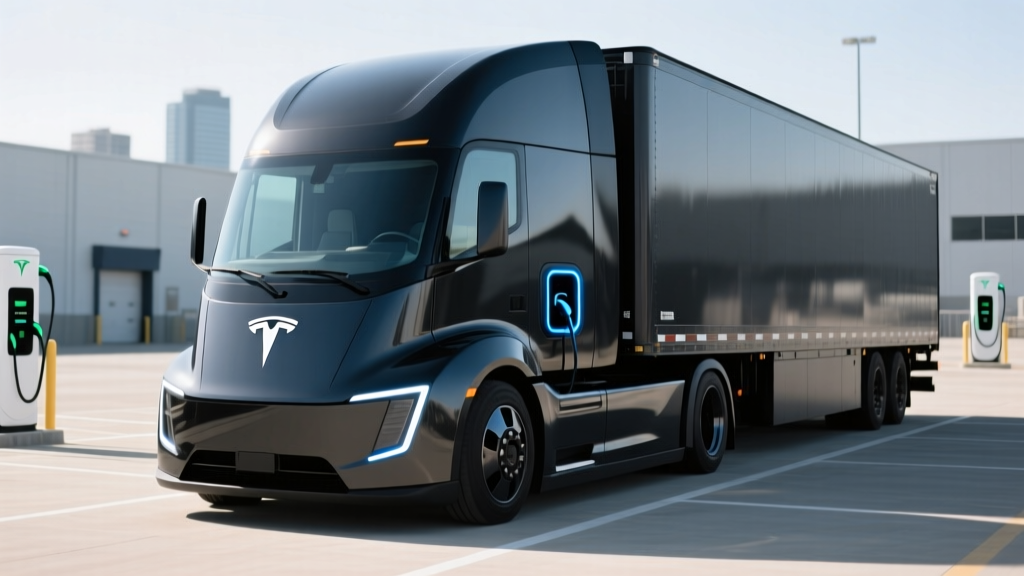
The Tesla Semi is the heaviest battery-electric production vehicle on the road, and for good reason: it hauls up to 82,000 pounds of combined vehicle-and-cargo weight across Class 8 routes. But the weight of Tesla Semi truck configurations directly affects payload allowances, energy consumption, and route planning for fleet operators. This profile digs into every available weight figure, battery specification, charging rate, and real-world efficiency number you need before spec'ing one for your fleet.
Real-World Expectation: 350–450 miles with a full 80,000-lb payload on mixed highway/grade routes; expect 20–30% reduction in sustained sub-30°F temperatures or on steep mountain corridors.
How Much Does the Tesla Semi Truck Weigh?
Understanding the weight of Tesla Semi truck configurations starts with the distinction between curb weight (the truck alone), gross vehicle weight rating (GVWR — the tractor itself plus cargo on its axles), and gross combination weight (GCW — tractor, trailer, and all cargo combined).
| Metric | 300-Mile Variant | 500-Mile Variant |
|---|---|---|
| Curb Weight (tractor only, est.) | ~20,000–22,000 lb | ~24,000–26,000 lb |
| GVWR (tractor axles) | ~26,000 lb | ~26,000 lb |
| Max GCW (tractor + trailer + cargo) | 82,000 lb | 82,000 lb |
| Battery Pack Weight (est.) | ~6,000–8,000 lb | ~10,000–12,000 lb |
| Estimated Usable Battery Capacity | ~500 kWh | ~900 kWh |
The 500-mile variant's heavier battery pack adds roughly 4,000 pounds compared to the 300-mile version. That extra mass reduces available payload by the same amount — a critical trade-off for fleets running weight-sensitive freight like beverages, aggregates, or dense consumer goods.
Tesla has not published exact curb weights on its official Semi spec page, but independent teardowns and fleet-operator reports from PepsiCo's deployment place the 500-mile tractor at approximately 25,000–26,000 pounds. For context, a comparable diesel Class 8 day-cab tractor (Freightliner Cascadia, Volvo VNL) typically weighs 16,000–18,000 pounds. The Semi carries a 7,000–9,000-pound battery penalty that directly reduces max cargo weight.
Battery Chemistry, Capacity, and the Weight Question
The Semi's battery pack is the single heaviest component, and its chemistry determines both energy density and longevity. Industry analysis and supply-chain reporting indicate Tesla uses a mix of high-nickel NMC (nickel-manganese-cobalt) cells in a structural pack configuration, similar to the 4680-format cells in the Cybertruck and Model Y produced at Giga Texas.
| Attribute | NMC (Tesla Semi) | LFP (Competitor Option) |
|---|---|---|
| Energy Density (cell-level) | ~250–280 Wh/kg | ~160–180 Wh/kg |
| Cycle Life | ~1,500–2,000 cycles | ~3,000–5,000 cycles |
| Cold-Weather Performance | Better low-temp output | Reduced low-temp output; needs more preconditioning |
| Cost per kWh | Higher | Lower |
| Weight for 900 kWh Pack | ~10,000–12,000 lb | ~14,000–16,000 lb (impractical for 500-mi range) |
LFP chemistry would be heavier at this capacity, making NMC the practical choice for the 500-mile variant where range and weight are in direct conflict. Tesla's Impact Report references the Semi's battery as designed for a million-mile lifespan, though independent validation of that claim at fleet scale remains ongoing.
Charging Speed: Megawatt Charging and Depot Infrastructure
The Semi uses the Megacharging standard — a proprietary Tesla connector capable of up to 1.2 megawatts (1,200 kW) of DC fast-charging power. This is roughly four times the peak rate of a Tesla Supercharger V4 stall for passenger vehicles.
| Charging Level | Max Power (kW) | Estimated Time / Rate |
|---|---|---|
| Megacharger DC Fast | 1,200 kW peak | ~30 min for 10–80% (500-mi pack); ~20 min (300-mi pack) |
| CCS2 / MCS Adapter (future) | Up to 1,000 kW (MCS standard) | Dependent on third-party station output |
| Depot Level 2 (AC) | ~40–80 kW (3-phase) | 10–18 hours for full charge; practical for overnight depot cycling |
Real-world charging curves matter here. The Semi will sustain peak 1,200 kW only in the lower state-of-charge window (roughly 10–40% SoC), then taper progressively. Fleet operators planning 30-minute driver-break top-ups can realistically add 300–350 miles of range in that window for the 500-mile pack.
There is no home Level 2 charging scenario for the Semi — this is a commercial vehicle requiring depot-scale electrical infrastructure. A single Megacharger installation demands a dedicated medium-voltage utility connection (typically 1–2 MW per stall), transformer upgrades, and utility coordination that can cost $150,000–$500,000+ per site depending on local grid capacity.
Performance, Drivetrain, and Efficiency
The Semi uses a tri-motor all-wheel-drive configuration: one motor on the steer axle (front) and two motors on the rear drive axle. Tesla claims the semi can accelerate from 0–60 mph in 20 seconds loaded at full 82,000 lb GCW — a remarkable figure for a Class 8 truck and roughly 50% faster than a loaded diesel equivalent.
| Specification | Value |
|---|---|
| Drivetrain | Tri-motor AWD (1 front, 2 rear) |
| Horsepower (combined, est.) | ~900–1,050 hp |
| 0–60 mph (loaded, 82,000 lb GCW) | ~20 seconds |
| 0–60 mph (unloaded) | ~5 seconds |
| Top Speed (governed) | ~75 mph |
| Energy Consumption (loaded, highway) | ~1.7–2.0 kWh/mile |
| MPGe Equivalent | ~20–24 MPGe (diesel-gallon equivalent) |
| Regenerative Braking | Aggressive single-pedal mode; recovers significant energy on downgrades |
Energy consumption is the metric that makes or breaks fleet economics. Tesla's claimed efficiency of less than 2 kWh per mile translates to roughly $0.20–$0.35 per mile in electricity cost (depending on commercial/industrial utility rates), compared to $0.60–$0.90 per mile for diesel at $4.00–$5.00 per gallon and 6–7 mpg. That gap is where the Semi's business case lives.
Pricing, Tax Credits, and Fleet Economics
The Tesla Semi carries a premium price tag that reflects its battery cost and low-volume production status.
| Variant | Base MSRP | Federal §30D / 45W Credit Potential | Estimated Net Cost |
|---|---|---|---|
| 300-Mile Range | $250,000 | Up to $40,000 (commercial clean vehicle credit, §45W) | ~$210,000 |
| 500-Mile Range | $290,000 | Up to $40,000 (commercial clean vehicle credit, §45W) | ~$250,000 |
| Founder's Series (limited, 500-mi) | $290,000+ | Up to $40,000 | ~$250,000+ |
Critical tax-credit note: The Semi is a commercial vehicle. Fleet buyers typically claim the IRC §45W Commercial Clean Vehicle Credit (up to $40,000 for vehicles over 14,000 lb GVWR), not the consumer §30D credit. Eligibility depends on battery-component and critical-mineral sourcing requirements that the IRS updates annually. Consult a tax professional specializing in commercial fleet incentives before projecting net cost.
Additional state and utility incentives may stack on top. California's Hybrid and Zero-Emission Truck and Bus Voucher Incentive Project (HVIP), for example, has offered vouchers of $60,000–$120,000 for Class 8 zero-emission trucks — though funding availability varies by fiscal year and demand. Check current program status with your state air-resources board.
Cab, Tech, and Driver Experience
The Semi's cab is unlike any conventional Class 8 tractor. The driver sits in a centered position (similar to a McLaren F1), flanked by two large touchscreen displays — one for navigation and fleet telematics, one for vehicle systems and camera feeds. There is no traditional instrument cluster.
- Seating: Single centered driver seat with a fold-down jump seat to the right; no sleeper cab currently offered (day-cab only)
- Cargo/Storage: No frunk or external compartments comparable to diesel; limited interior cab storage behind driver
- Visibility: Panoramic windshield with no hood obstruction; camera-based rear and side views replace conventional mirrors in some configurations
- Driver Assistance: Enhanced Autopilot (SAE Level 2) with automatic emergency braking, lane-keeping, and adaptive cruise — the driver must remain fully engaged at all times
- Connectivity: Over-the-air updates, fleet-management API integration, real-time energy monitoring
The biggest drawback for long-haul operators: no sleeper cab. The Semi is currently a day-cab tractor, limiting it to regional and short-haul routes (typically under 500 miles round-trip with depot charging). Tesla has not announced a sleeper-cab variant.
Warranty Coverage
| Component | Coverage |
|---|---|
| Basic Vehicle | 4 years / 500,000 miles (est.) |
| Battery Pack | 8 years / 1,000,000 miles (Tesla's stated target; retention threshold ~70%) |
| Drive Units | 8 years / 1,000,000 miles (est.) |
Tesla's Semi design page emphasizes a "million-mile" powertrain design target. However, formal warranty documentation for fleet buyers is provided through Tesla's commercial sales channel and may differ from consumer-vehicle terms. Confirm exact warranty language in your purchase agreement.
Who Should Buy the Tesla Semi?
- Your routes are regional, under 250 miles round-trip with depot charging
- You haul weight-sensitive freight and need every available payload pound
- Your depot has (or can get) medium-voltage utility service for Megacharger installation
- Your routes extend 300–450 miles and include highway segments with limited mid-route charging
- Your freight is volume-limited rather than weight-limited (lighter, bulkier goods)
- You want buffer for cold-weather range loss and terrain-related energy draw
- Your routes exceed 500 miles one-way without reliable Megacharger corridor access
- You need a sleeper cab for multi-day, team-driver operations
- Your depot utility infrastructure cannot support multi-megawatt charging without cost-prohibitive upgrades
Pros and Cons
- Lowest per-mile energy cost in Class 8 (~$0.20–$0.35/mi vs diesel $0.60–$0.90/mi)
- 1,200 kW Megacharging enables 30-minute route top-ups
- Tri-motor AWD with ~1,000 hp delivers unmatched loaded acceleration
- Regenerative braking dramatically reduces brake wear on mountain routes
- Centered driving position and panoramic glass offer superior visibility
- OTA updates and fleet API for telematics integration
- 7,000–9,000 lb heavier than diesel equivalent — directly reduces max payload
- No sleeper cab — limited to day-cab regional operations
- Megacharger infrastructure requires $150K–$500K+ per site in utility upgrades
- Proprietary Megacharging connector — no public charging network for Semis yet
- $250K–$290K MSRP is 2–3× a diesel tractor; payback requires high utilization
- Production volume remains limited; delivery lead times are lengthy
Frequently Asked Questions
What is the real-world range of the Tesla Semi when fully loaded?
With a full 82,000 lb GCW on flat interstate highways in moderate temperatures (60–80°F), expect 400–450 real-world miles from the 500-mile variant. Add steep grades, sustained 75+ mph speeds, or sub-freezing temperatures and that drops to 300–380 miles. The 300-mile variant delivers approximately 220–280 real-world miles under similar loaded conditions.
How fast does the Tesla Semi charge at a Megacharger?
At a full-output 1,200 kW Megacharger, the 500-mile pack can charge from 10% to 80% in roughly 30 minutes, adding approximately 350 miles of range. The 300-mile pack achieves 10–80% in approximately 20 minutes. Charging tapers significantly above 80% SoC to protect battery health — plan your stops around 80% rather than 100%.
Does the Tesla Semi qualify for the federal EV tax credit?
Not the consumer §30D credit. Commercial fleet buyers typically claim the IRC §45W Commercial Clean Vehicle Credit, which provides up to $40,000 for qualifying zero-emission vehicles over 14,000 lb GVWR. Eligibility depends on battery sourcing, manufacturer qualification, and your business's tax situation. Consult the IRS commercial credit guidelines and a qualified tax professional.
Why does the weight of the Tesla Semi truck matter for payload?
Federal bridge-law limits cap Class 8 combination vehicles at 80,000 lb GCW on interstate highways (82,000 lb with certain exemptions). Every pound the tractor weighs is a pound you cannot put in the trailer. The Semi's 7,000–9,000 lb weight penalty over diesel means roughly 3.5–4.5 tons less cargo per load — a significant revenue reduction for weight-cube-out freight like liquids, metals, or dense packaged goods.
Is the Tesla Semi worth buying versus diesel or hydrogen competitors?
For high-utilization regional routes (200–400 miles daily, return-to-base charging), the Semi's per-mile energy savings can deliver payback in 3–5 years despite the higher upfront cost. For long-haul corridors exceeding 500 miles, diesel remains more practical today due to fueling infrastructure. Hydrogen fuel-cell trucks (e.g., Toyota Kenworth T680 FCEV, Nikola Tre FCEV) offer faster refueling and longer range but face limited hydrogen-station availability and higher fuel cost per mile. The Semi wins on total cost of ownership where route geometry and depot charging align.
Can I charge a Tesla Semi at a public Supercharger?
No. The Semi requires Megacharger connectors and multi-megawatt power delivery that standard Supercharger stalls cannot provide. Tesla is building Megacharger corridors along key freight routes (initially in California and Texas), but public charging infrastructure for Class 8 EVs remains extremely limited as of 2026. Most Semi operators charge exclusively at depot-based installations.