The Real Cost of Going Electric: Tesla Semi Pricing in 2026
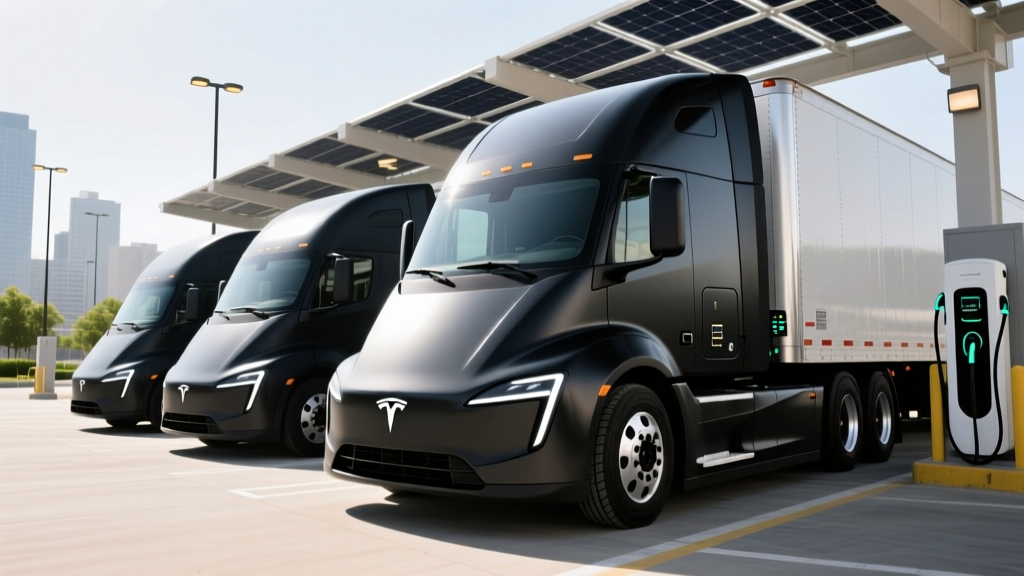
If you've searched "how much for a Tesla Semi truck" expecting a simple sticker price, the answer requires some unpacking. Unlike consumer EVs with transparent MSRP windows, the Tesla Semi — Tesla's Class 8 battery-electric freight hauler — operates in the commercial vehicle space where pricing depends on configuration, fleet volume, and charging infrastructure. As of early 2026, Tesla lists the Semi at a base MSRP of $250,000 for the 300-mile range variant and $290,000 for the 500-mile range variant (both at 80,000 lbs GVWR). These figures were announced at the 2017 unveiling and reaffirmed through limited production deliveries beginning in late 2022, though Tesla has historically adjusted commercial pricing without public revision.
For context, a comparable new diesel Class 8 day cab (think Freightliner Cascadia or Volvo VNR) runs $120,000–$180,000 before options. The Semi's premium is substantial upfront — but fleet operators evaluate total cost of ownership (TCO), where fuel savings, maintenance reduction, and incentive stacking can close the gap within 3–5 years depending on duty cycle.
| Specification | 300-Mile Variant | 500-Mile Variant |
|---|---|---|
| Base MSRP | $250,000 | $290,000 |
| EPA-Est. Range (loaded, 80k lbs) | ~300 mi | ~500 mi |
| Battery Capacity (est.) | ~500 kWh (NMC) | ~900 kWh (NMC) |
| Energy Consumption | < 2 kWh/mi (claimed) | < 2 kWh/mi (claimed) |
| Drivetrain | Tri-Motor AWD (1 steer + 2 drive) | Tri-Motor AWD (1 steer + 2 drive) |
| Horsepower | ~1,000+ hp (peak combined) | ~1,000+ hp (peak combined) |
| 0–60 mph (loaded) | ~20 seconds | ~20 seconds |
| 0–60 mph (unloaded) | ~5 seconds | ~5 seconds |
| Grade Holding (5% at 80k lbs) | 65 mph | 65 mph |
| DC Fast Charge (Megacharger) | Up to ~1,000 kW peak | Up to ~1,000 kW peak |
| 400-Mile Charge (70% recovery) | ~30 min (claimed) | ~30 min (claimed) |
| Cabin Seating | 1 (center-mounted driver seat) | 1 (center-mounted driver seat) |
| Warranty (battery/powertrain) | TBD (expected 8 yr / 1M mi) | TBD (expected 8 yr / 1M mi) |
Range Reality: EPA Estimates vs. Highway, Cold, and Payload
Tesla claims 500 miles at full gross weight for the larger-battery variant, and 300 miles for the smaller pack. However, the EPA does not currently publish standardized range ratings for Class 8 heavy-duty trucks in the same way it does for light-duty vehicles (you won't find a fueleconomy.gov listing for the Semi). The 300/500 figures should be treated as manufacturer-claimed operational targets under favorable conditions — flat terrain, moderate temperatures, 65 mph cruise.
- Ideal conditions (flat, 65°F, 60 mph, 60k lbs payload): ~450–500 mi
- Highway at 70 mph, 80k lbs GVWR: ~350–420 mi
- Cold weather (20°F), full load, highway: ~280–340 mi (30–40% reduction typical for large packs without cabin-heat optimization)
- Mountainous terrain (I-70 through Rockies): significant variability; regen on descents recovers 15–25% of uphill energy
Fleet planners should budget for 350–400 miles of dependable range from the 500-mile variant under mixed real-world conditions, and 220–260 miles from the 300-mile variant.
Tesla's claimed efficiency of under 2 kWh per mile is impressive for a Class 8 truck. If validated, that translates to roughly 500 kWh to cover 250 miles — a figure consistent with independent testing of early PepsiCo and Frito-Lay Semi deployments, which reported 1.7–1.9 kWh/mi on regional haul routes.
Charging Speed: Megachargers, Depot Power, and the 1-Megawatt Question
The Semi uses a proprietary Tesla Megacharger connector (a physically larger derivative of the CCS philosophy, designed to handle currents beyond standard CCS limits). Tesla claims the Semi can recover 400 miles of range in approximately 30 minutes — implying sustained charge rates near 700–1,000 kW during the bulk of the session.
| Charging Method | Power (kW) | Miles Added / Hour | Notes |
|---|---|---|---|
| Tesla Megacharger (DC) | Up to ~1,000 kW peak | ~800+ mi/hr (peak) | Proprietary; limited public availability |
| CCS2/MCS Adapter (est.) | 350–600 kW | ~280–480 mi/hr | Requires adapter; depends on site power |
| Depot Level 2 (AC, 480V) | 40–80 kW | ~30–65 mi/hr | Overnight depot charging; full charge in 10–12 hr |
| Standard Level 2 (240V, 80A) | ~19.2 kW | ~15 mi/hr | Emergency/trickle only |
The charge-curve reality matters here: a 900 kWh battery charging at a sustained 1,000 kW would theoretically fill in under an hour, but lithium-ion chemistry demands tapering above ~80% state of charge. Expect the 10–80% session to average closer to 600–750 kW sustained, with the final 20% stretching the session. Tesla's "400 miles in 30 minutes" claim likely refers to the 10–70% window where the curve is flattest.
Depot charging is where most fleet operators will actually juice the Semi. A 480V three-phase AC connection delivering 40–80 kW overnight (10–12 hours) comfortably refills a 500-mile pack. The capital cost for depot infrastructure — transformers, switchgear, cabling, and utility interconnect — can run $50,000–$250,000+ per site depending on existing electrical capacity and the number of trucks served. This is not a trivial line item.
Performance and Drivetrain: Tri-Motor Torque Meets 80,000 Pounds
The Semi uses a three-motor architecture — one motor on the steer axle (front) and two independent motors on the drive axles (rear). Tesla claims a combined output exceeding 1,000 horsepower, which sounds excessive until you remember the Semi must accelerate 80,000 pounds to highway speed and hold 65 mph on a 5% grade.
Performance figures:
- 0–60 mph (loaded, 80k lbs): ~20 seconds — roughly 50% faster than a comparable diesel Class 8
- 0–60 mph (bobtail/unloaded): ~5 seconds — sports-sedan territory in an 11,000-lb tractor
- Grade performance: 65 mph sustained on a 5% grade at full weight; diesel competitors typically drop to 45–55 mph under the same conditions
The instantaneous torque delivery eliminates the gear-hunting and turbo lag of diesel drivetrains, which matters for highway merging and urban stop-start delivery routes. Regenerative braking from three motors also dramatically reduces service-brake wear — a meaningful maintenance savings for high-cycle fleet duty.
Federal Tax Credits and Incentive Stacking for Commercial Buyers
The Tesla Semi does not qualify for the consumer §30D Clean Vehicle Credit (which caps at $7,500 and is restricted to vehicles under 14,000 lbs GVWR with MSRP and buyer-income limits — see IRS clean vehicle credit guidance). However, commercial fleet buyers have access to a different, often more valuable incentive stack:
- §45W Commercial Clean Vehicle Credit: Up to $40,000 for qualified commercial clean vehicles (the Semi qualifies as a Class 8 BEV). This is the heavy-duty equivalent of §30D, with no MSRP cap and no buyer-income restriction.
- IRA §179 / Bonus Depreciation: Full expensing or accelerated depreciation on the Semi and on charging infrastructure, subject to current-year IRS rules.
- State HVIP / voucher programs: California's Hybrid and Zero-Emission Truck and Bus Voucher Incentive Project (HVIP) and similar programs in New York, New Jersey, and other CARB-adopting states can provide $100,000–$180,000+ per truck in point-of-sale vouchers for Class 8 BEVs, especially in disadvantaged communities.
- Charging infrastructure credits: §30C Alternative Fuel Vehicle Refueling Property Credit provides up to $100,000 per item of charging equipment (subject to census-tract eligibility).
| Line Item | Amount |
|---|---|
| Base MSRP | $290,000 |
| §45W Commercial Credit | – $40,000 |
| State HVIP Voucher (CA example) | – $120,000 |
| Depot Charging Install (amortized/tractor) | + $40,000 |
| Estimated Net Cost | ~$170,000 |
Actual savings vary by jurisdiction, fleet size, and census-tract eligibility. Consult a tax professional and your state's incentive administrator for current program terms.
At a net cost of ~$170,000 (best case, California with full stacking), the Semi approaches diesel-tractor parity on acquisition alone — before factoring in fuel and maintenance savings.
Total Cost of Ownership: Diesel vs. Tesla Semi
The Semi's economic case rests on operating cost, not sticker price. A typical Class 8 diesel burns 6–7 mpg; at $4.50/gallon diesel, that's $0.64–$0.75 per mile in fuel alone. The Semi, consuming ~2 kWh/mi at an average fleet electricity cost of $0.12–$0.18/kWh (commercial rate, varies by utility), costs $0.24–$0.36 per mile in energy. That's a per-mile savings of $0.30–$0.50.
Over a 5-year, 500,000-mile ownership horizon (typical for regional-haul duty cycles):
- Fuel savings: $150,000–$250,000
- Maintenance savings: $30,000–$60,000 (no oil changes, no DPF/SCR, minimal brake wear via regen)
- Combined operating savings: $180,000–$310,000
Even conservatively, the Semi's TCO advantage is substantial for high-utilization fleets running predictable regional routes (200–400 miles/day, return-to-base overnight). Long-haul irregular-route operators face a harder math problem due to public Megacharger scarcity and downtime costs.
Tech, Safety, and Driver Experience
The Semi's cabin is unlike any production Class 8 truck. The driver sits center-mounted (a single seat, flanked by two large touchscreen displays), eliminating the traditional passenger-side dash and improving forward visibility. Tesla's stated technology suite includes:
- Enhanced Autopilot: Adaptive cruise, lane-keeping, automatic emergency braking, and jackknife prevention (stability control via independent rear-motor torque vectoring)
- SAE Level 2 driver assist — the driver must remain engaged and supervising at all times. This is not autonomous trucking.
- Sentry-style camera logging and over-the-air software updates
- No traditional instrument cluster — all information flows through the twin touchscreens
Notable drawbacks:
- Single-seat cabin limits team-driving / two-up sleeper operations (no sleeper berth currently offered)
- Megacharger public network remains extremely sparse compared to diesel truck stops
- Regulatory uncertainty: some states still require additional permitting for BEV Class 8 trucks at full weight
- Service network: Tesla's commercial service footprint is thin outside California, Nevada, and Texas
Who Should Buy the Tesla Semi?
- You operate a regional-haul or dedicated-route fleet with 200–400-mile daily cycles and return-to-base depot charging
- You run in California, Texas, or other states with strong HVIP/voucher stacking that compresses acquisition cost
- Your corporate sustainability mandates prioritize Scope 1 emissions reduction
- You have (or can invest in) depot-level 480V three-phase electrical infrastructure
- Your duty cycle is high-utilization (100k+ miles/year), maximizing fuel and maintenance savings
- You run irregular long-haul routes exceeding 500 miles without predictable charging access
- Your fleet operates in regions with limited utility capacity for depot charging upgrades
- You require sleeper-cab configurations for team driving
- Your annual mileage is too low to recoup the acquisition premium through fuel savings
Competitor Comparison: Tesla Semi vs. Class 8 BEV Alternatives
The Semi isn't the only electric Class 8 on the road. Direct competitors include the Freightliner eCascadia, Volvo VNR Electric, Peterbilt 579EV, and Kenworth T680E. Here's how they stack up:
| Spec | Tesla Semi (500 mi) | Freightliner eCascadia | Volvo VNR Electric |
|---|---|---|---|
| Base Price (est.) | $290,000 | ~$280,000–$320,000 | ~$280,000–$310,000 |
| Range (loaded) | ~500 mi (claimed) | ~230 mi (EPA-validated) | ~275 mi (EPA-validated) |
| Battery (kWh) | ~900 (est., NMC) | ~438 (NMC) | ~565 (NMC) |
| Peak DC Charge | ~1,000 kW | ~250 kW (CCS) | ~250 kW (CCS) |
| Dealer/Service Network | Limited | Extensive (Daimler Truck NA) | Extensive (Volvo Group) |
| Production Volume | Limited / pilot | Series production | Series production |
The Semi leads on claimed range and charging speed by a wide margin, but the eCascadia and VNR Electric are in series production with established dealer networks — a critical advantage for fleets needing guaranteed uptime and parts availability. Tesla's production volume remains limited, with deliveries prioritized to reservation-holding partners like PepsiCo, Frito-Lay, and UPS.
Pros and Cons at a Glance
- Class-leading claimed range (500 mi) and energy efficiency (<2 kWh/mi)
- Megacharger capability (~1,000 kW) crushes CCS-based competitors on charging speed
- Tri-motor performance: 0–60 in 20 sec loaded; 65 mph on 5% grade
- Massive fuel and maintenance savings at high utilization ($0.30–$0.50/mi)
- Center-seat cabin with excellent forward visibility and modern UX
- Jackknife prevention via independent motor torque vectoring
- $250K–$290K base MSRP requires aggressive incentive stacking to compete with diesel
- Limited production; long reservation waitlist for new fleet buyers
- Megacharger public network nearly nonexistent — depot charging required
- No sleeper cab; single-seat cabin rules out team driving
- Service network thin outside select metro markets
- Battery capacity and chemistry not officially published by Tesla
Frequently Asked Questions
How much does a Tesla Semi truck actually cost in 2026?
The listed MSRP is $250,000 for the 300-mile variant and $290,000 for the 500-mile variant. After the §45W commercial credit (up to $40,000) and state incentives (e.g., California HVIP up to $120,000–$180,000), net acquisition cost can fall to $130,000–$170,000 in best-case scenarios. Add $30,000–$80,000+ for depot charging infrastructure.
Does the Tesla Semi qualify for the $7,500 federal EV tax credit?
No. The §30D consumer credit applies only to vehicles under 14,000 lbs GVWR. The Semi qualifies instead for the §45W Commercial Clean Vehicle Credit (up to $40,000 per vehicle), which has no MSRP cap and no buyer-income restriction. Confirm current-year eligibility at IRS.gov.
What is the real-world range of the Tesla Semi under load?
Tesla claims 500 miles at 80,000 lbs GVWR for the larger pack. Independent fleet data from PepsiCo deployments suggests real-world range of 350–420 miles on highway routes at full weight, dropping to 280–340 miles in cold weather (below 30°F). The 300-mile variant delivers roughly 220–260 miles in mixed real-world conditions.
How fast does the Tesla Semi charge?
At a Tesla Megacharger, the Semi can recover approximately 400 miles in 30 minutes (peak rates near 1,000 kW). Depot charging at 480V AC (40–80 kW) refills the pack overnight in 10–12 hours. Standard Level 2 (19.2 kW) adds roughly 15 miles per hour — suitable only for emergency top-ups.
Is the Tesla Semi worth buying vs. a diesel Class 8?
For high-utilization regional fleets (100,000+ miles/year, return-to-base depot charging, operating in incentive-rich states), the Semi's TCO can undercut diesel by $180,000–$310,000 over five years. For irregular long-haul or low-mileage operations without charging infrastructure, diesel or fuel-cell alternatives remain more practical in 2026.
Can I buy a Tesla Semi right now?
Tesla is producing the Semi in limited volumes, primarily fulfilling reservations from large fleet partners (PepsiCo, Frito-Lay, UPS). New reservation slots open periodically, but delivery timelines are not publicly posted. Contact Tesla Commercial directly for current availability in your market.
Sources: Tesla commercial vehicle specifications; IRS Clean Vehicle Tax Credits; fueleconomy.gov (EPA); California Air Resources Board HVIP program documentation. Pricing and incentive figures reflect 2026 program terms and are subject to change.